by editor | Jul 31, 2010 | Outdoor education and Outdoor School
by Megan McGinty
North Cascades Institute
Last year we began a service-learning summer program for high school students focusing on climate change. The Climate Challenge program consisted of a summer residency in the North Cascades followed by a service project in which elementary-school students were taught by the returning high-school students back in their home communities that fall. We planned a challenging field itinerary for the summer portion – studying glaciers, interviewing scientists and exploring hydrological systems. The student team made both geographic and intellectual discoveries and practiced presentation skills in order to bring their stories to their hometowns. We anticipated that they would struggle to master new skills, become proficient communicators, and hoped that they would become passionate teachers.
ALERT: You need to be a CLEARING subscriber to read the rest of this article.
(enter password then hit return button on your keyboard for best results)
[password]
What we did not anticipate was the strength of the reaction from the adult audiences that the students encountered. The first clue was a rant posted online in response to an article in the local newspaper that briefly mentioned the then-pending program. (From the reference to “enviro-nazi youth,” I can only assume the comment was made by an adult.) Other reactions were far more favorable. People consistently commented upon how inspiring the students were, mentioning the word ‘hope’ again and again. The rangers and resource mangers that showed the students their daily work thanked us for the opportunity to interact with the students. The most striking meeting happened over dinner at our environmental learning center one evening when the students gave a brief impromptu presentation as a way to introduce themselves to a group of adults attending a naturalist class. When the students sat down, a woman across the room stood up and turned towards them. “I want to thank you all. We have done such a poor job of taking care of the Earth and now my generation has left you such a mess. I am so grateful to you and want you to know you are our only hope.” By this time, tears were running down her face, the dining hall was still and a few other adults also had red eyes. As she sat down, I looked over at the students, who were gape-mouthed. I had been nervous about them confronting the enormity of the task before them and wondered if the woman’s address would discourage them.
Over the course of the rest of the program, the students referred to that night as the point when they began to take the program more seriously, realizing that people were relying on them in earnest to address climate change. At times the amount and intensity of the expectations being put forth seemed a bit overwhelming and unrealistic for the students. As staff, we were often asked how to teach kids about climate change without getting depressed or depressing them.
 Amid all this, the students never struck me as burdened. Yet neither did they seem uninformed. If anything, they were saturated with information and were quick and adept at adopting new ideas and applying scientific concepts. Flux seems to be a natural state of affairs for them.
The youth who are growing up now, with climate change as a primary concern, are facing a far different threat than any confronted by previous generations. Since the founding of the United States of America, people have faced civil war, wars in Europe, unrest over race, wars in Asia and the possibility of annihilation by nuclear war. While variations of all these threats still exist (and may always be present to some extent), they are all generated by humans.
In these cases we are both the victims and the agents. Meeting these challenges is a matter of appealing to the humanity that lies within the enemy, an enemy that is biologically identical to us and therefore subject to all the great strengths and debilitating weaknesses that we ourselves are capable of. Hope is rooted in our vision of ourselves not just as a nation or race, but as a species.
The problem with casting climate change as a foe is that we can barely define it or its effects in concrete terms. At best it is a poorly understood process, driven by forces that we struggle to comprehend, let alone grasp well enough to manipulate. We may know enough about the gross concepts behind the carbon cycle, meteorology and hydrology to understand that our climate is changing, but these topics become exceedingly challenging and intricate when combined with the physics of aerosols and clouds, quantum mechanics and paleoclimatology. In addition, climate change occurs on a scale far greater than most of us can easily fathom. We know what tens of thousands of years is, but how many of us can honestly say we have an actual operating sense of even a hundred years? In terms of both the mechanisms involved and magnitude of change, climate change is a great unknown. The level of uncertainty posed by climate change is far greater than that posed by war.
This is probably where the generational hinge folds. Students today see climate change as a static fact, a reality that looms in the form of species loss, desertification, and wars about water. They consider themselves optimistic yet realistic. They expect to see changes in the climate, but they also expect to adapt, to develop technologies for a different planet and to live under laws that strictly regulate the use of resources. They anticipate losing habitats, biodiversity, and undeveloped landscapes. I’ve asked students what they think the difference between older people’s views of climate change are compared to theirs. Upon hearing their answers, it occurs to me that the fear surrounding climate change is ours, not theirs. Climate change is a great unknown, but this is true of so many other factors in these students’ lives- whether they will go to college, fall in love, have children, what career they will choose, whether they will encounter fortune, illness or wealth. To them, the issues resulting from climate change are among a host of many other big questions. These students still embrace uncertainty, and right now, that fact is to their advantage.
This past fall, the same students that addressed the group in the dining hall were presenting their views on youth, climate change and involvement before a panel of federal officials. One young woman stood up and related a pivotal moment that occurred for her during the summer. As she spoke about standing on top of a mountain and realizing that the land as far as she in every direction was public land, her voice cracked and tears ran down her face. She took a deep breath and continued. “I realized that this land was my responsibility and that I want to do everything I can to protect it into the future.” While some of us may see a reason for despair, there are others who hear a call to arms.
When these students learn about pressing issues, their response is a desire to inform others about it. They intend to catalyze the change they believe their communities need. One student said “It’s easier for us because people who grew up earlier kept seeing things get better and all we’ve seen is things go downhill.” They consider themselves naïve, but are looking forward to making and seeing change. They realize that not all the changes will be good, just as they realize that they will not be successful in all they undertake. They also understand that climate change has winners and losers, but they see no reason why they, and we, can’t adjust.
 Perhaps as these students age, and go on to both succeed and fail at the challenges that occur in the course of their life journeys they will become jaded, tired and lose hope. Their expectations don’t seem as high as those of students 10 or 20 years ago, but they also seem to be more accepting of the situation. I am confident that as they go out into world they will find some assumptions that they are working under to be far more challenging than they imagined, but also suspect that their lack of pre-set notions about what should be will serve them well as they innovate and adapt their way onward.
[/password]
by editor | Jul 29, 2010 | Marine/Aquatic Education, Place-based Education
The Colquitz Watershed Stewardship Education Project
By Pam Murray
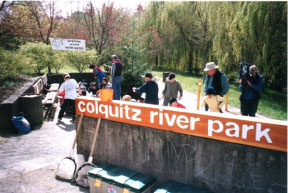
A school class at Colquitz River Park in Victoria, BC
Along the Cowichan River, surrounded by the smell of cottonwood resin, an elementary school student discovers that dragonfly larvae look like aliens. In a quiet wetland, a middle school teacher marvels as a guest expert shows his class how to fold cat-tails into duck shaped toys and send them downstream with wishes. In a municipal office, a bureaucrat considers a community proposal, initiated by an elementary school class, to create a new park.
Since 1994, the Colquitz Watershed Stewardship Education Project (CWSEP) has been bringing students, teachers, and the community together to experience educational turning points like those above. Headed by teacher Lenny Ross, the award winning project has successfully instilled an environmental ethic in students of all ages and their teachers by connecting them to the watersheds in which they live.
Flowing through two school districts near Victoria, B.C., Colquitz Creek is an urban salmon-bearing stream affected by development, runoff, encroachment and other negative impacts from the increasing population density within its watershed. The care of watersheds like the Colquitz is often championed by local naturalists and activists who feel a sense of stewardship towards their local environment and community. Creeks are much longer lived than people, and so it is crucial to pass on this ethic to young people who can continue to act as stewards of natural places in the future. Fostering this ethic, however, is difficult through textbook-based classroom learning. Depressing environmental stories of polluted rivers and decreasing salmon returns may actually turn students off of learning about their environment (Sobel, 1996). How then, did this project manage to instill a strong environmental ethic and sense of stewardship in the students and teachers who participated in it?
Inspired by a growing number of environmental education programs, including the Streamkeepers program and Project Wild, which were becoming available in British Columbia during the early 1990’s, Lenny Ross developed the CWSEP during a summer at the Wetlands Institute in the U.S. Over the years, the program has branched out and changed course, but throughout all of these changes, the essential goal has remained the same. “Students learn”, according to Ross, “to appreciate their environment, understand scientific concepts of watershed ecology and take action to help the watershed, and thus become responsible citizens of their community.”
A watershed, as defined by ecologists, is an area which drains into a common body of water, such as a river or stream. As well, the term can be used to describe a turning point in a process. The point at which a course of events is irrevocably altered may be described as a ‘watershed moment’. The CWSEP began with such an event, in which political and school district boundaries were set aside in favor of a new method of defining borders – the watershed of Colquitz Creek. Ten schools were identified within those boundaries, and at each school an environmentally minded teacher agreed to participate. Grant proposals were prepared and submitted with successful results due to the clear focus, goals, and objectives of the program. The project was on its way with a budget to work with.
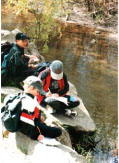
Students take time to reflect along Colquitz Creek.
Over the years, a variety of methods have been utilized to engage students in learning about their watershed. As well, changing focus slightly each year has kept the CWSEP fresh for the growing number of teachers who implement the program in their classroom year after year. In the 1999 – 2000 school year, classes went on watershed tours of Colquitz Creek while teachers used curriculum materials developed around music and literature. The following year, teachers received a curriculum package focusing on fish biology and their classes traveled to the watershed of the Cowichan River to compare it to the Colquitz. Other years have tied into community events such as Rivers Day or Science and Technology Week. This flexible focus has also helped the project make use of available funding which may require that specific themes are addressed. The essential components of the program, however, have remained the same each year and are as follows:
• Development of curriculum resources and provision of in-service training for participating teachers
• Implementation of curriculum materials and resources in the classrooms of participating teachers
• Field trips, during which classes participate in field studies and environmental assessments, often assisted by high school students who have received special training.
• Students then work on class projects and stewardship activities such as planting native plants or cleaning up streams
• All participants are involved in a community celebration during which they help educate members of the public and are recognized for their accomplishments.
Together, these components make up a project that has catalyzed ‘watershed moments’ for students and teachers alike.
Teachers try out an activity during the “Project Wet” workshop.
Teachers as Students
An integral part of the CWSEP’s success has been providing curriculum resources, in-service workshops, and the knowledge of local ‘experts’ to teachers involved in the program. Many of the teachers who have taken part in the CWSEP do not have science backgrounds. Lenny Ross’ own professional background was originally in special education. The opportunity for professional development motivates teachers by giving them the resources they need to tackle topics like stream ecology and bird identification. Through the years, these resources have variously included lessons in fish biology, contributions from local government agencies such as park departments and water districts, guest speakers from the local natural history society, a partnership with musician Holly Arntzen to create classroom activities which use songs celebrating watersheds, and a guide using a literature-based approach to investigating freshwater ecosystems.

Teachers received Stream Team vests after completing training.
According to Lenny Ross, teachers are also attracted to the program because “As research out of the U.S. shows, if you integrate education around an environmental theme,
children’s test scores across all aspects of the curriculum go up because the learning is relevant and meaningful to their world. Such socially responsible education affects more than just grades. Student behaviour improves as children see that their work is valued in the community, and teacher enthusiasm goes up because they know this type of education is effective and it feels worthwhile when they see they are having a positive effect on the community as well.(Lieberman & Hoody, 2000) As one teacher said, “It makes for a really strong personal connect and that’s how you make a change.”
The program also benefits from the sense of community which develops between the teachers as they take on new challenges at workshops or eat meals together while planning the year’s activities. In 2001, the project partnered with the Freshwater Eco-Centre and Vancouver Island Trout Hatchery in Duncan, B.C. to assist in adapting activities for a “Fish Ways” manual, which provided teachers with activities for exploring the biology and ecology of fish with their classes. At the in-service in Lenny Ross’ school, teachers sat in groups for a hands-on lesson in fish anatomy and ecology facilitated by a naturalist from the Freshwater Eco-Centre. This included watching a fish dissection, counting rings on fish scales, and discovering that they could tell, even with paper bags on their heads, that the skin of a flounder, embedded with star-shaped scales, feels like sandpaper.

A Stream Team student shows a turbidity wedge to younger students.
Students as Teachers
The Colquitz Watershed Stewardship Education Project has involved teachers and students from Grade 1 to Grade 12. In general, any class that has expressed interest in the program has been allowed to participate. As a result, it has been necessary to develop relevant and challenging components of the program to suit students of various ages. When high-school students became involved, the project partnered with Streamkeepers, a college-level course provided through the Department of Fisheries and Oceans Canada, to train them in the skills needed to assess stream quality. Students were provided with sophisticated equipment which enabled them to determine the pH, oxygen content, and temperature of streams, as well as with training in many aspects of stream stewardship. This group of students, through the vision of middle school teacher Angus Stewart, evolved into the “Stream Team” and began helping with field trips for younger students.
 In the 1999/2000 school year, participating classes spent a day touring the entire watershed of Colquitz Creek, from its headwaters at Beaver Lake, through their community, to where the creek meets the ocean. By visiting three different stations along the creek and taking short hikes, the classes experienced the watershed first hand and began to see how it conncts their community. Students examined water quality, sampled and identified stream invertebrates, and completed reflective activities to record their impressions of the experience.
Throughout the tour, high school Stream Team students acted as teachers. Set up at stations along the route, the Stream Team students helped with activities for three or four classes a day, each day throughout the week. Given the opportunity to teach the younger students, on an ongoing and repetitive basis, the Stream Team participants quickly became adept at sharing their knowledge and acted as role models for the younger participants.

Students student stream invertebrates in a “mini pond.”
Students as Scientists
As much as the CWSEP has positively affected the teachers and students involved, it has also had tangible successes in improving the quality of the Colquitz watershed. Early in the program’s history a group of high school students from Spectrum Community School became involved with the project. Using their Streamkeepers equipment provided by the CSWEP, they recorded water quality data from the creek and used this data to plot graphs.
By doing so, they discovered that an area known as Quick’s Bottom, just downstream from the headwaters at Beaver Lake, had an elevated water temperature and low oxygen levels which would be deadly for salmonids. As it happened, many schools in the area were also involved in a “Salmonids in the Classroom” program where they were provided with equipment to rear salmon fry in their classes. These fry were then released into appropriate streams, including Colquitz Creek. The favored location for salmon releases in the Colquitz Watershed was just upstream of the warm, low oxygen area discovered by the students – an area that they renamed “Quick Death Bottom”.
After this discovery, it was decided that a new location for salmon releases should be found. A nearby park was located, safely downstream from the “Quick Death” area, where earlier habitat enhancement projects had already created excellent conditions for salmon fry. Classroom-reared salmon fry began to be released into this new location, greatly improving their chances of survival.
Students in the Community
After field trips are completed each year, students participate in class projects which apply their knowledge of environmental stewardship. Stream cleanups, plantings, and recycling projects have all taken place. Salmon have been raised in classrooms, invasive plants have been removed, and storm drains have been marked. Classes have done research projects to create posters and help educate their community about their shared watershed.
At Strawberry Vale School, where Lenny Ross teaches, mapping activities took place. In becoming more aware of their watershed, students and teachers noticed an open natural area near their school, owned by the Municipality of Saanich. Students helped work on a community proposal that resulted in this land being designated as a park, which the students named “Strawberry Knoll.”

Holly Arntzen leads students in a song and dance during an end of year festival.
As well, the program has involved community festivals. Displays have been erected in a local mall to highlight student’s work, and celebration concerts featuring local musician Holly Arntzen – who has also contributed to curriculum resources – have brought together participants to finish the year. In 2001, students came together from four school districts to Fort Rodd Hill National Historic Site near Victoria to highlight what they had learned in an ecology fair called the Salish Sea Festival.
Watershed Moments for Schools
The CWSEP has had lasting effects not only on students, teachers, parents, and community members, but on entire schools. In the case of Strawberry Vale School, the elementary school where Lenny Ross teaches, the project has been partly responsible for inspiring a new school design.
Located in a semi-rural area within the Colquitz Watershed, Strawberry Vale was intimately involved with the CWSEP from its very beginning. Not only Lenny Ross, but almost every teacher in the school, was involved with the project each year. When, during the project, the opportunity to build a new school arose, the teachers’ interest in environmental education helped to shape the new school. Landscape architect Moura Quayle interviewed the teachers to determine what kind of school they wanted, and discovered that Strawberry Vale was the perfect school to pilot projects with an environmental focus, reflecting the natural features of the semi-rural area in which it was located.
The new school and its grounds incorporated many features to allow children to learn, play, and interact with the natural world. The school is designed without eaves troughs. Instead, water pours off the roof in a waterfall-like fashion, past windows where students can observe the water cycle in action. The water then goes into a ground drainage system and eventually runs into a swale which empties into a newly created seasonal pond on the school’s property. Drains in the parking lot also lead into the pond, and have been painted with yellow storm drain marking fish to indicate that they lead to fish habitat. Between the school and the pond is a native plant garden approximately 100m long by 20m wide. This garden was created over many years with the participation of students who helped fundraise and create interpretive signage, as well as teachers, the parent association, district grounds and facilities staff, and other school staff. Ongoing planting and mulching days that take place at the school engage everyone, including the school custodian who has come to accept mud and leaves being tracked through the halls as a minor inconvenience when compared to the exciting and important learning that is taking place.
Students at the school who have been involved in the creation of their garden and ponds have developed a stewardship ethic that they readily apply to the greater community. When they discovered that a neighboring grove of Garry Oak trees was suffering from misuse and neglect, the students and staff took action to remove invasive ivy and add leaf mulch to the soil. These wild places near their school also provide opportunities for study. The pond and garden are regularly used for lessons about habitat requirements, aboriginal uses of plants, and more. Local experts have come to the garden to teach the students about traditional uses of plants and to make wild teas. Heavy snows this past year revealed dozens of birds searching for seeds and shelter amongst the shrubs. Red- winged blackbirds and marsh wrens have nested amongst cattails growing in the pond, and mink and great blue herons have been seen on the school grounds as well. Over the years, students have been able to learn about pond succession as the pond gradually filled in, and recently they raised funds to dig the pond out and start over so that future classes can continue to enjoy and learn from it.
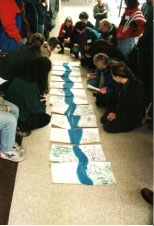
Some years, the students and staff of Strawberry Vale shared their watershed moments with others when the CWSEP end of year festival was hosted in part at their school. Participants from four other schools were able to rotate through various activities in different classrooms including storytelling and watershed models. Class projects were displayed in the hallways, a watershed drawn on the floor flowed towards the gymnasium, and students led tours of their school garden and pond, explaining how their school fits into the watershed of Colquitz Creek.
Aside from opportunities to practice stewardship and to study, the garden, swale, and pond also provide the students at Strawberry Vale the very important opportunity for unstructured play. “You can walk down the trail at recess”, says Lenny Ross, “and think there’s nobody in the garden, but as soon as the bell goes, kids pop out everywhere. They are down at their own level, in the thicket, and if you join them and ask what they are doing they go on forever about the rooms and shelves and castles they have created.” This kind of unstructured play has been shown to contribute to children’s creativity and problem solving abilities, and also to be instrumental in fostering the environmental ethic that the CWSEP strives to create (Louv, 2005).
Assessment
Because of the longevity of the program, which began in 1994, teachers involved have been able to see students who participated in the program in elementary school grow up. They have observed these students carrying a sense of stewardship and an environmental
ethic with them into university and beyond. The ponds, gardens, and lasting dedication to environmental programs at Strawberry Vale school are one legacy of the project.

Lenny Ross (left) and Nikki Wright of SeaChange Marine Conservation Society celebrate the program’s success.
Through a partnership with the SeaChange Marine Conservation Society, the watershed tours continue as part of the Living Watershed Program. The high- school Stream Teams still work to take care of their local watersheds. Today, a middle-school oriented program called EcoRowing, which also involves yearly themes, extensive networking amongst teachers, and the knowledge of local experts, continues to provide more “hands on, feet wet” learning for teachers and students alike.
So why does this program work? According to Dr. Gloria Snively, University of Victoria environmental and marine education professor:
A major factor is the outstanding leadership of Lenny Ross who is a master environmental education teacher. Lenny is an extremely knowledgeable environmentalist and a visionary elementary school teacher without an ego. By demonstrating a strong environmental ethic and warmly welcoming all teachers and resource persons who want to participate, Lenny himself contributes significantly to the program’s success. (Personal communication, March, 2007).
Aside from this leadership, some identifiable “watershed moments” from the program are likely major factors:
a) The program was created in a focused manner. Having clearly stated goals and objectives made it easy to ‘sell’ the program when applying for grants and other funding, as well as asking for the participation of community partners. By 2001 the program had 29 community partners including parks systems, government agencies, local non-profits, two universities, the local natural history society, artists, and musicians.
b) Resources and in-service workshops were conducted for participating teachers that provided them with the knowledge, resources, and confidence necessary to prepare units on watershed ecology to teach in their classroom. Many of the resources were not necessarily science based. Musician Holly Arntzen recorded a CD of environmentally themed music and worked with Lenny Ross to create a teacher’s guide to use the CD in their classroom, and materials using a literature- based approach were also used.
c) Students came to field trips prepared. All the classes who took part in watershed tours or other activities had completed a watershed unit in their classroom beforehand, which meant they were primed for the hands-on experiences of closely observing the creek.
d) Stewardship projects were involved – being able to clean up litter, plant shrubs, or even create a new park gave participants a taste of success and the feeling of truly making a difference in their community.
e) Finally, the students’ efforts were recognized. Community celebrations and eco- fairs that showcased the students work meant students accomplishments could be shared with the larger community, giving them a true sense of contribution.

A student project illustrates a healthy watershed.
Finally, an unspoken strength of this program is perhaps simply the amount of time students are given to have direct contact with nature – a factor that has been shown to directly affect students’ performance (Louv, 2005). The success of this program has garnered it recognition at both the provincial and national level.
Experiencing success with their stewardship projects, feeling a sense of pride as they educate their community, and spending time in nature all help to foster an environmental ethic in the students who participate. Most significantly, however, the students have experienced critical moments that have allowed them to see themselves as an integral part of their watershed. Having made this connection through the CWSEP, they cannot help but care for the environment in which they live.
References:
Lieberman, G. & Hoody, L. (2000). California student assessment project: The effects of environment-based education on student achievement. San Diego, California, State Education and Environment Roundtable.
Louv, R. (2005). Last child in the woods: Saving our children from nature-deficit disorder. Chapel Hill, North Carolina: Algonquin Books.
Snively, G. (2007). (Personal communication, University of Victoria professor, March 28, 2007).
Sobel, D. (1996). Beyond ecophobia, Great Barrington, Maryland: The Orion Society.
About the Author:
 Pam Murray is a writer and park naturalist from Victoria, B.C., who currently lives in the Bowker Creek watershed. In 2001, as a naturalist at the Freshwater Eco-Centre in Duncan, B.C., she participated in the CWSEP by helping to deliver the “Fish Ways” in-service workshop. Over the years, Pam heard many positive comments about the CWSEP, mostly from other naturalists who told her how much fun it was to help out with Lenny’s program. This paper could not have been written without the generosity and patience of Lenny Ross, who also provided all of the photos and illustrations.
[/password]

 By Robert Yager