
by editor | May 24, 2016 | Learning Standards, Learning Theory, Schoolyard Classroom
Use the Real World to Integrate Your Curriculum
In today’s test-driven schools, there’s little room for including the world outside the classroom in the curriculum, even though school is supposed to be based on the real world. And prepare us for it.
by Jim Martin
CLEARING Associate Editor
 his year I watched good classroom programs which involved and invested students in the learning they were doing come to a halt for several weeks so they could prepare for the standards tests. This, during what is the best teaching time of the school year: January through March, when there are very few breaks in the schedule, and teachers can concentrate on the delivery of curricula. Somehow, we have to wake up, get back to our senses, and use this time for learning.
That said, students do need to go out into the world to learn. Let’s look at two possibilities, the first in a stream, the other in a school yard. We’ll do the stream first, since it is the kind of place we ought to be going to. Then the school yard, since it is often the only alternative we have.
There are many places where students can find a streambank to explore. Or a wooded area; an open meadow; some place where they can see and count the organisms who live there. Then learn about them. These are wonderful places for students to engage new content via Active Learning. There is one, a small stream, near where I live. Here’s a list of some of those who live there: Salmon fry (very small, recently hatched, eat copepods); Copepods (eat algae and organic debris); Amphipods (eat organic debris, algae); Mayflies (eat algae, organic debris); Caddisflies (eat organic debris, algae, mayflies); Organic debris (this is dead and decomposing organisms on the streambed); and Algae (plants found on the streambed and submerged rocks). This list of organisms and information about them is abbreviated, mostly out of necessity; this is a blog, not a book!
Why Employ Active Learning?
Active learning is the best way for humans to learn. It entails having a learner-generated reason to find out something, and access to the resources which will help them find out. Finding plants and animals in a riparian area always stimulates students, and easily leads to conceptual learnings. Providing their teacher is comfortable with this way to learn. This is because noticing something in the world outside your body that catches your interest can, if you’re allowed to follow up on noticing, engage your prefrontal cortex and the machinery it employs in critical thinking. That builds brains. We need to do it.
Let’s say you find a stream near your school which has been restored, and supports a small salmon population. Your class can make a round trip to it in 20 minutes, which leaves time to make observations each time they visit. When they make a visit, they’ll group to study macroinvertebrates on the bottom of the stream, algae on the stream bottom and rocks, and animals living in the water column who will fit into a small net. Next, they’ll organize themselves to learn to identify the organisms they’ve found, and find out what the animals eat. This is an opening to several NGSS standards: Let’s look at four, one each from K-3, 4-5, 6-8, and 9-12. (I haven’t started this yet, but it should be doable. It’s all LS.) So, while they’re gathering data to build a food web, they can also be embarking on an integrated curriculum about diversity, thermal tolerance, diet, a John Steinbeck novel; whatever is coming up.
For K-3, look at K-LS1-1: From Molecules to Organisms: Structures and Processes, in which students use observations to describe patterns of what plants and animals (including humans) need to survive. In this case, building the food web helps students answer the question of what do living things need to survive. That might also lead to learning how some organisms not having enough to eat might affect their food web.
For 4-5, try 5-LS2-1: Ecosystems: Interactions, Energy, and Dynamics, in which students develop a model to describe the movement of matter among plants, animals, decomposers, and the environment. In this case, when one species becomes scarce in its ecosystem, then is lost, this affects the movement of matter in its food web. In doing this, it also affects species diversity. This might lead to learning more about diversity, how we determine it, and what it provides for the species in a food web.
For 6-8, try MS-LS2-4: Ecosystems: Interactions, Energy, and Dynamics, in which students construct an argument supported by empirical evidence that changes to physical or biological components of an ecosystem affect populations. This might lead to learning more about how their food web reflects ecosystems, and some of the biotic interactions which affect them. Middle school students might also use their food webs to approach another NGSS standard, MS-LS2-5: Ecosystems: Interactions, Energy, and Dynamics, in which students evaluate competing design solutions for maintaining biodiversity and ecosystem services. Again, they learn how to assess biodiversity, and apply those learnings to their food web.
For 9-12, try HS-LS2-6: Ecosystems: Interactions, Energy, and Dynamics, in which students evaluate the claims, evidence, and reasoning that the complex interactions in ecosystems maintain relatively consistent numbers and types of organisms in stable conditions, but changing conditions may result in a new ecosystem. For instance, they can use their food web to learn about thermal tolerance, and how it might cause the loss of one or more species in their food web. Then they might even search the literature for current evidence that, as species move from one ecosystem to another due to the stressors involved in global warming, they are replaced by other species, more tolerant of the changed thermal regime.
Can you engage active learning?
All of these can be enhanced with lab and field activities. This is in addition to the learning each group of students engages. Because they’re learning about particulars they have engaged in a stream, these learnings will become part of a readily accessible conceptual schematum, rather than a smorgasbord of disconnected facts.
Pick one of these which doesn’t seem overpowering, look it up on the NGSS web site, and try it out. Read what the NGSS says about it, then think of what you understand of food webs, and see how you can put the two together. When you’ve done that, then see what area of science you will soon be teaching, and see how you can use the NGSS description plus what you know of your food web, to integrate all into a workable unit to teach.
While the NGSS documents don’t often refer to food webs, there are some references to them at the elementary, middle, and high school levels. You can just do a search for ‘food web’ to find them. I’ve used the labels and titles, and the descriptions from the NGSS site in this writing. But I’m uncomfortable with the bureaucratic way they describe a very vivacious, dynamic, interesting system. A food web is one place where much science can be effectively addressed. Then, instead of learning facts about systems, students develop conceptual schemata which tie many areas of science together in meaningful concepts, ideas of how the world works.
We’ll use the organisms I found at the stream near my home for the next step; and that is to build a food web for this riparian area. As in all studies like this, the data collected will apply to just my reach, not the whole stream. To be more confident that my sample represents the stream, I’d have to sample more reaches. This collected information can then be used to construct food webs for that extended reach of the stream. Here’s one for the stream near where I live. (I had to look in side channels and slow waters near the stream’s edge to find the fry. Then, lacking time to complete the sampling, I looked up their diets on the web. I used this information to construct the food web in Figure 1.)

Figure 1. A Riparian Food Web. Elements of the food web are organized by trophic level.
While I’ve named each organism just once, I’ve grouped larvae, both young and mature, in one place, even though they might show up within more than one trophic level if I have considered all of the stages in their lives. And for some, there are more than one species gathered under a name. Considering all species and their life stages would make a more complex, but more informative food web if done with more attention to these details. You can take this as far as your students can comprehend or stand. Complexity increases comprehension up to a point. Beyond that, learners are on overload, and their work isn’t effective. This information/concept overload point is different for each student. You can overcome these differences in capacity by parceling out the work according to each student’s capacity and instructional level. And interest!
You’ll find that active learning is evident in the negotiations within groups as they sort out the pieces of their food webs. As they learn more details about the organisms, their conceptual understandings grow exponentially. And their food webs become more complex, and more meaningful.
Now, we’ll go to a school yard to build a food web. It may not be a riparian area, but it is an area we can study nonetheless. (When I taught inmate students in the college program at the Oregon State Penitentiary, they were able to discover and report data on food webs found in the prison’s exercise yard, an ecosystem where there were no trees, shrubs, or streams. We, too, can do this, without going to prison.) Natural areas are the best to study, but as a workable alternative, you can do an effective study in your own school yard. For lots of us, this is a more workable alternative than field trips to a stream or forest. Take a look. What can you find? Jot down their names, or make names up. (As you learn their actual names, update your food web. This tactic works well with students.) Make an initial food web from your observations, then amplify this with information students research. (Food webs are easier to assess in fall and spring, when the organisms are there in greatest number. However, as compost piles remain warm in their interior, you can probably assess them any time. Be sure to cover them back up!)
Here is one I made up as an example. It’s based on what you might find in a compost pile in a corner of the school yard. If you’ve ever rummaged a compost pile, you’ll know that this is a much simpler food web than you’d find in most compost.
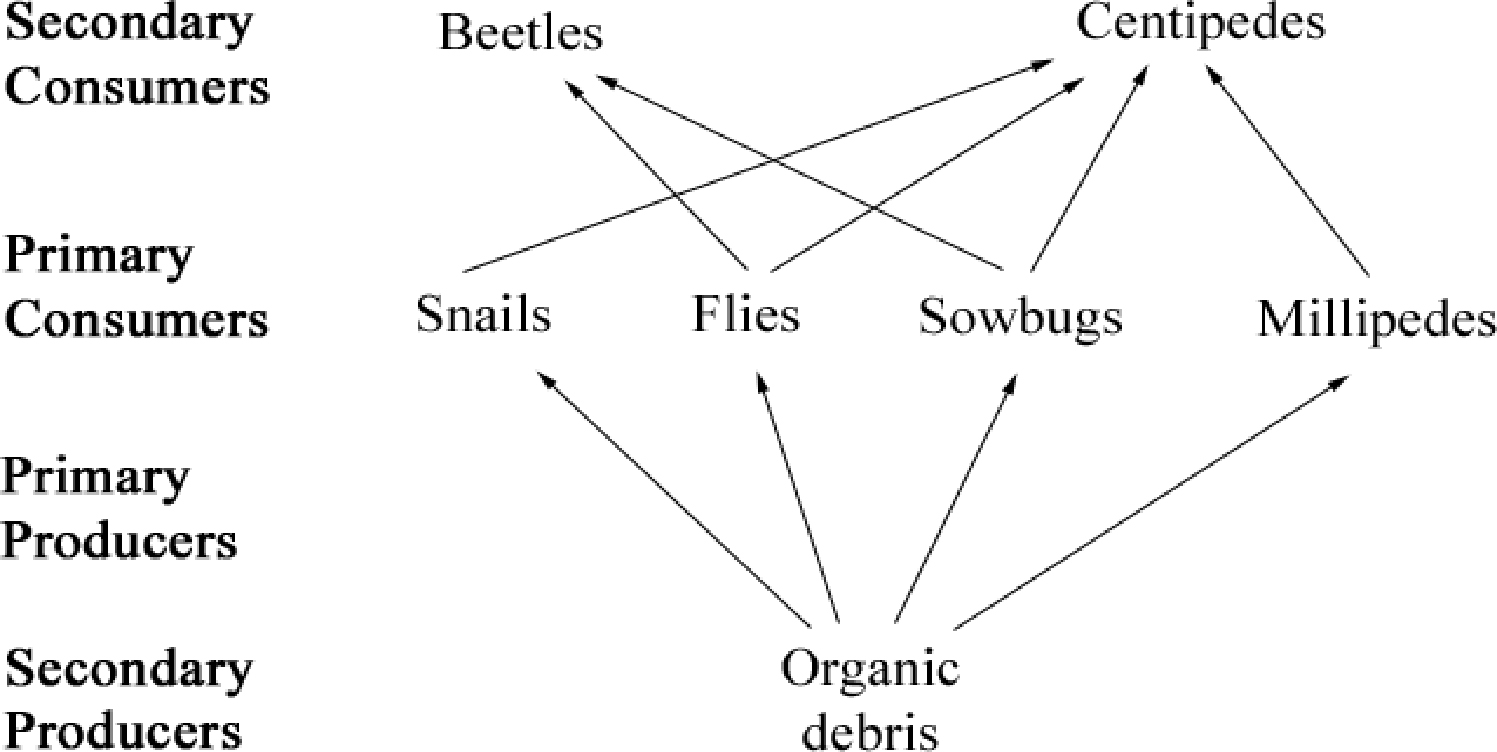
Figure 2. A Schoolyard Food Web.
Food webs, by themselves, provide a visible platform for thinking about organisms and their ecosystems in a dynamic, conceptual way. Both species diversity and thermal tolerance can be effectively introduced via a food web. Thermal tolerance can affect diversity as species move from an ecosystem where temperatures have gone from within their thermal tolerance range to one which offers a better thermal regime. Diversity can attenuate the effects of thermal tolerance limits by reducing the effects of losing a food web species. The more diverse the population, the better the chance that other species will utilize the food sources that the departing species exploited. And might be exploited by the same consumer which consumed the species which departed. Like the visible, dynamic structure of a drawn food web, these two biological phenomena effectors of ecosystem stability live in a dynamic relationship with one another.
So, what will they do with their food webs? In the next two blogs, let’s look at diversity first, then thermal tolerance. Both will provide valuable insights into the effects of global warming on living things; which is something our students need to become experts in.
 This is a regular feature by CLEARING “master teacher” Jim Martin that explores how environmental educators can help classroom teachers get away from the pressure to teach to the standardized tests, and how teachers can gain the confidence to go into the world outside of their classrooms for a substantial piece of their curricula. See the other installments here, or search Categories for “Jim Martin.”

by editor | Jan 19, 2016 | Environmental Literacy, Learning Theory
by David A. Greenwood, Lakehead University, Canada
As part of the 2009 North American Association of Environmental Education Research Symposium, this article addresses the cultural and theoretical frameworks that we bring to environmental education, the web of ideas and experiences that define the scope and purpose of the work in its geopolitical context. Originally delivered as a keynote address at the symposium, the paper highlights two necessarily related conversations within environmental education: the first concerns the problem of empire, including its roots in imperialism and colonialism, as well contemporary problems of globalization; the second concerns the problem of nature, including the need to develop intimate connections with the non-human on a planet that everywhere bares the mark of human alteration. Nature and empire are two poles on a continuum that shape the cultural and ecological contexts of life and learning. The author argues for the need to hold empire and nature not in opposition, but in paradox. Holding the tension of paradox complicates simplistic binaries, and can contribute to a stance that appreciates the relationships between seeming polarities in the intersectional work of social and ecological change.
For starters, I want to welcome all travelers to the Columbia River watershed. Here we are. I live some 300 miles east on the Idaho border, and the Palouse River that flows full of agricultural silt and erosion through my rural town mixes here with Portland’s urban confluences on its way to the Pacific Ocean. The mouth of the Columbia is an impressive roar of waves, marine life and history, commerce, and even today, shipwreck. Historian Richard White (1995) called the great Columbia River “the organic machine”: upriver the once wild Columbia and its many tributaries are now a mechanized and politicized system of dammed, slack-water reservoirs. The organic machine, indeed.
The tension of paradox surrounds us, and it surrounds the field of environmental education: local-global; urban-rural; environment-culture; masculine- feminine; native-settler; public-private; land-property; commons-enclosure; human-more-than-human; inhabitant-refugee; social justice-ecojustice; schooling- learning; domination-resistance; me-you; us-them; nature-empire.
My thesis is a simple claim around a single paradox: environmental education of any stripe can deepen its theory and practice by purposefully embracing the tensions between nature and empire. Nature and empire are two poles on a continuum that shape the cultural and ecological contexts of life and learning.
In the tradition of 19th century natural history, imagine an object lesson. I hold in my hands two related objects: the flight feather of a barn owl, and a wallet full of plastic and paper money. Inquiry: How do these objects and what they represent implicate me and shape our work? Nature and empire, the flight feather of an owl and the wallet of a white man, generate a paradox, a paradox that we need to hold, and balance.
 We need to embrace paradox because we nature-lovers and no-child-left-insiders must also face up to the eco- and genocidal politics of empire, politics we’re all complicit with everyday in our cosmopolitan superprivilege. We need to embrace paradox because as heady academics and well-meaning activists, we can easily forget the gift of our own embodied and earthy existence. This feather is perfect. No matter how scientifically rigorous, politically informed, or culturally responsive, environmental education is barren if it does not include re-enchantment with the wide world of creation, encounters with the others, and gratitude for the gift of life.
Nature, empire, and paradox.
Nature. Remember, when you walked miles into the mountains until the rant of your mind receded. The sounds around you returned. Birds, insects, movement in the cover. The air, warm and cool of sun and shade. You started to blend, quiet self diminished and enlarged by a place full of others, and though walking through, you felt belonging. Until later you startled a cougar, you had thought this impossible, your shared shock while everything stopped, her ears twitching, brown eyes locked on your next move, your heart jumping on your chest, predator, prey, you watched each other’s bodies trembling. Remember, how against reason you wanted to run, how you caught your breath and she suddenly returned easily to the ninebark. The day shimmered, your relief, you had finally come back to your senses.
Encounter, enchantment, gratitude.
Empire. Like globalization, empire describes the political economy of the planet: the new imperialism, colonization, development, free trade. Empire—a system of domination and resistance, a bio-political power that is exercised, internalized, and shaped by networks of human cultures worldwide. A system of authority and control enacted by all of us, motivated by habit, addiction, desire, necessity, dreams of a better life, fantasies of endless economic growth—all increasing the throughput of natural and human capital. Empire creates and destroys under the flashing lights of a “postindustrial” age. Empire—your I-Phone, my laptop, the G-20—ecological and social impacts concealed, denied, ignored, and masked as ecological nostalgia or market opportunities. The subject of empire is the commodity; the object is the consumer. All of us are its soldiers.
Domination, critique, resistance
Context: It’s a beautiful world, life is short, and I want to live. I want to feel the wind rushing around me. I want to walk on the land I love, every day. I want to garden with my children and watch them taste the fruits. I want friends. I want to drink starlight in the mountains and howl at the moon. I want the experience of being alive, to feel my sensuous and spiritual relation to flesh, water, rock, fire, wind, species, shooting stars. I want to keep my privileges and increase them. I want to travel to Europe with my family. I want to see my daughters in London or Paris.
Context: Planet Earth 2009, population and industrial explosions, perpetual war, mass extinctions, billions of us striving for better and more, the unthinkable suffering of others. Such beauty and possibility for wonder, connection, pleasure—and—as Barry Lopez (2001) wrote in his great essay “The Naturalist”: “To read the newspapers today, to merely answer the phone, is to know the world is in flames” (¶ 24). Earth abides; meanwhile, no one knows the full extent of the mess we’re making of habitats, species, biosphere, ecosystems, neighborhoods, cultures, selves, others, relationships. No one knows the full extent of “this entire extractive culture [of empire] that has been deforesting, defishing, dewatering, desoiling, despoiling, destroying since its beginnings” (Jensen, 2009, ¶ 10). No one knows the full scale of the problem of empire, its spiral of unintended consequences, and the degree of our own complicity: the way we are part of the problem we fail to understand, the way we fail to understand our part in it. Some say we are on the brink of industrial apocalypse. Others remember: we’ve been here about 500 years.
Anyone paying any attention can see that the mounting data describe an awesome mess of impacts, but fitting the fragments together is complicated. How many parts per million CO2? How many African American men in prison?
Rare is the space in which related impacts are acknowledged along with their more complex cultural causes. But increasingly, impacts are experiential, and therefore transformative. During my first week of classes this fall, a graduate student showed us a collage of photographs she made from her travels with Philippine Exchange: a dichotomous landscape of incredible beauty, destruction from mining, factories like prisons, and desperate poverty: people barely surviving, naked children playing on mountains and rivers of waste. Slumdog without millionaire; millionaire far removed. “It humbled me,” she said, and our privileged space of learning grew quiet. Breathe it in now.
I believe that appropriate responses to the facts surrounding nature and empire—what we know and don’t know, what we feel and don’t feel—are anger, fear, grief, and humility. Avoiding such emotions can lead to projections that may contribute to problems we deny or arrogantly claim to understand. We might learn to be with, rather than run from, the natural sense of despair that the field of environmental education sometimes schools us to avoid. If we are the least connected to others, we are part of a great suffering. Inquiry: Can we hold the paradox between suffering and hope, the dichotomous landscape of wretchedness and magnificence? “The test of a first-rate intelligence,” F. Scott Fitzgerald (1936/2008) wrote, “is the ability to hold two opposing ideas in mind at the same time and still retain the ability to function. One should, for example, be able to see that things are hopeless yet be determined to make them otherwise” (¶ 2).
Paradox. Along with grief, anger, and a rational fear of catastrophe, there is also a sense of urgency and responsibility, an embodied and shared knowing that we must do what we can, and now. From “Hieroglyphic Stairway,” by Drew Dellinger (2006, p.47):
it’s 3:23 in the morning and I’m awake because my great great grandchildren won’t let me sleep
my great great grandchildren ask me in dreams
what did you do while the planet was plundered? what did you do when the earth was unraveling?
surely you did something when the seasons started failing?
as the mammals, reptiles, birds were all dying?
did you fill the streets with protest when democracy was stolen?
what did you do once you knew?
(See the poet perform the entire poem at http://www.youtube.com/ watch?v=XW63UUthwSg)
W. S. Merwin said of poetry, “Any work of art makes one very simple demand on anyone who genuinely wants to get in touch with it. And that is to stop. You’ve got to stop what you’re doing, what you’re thinking, and what you’re expecting and just be there . . . however long it takes” (Merwin in Moyers, 1995, p. 2). Like the other time I seek out on the land, poetry engenders another cultural way of knowing. It is a dissident minority tradition within my own colonized and colonizing culture. Stopping for poetry is an antidote to the morning news, to the incessant political posturing, to the super-sure academic argument, to the voice of reason that governs research methods and reports findings with caution and restraint. Poetry revives me, helps me to recover my wilder self, my possibilities, my empathy, in a domesticating competitive culture that makes me feel loss and lost. Poetry does not argue for the truth, it burns with it. “What did you do once you knew?” (Dellinger, 2006, p.47).
At 82, W. S. Merwin has won two Pulitzer prizes for poetry including this year’s prize; he is also an environmental and peace activist. What Merwin says of poetry is a fruitful beginning for any field of inquiry shaped in part by empire: we’ve got to stop what we’re doing, what we’re thinking, and what we’re expecting. Is it possible to let down our guard and just be here, together?
To deepen a felt experience of paradox between nature and empire, I want to read two poems by Mary Oliver, another great American poet of nature. The poems I’ll read are from her recent volume, Red Bird (2008); the titles are “The Teachers” and “Of the Empire.” These two poems reflect a tension in environ- mental education: between a focus on nature and human relationship with the more-than-human world, and a focus on empire and the political structures that shape people, place, and planet. My argument, again, is simple: environmental education research must hold together the tension between nature and empire or risk its own irrelevance while empire grows and nature recedes.
Mary Oliver is one of the best nature poets ever. She has taught millions to stop and wake up to their own terrestrial embodiment. In “The Summer Day” Oliver (1992) confesses:
I don’t know exactly what a prayer is. I do know how to pay attention, how to fall down into the grass, how to kneel down in the grass, how to be idle and blessed, how to stroll through the fields. (p.94)
Oliver ends this poem by asking of everyone alive, “What will you do with your one wild and precious life?” (p. 94). Her poem “The Teachers” (2008, p.27) is typical of her meditations on slowing and stopping to pay attention to the others and what our relationship to others might signify.
The Teachers
Owl in the black morning, mockingbird in the burning
slants of the sunny afternoon declare so simply
to the world everything I have tried but still
haven’t been able to put into words,
so I do not go far from that school
with its star-bright or blue ceiling,
and I listen to those teachers, and others too—
the wind in the trees and the water waves—
for they are what lead me from the dryness of self
where I labor with the mind-steps of language—
lonely, as we all are in the singular,
I listen hard to the exuberances
of the mockingbird and the owl, the waves and the wind.
And then, like peace after perfect speech, such stillness.
The teachers, the others, make me more human. The more-than-human world—as David Abram, Paul Shepard, Annie Dillard, Henry Thoreau, Rachel Carson, Jay Griffiths, Derrick Jensen, and all my friends remind me— the more-than-human-world is sacred, biological diversity makes human life possible, it makes my life, your life, potentially, beautiful. The logic of empire is destroying this world, leaving behind what David Quammen (1998) called “a planet of weeds.”
Who are the teachers, what are their names, and what, if we learn to listen, might we hear the land and the water telling us? Robert Michael Pyle (2008) wrote, “[Environmental] education, no matter how topographically or culturally informed, cannot fully or even substantially succeed without reinstating the pursuit of natural history as an everyday act” (p. 156). It’s only good manners, Pyle says, to get to know our neighbors. “What we know, we may choose to care for. What we fail to recognize, we certainly won’t” (Pyle, 2001, p. 18). Nature study, from this perspective, must also include the study of what we fail to recognize, the study of what dominates our attention and stunts our ability to perceive nature. It must, in other words, include the study of empire.
Environmental education requires an expansive conceptual and experiential framework connecting local and global realities; it requires ecological attention and political edge, to make it relevant to our place and time. It also requires what Phillip Payne and Brian Wattchow (2009) call “slow pedagogy,” deep experience that helps us open and become responsive to the voices of the teachers:
Owl in the black morning, mockingbird in the burning
slants of the sunny afternoon…
…I do not go far from that school…
(Oliver, 2008, p.27)
How far gone are we now, here, today, from the teachers? Returning to the teachers, slowing to open to the more-than-human others, to the experience of habitat and biological diversity, to the interactions between land and people— this is the heart and soul of environmental education. What impedes our ability to perceive these teachings?
Aldo Leopold (1949-1968) said it over a half century ago: “our educational and economic system is headed away from, rather than toward, an intense consciousness of land” (p. 223). Today, it is even possible to observe that some environmental education research is headed away from, rather than towards, intense consciousness of land, consciousness that can only develop through direct experience of sufficient frequency, duration, curiosity, and reverence, so that we may learn to listen and to love. The environmental education field has become culturally responsive, politically astute, and psychologically smart—mainly in response to empire. But we still need the teachers. What they teach us is irreplaceable, and endangered, unless we stop, look, and listen for a long time.
Before sharing Oliver’s (2008) poem, “Of the Empire,” I want to make a few paradoxical claims about the field of environmental education.
First, environmental education researchers and practitioners ought to guard against the lure of professionalization and the pressures of specialization that surround all fields of inquiry. There is a danger inherent in specialization that narrows our potential community and that distances us from the teachers. In many ways I believe, as Peter Martin wrote in 1996, that “having become institutionalized, environmental education is a lost cause and should be phased out as soon as possible” (p. 51). This obviously does not mean that I don’t support environmental education; rather, I observe that the development of environmental education as a profession can dull its political edge, and can school it far away from the teachers. What is more, as Foucault (1977) showed us, professions tend to normalize behaviour, marginalize outsiders, and disqualify dissent; they can make us docile and unresponsive to nature or empire.
In a provocative lecture titled “Professionals and Amateurs,” Edward Said (1994) noted:
 Specialization means losing sight of the raw effort of constructing either art or knowledge; as a result you cannot view knowledge and art as choices and decisions, commitments and alignments, but only in terms of impersonal theories or methodologies. . . . In the end as a fully specialized . . . intellectual you become tame and accepting of whatever the so-called leaders in the field will allow. Specialization also kills your sense of excitement and discovery, both of which are irreducibly present in the intellectual’s make-up. In the final analysis, giving up to specialization is, I have always felt, laziness, so you end up doing what others tell you, because that is your specialty after all. (p. 77)
Environmental education, because of its inherent interdisciplinarity and the enormous scope of the work, ought to resist specialization by definition. The real challenge is not to advance the field, but to participate in and help shape the larger movement for cultural and ecological renewal and transformation. As Paul Hawken (2007) tells it in his book Blessed Unrest, the larger movement is huge. It is made up of diverse networks of organizations and individuals working for peace, social justice, ecological sustainability, and Indigenous and civil rights. Each of these related ideals is threatened by the same empire. Political and conceptual power capable of resisting and shaping empire can be found in the intersectionality of the larger movement. This power is also found in the arts, the soul of all social movements.
Mary Oliver’s (2008) “Of the Empire”:
We will be known as the culture that feared death and adored power, that tried to vanquish insecurity for the few and cared little for the penury of the many. We will be known as a culture that taught and rewarded the amassing of things, that spoke little if at all about the quality of life for people (other people), for dogs, for rivers. All the world, in our eyes, they will say, was a commodity. And they will say that this structure was held together politically, which it was, and they will say also that our politics was no more than an apparatus to accommodate the feelings of the heart, and that the heart, in those days, was small, and hard, and full of meanness. (p.46)
Let’s face it: environmental education is a pedagogical David to the Goliath of empire with its schools, bombs, patriarchy, and shopping opportunities everywhere. The way the U.S. national budget is prioritized is symptomatic: trillions for horrific wars; nothing for the environment within the Department of Education. Even if the United State’s No Child Left Inside Act of 2009 eventually passes, and the environment is finally noted by the Department of Education 40 years after Earth Day, it and its budget will be subsumed under No Child Left Behind, which is the climax of neoliberal education reform aligned with the politics of empire. This is not conspiracy theory or even critical theory, but the explicit expression of educational purpose from policymakers and leaders from local, state, and federal levels. No Child Left Inside is a remarkable example of grass-roots political activism in support of environmental education. May we please open a window and listen to the teachers? But obviously, the thrust of formal education in the industrial/capitalist state is aligned with the politics of empire.
 Today in wartime, these politics constantly promote the expectation of “economic recovery,” and the recovery of “consumer confidence.” We might wonder what it means. Consumer confidence? Recovery back to what? The prevailing fiction of limitless growth, that logical impossibility that Edward Abby called “the ideology of the cancer cell”? Recovery back to what? An unjust colonial order? An economically exploitative and ecologically destructive culture of hyper-consumption, speculation, and debt? Today in wartime, few educators, environmental or otherwise, are questioning the profoundly pedagogical impact of empire: economic growth for the class economy, military adventurism for false security, and the erosion and commodification of the cultural and ecological commons. The most insidious effect of empire, however, may be that it functions to conceal from thought the very idea that any of this is problematic. These are the politics from which no child is left behind, and to which environmental education research must attend.
Memory and Reinhabitation
A writer and lover of beauty, my grandmother suffered from Alzheimer’s the last decade of her long life. She was the matriarch of a large family, a first generation immigrant who loved America, and the American flag, for the real opportunities it represented for freedom from poverty and oppression that my ancestors fled in Eastern Europe. I remember the last time I saw her before she was placed into full-time care. I took her for a short canoe ride on a lake in northern Wisconsin. She crawled into the bow seat; I paddled from the stern. I had never paddled so intentionally, every stroke deliberate and smooth. Once out on the water, she leaned over the gunwale and let her hand dip below the glassy surface. “Soft,” she said, “it’s so soft.”
The last time I saw her before the funeral was at the nursing home in Milwaukee. The attendant who wheeled her into the common room told her, “Your grandson is here to visit with you, Liz,” and then she parked the wheelchair next to me and left us alone. I was scared. Would she know me? Was it a good day or a bad day? So, I started talking about the weather, the season, what was going on. I said: “Nonny, guess what. I moved to the country.” Instantly, as if from far away, she came back: “Smart,” she said, “smart.”
Then she must have remembered I was a teacher. She loved education, read all the time, left school after eighth grade. “You’re teaching,” she said, half statement, half question. I answered, “Yes, I’m a professor now.” Unimpressed, she asked me what I was teaching, and glibly I told her, “Well, I’m trying to help tear down the system.” Her eyes got real squinty then, and they widened and cleared as she looked up at me with the firm authority of elderhood, “You mean build it up!” She was insistent, and that was the end of that.
Most days my grandmother didn’t know her own name, her children or grandchildren’s faces, the season, the current president (she often spoke of Lincoln), or how long ago her husband had passed (it had been 30 years). But at the mere mention of tearing something down, the response from my grandmother was immediate. “Sonny,” she said, “you need to build it up.”
Today I honor my grandmother’s wisdom. She came of age during the Depression. She stretched a meager budget for food for seven children. “Sonny,” she said, “you need to build it up.”
Building things up and tearing things down—this apparent dichotomy presents another opportunity to hold and balance paradox. I’ve described nature and empire as two poles of a paradox that reflect the expansive landscape of environmental education, the linked cultural and ecological contexts of our work. I want to offer another paradox that holds together the big aims of environmental education, and that also points to pathways for pedagogy and curriculum. The paradox is between decolonization and reinhabitation, between tearing things down, and building things up.
 I propose considering “decolonization” and “reinhabitation” as twin goals for education in a culture of empire. It should be said that these goals parallel other aims of educational research and practice; naming them is an effort to make inclusive space for those interested in environment and culture, nature, and empire. Like other synonymous terms, decolonization signals a strong critique of cultural practices and their underlying assumptions. The significance of decolonization as a theoretical category is that its usage specifically problematizes the colonization of people and land, both as historical practice and as the political progenitor of today’s empire. Of course critique alone is insufficient theory for environmental education research, and thus the pairing of decolonization with the vision of reinhabitation. It is the tension of paradox between decolonization and reinhabitation that gives both terms their conceptual range. Though for the sake of theory-building the two terms are called out as distinct, reinhabitation and decolonization are two dimensions of the same task. Renewal often requires that something is undone. In California, Van Jones expressed this clearly with his program, “Green Jobs, Not Jails.” Nature, empire, paradox.
Decolonization involves learning to recognize disruption and injury in person-place relationships, and learning to address their causes. Because colonization refers also to the colonization of the mind and body, it involves the practice of unlearning and undoing. Reinhabitation involves maintaining, restoring, and creating ways of living that are more in tune with the ecological limits of a place, practices that are less dependent on a globalized consumer culture that values profits and conveniences more than people and places. Reinhabitation means learning to live well socially and ecologically in a place, and learning to live in a way that does not harm other people and places (Gruenewald, 2003).1 These are big aims, but there is more. Reinhabitation also implies taking a new stance toward one’s own becoming. We reinhabit the self whenever we seek our own renewal, when we stop to listen to the teachers, or when we acknowledge the heartbeat of empire in our own bodies:
they will say also that our politics was no more than an apparatus to accommodate the feelings of the heart, and that the heart, in those days, was small, and hard, and full of meanness. (Oliver, 2008, p.46)
Because decolonization emphasizes human relationship to land, Indigenous perspectives on inhabitation are vital, as are the perspectives of other displaced and minoritized groups. Acknowledging Indigenous inhabitation is not only to recognize place-based relations to nature, but also to remember the long story of colonization, resistance, and the rights of sovereignty. Indigenous cultures are not the only cultures that have histories that need to be remembered; many minority traditions tell sacred stories of land, displacement, and struggle. Even mainstream white America incubates movements for resistance and change. The voices of poets, artists, activists, and others working for peace, social justice, Indigenous and civil rights, and for environmental justice and ecological sustainability—these voices are a worldwide movement standing up to empire. Whatever success this unnamed movement will have building things up and will depend not merely on critique and vision, not merely on developing communities of congruence and resistance. Perhaps building things up will depend mainly on changes in consciousness that open the heart, reinhabitations that slow us down so that we can recognize the intersectionality of our interests, how each of us is implicated in the other.
Listen to the teachers, confront empire. I want to build now toward naming a course of action for the field. While we might celebrate No Child Left Inside and the growth of green, decolonization means that we dig deeper: that we acknowledge genocide, racism, and patriarchy, past and present; that we acknowledge the class and caste systems that our contented consumption supports; and that we face up to our militarized culture of violence, repression, and war. Decolonization and reinhabitation mean untangling the roots of empire and building something up, a process that begins with ourselves, reaches outward, and never ends. Every act is important and not without consequence; collectively all of our actions create all of our contexts. Our numbers are many.
Our numbers, in fact, and our impacts, are extreme. Chris Jordan is a photographer who creates images that communicate the otherwise ineffable scale of our culture of mass consumption (see all the following images at http://www.chrisjordon.com). What is indistinguishable from a distance is revealed on closer scrutiny. “Gyre” (2009) depicts 2.4 million pieces of plastic, equal to the estimated number of pounds of plastic pollution that enter the world’s oceans every hour. All of the plastic in this image was collected from the Pacific Ocean. “Shark Teeth” (2009) depicts 270,000 fossilized shark teeth, equal to the estimated number of sharks of all species killed around the world every day for their fins. Jordan’s art also magnifies the social and psychological impacts of empire: “Ben Franklin” (2007) depicts 125,000 one-hundred dollar bills ($12.5 million), the amount our government spent every hour on the war in Iraq during 2007; “Constitution” (2008) depicts 83,000 Abu Ghraib prisoner photographs, equal to the number of people who have been arrested and held at US-run detention facilities with no trial or other due process of law, during the Bush Administration’s war on terror; “Barbie Dolls” (2008) depicts 32,000 Barbies, equal to the number of elective breast augmentation surgeries performed monthly in the US in 2006. The commodification of life under empire reeks of plastic, petroleum, patriarchy.
Paradoxically, the demand for Jordan’s work is high: people are drawn to the terrible truth of his poetry. Of all of Jordan’s (2009) work, his “E. Pluribus Unum,” or “the many become one,” best represents to me future directions for environmental educational research. From a distance, this image reminds me of the stories of the land told in tree rings. Complexity and beauty are revealed in proximity. This large scale mandala (the indoor wall hanging measures 45 by 45 feet) depicts the names of one million organizations around the world that are devoted to peace, environmental stewardship, social justice, and the continuation of diverse and indigenous cultures. The actual number of such organizations is unknown, but Paul Hawken’s (2007) “Blessed Unrest” project estimates the number at somewhere between one and two million, and growing. If the lines in this piece were straightened out, they would make an unbroken line of names, in a ten point font, twenty seven miles long.
 What I’m suggesting is that if part of the work of environmental education is to decolonize and reinhabit empire, then we must better recognize the intersectionality of our interests with the interests of others, even or especially those whose ecological consciousness may be diminished by the ravages of empire. Green jobs, not jails. Environmental educators who can hold the paradox between nature and empire can expand the landscape of the field while enhancing the reach and impact of environmental education. In all intersectional social movements there are opportunities to acknowledge and resist the power of empire, to remember and reinhabit colonized land and colonized places, to remember their stories, and to listen for the wisdom of the teachers. We need an intersectional approach because our work is already braided in its resistance to and reconfiguration of empire, and moreover, to discount the struggles of others is to cut ourselves off from the principle of interrelationship; and to discount the struggle of others is to enact the logic of empire.
The intersectional movement that environmental education needs has been gathering: social ecology, environmental justice, ecofeminsim, ecojustice, eco-pedagogy, ecopsychology, critical geography, Indigenous ways of knowing, place-based education, peace education, humane education, sustainability education, disability studies, transformative education, Transition Towns, Wendell Berry, Jane Goodall, the Earth Charter. The shared theme of intersectional movements is their responsiveness to both nature and empire. Their movement energy is the vanguard of educational theory and practice.
The politics of empire do not change unless they are resisted by growing social movements: locally, nationally, globally. Democrats in Washington are obviously not enough. President Obama is not enough. Even if he wanted a strong climate agreement, for example, or to remove the salmon killing dams on the Snake River, or to provide affordable universal health care, or to end war–he can’t get it done, because his work is governed by the logic of empire.
History shows us that through partnership, solidarity, and persistence, social groups grow wiser and stronger in their ability to transform this logic, and to reinhabit our colonized places and lives. In the age of empire, the field of environmental education can itself become a kind of E. Pluribus Unum that invites and creates intersectional theory and action.
But—as important as it is to politicize our work and to ally the field with kindred social movements, we must remember the teachers. We need to learn how to stop, slow, and invoke their sacred presences. We need to learn how to privilege the teachers—other species, their languages, “owl in the black morning”—as full partners in E. Pluribus Unum. Nature, habitat, ecosystem, species, climate—this is not a political group; it is the context that makes all politics possible. There is a power greater than political power, and a strength greater than intellectual muscle. We know it as the experience of being alive, and being connected to others. The challenge is to hold this power and develop this strength as we participate in the larger struggle for peace, social justice, Indigenous and civil rights, and ecological well being.
Because a culture of perpetual war undermines the growth of any environmental ethic, I want to close with a poem by Judyth Hill (2002, p.4) called “Wage Peace.”
“Wage Peace”
Wage peace with your breath. Breathe in firemen and rubble,
breathe out whole buildings and flocks of red wing blackbirds.
Breathe in terrorists and breathe out sleeping children and freshly mown fields.
Breathe in confusion and breathe out maple trees. Breathe in the fallen and breathe out lifelong friendships intact.
Wage peace with your listening: hearing sirens, pray loud. Remember your tools: flower seeds, clothespins, clean rivers.
Make soup. Play music, learn the words for “thank you” in three languages.
Learn to knit, and make a hat. Think of chaos as dancing raspberries,
imagine grief as the outbreath of beauty or the gesture of fish.
Swim for the other side. Wage peace.
Never has the world seemed so fresh and precious. Have a cup of tea and rejoice.
Act as if armistice has already arrived. Celebrate today.
Notes
Participation in the money economy makes it difficult to know how one’s consumption is impacting other people and places. The point is that to practice reinhabiting place, one must become more aware of how one’s actions have impacts “all over the place” now and in the future—and—one must begin to act ethically on that knowledge.
Acknowledgements
This paper was the concluding plenary address at the North American Association of Environmental Education (NAAEE) Annual Conference Research Symposium in Portland, Oregon, USA, October, 2009.
Excerpt from “hieroglyphic stairway” by Drew Dellinger. Copyright © 2006 by Drew Dellinger. Used by permission of the poet. www.drewdellinger.org
Excerpt from “The Summer Day” by Mary Oliver. Copyright © 1992 by Mary Oliver. Used by permission of the poet.
“The Teachers” and “Of the Empire” by Mary Oliver. Copyright © 2008 by Mary Oliver. Used by permission of the poet.
“Wage Peace” by Judyth Hill. Copyright © 2002 by Judyth Hill. Used by permission of the poet.
David A. Greenwood is Associate Professor and Canada Research Chair in Environmental Education in the Faculty of Education of Lakehead University in Thunder Bay, Canada. His teaching, research, and community work revolve around place-based, environmental and sustainability education. Widely published in these areas, David recently guest edited with Marcia McKenzie Volume 14 of the Canadian Journal of Environmental Education (2009), and is editor with Greg Smith of the book Place-Based Education in the Global Age (Routledge, 2008). Contact: greenwooddavida@gmail.com
References
Dellinger. D. (2006, Summer). hieroglyphic stairway. YES!, 38, 47.
Fitzgerald, F. S. (1936/2008). The crack up. Esquire. Retrieved from http://www.esquire.com/features/the-crack-up Foucault, M. (1977). Discipline and punish: The birth of the prison. New York: Vintage Books.
Gruenewald, D. (2003). The best of both worlds: A critical pedagogy of place. Educational Researcher, 32(4), 3-12.
Hawken, P. (2007). Blessed unrest. New York: Viking. Hill, J. (2002). Wage peace. In M. Adams (Ed.), Singing this great body back together:
In remembrance of September 11, 2002 (p. 4). Columbine Hills, CO: Baculite Publishing.
Jensen, D. (2009, May/June). The world at gunpoint. Orion. Retrieved from http://www.orionmagazine.org/index.php/articles/article/4697/
Leopold, A. (1949/1968). A Sand County almanac. Oxford, United Kingdom: Oxford University Press.
Lopez, B. (2001, Autumn). The naturalist. Orion. Retrieved from http://www.orionmagazine.org/index.php/articles/article/91/
Martin, P. (1996). A WWF view of education and the role of NGOs. In J. Huckle and S. Sterling,(Eds.), Education for sustainability (pp. 40-54). London: Earthscan.
Moyers, B. (1995). The language of life: A festival of poets. New York: Doubleday. Oliver, M. (1992). New and selected poems. Boston: Beacon Press.
Oliver, M. (2008). Red bird. Boston: Beacon Press.
Payne, P. & Wattchow, B. (2009). Phenomenological deconstruction, slow pedagogy, and the corporeal turn in wild environmental/outdoor education. Canadian Journal of Environmental Education, 14, 15-32.
Pyle, R. (2001). The rise and fall of natural history: How a science grew that eclipsed direct experience. Orion, 20(4), 16-23.
Pyle, R. M. (2008). No child left inside: Nature study as a radical act. In D. Gruenewald & G. Smith, (Eds.), Place-based education in the global age: Local diversity (pp.155-172). New York: Routledge.
Quammen, D. (1998). A planet of weeds. Harper’s Magazine, October, 57-69. Said, E. (1994). Representations of the intellectual. New York: Pantheon Books.
White, R. (1995). The organic machine: The remaking of the Columbia River. New York: Hill and Wang.

by editor | Oct 25, 2015 | Learning Theory, STEM
schoolship.blogspot.com
Arts and Humanities in the Sciences? Is that incongruous, or what?
By Jim Martin
Have you ever ‘felt’ the weather as cloud formations began to change? I love to watch Mares’ Tails form; multiple long extensions of a cumulus cloud that race out ahead, then turn up and curl back. They signal a change in the weather; an eye-catching choreography in the sky; a dance students could perform to learn about weather. I started teaching biology to college students in 1970, and had no thoughts about using the arts and humanities in my delivery. I was open to them; my childhood and youth were infused with them. But I saw no way to employ them because it seemed to me that they were an adjunct, a vehicle I would have to tack onto an already overloaded syllabus.
Then, a few years later, concerned about the quality of my general biology (Bio 101) students’ understandings, and wondering what they were learning during their K-12 years, I accepted an opportunity to teach a 7th grade self-contained classroom. Before the first day of school, I decided not to use the school’s language arts texts and workbooks. They were utterly boring; pages to go through so you could answer a few tedious questions. So, I organized my own curriculum. In one part, the delivery vehicle was drama. We stretched sheets across the length of the classroom, and began to write and perform scripts.
I used these scripts, and their repetitious deliveries to teach topics like DNA and protein synthesis, natural selection, and more. While doing that, I discovered that certain pieces of the science were learned well with this method, so this integrated way of teaching started to become a vehicle I used to teach multi-disciplinary units in language, performance arts, and science.
This is beginning to sound ominous! Don’t despair. I did these things because I was comfortable with them. For one thing, I was teaching both language arts and science to this class. Since we were in the same classroom all day, it was an easy thing to do. I can tell you this: If you can find the courage to try to use one piece of the arts and humanities in one science activity, you might discover the strength of this method in helping students understand the concepts they are studying. And, developing critical thinking and executive functions you might not have noticed they carry with them.
Be patient. Let me finish this reminiscence, and we’ll get to the pragmatic details of how you might try one small activity; and assess it. Not long after, I found myself learning what I could of the human brain; how it learns, how it expresses these learnings. This set me on a journey I still travel. An interesting viewpoint on that journey was one where I could see the parts of the brain, and their connections (critical piece there) that were used to conceive a visualization of a piece of art, then execute its expression in the finished piece itself. Contrary to what I’d always assumed, that art and science used different parts of the brain for their work, both used nearly the same parts and their connections. No wonder my tentative attempts to teach art and science together seemed to work! While we isolate and jurisdict the disciplines, the brain does not.
It’s challenging to meet science standards and benchmarks by using the arts and humanities as vehicles for teaching to these standards. The main reason teachers who do this continue the practice is that students’ learnings stay with them. After they take the test, they don’t forget what they have learned. The Seeking System, as described by Jaak Panksepp, is a coordinated effort between the limbic system and the cortex which can lead to conceptual learnings, encourages conceptual learning by engaging learners in an active learning inquiry which builds on students’ curiosity. It’s this state of expectant curiosity which keeps students on-task, seeking an answer, finding out. Like observing paramecia flitting about among algae on a microscope slide. What are they? What are they doing? Where are they going? Curiosity a fair wind which drives their sails, students will devour the books and internet for information they seek.
While this state is initiated in the limbic, a part of the brain which does little thinking, it engages, via prompts from the limbic to the prefrontal cortex (pfc), which processes students’ thoughts, engages critical thinking, brings to working memory in the pfc other relevant information, and performs the executive functions which keep learners on task, following their plan. Learnings there then move back to the cortical regions brought on line, where they become connected; long-term memories, which can be called out via any of the neural circuits brought to the pfc to deal with this new experience.
Let’s look at an activity which incorporates the arts and humanities to drive a science unit in weather. Teachers have used dance to help their students learn the meteorological processes that cause phenomena like Mares’ Tails. You can do the observation any time in the year, then recall it when your class does meteorology. Or, start the dance when you make the observation, and finish in the appropriate unit. When students observe Mares’ Tails, then build a dance around what they have observed, they follow an interesting trail into meteorology to discover the processes involved in producing Mares’ Tails. And, even better, their connection to subsequent weather. Then, students and the teacher can use this newly learned information to better inform the choreography they are constructing.
As they observe and find out about Mares’ Tails, the fact that they are also observing for the clouds’ dynamics will engage the Seeking System in many students; the quest to find out. Engaging the idea of dance and Mares’ Tails will pique the curiosity of others. And, a very nice coincidence, both alert the prefrontal cortex and initiate the critical thinking and executive direction capacities of the brain as they build an abundance of routes to relevant memory, which your students use to move effortlessly through the landmarks delimited in Bloom’s Taxonomy.
While relatively simple, the teaching and learning in an activity like this is challenging for teachers. It is definitely not part of most of our pre-service and in-service professional educations. We all want to teach well, and to understand what and how we are teaching. If, like most Americans, the arts and humanities aren’t an integral part of our teachers’ developmental experience, incorporating them into our teaching is uncomfortable at best. In spite of this, in time, this sort of integrated teaching will have wider acceptance, but just now it seems like an adjunct to most education. I say this: The education establishment in America is woefully unfamiliar with the brain and its processes in learning, and its relationship with the rest of the body currently being described in the area of embodied cognition; the close coupling of processes in the brain and processes in the rest of the body. We need to have the courage to begin to explore this lucrative, brain-based teaching modality. The brain is the organ of learning.
By actively participating in the process of using dance to begin to learn about Mares’ Tails, both teacher and students incorporate the learning in long-term conceptual schemata they will carry with them. This is because the conceptual information they have learned is available via multiple neural pathways; much better than being accessed only by reading a question stem. Both the dance and the science inquiry follow similar trails through the brain. This is in contrast to the effect of relying on what Panksepp terms the limbic’s Fear System; the anxiety of some degree which is associated with learning science facts in order to pass a test. In this case, the information is stored by itself, un-connected to other relevant conceptual information stored elsewhere, and with no connection to the real-world memories produced during active learning. If students are to carry what they learn into their lives, they need to learn it in authentic ways. Seeking’s learnings are remembered; Fear’s are forgotten after the test. This means that the teacher has to be committed to this learning modality. And, committed to taking on only that which she is comfortable with. Should you want to try, but are unsure, you can contact a dance teacher to help, or a colleague who has taken dance. Lots of them around. You could even check a dance studio. Most people who work in the arts and humanities are open to help.
Here is a breakdown of planning steps a hypothetical teacher might take in preparing to deliver the Mares’ Tails meteorology/dance section of a unit on weather. As you read each step, ask yourself if you could do it now. You might surprise yourself.
1) Observe Mares’ Tails; either a serendipitous observation, or consult a meteorologist to find out when to expect them. Difficult until you’ve positively identified one; fun and easy after that. Students can do this as homework, or as a whole class if Mares’ Tails occur during a class. (You may have noticed that weather doesn’t program itself to coordinate with school schedules. Or their needs.)
2) During the observation, have students note any dynamics in the clouds. This is a good time to suggest the idea of clouds dancing.
3) If their interest is piqued, raise the idea of a Mares’ Tail dance; otherwise wait.
4) First approximation of the dance. Note questions which arise within groups.
5) Ask the class what more can they find out about Mares’ Tails. Give them time to find out.
6) Incorporate this information into the choreography. Name the dance’s sections from meterological learnings. (Note: I was feeling creative, in Seeking mode, by this time, and that’s when my pen wrote, “. . . (n)ame the dance’s sections from meteorological learnings.” Words and a visualization just popped up. Evidence my prefrontal cortex was coming on line. One of the things Seeking does.)
7) Perform the dance for an audience, and explain the meteorology; perhaps by dance section.
8) Two assessments or tests: Yours, based on their work; and a standard test from your publisher or the web. Compare results.
9) Assess the project: you, your students, their audience.
10) Write an article for Clearing and send it in!
This is a regular feature by CLEARING “master teacher” Jim Martin that explores how environmental educators can help classroom teachers get away from the pressure to teach to the standardized tests, and how teachers can gain the confidence to go into the world outside of their classrooms for a substantial piece of their curricula. See the other installments here, or search Categories for “Jim Martin.”

by editor | May 27, 2015 | Critical Thinking, Learning Theory, Place-based Education, Questioning strategies
Photo by Jim Martin
“Lessons for Teaching in the Environment and Community” is a regular series that explores how teachers can gain the confidence to go into the world outside of their classrooms for a substantial piece of their curricula.
Part 3: Emergent phenomena
by Jim Martin, CLEARING guest writer
If you go to a place in the world outside your classroom – your school yard, a trail nearby, a stream bank – and think about it, you’ll find it is a prism which, oriented effectively, holds the power to involve and invest your students in their educations, and empower them as persons. Simple miracle; takes work to discover.
You’ve found a place for your project, large or small, and thought of a partner or partners. Quite possibly, you might have noticed a piece of embedded curriculum. And maybe even thought of what students would do. These are the sort of things that emerge from the places in the real world when you go to them with your teacherly knowledge, skills, and understandings. The part of you that is Teacher is the prism from which the potential that resides in your community and environment emerge in observable form, paint their elements, disclose the human mind.
We named two projects last week. Let’s take a closer look at them and see what emerges.
A Small Project
Your class visits a nursing home every spring, and your students would like to grow flowering plants, pot them, and take them when they make their visit. You discuss this, and decide to plant seeds in the soil just under your classroom’s windows. When they’re growing well, students will transplant them to pots, which you have in your room.
What are the partnerships that will help you do this work? To do the project, you must get students out of the room and back, procure seeds and tools, touch bases with the custodian and principal, do the potting and manage kids on station. Plus, you have to deliver the fractions and biology lessons that you discovered in the schoolyard near your window. You have some resources, like the manager of a small local pharmacy, who has a limited budget for public services expenditures. Also, the nursing home and the school, which has gardening tools.
You need seeds, so ask the manager of the pharmacy outlet for a donation of one packet each of eight kinds of annual flowers. She agrees, and you get your seeds. So, children plant, seeds grow, students pot and then take their flowers to the nursing home. During the work, they learned about fractions and studied a biology unit on seeds. A resource you used is doing fractions and studying biology on site, so that you don’t do the project in addition to your already heavy teaching load.
Let’s call the people, institutions and organizations you worked with your “Partners,” and think of the project as one done with partnerships. Your Partnerships assist you with the logistical load involved in doing projects.
So, one tool you use is Partnerships, however small, to share the load. Sharing the load is an important part of doing projects. We live in communities, and ought to use them. It’s important to understand partnerships. Even though your partners are sponsoring part of the project, you are doing something for them and they are doing something for you. That’s why people engage in partnerships, because all parties bring something useful to the table.
A Larger Project
This project is a streambank restoration sponsored by a regional bird sanctuary and the local Friends of Trees organization. They provide tools, supplies, plants, and training for you and your students,. They also schedule three Americorps Volunteers for field trips and one classroom visit. You provide workers (your students), student-made site maps, site habitat assessments, and a summative Power Pointtm presentation.
The project entails a site visit to orient yourselves and begin site mapping, one to clear vegetation and continue mapping, another to survey, one to plant, and another to monitor the planting. In this sort of project, your partnerships are crucial to beginning and finishing the project. The bird sanctuary has some equipment and materials available to you for making the observations you’ll need to make the site map, and guidelines for performing the habitat assessments. They also have a person who will mentor you as you go through the stages of a streambank restoration project. This will give you the large picture within which your students’ work will fit. It also has, embedded within it, lots of useable curricula. Friends of Trees will help to plan and do vegetation clearing and using GIS techniques to map plants your students will put into the ground.
This means that you now must manage transportation, substitutes, and curriculum on your own. These present their own learning curves. The prism which organizes this confusing chatter of pieces, parts, jobs, and so forth, into recognizable and useful bands, bands which clarify community and environment based education into an inspiring and inviting rainbow is your capacity for doing self-directed science inquiry. In my experience, that seems to be the key empowering piece of the education puzzle. Most of us have never done a science inquiry from noticing something interesting, to asking a clear question about it, designing an investigation, collecting data, analyzing and interpreting it, communicating our findings, and identifying interesting follow-up questions. Somehow, engaging this from start to finish leaves teachers with a fresh perspective on what they are teaching, and how. And empowers them to thoroughly involve and invest their students in their educations and their lives. If you’ve ever seen the face and eyes of an empowered child, you’ll know what I mean.
Part of this change in perspective comes from releasing yourself from dependence upon directions in the publishers’ materials and teachers’ editions, and discovering that your students will find better, more effective ways to use them. Especially those in your bottom 25th percentile. (You can get an idea of what this might look like by going to Mike Weddle’s article here. He gives the most complete picture of what community and environment based education looks like that I’ve read. Written from the pen of a teacher. Jude Curtain, also on the website here, gives the best one-page description of science inquiry that I’ve read. They both know, and clearly express student-directed science inquiry.)
So, let’s walk through an inquiry, one blog at a time. The site can be your school, a natural area, a parking lot. They all work. Here’s what to do. If you can, spend some time in a place you’d like to do an inquiry. It doesn’t have to be one you’d take your students to. Browse around; find things that either interest you or raise questions in your mind. Just immerse yourself in the place. Here’s how one started for Dryas, my wife, and Carol Lindsay, our African Drum teacher, on a summer afternoon several years ago. We were by a side channel of a local stream, and they saw what they thought was a dragonfly with eight wings. They wondered what it really was, and set out to find out. This happens when you let something catch your eye. Go out this week and let it.
 This is the third installment of “Teaching in the Environment,” a new, regular feature by CLEARING “master teacher” Jim Martin that will explore how environmental educators can help classroom teachers get away from the pressure to teach to the standardized tests, and how teachers can gain the confidence to go into the world outside of their classrooms for a substantial piece of their curricula. See the other installments here.

by editor | Apr 21, 2015 | Conservation & Sustainability, Environmental Literacy, Learning Theory
Although this article was written in 1996, and contains references to events and people from that era, much of Weilbacher’s critique remains relevant today. -Ed.
 Every Day is NOT Earth Day
Reflections on the True Meaning of Earth Day
by Mike Weilbacher
 ‘ll admit it up front: I’m a sucker for Earth Day. I’m a child of the first Earth Day in 1970, for its tidal wave of publicity captivated my teenage attention and launched my career. My wife and I met planning Philadelphia’s Earth Day ’90 extravaganza – her parade met my outdoor stage, and the rest was history. Today, my workplace’s largest education program has become Philly’s longest running Earth Day event.
So few things annoy me more than the standard environmental knee-jerk position on Earth Day. You know it well, and have probably recited it like some Zen mantra: every day is Earth Day; make every day Earth Day.
As usual, we got it all wrong.
Because the environmental movement began as a countercultural phenomenon, we simply can’t stand our own successes, and continually sabotage our greatest gains. Like Earth Day.
Just think of what’s happened. Millions of kids across the planet are gearing up for some celebration of the day, perhaps a tree planting, a litter clean-up, a bad assembly featuring some whining folksinger (“Please save the rainforest, boys and girls, and when you’re done, please save every large endangered mammal”), or a recycled art contest, where eminently recyclable objects like cans and egg cartons are irrevocably glued to each other and turned into wholly non-recyclable monstrosities that are trashed after the event is over (and we’re teaching what here?).
OK, bad examples, but what it means is so startlingly simple it has flown way over our still-shaggy heads. Earth Day has arrived; it has planted a taproot in the mainstream of American pop culture, and like it or not, there it will stay, and grow, and blossom…
…Into a new intemational holiday that will one day rival Christmas in its scope. I’m dead serious. Signs of this were first revealed during the extraordinary event that was Earth Day’90. While the first Earth Day was an exclusively American college-oriented teach-in, Earth Day ’90 graduated into a global festival of more than 100 million people in more than 100 countries gathering to, in some cases, perform quite meaningful work: restore rivers, save species, reclaim battered landscapes. Earth Day ’90 was, barring world wars or Michael Jackson concerts, the largest mass event in world history.
Today, the sound of the holiday embedding itself in our cultural psyche can be heard everywhere. In schools: Earth Day has become a part of many school curricula; kids are growing up knowing that Earth Day is April 22nd, and doing something relevant on or near that day. In politics: every April 22nd, President Clinton – with Vice President Green, I mean, Gore, at his side – hosts a press conference to announce another underwhelming eco-initiative. On TV: every April, there’s a round of cheesy Earth Day specials featuring forgettable stars like Bob Saget performing amazing feats like installing toilet dams in their home bathrooms (that really happened a few years back.) On radio: Rush Limbaugh will likely repeat his tired tirade that the day reflects the true deep green plot against society, for April 22nd is also Lenin’s birthday – proof that environmentalism is a Communist plot! (Memo to Rush: April 22nd was chosen because it was the only spring Saturday Senator Gaylord Nelson had free in 1970, and no environmentalist I’ve ever met in 27 years of Earth Days ever knew when Lenin was born.
You’ll hear it in newspaper editorials and worldwide web pages; in store ads and nature center events; in zoos and museums; on T-shirts and coffee mugs.
Love it or hate it, you gotta admit it: Earth Day is here to stay.
And Earth Day will only grow in scope because environmental issues are not going to go away. Quite the contrary. With Pinatubo’s ash finally settling out, with atmospheric carbon dioxide concentrations on the rise, the global warming debate will likely warm up quite dramatically in the next few years. The biodiversity conflict is only starting to gain any intensity at all – here’s one issue guaranteed to explode as soon as a large, charismatic mammal vanishes, like the black rhino or mountain gorilla, both threatened by Africa’s political instability. And we have never properly confronted the population issue – we likely will when the next famine arrives.
On top of this, the nascent Earth Day holiday will receive a huge jolt in the year 2000. New millennium. The thirtieth anniversary. That year’s Earth Day will be a humbling event.
Sure, the “make every day Earth Day” sentiment has its place. Mostly, it serves as a reminder that the values and ethics we hold important must be cultivated daily if they will thrive. And it should remind schools of the danger of pigeonholing the ecology unit into a one-day or one-week project. Certainly, state educational mandates for ecological/environmental understandings must never be met from a one-day event, and too many schools rely on this one day to complete its environmental education requirements.
Speaking of schools, Earth Day brings out the worst in too many teacher, and too many outside educational agencies, from corporations to utilities to non-profit. There are too many lame Earth Day poster contests, where kids are asked to draw a colorful poster with an Earth Day theme. So it’s education as fascist slogan: “Don’t Pollute!” “Love the Earth!” “Reduce! Reuse! Recycle!” Relax already. We still labor under the horribly misguided notion that if we command kids’ knees to jerk in the proper direction, their heads will follow. Wrong, so wrong. Sloganeering is not educational in any sense whatsoever, teaches no information at all, and only confirms our kids’ worst fears about the state of the Earth: The Earth must be dying because the posters say so. Environmental education must be uplifting, never down- grading, and never be reduced to a bumper-sticker answer to a lapel-pin question.
Still, wading through all the flotsam and jetsam floating around Earth Day, there is a nugget of truth, a seed of change that we must hold onto tightly.
We need holidays. Better yet, we need holidays with meaning. Christmas resonates with so many people – even people who are barely Christian the rest of the year – because it speaks to a set of values we all want so desperately to believe, like the triumph of Light over Dark. The Fourth of July is centered on freedom, independence, and the meaning of America. Martin Luther King Day, I hope, will evolve to take on transcendent relevance around issues of equality, nonviolence, change and the need for multicultural connections.
Sadly, Memorial Day, Labor Day and President’s Day have lost so much of their original meaning, and exist only as three-day holidays for overworking people. Our culture may be seeking new holidays with new meanings for a new millennium, and the beauty of Earth Day is that it emerges as the only secular holiday the entire world will celebrate simultaneously. Earth Day will become just that, the “Earth’s day,” a holiday where people pause to consider what it means to be a planetary citizen, and reflect on how well we shared limited resources with so many other species.
My eldest daughter will be a graduate of the Class of 2010. I’ll wager that during her school career, she’ll have a day off from school for Earth Day. Banks will close. Governments shut down. Stores hold Earth Day sales. Greenpeace’s executive director will write an op-ed piece in the New York Times begging us to “put the ‘Earth’ back in Earth Day.”
And I’ll be on some stage somewhere hosting an Earth Day festival, living every minute of it all.
So remember: every day is NOT Earth Day. Once a year is fine. Happy Earth Day.
At the time this was written, Mike Weilbacher was executive director of the Lower Merion Conservancy, sponsor of the Children’s Earth Day Forest, an event featuring an indoor life-size recreation of a Pennsylvania forest hand-crafted by local schoolchildren.

 This is a regular feature by CLEARING “master teacher” Jim Martin that explores how environmental educators can help classroom teachers get away from the pressure to teach to the standardized tests, and how teachers can gain the confidence to go into the world outside of their classrooms for a substantial piece of their curricula. See the other installments here, or search Categories for “Jim Martin.”

