
by editor | Mar 22, 2017 | Learning Theory
Can We Learn What Science Inquiry Does For Us? What To Teach; And How?
by Jim Martin
 n a previous blog, a student, Maria, noticed a salmon fry darting toward a rock covered with periphyton, a thin colony of algae which supports microbes and invertebrates living in it. Her eye lit up as she became aware of it; a wonderful learning moment, the kind which lights up our brain.
How do you learn to recognize when Maria’s eye has noticed something, and made a conceptual connection with it? What experiences ought you have to recognize that moment and use it effectively? Then to follow up? How did we get here in the first place? We’re exploring the use of inquiries outside the classroom to discover how to use active learning effectively. And, while doing that, to discover and use the curricular content embedded in the world outside the classroom. How do we help teachers become comfortable with this?
Does what we teach reside solely in our curricular materials?
We do inquiries; do we ever ask what inquiries do for us? One thing that student-directed inquiries do is to use the way our brain learns best, which should be driving our deliveries. When we begin a new learning, it will more than likely possess latent connections to previous conceptual learnings stored in associative memory in our brain. If we can organize a student’s environment so that this might happen, then we have set up an environment where conceptual learning will occur. Our brain is an autonomous learning machine when it encounters something interesting in the world about. We set this in motion when we organize a student’s environment so that a question will more than likely emerge from it. When this becomes part of the foundation our teaching is based upon, conceptual learnings become a normal product of our classrooms.
Some students, like Maria, will rather quickly note a connection between what they observe at the moment, and what they already know. These students, engaging what Lev Vygotsky described as a zone of proximal development, will provide, by what they say and do, the pieces of the puzzle for those who have not yet attained the new concept; not yet seen the connection between what they observe, and what they already know. Yet, whose brains already hold all of the relevant pieces. This capacity to see and make connections is something I’ve observed that all students will develop as long as they are in an environment where active learning is routinely engaged. Since self-directed inquiries stimulate our brain to engage in critical thinking and conceptual learnings, that is precisely what inquiries do for us. Build autonomous, thinking brains.
Does conceptual learning only occur when students engage curricular materials in our classrooms?
How do we get there, the place where autonomous, thinking brains develop? You have to know the things students will encounter as they learn, then direct them to those pieces which have the capacity to engage human interest. In the previous blog, we discussed the idea of a teacher in-service workshop in which teachers, environmental educators, and a regional environmental education center might be used to help classroom teachers become comfortable with science inquiry in a natural environment. In this pilot workshop, we posited starting with a science inquiry training in which teachers would engage concrete entities in a natural area. Those who I have worked with in workshops like this have always experienced the way that simply engaging teachers in particulars of the place they are in stimulates questions which are easily turned into effective inquiries.
Noticing something which catches your interest has a way of stimulating you to want to know more about it. Everything could end right there, and you might continue on your way. If, as you move along, you encounter another of the thing which caught your interest, you will notice it, and may even raise a question about it. This is the way your brain works when it is engaged in conceptual learning. We need to learn to use it routinely in our teaching. It leads to long-term conceptual understandings. Not items to recall on a test, but conceptual information which seems just common sense.
If you were a participant in the in-service workshop I mentioned above, and you encountered something interesting which raised a question in your mind, there would be teacher-mentors and environmental educators there to help you locate resources, etc., but not to tell you what to think and do to answer it. Your brain, not theirs, is the one that’s learning. (Likewise in our own classrooms; the students, not we, need to do the learning!) Then, there would be a follow-up on questions and/or insights entrained by the science inquiry process. (My own students would review and research more information than I could teach via a conventional deliveries.) The important thing is that much of what you find and process in your brain will remain as conceptual associative memory, available on demand. Even when, in your classroom in May, you ask students to recall what they learned when they did such and such an inquiry in October. It does work.
Maria went on to learn about the salmon fry and periphyton colonies she met while she was on site at the stream. Most of what she learned came from her observations in the real world, researching information about them on the web, and reading in the texts in her classroom. More learning than a teacher can deliver by teaching the whole class one piece at a time. The trick is to organize the work so that each student or group contributes a nice piece of the overall learning. Sharing brings it all together. Enough teachers, and schools, have successfully adopted active learning deliveries that we ought to be encouraging it in our schools, our districts, and our state departments of education.
Many classroom teachers don’t have a strong background in the science they teach. We, the classroom teachers, need to develop a systemic way to build a strong content background in the concepts that we teach. Formidable hurdle, but it can be done. Since I first started tracking it in the early 1970s, about half of U.S. teachers have had little or no college-level preparation for the content they teach. We’re assigned to teach it anyway because there’s no one else to do it; we’re coaches who need a full-time salary, our principal assigns us to teach it, etc. How would our tech sector do if they applied the same staffing model? For now, we are the ones who have to take up the slack. We need to work together to build our capacity to effectively engage our students in the excitement and comprehension of science in the real world. We may not solve the problem, but I know from experience that we can make a dent in it. We’ll take that up as we go along.
 This is a regular feature by CLEARING “master teacher” Jim Martin that explores how environmental educators can help classroom teachers get away from the pressure to teach to the standardized tests, and how teachers can gain the confidence to go into the world outside of their classrooms for a substantial piece of their curricula. See the other installments here, or search Categories for “Jim Martin.”

by editor | Feb 22, 2017 | Learning Theory
The Importance of Deep Experiences in Nature
By Joseph Cornell
 rofound moments with nature foster a true and vital understanding of our place in the world. I remember an experience I had as a five-year-old boy that awakened in me a life-long fascination for marshes, birds, and for a life lived wild and free.
I was playing outside on a cold, foggy morning when I suddenly heard a startling chorus of “whouks” coming toward me through the air. I peered intently at the thick fog, hoping for at least a glimpse of the geese. Seconds passed; the tempo of their cries increased. They were going to fly directly overhead! I could hear their wings slapping just yards above me. All of a sudden, bursting through a gap in the fog, came a large flock of pearl-white snow geese. It seemed as if the sky had given birth to them. For five or six wonderful seconds their sleek and graceful forms were visible, then they merged once again into the fog. Seeing the snow geese thrilled me deeply, and ever since then I have wanted to immerse myself in nature.
Being Fully Present
When outdoors, many people are so engrossed in their own private concerns that they spend little time noticing their surroundings. I once demonstrated this to a group of 25 teachers in Canberra, Australia. I asked them to look at a beautiful tree as long as they were able to, and to raise their hands when their attention wandered from the tree and drifted to other thoughts. In only six seconds, every hand was raised. They were amazed to discover how restless their minds were.
Exposure to nature isn’t always enough. A friend of mine discovered this when he took his eight-year-old son hiking in the Canadian Rockies. They hiked for several hours until they came to a spectacular overlook where they could see two glaciated valleys and several alpine lakes.
He said, “That view alone made our long trip from Iowa worthwhile.” He suggested to his son that they sit and enjoy the mountain scenery. But the boy, who’d been running exuberantly back and forth along the trail, sat for five seconds, then scrambled to his feet and started running up the trail again. My friend said he felt like screaming, “Stop! Look at this incredible view!”
How can we help others experience nature deeply when their minds and bodies are so restless? The secret I’ve discovered is to focus their attention with captivating nature activities that engage their senses.
For example, in the Camera Game, which is played with two people, the “photographer” taps the shoulder of the “camera” twice, and the camera-person opens his eyes on the scene before him. Because the camera-person looks for only three seconds, his mind doesn’t have time to daydream, so the impact of his “picture” is quite powerful. Players of the Camera Game have told me that they’ve retained a vivid memory of their pictures for five, even eight years afterwards. This activity helps people of all ages experience what it is like to truly see.
Other examples of simple, absorbing activities are mapping natural sounds, writing an acrostic poem about something captivating, drawing one’s “best nature view,” and interviewing nature, where you look
for a special rock, plant, or animal that has an interesting story to tell. Then you ask it questions like, “What events have you seen in your life? What is it like to live here? Is there something you would like to tell me?”
Superlative Moments
Abraham Maslow described peak experiences as especially joyous with “feelings of intense happiness and well-being” and which often involve “an awareness of transcendental unity.” Mountaineers commonly report having these kinds of experiences. John Muir, in the following passage, explains why:
In climbing where the danger is great, all attention has to be given the ground step by step, leaving nothing for beauty by the way. But this care, so keenly and nar- rowly concentrated, is not without advantages. One is thoroughly aroused. Compared with the alertness of the senses … on such occasions, one may be said to sleep all the rest of the year.
—John of the Mountains
The intense focus required by wilderness pursuits such as climbing heightens one’s awareness, which is why so many people avidly enjoy them.
 Leaders can encourage peak experiences on less wild walks by using experiential activities that focus people’s complete attention on nature. Concentration is concentration; people benefit from increased perception wherever they are. One educator who hikes the Appalachian or Pacific Crest Trail every summer practiced the Sharing Nature organization’s reflective “I Am the Mountain” exercise for just four minutes. Afterwards, he said enthusiastically, “I was able to experience a state of heightened awareness that usually takes me a month in the wilderness to feel.”
Meeting Nature Face to Face
Science can only describe a flowering cherry tree; it cannot help us experience the cherry tree in its totality. To develop love and concern for the earth, we need deep, absorbing nature experiences; otherwise, our relationship with nature will remain distant and abstract and never touch us deeply.
Rita Mendonca, Sharing Nature Brazil’s national coordinator, recently gave a training program in the Amazon for professional ecotourism guides, some of whom had worked in the area for 40 years. Their attitude at first was that she had little to teach them. But after participating in several experiential Sharing Nature® activities, a woman approached Rita and said with deep emotion, “You are helping me find the forest inside of me! We don’t know the forest in this way!”
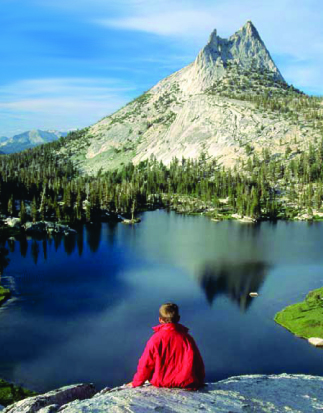
Absorbing experiences bring us face-to-face with nature. The observer and the observed become united—and only then is true knowing and love awakened in the observer’s heart. John Muir said that the content of the human soul contains the whole world. The deeper purpose of experiential learning is to broaden our experience of life and include other realities as our own. When one is immersed in nature, Muir said, the “body vanishes and the freed soul goes abroad.” Only by expanding our sense of identity beyond our physical body and egoic self can we commune with distant horizons, brightly colored songbirds, and countless other delights.
When people are quiet and receptive, fully immersed in nature, insights on the real purpose of life reveal themselves. David Blanchette is a teacher at the Punahou School on Oahu Island, Hawaii, where every year he leads his 13-year-old students on an inspirational nature walk along a remote and wild coastline. Below are some of his students’ thoughts about life and nature after playing reflective, experiential Sharing Nature activities like “Expanding Circles,” “Trail of Beauty,” and the “John Muir Game”:
• It made me feel like I was actually a part of the sand and ocean.
• I was a calm ocean wave gently rolling towards the shore. I was the reef, feeling the cool water roll over me.
• I felt euphoria. I felt like I was one with everything around me.
• It felt powerful, yet peaceful. Every part of me is moving and flowing in harmony.
• Watching the turtle swim carefree reminded me that I have nothing to worry about.
• You really live when you take time to notice your surroundings.
• If you find beauty within the world you can find it within yourself.
Jessica, one of David’s students, wanted to express her appreciation for the ocean, so she gratefully wrote “thank you” in the sand—and let the ocean waves embrace her sentiment and take it into itself.
Fostering in others beautiful human qualities of humility, respect, love, and joyful harmony with one’s environment outside and inside of oneself—as expressed by the Hawaiian students—is what nature education is really about.
 Becoming Good Stewards
A teacher in the Southwest once asked the children in his class to draw a picture of themselves. He recalled, “The American children completely covered the paper with a drawing of their body, but my Navajo students drew themselves differently. They made their bodies much smaller and included the nearby mountains, canyon walls, and dry desert washes. To the Navajo, the environment is as much a part of who they are as are their own arms and legs.” The understanding that we are a part of something larger than ourselves is nature’s greatest gift. With it, our sense of identity expands and, by extension, so does our compassion for all things.
In order to create a society that truly reveres the natural world, we must offer its citizens life-changing experiences in nature. Saint Teresa of Avila said, “The soul in its ecstatic state grasps in an instant more truth than can be arrived at by months, or even years, of painstaking thought and study.” One moment of deeply entering into nature can inspire in us new attitudes and priorities in life that would take years to develop.
When people feel immersed and absorbed in the natural world, they are learning the highest that nature has to offer—because nature herself is their teacher.
Joseph Cornell is the author of the highly acclaimed Sharing Nature book series and is the founder and president of Sharing Nature Worldwide. You are welcome to reprint this article with prior permission from Sharing Nature Worldwide. You can find out more about Sharing Nature activities and resources at www.sharingnature. com or 530-478-7650. Contact Joseph Cornell at info@sharingnature.com.
by editor | Dec 19, 2016 | Learning Standards, Learning Theory
Maria’s Eye: How do we empower it to engage and understand her world?
by Jim Martin
CLEARING writer and contributor
 f I could imagine the best possible classroom in the world, it would be one in which each student is empowered to look out into the world, see something which catches her attention, then know what to do to find out about it. Students engaged, involved, invested, and empowered in their world. My mind’s eye expresses this dream as one of a salmon fry darting quickly into a thick growth of periphyton on a fist-sized cobble, as Maria’s eye turns up and the corner of her mouth sets its sails toward a smile. That, not checking off a cell in a table, is the moment of learning that we teach for. That tells us that all is going to work out; we’ll accomplish this unit, and be ready for the next; empowered to accomplish whatever comes down the road.
How do we recognize that moment, and what do we follow it up with? So far, all of the work on science standards hasn’t clarified an answer to that question. Go to the Next Generation Science Standards (NGSS) website (http://www.nextgenscience.org/) and look for teachers’ resources. And for teachers’ in-service opportunities. What do you find that is cognizant of how teaching and learning actually happen? That offers in-service training on using active learning to engage students in self-directed inquiry. Perhaps we need to work on this ourselves.
How did Maria’s eye get to the place where it turned into anticipation, and an incipient smile expressed a clear message that she was on the way to understanding? Something in her environment invited Maria to explore a concept, and her brain did the rest. Something her teacher anticipated and organized within her students’ work environment so they would engage it. Not a simple thing to do. It takes knowledge, time, confidence, and experience to do this well. And competent mentors. (For about twenty years, I did science inquiry workshops for teachers which began with a casual observation that I hoped would lead participants to notice something. Each time, to the very last I did, this is the moment I felt that this time, it wouldn’t work. Each time it did, and my experience was the thing I relied on the most to trust it would. Takes courage! And experience.)
When students engage the real world, the one outside the classroom, and discover questions embedded in what they find, that process turns on their brain, engages the prefrontal cortex (pfc), and real learning begins. When they do this in partnerships or groups, the medial pfc adds to that learning power by engaging the negotiation of meaning with its power derived from the social interactions involved in exploring, then recognizing a question. Quickly, the whole brain becomes actively involved, and new conceptual understandings are reinforced in long term memory. Can teachers learn to use this wonderful, built-in resource?
How can environmental educators help get them out here? How do we get departments of education (unwieldy bureaucracies) and legislators to recognize the need and support it. Perhaps we can pilot a project which first describes what teachers need in order to appreciate and understand how active learning works, and why. Then provides the in-service support teachers need to feel confident with the content they are teaching, and comfortable with all aspects of delivering content via active learning.
There are educators who routinely use active learning to deliver content – environmental educators. They teach in places which are interesting, and where students can initiate learnings with real-world, concrete objects. A good way to start a learning activity by engaging the brain, especially the pfc. A nice five-to-ten day summer workshop, followed by mentored field trips to nail down specific learnings. What might this pilot look like?
Some teachers are already delivering content via competent active learning. A large number of environmental educators are doing the same. What if we could gather a few of each for a few hours to discuss the idea of helping teachers become comfortable with active learning, and comfortable integrating and aligning their deliveries to their state’s content standards? There are large regional environmental education learning centers which have the infrastructure to support workshops. A collaboration between teachers, environmental educators, and environmental learning centers might have the capacity to deliver a pilot project. I like to think in terms of the long run, so add a comment that this would be a three-to-five year pilot in which initial participants would, where feasible, mentor new teachers each year, periodically review progress and tweak the project, and present their work and findings at annual teacher and environmental education conferences.
It doesn’t take many people to make positive change. I’ve learned over the decades that they simply have to start.
This is a regular feature by CLEARING “master teacher” Jim Martin that explores how environmental educators can help classroom teachers get away from the pressure to teach to the standardized tests, and how teachers can gain the confidence to go into the world outside of their classrooms for a substantial piece of their curricula. See the other installments here, or search Categories for “Jim Martin.”

by editor | Dec 19, 2016 | Learning Theory
A Pedagogy for Ecology
by Ann Pelo
 s a teacher, I want to foster in children an ecological identity. I believe this identity, born in a particular place, opens children to a broader connection with the Earth; love for a specific place makes possible love for other places. An ecological identity allows us to experience the Earth as our home ground, and leaves us determined to live in honorable relationship with our planet.
We live in a culture that dismisses the significance of an ecological identity, a culture that encourages us to move around from place to place and that posits that we make home by the simple fact of habitation, rather than by intimate connection to the land, the sky, the air. Any place can become home, we’re told. Which means, really, that no place is home.
This is a dangerous view. It leads to a way of living on the Earth that is exploitative and destructive. When no place is home, we don’t mind so much when roads are bulldozed into wilderness forests to make logging easy. When no place is home, a dammed river is regrettable, but not a devastating blow to the heart. When no place is home, eating food grown thousands of miles away is normal, and it is easier to ignore the cost to the planet of processing and shipping it.
Finding a Place
Our work as teachers is to help children to braid their identities together with the place where they live by calling their attention to the air, the sky, the cracks in the sidewalk where the Earth bursts out of its cement cage. For me, teaching in a childcare program in Seattle located next to a canal that links Lake Union and Puget Sound, “place” means the smell of just-fallen cedar boughs and salty, piquant air, the sweet tartness of blackberries (and the scratch of blackberry thorns), the light gray of near-constant clouds, the rough-voiced calls of seagulls, and the rumble of boat engines. It is exhilarating to offer children this place as home ground.
Other places are less compelling as home ground. What does it mean to do this work of connecting children to place when the immediate environment numbs rather than delights the senses? What can we embrace in a school neighborhood dominated by concrete, cars, and convenience stores?
Children’s worlds are small, detailed places—the crack in the sidewalk receives their full attention, as does the earthworm flipping over and over on the pavement after rainfall. Children have access to elements of the natural world that many adults don’t acknowledge. When we, like the children, tune ourselves more finely, we find the natural world waiting for us: cycles of light and dark, the feel and scent of the air, the particularities of the sky—these are elements of the natural world that can begin to anchor us in a place.
Rather than contribute to a sense of disconnection from place by writing off the environments around our most urban schools as unsalvageable or not worth knowing, teachers can instill in children an attitude of attention to the natural world in their neighborhoods. The sense of care for and connection to place becomes the foundation for a critical examination of how that place has been degraded. Rick Bass, in The Book of Yaak, describes his experience of the interplay between love of place and willingness to see the human damage done to that place: “As it became my home, the wounds that were being inflicted upon it—the insults—became my own.”
Every child lives someplace. And that someplace begins to matter when we invite children to know where they are and to participate in the unfolding life of that place—they come to know the changes in the light and the feel of the air, and participate in a community of people who speak of such things.
Cultivating an Ecological Identity
Children know how to live intimately in place; they allow themselves to be imprinted by place. They give themselves over to the natural world, throwing endless rocks into a river, digging holes that go on forever, poking sticks into slivers of dirt in pavement, finding their way up the orneriest tree. They learn about place with their bodies and hearts. We can underscore that intuited, sensual, experiential knowledge by fostering a conscious knowledge of place.
How do we cultivate a love of place in young children’s hearts and minds, moving beyond the tenets of recycling to intimate connection with their home ground? From my experiences as a childcare teacher, I’ve distilled a handful of principles.
• Walk the land.
• Learn the names.
• Embrace sensuality.
• Explore new perspectives.
• Learn the stories.
• Tell the stories.
My primary work is as a teacher in a full-day, year-round childcare program in an urban Seattle neighborhood that serves families privileged by race, class, and education. I’ve also worked closely with teachers and children in urban Head Start programs. The principles I suggest resonate in these widely varying contexts; all children deserve home ground.
Walk the Land
Contemporary U.S. culture is about novelty and fast-moving entertainment: a million television channels to surf, and news stories that flash bright and burn out fast. This disposition to move quickly and look superficially translates to a lack of authentic engagement with the Earth: Get to as many national parks as we can in a two-week vacation, drive to a scenic view, take some photos, and drive to the next place.
As teachers, we must be mindful of this cultural disposition to superficial knowledge. It’s easy to fall into the habit of aiming for novelty, offering children many brief encounters with places, experiences that leave them familiar with the surface, but not the depths. Instead, we ought to invite children to look below the surface, to move slowly, to know a place deeply.
For many years, my emphasis in planning summer field trips was to get to as many city parks and beaches as I could. Each week, we’d head out to two or three different places, so that by the end of the summer we’d taken a grand tour of the city. I thought that by visiting a range of places in Seattle, the children would come to know their city. We had a hoot on those trips, but each place was a first encounter, and offered novelty rather than intimacy. The children came away from those summers not so much with a sense of place as with confusion about how these various places fit together to make up their home ground. We’d skimmed the surface of Seattle, but didn’t know its depths.
Now, my emphasis has shifted. I plan regular visits to the same two or three places over the course of a year. Spending time at the same park and the same beach, we see it change throughout the year. I point out landmarks on the beach to help the children track the tide’s movement up and down the beach. At the park, we choose a couple of trees that we visit regularly; we take photos and sketch them to help us notice the nuances of their seasonal cycles. From the top of a big rock at the park, the children play with their shadows on the ground below, noticing how shadow and light change over the year. The children greet the rhododendron bushes like dear old friends, and know the best places to find beetles and slugs.
My commitment to walking the land consciously with children has changed how I walk with them to the park in our neighborhood. I used to focus our walk on getting there efficiently and safely, and chose our route accordingly. Now, I’ve charted a longer route, one that takes us past a neighbor’s yard full of rosemary and lavender and tall wild grasses. We take our time walking past this plot of earth, and I coach the children to point out what they notice about this familiar place. I worried that the children would become bored, walking the same path every day, or would stop seeing the land, so I developed several rituals for our walk. We pause at the rosemary to monitor changes in its fragrance, buds, and foliage, and to watch for the arrival of spit bugs, whose foamy nests delight the children. We pause at the wild grass to compare its growth to the children’s growth, an inexact but joyfully chaotic measurement.
Learn the Names
When we talk about the natural world, we often speak in generalities, using categorical names to describe what we see: “a bird,” “a butterfly,” “a tree.” We are unpracticed observers, clumsy in our seeing, quick to lump a wide range of individuals into broad, indistinct groups. These generalities are a barrier to intimacy: a bird is a bird is any bird, not this red-winged blackbird, here on the dogwood branch, singing its unique song.
Most of us don’t have much of a repertoire of plant, insect, animal, tree, or bird names; I sure don’t. For many years, I wasn’t particularly interested in learning the names of the flora and fauna, and imagined that learning the names would be a chore, a tedious exercise in memorization. When I turned 40 and visited Utah’s red rock desert, it awakened me to a passionate love, born in my eastern Washington childhood, which I’d forgotten, or never consciously acknowledged: love for a spacious, uncluttered horizon, love for dirt, rock, and sage, for heat and dust and stars, for open sky. Being there taught me that learning the names is an exercise in love. I was in an entirely unfamiliar place, and had only the clumsiest of generic names for what I encountered: a bush, a rock, a lizard. As I began to fall in love with the red rock desert, I wanted to know everything about it, including the names it holds. I bought a field guide and began to learn the names—the identities—of the plants, the creatures, the types of rock. Each name was a step closer into relationship. The names helped me locate myself in the desert.
I carry a field guide to the Pacific Northwest with me now, when I’m out with the children in my group. We take it with us when we walk to the school playground around the corner, and when we go farther afield. We turn to it when we encounter a bug we don’t recognize or find an unfamiliar creature revealed by a low tide. And I’ve created lotto and matching games from the field guide, photocopying images of familiar trees, birds, marine creatures. We use the images for matching games and bingo games: Together, we’re learning the names of this place that is our shared home ground.
Embrace Sensuality
In a culture that values intellect more than intuition or emotion, typical environmental education too often emphasizes facts and information in lieu of experience. Plenty of plastic animals, nature games, videos, and books for children invite them to intellectualize—and commodify—the natural world. Teacher resource catalogues offer activity books and games that teach about endangered species, rain forest destruction, pollution, and recycling. These books and games keep the natural world at a distance.
To foster a love for place, we must engage our bodies and our hearts—as well as our minds—in a specific place. Intellectual and critical knowledge needs a foundation of sensual awareness, and, for very young children, sensual awareness is the starting place for other learning. How does the air feel on your skin? What birds do you hear on the playground?
A friend of mine taught in a Head Start program in a housing development that had been the scene of several shootings, and that had more graffiti than green. She wrestled with how to stir children’s numbed senses awake in that harsh landscape where playing outdoors was dangerous. She decided to bring the sensual natural world into her classroom. She added cedar twigs to the sand table, and chestnuts, and stems of lavender. She included pinecones and seashells in the collection of play dough toys. She supplemented her drama area with baskets of rocks and shells, and included tree limbs, driftwood, stumps, and big rocks in her block area. She played CDs of birds native to the Northwest. And in early fall each year, she welcomed the children to her program with feasts of ripe blackberries, making jam and cobbler with the children, telling them about her adventures picking the blackberries in a wild bramble in the alley behind her apartment building.
Explore New Perspectives
Living in a place over time can breed a sense of familiarity, and familiarity can easily slip into a belief that we’ve got the land figured out. We stop expecting to be surprised, to be jolted into new ways of seeing; we become detached from the vitality of a place.
Our challenge is to see with new eyes, to look at the familiar as though we’re seeing it for the first time. When we look closely and allow ourselves to be surprised by unexpected details and new insights, we develop an authenticity and humility in our experience of place, and wake up to its mysteries and delights.
Several years ago, one of the 4-year-old children in my group posed a simple question: Why do the leaves change color? Her question startled me awake: I saw the transformation of color through her eyes, a phenomenon consciously witnessed only once or twice in her young life, and one full of mystery and magic. Her question deserved my full attention, not a recital of the muddled information that I remembered from my science classes in school, and not a quick glance at an encyclopedia. Madeline’s question launched our group on an in-depth study of the lives of leaves that carried us through the seasons.
My co-teacher, Sandra, and I took the children on a walk through the neighborhood to study the trees. Moving from one tree to the next, we began to see a pattern, and shared our observation with the children: the leaves on the outermost branches began to change color before the leaves in the center of the tree. The children built on our observation, adding what they’d noticed: The leaves first changed color on their outermost edges, while the center of the leaves remained green. I suggested that we gather leaves to bring back to our room, where we could study them up close and record what we observed, sketching the details that we saw and adding nuances of color with watercolor paint. As we sketched the lines of the leaves, children pointed out the resemblance between the skeletal lines of leaves—the “bones” of a leaf, the children called them—and the tendons and lines on our hands: “The lines of the leaf feel like human bones.” “The lines are like the lines on our hands.” Excited by the children’s observations, I suggested that we sketch our hands, just as we’d sketched the leaves, knowing that our sketching would help us see ourselves in new ways, as cousins to leaves.
As we sketched, I asked the children to reflect on why the leaves change color in the autumn. “What is it about autumn that makes leaves change from green to red, orange, brown?” The children generated several theories: “In the fall, it’s cold. Leaves huddle together on the ground to get warm. The trees are cold because they don’t have any leaves to keep them warm.” “The color is a coat to keep the leaves warm, because it’s cold in the fall.”
From this analysis, one child made a leap that deepened our conversation: “Leaves get sad when they start to die.” From this decidedly unscientific conjecture, the children forged a potent connection to the leaves: “Like we give comfort to others when they’re sad, the plant needs comfort.” “I think a hug would help a leaf, and being with the leaf.” “Maybe you could stay with it. You just give it comfort before it dies.” “When it drops on the ground, that’s when it needs you.”
At Hilltop, we use an emergent pedagogy, developing curriculum from the children’s questions and pursuits. In our study of the lives of leaves, I experienced the value of this pedagogy, as we lingered with questions, theories, and counter-theories, and with our not knowing. Our emergent curriculum framework allowed us to explore Madeline’s question in the spirit in which it was posed: a question about the meaning of change and the identity of leaves. Through our exploration, we became intimates of leaves, anchored in our place.
Learn the Stories
To foster an intimate relationship with place, we need to know the stories and histories that are linked to that place, just as we do in our intimate relationships with people. In our work with young children, our focus in gathering these stories is as much about the children’s imaginings as it is about scientific facts. We can invite their conjectures to complement the facts, opening the door to heartfelt connections.
Visiting a Head Start program one afternoon, I watched Natalie catch ants on the asphalt slab that served as the program’s playground. She hovered over a crack in the pavement, carefully picking up each ant that crawled from the crack and dropping it into a bucket. Curious about her intention, I asked what she was planning for the ants: “They’re bugs and we hafta kill them.” I imagined contexts in her life in which this could be true: Had her family dealt with invasive insects at home? Had she experienced the pain of bee stings and itch of mosquito bites? I wanted respectfully to acknowledge these sorts of experiences, yet I didn’t want them to become her only references for understanding and relating to the natural world. I said, “Sometimes, when bugs come into our houses, we have to kill them to keep ourselves healthy. And some bugs can bite us in painful ways. But sometimes we don’t have to worry so much about the bugs we find. I’m curious about these ants. Where do you suppose they come from?”
Natalie was quick to imagine the ants’ story: “The ants are in the hole talking. If they hear loud noises, they won’t come out. We have to be very quiet! If they see us, they stay in because they’re scared. When one ant wasn’t looking, I got him! I’m faster than them—that’s how I catch them.”
“What’s in the hole that the ants come from?” I asked.
“Maybe their family,” Natalie mused. I offered her a clipboard and a pen, and invited her to draw what she imagined was in the hole. She began to sketch, talking aloud as she worked: “They’re a family. They talk to each other and bring food to their baby. In the house, there’s food and a table and a bed and a seat.”
Natalie stopped drawing to look into her bucket: “There’s 15 ants in the bucket! That’s more than one family. That’s a lot of families. They share one house in the hole. The ants come not fast because they’re talking, saying their plan to come out to see what’s outside. They want to find their family that’s in the bucket. The ants in the bucket want to get out of the bucket and go to their family.”
Natalie abruptly dumped the bucket upside down next to the crack in the pavement, and tapped it on its bottom. “Go home, ants! Go to your home. Go to your family.”
When I invited Natalie to imagine the ants’ story it helped her see her bucket from the inside as well as from above, and shifted her relationships with the ants. She moved from a defensive posture to that of being a protector. Particularly for children living in places where the natural world is degraded or dangerous, imagining the stories of a place can inspire new possibilities; it casts children into an active role as people who care about and take action on behalf of a place.
Tell the Stories
We’re often encouraged to see the Earth as landscape, which is scenery—something to look at, but not to participate in. But when we collapse the distance between the land and ourselves and allow ourselves to become part of the story of a place, we give ourselves over to intimacy. This can be our work with young children—weaving them into the story of the place where they live.
One way I’ve begun trying to link the children to the land is by using observable markers anchored in place to measure our lives. “You’ll start kindergarten in the fall, when the blackberries are ripe.” “Christmas comes in the darkest part of winter, when the sun sets while we’re still at school, and the sun doesn’t rise until we’re back at school the next morning.”
And I’ve been playing a game with the children that I learned from Richard Louv’s book, Last Child in the Woods, “The Sound of a Creature Not Stirring.” We listen for the sounds we don’t hear (a leaf changing color, an earthworm moving through the soil, blackberries ripening)—a way to focus our attention on the Earth around us and to participate in what’s happening in it.
A Foundation for Action
In The Pine Island Paradox: Making Connections in a Disconnected World, Kathleen Dean Moore writes, “Loving isn’t just a state of being, it’s a way of acting in the world. Love isn’t a sort of bliss, it’s a kind of work. . . . Obligation grows from love. It is the natural shape of caring.” She writes: “To love a person or a place is to take responsibility for its well-being.”
From love grows action. In my work with young children, I share stories of local environmental activists who have used their love of place to fuel their action. For example, I tell the story of a group of children and their families who launched a campaign to save the cedar tree at the school playground where we often play.
Children have loved the cedar tree at Coe School for a long time; children played at this tree even before you were born. One year, a mom was at a community meeting and learned that the city park department was planning to cut down the tree because it was damaging the asphalt on the playground with its big roots. She told the children in her daughter’s kindergarten class, and those children and their families decided that they had to work to protect the cedar tree and to help the park department find another way to fix the problem of broken asphalt. The children and their families wrote letters to the city workers, telling them about how much they loved the cedar tree, and sharing their ideas for taking good care of the tree and the pavement on the playground. They had a meeting with the city workers, who hadn’t known that the tree was important to the children. After the meeting, the city workers decided not to cut down the tree; they made a plan with the children and their families and the other kids at Coe School about how they could work together to fix the asphalt and take care of the tree.
I watch for opportunities for the children to add their own chapters to the story of activism on behalf of beloved places. I want them to see themselves as part of a community of people anchored by fierce and determined love of place and who take responsibility for its well-being.
The poet Mary Oliver instructs us on how to open the natural world to children: “Teach the children. Show them daisies and the pale hepatica. Teach them the taste of sassafras and wintergreen. The lives of the blue sailors, mallow, sunbursts, the moccasin flowers. And the frisky ones—inkberry, lamb’s quarters, blueberries. And the aromatic ones—rosemary, oregano. Give them peppermint to put in their pockets as they go to school. Give them the fields and the woods and the possibility of the world salvaged from the lords of profit. Stand them in the stream, head them upstream, rejoice as they learn to love this green space they live in, its sticks and leaves and then the silent, beautiful blossoms. Attention is the beginning of devotion.”
And devotion is the beginning of action.
 Ann Pelo is a teacher educator, program consultant, and author whose primary work focuses on reflective pedagogical practice, social justice and ecological teaching and learning, and the art of mentoring. She is the author of five books, including The Goodness of Rain: Developing an Ecological Identify in Young Children; Rethinking Early Childhood Education/ and The Language of Art: Inquiry-based Studio Practices in Early Childhood Settings.
This article is reprinted with permission from A People’s Curriculum for the Earth: Teaching Climate Change and the Environmental Crisis, edited by Bill Bigelow and Tim Swinehart. Available from www.rethinkingschools.org.

by editor | Nov 22, 2016 | Learning Theory
Understanding Ecosystems is a Real Need:
Will we help today’s kids learn what they ought to know about ecosystems?
by Jim Martin
CLEARING Writer and Contributor
 ids in school today, and their children, need to understand ecosystems, and their own place within them. And teachers need to possess the capacity to ensure this can be accomplished. A recent study published in Science, (Vol. 351, Issue 6274, 12 February 2016, pp. 664-665) indicates that US teachers are not adequately prepared to teach about global warming in any detail; nor, for many, with confidence that it is even happening, or is caused by human activities. And, how many know with confidence how local ecosystems will respond to global warming? This is, I submit, knowledge and understanding that our students need. As important as technical and engineering knowledge and understanding, which receives far more attention in our society than ecosystems.
 This is a poor state of affairs. Ecosystems aren’t simple; nor is global warming. How many teachers, or citizens for that matter, know that the Earth’s current orbital position and ‘wobble’ about its axis indicate that we should be in a long cooling, not a warming, period? How many know the length of these periods during Earth’s journey around the Sun? Or their effect on ecosystems; ecosystems which support all life on Earth. Not to mention the human population explosion, which is the driver of much of this warming process. How many teachers spend quality time each year on these topics? How many feel free to do so? They need help. And help is what we can offer them.
How can our teachers bring themselves up to date on the complexities and importance of global warming? What resources do they have available? If you were to check the New Generation Science Standards (NGSS) web site, you might be surprised. I just checked the Oregon Department of Education’s web site, and found nothing in the teacher resources section that could be used to support student learnings about ecosystems, global warming, or the human population explosion. The NGSS web site has the same paucity of resources for teachers, although they do note that some resources will be forthcoming. NGSS and the National Science Teachers Association web sites offer resources like worksheets and ties to the standards for the content the worksheets cover, but there is nothing I can find that offers teachers without strong backgrounds in science an opportunity for in-service training which will prepare them to teach ecosystems so that they are understandable. The same is true for the in-service support teachers need to attain the conceptual understandings which underlie competent teaching. We, the people who teach, or have taught, in our classrooms are the ones who will have to do this work. We need to start.
I submit that this state of affairs means the NGSS (and CCSS) need to become more expressive; to become useful, descriptive, aids that teachers can rely on to support their efforts in teaching a complex environmental curriculum. We can’t ask the federal or state education organizations to do this, but we can do it ourselves. Taking it one step at a time. Environmental educators know their sites and the science and math involved in understanding them. They may not currently discover and use the curricula which is embedded within their sites. This is where those teachers who, together, have this experience can help. Environmental educators and teachers, working together to exploit curricula which is embedded in natural environments. To learn about ecosystems. What if a few teachers and environmental educators got together to talk about how they could work together to use a study of ecosystems as a vehicle to drive curriculum in other content areas? A conversation in which they cover broad topics students would need to work with in order to learn about ecosystems, coupled with conversation about particulars of other content areas that could be integrated into the study of ecosystems.
 For instance, while studying a forest ecosystem, students at any grade level could count the number of each species of tree they find. Then, depending on their math capacity, they could draw a representative of each of the tree species, with the size of each kind based on its population count. They can add the numbers counted to get the total trees counted. They could subtract the number of the first species from the total; then the second, and on to the last. What is left? They can develop fractions and do the division built into a fraction’s structure, to calculate the decimal fraction which says the same thing. They could multiply each divided fraction by one hundred to calculate the percent that kind of tree is of the whole. They could use the counted numbers of trees, their total and the number of each species, in an equation to calculate species diversity. That’s just a smattering of the math curricula embedded in one activity in a natural area. And the concomitant standards embedded there along with them. How do teachers take these pieces of math to a larger mosaic which enables students to attain the conceptual understandings which prepare them to deal with global warming and ecosystems? What can you imagine for all of the other content areas taught in your schools? What we teach is in and of the real world, that place outside the classroom. Can we use it to learn?
Would you be interested in engaging a substantive conversation about how environmental educators and teachers can work together to do a better job of teaching mandated curricula while building students’ knowledge and understandings of ecosystems? If you’d like to contribute to a conversation on this theme, you might write an article for Clearing, write a comment in the space below, start a conversation where you are, or decide to try this yourself. If teachers know environmental educators, or environmental educators know teachers, you can present the concept at environmental education and teacher annual conferences. For myself, I’ll continue to write on this theme. And contact my regional environmental and teacher organizations to suggest it. We all need to do something. The kids need that.
Jim and Dryas Martin 604 E. 28th St. Vancouver, WA 98663 berrywd@teleport.com home.teleport.com/~berrywd/index.htm
This is a regular feature by CLEARING “master teacher” Jim Martin that explores how environmental educators can help classroom teachers get away from the pressure to teach to the standardized tests, and how teachers can gain the confidence to go into the world outside of their classrooms for a substantial piece of their curricula. See the other installments here, or search Categories for “Jim Martin.”
by editor | Aug 18, 2016 | Learning Theory
Chymograph
by Jim Martin·
kymograph (‘wave writer’): a device that produces traces on a piece of smoked paper clamped onto a rotating drum, a mechanically amplified graphical representation of spatial position over time, such as the rise and fall of a worm’s blood vessel as pulses of blood travel through it. Invented by Carl Ludwig in the mid-1800’s, it consists of a revolving drum wrapped with a sheet of smoked paper on which a stylus connected to the tissue being measured moves up and down, recording changes of motion. (Adapted from Turtles, all the way down: A scrapbook about various hacks and obscure topics.
Chymograph
beautiful
clear grey skin
a touch of blue
the blade reaches deep
line unfolds
reveals skin has edges
and depth
beneath the line
aortic arches pulse
beat out the rhythm
of life
vibrant
vital
vivacious
determined to live
to live
Life
bursts from the wound
an emotional visual
physical
blow to my mind
my soul
can I
because I teach
sacrifice this life
so a line may be scratched
on a piece of smoked paper
❧
Early in my teaching career, I was demonstrating how to set up a chymograph to measure the pulse rate of blood as it was pumped through an angle worm’s dorsal aorta. The set up was simple, but had to be done with great care. Students in the lab class would then introduce their worms to water baths at various temperatures and measure the worms’ response to these environments via changes in pulse rate.
I made the incision along the worm’s long back, exposing the pulsing aortic arches, five blood vessels that pumped blood from the long ventral vein up to the dorsal aorta. These arches perform the same function as our heart, and may represent an ancient step in the ultimate development of the mammalian heart.
As the pulsing arches were exposed, I saw the worm very clearly, not as Lumbricus terrestris, the common angle worm, but as a living being, determined to continue to live at any cost; I saw life itself, and its right to its own existence, and remarked on this to the class. The beauty and persistence of life. An odd comment from a zoology teacher who was showing students how to kill an animal to learn about it.
My life took an unexpected turn at that moment; both my teaching and my personal life. At the time, I was in the early stages of starting to deal with my experiences in the Gulf of Tonkin, where I learned that some human lives were sacrosanct, others were not. I asked then, and still do now, ‘How does a life, valued and valuable, just and humane where it lives, become valueless and inhumane to those who live elsewhere?’ Is there some connection between this human phenomenon and how conceptions of deities and heavens change with changes in time, culture, and circumstances? Experiencing the worm, I began a long transition in my view of life.
The analog line the worm’s pulse traced on the chymograph’s slowly rotating smoked paper was thin and eloquent, instructive and inspiring; its own cognitive beauty. The ‘heart’ was marking its own course, its own activity, its own life and demise. Surely this is a worthy thing to contemplate, reflect upon, and to refocus one’s thoughts and beliefs about life on Earth.
The very first thing that wavering line did was to expand my view of life, to consider it to be more than the lives of humans, their worth and rights. I had a clear cognitive understanding of the evolution of life from the components of cells to cells to multicellular life, but had never personally considered the thought that these lives of all creatures were lived, that they persisted until they could persist no more. My view now began to include the right of all living things to their lives, including human living things.
Because we need to eat, the facts of ecology and nutrition were a stumbling block for awhile, until I realized that all things are in the process of becoming other things. They have to do this in order to live; a paradox built right into the fact of life on Earth.
One thing has seemed to me to separate how humans go about this business of living from the way of all other life. Each living and non-living thing in every ecosystem goes about its work with integrity. They don’t cheat, so, together, they produce a remarkably efficient and effective economy. We don’t exercise this ethical integrity, and create endless problems for the rest of life on Earth. Confucius spoke the only realistic solution to this human dilemma when he suggested we know ourselves, our inner selves, and remain true to that person; doing this he knew we would learn we should treat others as we would wish to be treated ourselves. And so, I began to concentrate on learning to do this, to know myself and to know others; not their externals, but the person deep within.
That person is difficult to miss once you’ve learned to locate it. Eventually, you recognize patterns, and come to the certain understanding that we’re all people, just people. That sets everything straight.
I began to appreciate the relevance of Dryas’ [the author’s late wife — ED.] inclusive spirituality, her sense of the personal and spiritual connection among all living things. The scientist in me needed mechanisms, and continued to look for them, but I could not deny the strength and universal relevance of the spirit that I began to perceive which pervaded all living beings. And I began a search for how humans have perceived this during all of their history in Earth; I continue to try to make sense of our search for spirituality and the traps that are built into being human which impede and disrupt that search. Since we can never know for certain, we are all searchers.
My teaching began to organize itself so that I and my students could observe intact organisms while doing them little or no harm. For instance, you can hold an angle worm still (try it on a moist paper towel) and count the pulses as each bolus (blob) of blood moves down the dorsal aorta. Time them or count how many there are per minute. This provided information about the worm’s response to temperature as useful as that gained from the chymograph. After all was done, the worm went out into the yard. The effect of this change in direction was to focus my students on the organism they were studying, and not on the instruments they might use to make their observations. They began to notice behaviors and other relevant phenomena associated with the environmental perturbations they introduced their subjects to. And I, in turn, turned my focus to the students’ behaviors and relevant phenomena while they went about their work and their thinking. In the end, I learned more from them than I ever did in my education and inservice coursework.
I discovered that organizing my delivery so that students come into my classroom to become scientists did more to involve and invest them in their educations, and empower them as persons, than coming in to learn about science, and being tested on it, ever did. They began to focus on following up on the needs-to-know that their inquiries generated, rather than getting the right answer, then forgetting immediately after the test. And so they carried the weight of their learning, while I busied myself getting reference works on the shelves, providing lab particulars they needed, and so forth. My lectures, which were good ones, were reduced to small mini-lectures, often delivered at a lab table, in response to questions students posed. I recall one sunny afternoon, walking through the lab as the class worked away, wondering what I had done to my stable world of lecture, lab, exam.
And so where does this take me in responding to my original concern about my right to take a life so that a line may be scratched. If I truly respect all life, can I sacrifice an animal’s life in order to know more about it? How about a plant’s life? A paramecium’s? Are there circumstances where this is ethically permissible? I’m not an ethecist, but I think that any time my only resort is to use a life to learn what may be applied to the benefit of others, I must look upon it as a sacrifice and ensure that whatever is done is humane, is as it would be done with a human.
Fortunately, we managed to eliminate these sacrifices in my curricula without short-changing my students’ understandings about the phenomena they studied. In the process, I’ve learned to find the person behind the outward appearances we learn to attend to, the inner light that shines in each of us, that holds our hopes and aspirations, that wants to be recognized and appreciated, and which recognizes and appreciates others.
I’m still working on the insight an angle worm gave me forty years ago. I know from my personal experience that it does no harm to communicate directly with the person who lives at the heart of each of us. And that it usually helps us all relax and appreciate one another’s company on the road we all travel. Together, whether we acknowledge it or not.
When next you see an angle worm, look carefully on its back for a long, dark line. Observe it carefully, and you’ll see either a recognizable pulse, or the line will fade and reappear on a regular schedule. When you see it, you’ll know that its aortic arches are doing exactly what your heart is doing for you. And for the rest of us.
❧

 This is a regular feature by CLEARING “master teacher” Jim Martin that explores how environmental educators can help classroom teachers get away from the pressure to teach to the standardized tests, and how teachers can gain the confidence to go into the world outside of their classrooms for a substantial piece of their curricula. See the other installments here, or search Categories for “Jim Martin.”