
by editor | Jul 17, 2014 | STEM
2014 E3 Green Apple Award Winners
Using Links as Labs: First Green Connects Kids, Classrooms and Golf Courses

Glenwood Golf Course Superintendent Steve Kealy helps students measure water flow of a stream running through the course as part of the First Green Environmental Education Program.
 As the United States seeks to meet the rising need for graduates with STEM (Science, Technology, Engineering and Math) degrees, First Green is filling the gap with its innovative program of using golf courses as learning labs. First Green coordinates outdoor STEM “learning labs” at golf courses that allow students to perform hands-on experiments and tests, all within the focus of their schools’ environmental science and/or environmental horticulture curricula. In these outdoor “labs” students test water quality, collect soil samples, identify plants, do math activities and work with local issues such as stream-bed or owl-nest restoration.

Superintendent Steve Kealy helps student find macroinvertebrates in leaf litter from the golf course.
Many of the field trips involve community organizations. In Bellevue, Wash., the city’s Stream Team often has a learning station at Glendale Country Club’s field trips and engages students in identifying macro-invertebrates (bugs) from the Glendale pond. In addition, a Puget Sound area group, Nature Vision, provides a salmon life cycle lab.
 A 501(c)(3) tax-exempt foundation, First Green was founded in 1997 and is based in Bellevue, Wash. Over 15,000 students have been on First Green field trips. Each field trip reaches an estimated 230 people with environmental and golf messages (due to students sharing with friends and families and teachers sharing with colleagues. First Green has replicated the program across Washington and into other states – Oregon, California, New Jersey, New York, Utah, Colorado, and just launched a program in Western Canada in May 2014.
Support
First Green receives ongoing support from the Washington State Golf Association, Pacific Northwest Golf Association, golf clubs and individual donors.
In addition, First Green was awarded STEM (Science, Technology, Engineering and Mathematics) grants of $155,750 and $100,000 by the United States Golf Association (USGA) for 2014 and 2013. The grants are funded by the USGA’s partnership with Chevron, designed to encourage students in science, technology, engineering and math disciplines (STEM) through the world of golf.
Awards
 First Green was awarded a 2014 E3 Washington Green Apple Award for Business Excellence. Steve Kealy, Golf Course Superintendent and First Green Board member, accepted the award at a ceremony on June 26, 2014.
For More Information
For more information about First Green, visit www.thefirstgreen.org or call 425/746-0809. The media contacts are Cathy Relyea, email cathyrelyea@thefirstgreen.org or call 425/373-9915; and Jeff Shelley, email jeffs@cybergolf.com or call 206/522-6981.

by editor | Jun 24, 2014 | K-12 Classroom Resources

First graders at St. John the Baptist School observe the beautiful flowers that have developed from the seedlings they planted a year ago
Gardens Grow Minds: The School as Green Educator
by Mary Quattlebaum
“We have a garden! With flowers and butterflies!” The third graders beam as they describe their wildlife garden during my author visit to St. John the Baptist (SJB) School in Maryland.
I thought about their enthusiasm and the dedicated teachers and parent volunteer, Mary Phillips, I met that day as I researched and wrote Jo MacDonald Had a Garden. How best to convey a child’s joy in digging and planting while offering teachers and parents helpful information on starting and/or teaching with a school or backyard garden?
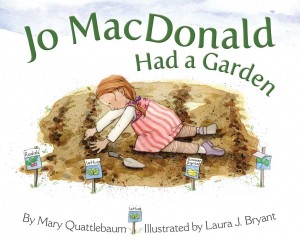 These days, schools, such as SJB, can be the venues best positioned for nurturing a child’s wonder in the natural world. I grew up with a dad who shared his curiosity about nature with his seven kids and umpteen grandkids and showed us how to garden. (He’s the model for Old MacDonald, Jo’s grandfather, in my book, which is an eco-friendly riff on the popular song “Old MacDonald Had a Farm.”)
But in today’s fast-paced, busy world and with diminishing green spaces, these “growing experiences” and “life lessons” may be missing from childhood.
Happily, SJB seems to be part of a national trend, with an increasing number of schools adding an “outdoor classroom” to the traditional learning environment. At the National Wildlife Federation (NWF), Senior Coordinator Nicole Rousmaniere, who manages school programs, shared recent statistics. More than 4200 schools have started schoolyard habitats that help sustain regional wildlife, she says, with an additional 300 to 400 being added yearly.
Rousmaniere emphasizes that commitment rather than size is the key to an effective “green education” from school gardens. Small can be powerful. Having children plant and care for native plants in containers or in a little patch beside a school can foster lessons in biology and stewardship. Indoor “green” activities pique youngsters’ interest in learning and doing even more. (Dawn has such activities online and in the back of all its children’s books, including Jo MacDonald Had a Garden.)
“Kids love a garden, but you’ve got to start them young,” says William Moss, a master gardener and horticultural educator. Advocating for school and small-space gardening, Moss writes the popular “Moss in the City” blog for the National Gardening Association, hosts HGTV’s “Dig In” and is a greening contributor to “The Early Show” on CBS.
Just about any subject can be taught through a garden, says Moss, including science, math, natural history, geography, nutrition, reading and writing.
A garden offers hands-on and experiential learning, says Phillips, the parent volunteer who helped SJB’s science teacher to create the school garden three years ago. Phillips has seen teachers use the garden to teach units on pollination, history, the food chain and the ozone. Her blog www.theabundantbackyard.com showcases student art inspired by the garden and by the art teacher’s lessons on Georgia O’Keefe’s flower paintings. An added bonus, says Phillips, is that the garden, in addition to enriching academic studies and creative expression, also stimulates the brain, enhances sensory awareness and gets kids outdoors for some exercise.
I thought of all these points so beautifully articulated by Moss, Phillips and Rousmaniere as I researched and wrote Jo MacDonald Had a Garden. My hope, along with illustrator Laura Bryant’s, was not only to playfully introduce youngsters to wiggling worms, fluttering birds and growing plants but to make it easy for teachers and parents to build on basic lessons.
School gardens can be the start of a learning experience that grows over a lifetime. As NWF’s Rousmaniere points out, just as schools teach the 3 R’s, so, too, they might provide a setting that connects children with and increases their knowledge about the natural world. One of the most important lessons to learn young is stewardship, says Rousmaniere, the idea that we are all caretakers of the earth and its wild inhabitants.
Resources for Starting and Learning from a School Garden
William Moss, horticultural educator www.wemoss.org
National Gardening Association www.kidsgardening.org
National Wildlife Federation www.nwf.org
Mary Phillips, school garden advocate www.theabundantbackyard.com
Mary Quattlebaum is the author of Jo MacDonald Had a Garden and numerous other children’s books. She and her family enjoy watching the birds, bugs and other wild creatures that visit their urban backyard habitat. www.maryquattlebaum.com


by editor | Jan 3, 2014 | K-12 Classroom Resources
NATURAL TEACHERS: 10 Ways You Can Add Vitamin “N” to your Classroom & Beyond.
from the Children and Nature Network website
http://blog.childrenandnature.org/2013/03/23/natural-teachers-10-ways-you-can-add-vitamin-n-to-your-classroom-beyond/

by editor | Jan 2, 2014 | K-12 Classroom Resources
We need to provide opportunities for students to establish connections with the natural world, to be in awe of its power and beauty.
 t was February 2012 in northwestern Ontario. I was in teachers college and my outdoor, environmental education cohort was on a winter camping trip. Cold winds blew outside, but inside of our cabin it was cozy as my peers snuggled up under blankets, ready for story time. I was about to share with them Stuart McLean’s “Burd”, a short-story from the author’s Home from the Vinyl Café.
“Burd” tells the story of Dave, a second hand record store owner, who becomes a reluctant new birder when an unexpected visitor begins to frequent Dave’s backyard birdfeeder. The visitor is a summer tanager, completely off-course from its usual winter habitat of Mexico or Brazil. Dave comes to cherish the time he spends with his bird; waking up early to feed the bird, and coming home from work at lunch so that the bird does not go hungry. When, on an early May morning, Dave discovers that his bird has left, he is heartbroken and hopes she will return next winter.
“Burd”, in its simple way, speaks to the pain and gratification that can come with the beauty and wonder of the natural world. Can you recall a time when the natural world overwhelmed you? Have you ever felt in awe of the beauty of nature? Have you sat in salutation to the sun, or in quiet reverence to the river? Has nature left you speechless? When I posed these questions to my peers, in anticipation of reading “Burd”, they shared stories about thunder storms and the stars. Of canoe trips that they wished had never ended. One friend talked about that moment at night when you roll over in bed and catch a glimpse of the full moon outside your window. Magic moments, courtesy of our natural world.
But what about heartbreak? Nature provides those moments too. As educators of environmental literacy we can all surely reflect back on moments of loss, as something from the natural world was taken from us. It may have been as small as returning to your childhood home to find that the tall birch tree in your front yard had been cut down. Or it might be bigger – those lost fights against short-term gains and corporate interests that take away our rivers, our lakes, and our forests.
Does this sense of loss have a place in our classrooms? Indeed it is our students’ generation that is going to be handed the consequences of greed and inaction – rising sea levels, frequent and severe natural disasters, a complete disconnect from the natural world. If we continue down our current path, their losses will be far greater than anything we have experienced.
And yet, a feeling of loss necessitates that a connection has been established in the first place. In a world where children and adults alike are spending increasingly less time outdoors, these connections to the natural world are precious. For every story we have of loss, we each have a million more of those little moments of taking time for nature – time to be in awe, to slow down and find connection. If it weren’t for these moments, we wouldn’t be working as hard as we are to ensure a healthy and sustainable future for our children. The environmental movement wouldn’t exist. Dave’s summer tanager may not have survived an unplanned Canadian winter.
It is moments to build connection, awe, and wonder then that we must help create for our students. Moments that connect our students to the natural world, for not only is time in nature good for them, but they will then be good to the natural world. We can share our own experiences and the experiences of others, like Dave’s romance with a bird. But we must also provide opportunities for our students to have their own experiences – to establish connections with the natural world, to be in awe of its power and beauty. We know this already, it is why we seek out resources like CLEARING to inspire us to rely less on our four-walled classroom.
The most powerful story I can share, of my own experience creating space for awe, is from a most unlikely place: a suburban Grade 8 classroom. It was mid-December, the air was chilly, the sky was clear, and anticipation was building…snow would be coming soon. And sure enough it did, just as I started an afternoon lesson on local hunger issues. I didn’t notice the snow at first, but rather the sudden excitement on students’ faces as they began whispering and furtively pointing to the window. I looked outside and there it was – the first snow of the year! Big, beautiful snowflakes whipping around outside of the window.
I had two choices: as a student teacher I could maintain “classroom order”, aware that my teacher advisor was evaluating me, or I could allow space for awe. I chose the latter: “It’s snowing – look outside!” And then my students cheered. Suddenly, without any prompt from me, they ran to the window and cheered for snow. I cheered with them and also made a promise to myself: if I was ever lucky enough to be in front of a classroom again when snow fell for the first time outside, my class would bundle up, run outside, and lift our faces to the sky.
I made this promise because the first snow only happens once a year. Because nature has a way of spontaneously providing beautiful and powerful teaching moments, with no lesson plan required. And because these are the moments that students remember, and are the reason us educators do the work that we do.
Dave was heartbroken when his bird left. Not only had he lost a bird that he had come to care for, but he had also lost that very real connection to the natural world. In a world that is continually spinning faster and faster, Dave had found something small and vulnerable to focus on and to care for. He had been gifted with a reason to sit and watch nature – and to wonder. Why did this bird come to his backyard, of all places? How did it get there? Would it return? Dave did not know all of the answers and that was okay, because the answers were not what mattered. What mattered was that Dave knew how his bird looked in warm sunlight, and from what direction she flew in from the hedge to be fed. That is the beauty of “Burd” –it makes you want to go outside, sit by a bird feeder, and see what happens.
Let us make a promise to ourselves that as educators we will allow more time for awe. For wonder. For connection. That we will consider it a lesson well done if all our students do is sit by a bird feeder to see what happens.
Kim McCrory is a certified teacher and experienced outdoor educator from Ontario, but now calls Victoria, British Columbia home. Kim works for Sierra Club BC as the organization’s environmental educator, traveling the province to reconnect students with the wild products of our Temperate Rainforest.
Bibiliography
McLean, Stuart. 1998. Home from the Vinyl Café. Toronto, ON: Viking by Penguin Books Canada Ltd. P. 256. ISBN 0-14-027743-9.
by editor | Apr 11, 2013 | Environmental Literacy, Forest Education, Learning Theory, Outdoor education and Outdoor School

…at Starker Forests
Helping students climb the ladder to responsible citizenship
by Dick Powell
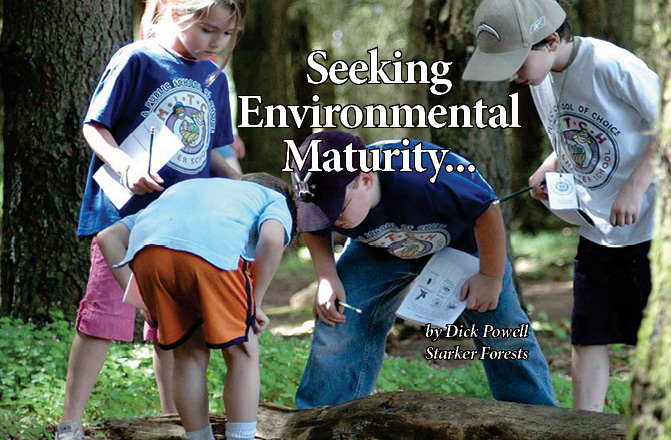
This past summer I attended the World Forestry Center’s International Educator’s Institute (IEI). As an environmental educator without any formal pedagogical or interpretive training, I found this week-long workshop enlightening and very worthwhile.
The part of IEI that I found most useful was called the “Pedagogic Steps in Environmental Maturity.” It validated what we’ve been doing.
Read the article here. (From the 2012 CLEARING Compendium).

