by editor | Sep 18, 2025 | Adventure Learning, Conservation & Sustainability, Critical Thinking, Data Collection, Environmental Literacy, Experiential Learning, Forest Education, Inquiry, Student research, Sustainability, Teaching Science
Expeditionary Learning: Exploring Healthy Forests
By Val McKern and Greg Goodnight
What is a healthy forest? That is the question that Kettle Falls Elementary School fourth graders have been grappling with all winter. In order to examine this question, fourth grade teachers Sally James, Sydney Potestio and Judy Galli have designed an expedition with carefully scaffolded projects for their students. Through these in-depth, service-learning projects, students have been engaged in reading, writing, math, science, social studies and technology. In Kettle Falls we firmly believe that it takes a village to educate a child and we count on a cross curricular approach of teachers and many experts to make any expedition a success for our students. Our priority is creating engaging expeditions that have rigorous learning for ALL students.
Kettle Falls Elementary: an expeditionary learning school
An expedition is the format Kettle Falls Elementary uses to combine adventure and service with learning state standards. Each expedition has standards strategically embedded in fieldwork. The healthy forest expedition will combine many “I can” learning targets based on state standards, with snowshoeing, animal tracking, trail cameras and forestry. In the end, students will deliver PowerPoint presentations to the North East Washington Forestry Coalition (NEWFC) as an authentic audience for their service learning work product. The expedition will provide an exciting and adventurous outlet for student learning and assessments on rigorous state standards. As an Expeditionary Learning School, Kettle Falls Elementary believes that expeditions are the primary way of organizing curriculum.
The subject matter of a learning expedition is a compelling topic derived from content standards. Expeditions feature linked projects that require students to construct deep understandings and skill and to create products for real audiences. Learning Expeditions support critical literacy, character development, create a sense of adventure, spark curiosity and foster an ethic of service. They allow for and encourage the authentic integration of disciplines. (Expeditionary Learning Schools Core Practice Benchmarks p.8.)
 This learning expedition began as all expeditions begin at Kettle Falls Elementary. The staff went through a careful study of the new Washington State standards and determined the “priority standards” at each grade level. The standards are then written as long-term learning targets. Once these standards were determined, teams researched case studies that could become the focus of the learning expeditions. The life science standards addressed focused on life cycles, animal structures and behaviors, food webs, ecosystems and human impacts as the center of the expedition.
Literacy is embedded with in the expedition. Priority learning targets are written based on the standards of reading and writing. Reading comprehension strategies and the traits of writing are the focus of these targets. A content map is designed that assigns long term learning targets to each of three expeditions through out the school year. Each expedition runs for eight to twelve weeks.
Learning targets are at the heart of our work. There is clear criteria for posting and referencing learning targets school-wide. Long- term targets, project targets, and scaffolding steps are organized so that students can track their achievement during the daily debrief. We emphasize “learning together, but assessing independently.” Anchor charts that hold the thinking of the class are posted near the targets. The anchor charts will collect information that makes the learning target clear, whether it is knowledge or meta-cognitive thinking. All students are independently assessed on all learning targets.
Kettle Falls Elementary as a 21st Century School
Expeditionary Learning Schools set an expectation for service and authentic work. Kettle Falls Elementary teachers create expeditions that foster service in authentic ways.
Benchmark 3: B. Authentic Audiences
1. Products often meet an authentic need and have an audience and purpose beyond families or the classroom teacher.
2. Some of the products are particularly motivating because in themselves they are acts of service.
(Expeditionary Learning Schools Core Practice Benchmarks p.13.)
We are a Learn and Serve Grant recipient, which has helped us focus on the service aspect of our expeditions. This grant gave teachers release time to write rigorous expeditions and make the community contacts necessary for authentic service. It also supported the expedition through fieldwork and materials for a new expedition.
We knew that this expedition was an outstanding opportunity to educate our students in sustainable education. It meets many of Jaimie P. Cloud’s EfS Frameworks:
Responsible Local/Global Citizenship — The rights, responsibilities, and actions associated with leadership and participation toward healthy and sustainable communities. Students will know and understand these rights and responsibilities and assume their roles of leadership and participation.
Healthy Commons — That upon which we all depend and for which we are all responsible. Students will be able to recognize and value the vital importance of the Commons in our lives, their communities, and the places in which they live.
Multiple Perspectives — The perspectives, life experiences, and cultures of others, as well as our own. Student will know, understand, value and draw from multiple perspectives to co-create with divers stakeholders shared and evolving visions and actions in the service of a healthy and sustainable future locally and globally.
A Sense of Place — The strong connection to the place in which one lives. Students will recognize and value the interrelation- ships between the social, ecological and architectural history of that place and contribute to its continuous health. (Cloud, p. 172-173.)
The North East Washington Forestry Coalition (NEWFC) agreed to partner with Kettle Falls Elementary School. This expedition reaches each of these components of Cloud’s framework. It is the basis of an expedition with an authentic purpose, service, purposeful fieldwork, multiple perspectives and rigorous content.
 Kettle Falls Elementary Bangs monitoring project
Three KFE classes will be engaged in a hands- on learning experience that includes in-class preparation and learning and fieldwork designed to teach them about the life cycles of natural systems, sustainable resource management, and community collaboration. The project will include wildlife, tree, and plant monitoring within the Bangs Mountain Wildland Urban Interface project on the Colville National Forest, as well as presentations and instruction from school and community experts in the field and in the classroom, including members of the Northeast Washington Forestry Coalition. The students will work with the Coalition to complete a final report in the form of a PowerPoint presentation, documenting their monitoring work and educational experience with photos and written reporting. The final report may be posted on the Coalition’s web site, and a final press release may be prepared for local newspapers to share the outcome of the project with the broader community. Derrick Knowles, Education Outreach, NEWFC.
NEWFC is a local organization that believes in demonstrating the full potential of restoration forestry to enhance healthy forests, public safety, and community economic vitality. Because Kettle Falls is community that relies on the timber industry to survive, we wanted to create an expedition that would have many viewpoints. We felt that NEWFC would have the multiple perspectives within the organization that would make our study to compelling to students and community members, since NEWFC is comprised of members who come from the timber industry to those in Conservation Northwest. Our students are seeing that there is not one “right” answer to their question of “What makes a healthy forest?”
Kettle Falls Elementary fourth grade expedition: the stories tracks tell
Case Study One: Indicator Species of Bangs Mountain
Our Learn and Serve Grant gave a team of six staff members the opportunity to participate in a SEA (Service, Education and Adventure) training this fall. This adventure included learning to track with Tom Murphy of Edmonds Community College and the LEAF (Learn-n-serve Environmental Anthropology Field) school. This so engaged the teachers that we were determined to give our students the same opportunity. Murphy was able to create an alterna- tive winter course that brought 12 college students to Kettle Falls for a week. During that time, the LEAF school taught the students how to recognize tracks and gaits of our local animals. The focus was on five animals: whitetail deer, turkey, snowshoe hare, lynx and coyote. These animals were chosen with help from the Forest Service because of their status as indicator species for the Bang’s Mountain area. Students spent time in the forest that week, learning to track, photograph tracks, and measure tracks. They also learned to set trail cameras along trails in order to capture photos of the elusive animals.
Students from Kettle Falls High School Wildlife class with teacher Jono Esvelt participated in each of these activities sup porting the fourth graders throughout this expedition. They also took on the task of writing “field guides” for the fourth graders to use in their work.
This project focused on the learning targets of
- I can independently sort animals by the structures and behaviors that help them survive in their environment.
- I can independently list 4 parts of an animal and describe how the parts help the animal meet its basic needs.
- I can independently generalize from multiple forms of text to learn about forest animals.
- I can independently elaborate using details and/or examples about one forest animal.
- I can edit for capitals against the class capitalization chart.
Students learned about each animal through predicting structures and behaviors by analyzing a collage of photos and You Tube videos. Predictions were recorded before reading field guides and predictions were confirmed or not. Once the recording sheets were completed, the students wrote expository papers on the survival structures and behaviors of each animal. These were combined to create PowerPoint slides that will be included in their final product, some with actual photos of the tracks or animals that were photographed at the Bangs Mountain site. The good news was that some animals were captured by the trail cams, but some remained elusive!
Case Study Two: Food Webs of Bangs Mountain
This project really focused on the interdependences within the forest ecosystem. Learning targets in this investigation focused on giving students the knowledge to be able to complete the narrative prompt:
You are a wildlife biologist researching animals on Bangs Mountain. One of your jobs is to report to the community of Kettle Falls the stories the animal tracks of an indicator species told you while doing your fieldwork. To do this you will need to describe where the tracks were found and your inferences of what the tracks are telling you about that animal’s daily life:
- I can describe the interdependences in a forest ecosystem.
- I can explain how a forest ecosystem impacts animal population.
- I can independently generalize from multiple forms of text to learn about forest ecosystems.
- I can write a narrative with a clear beginning, two events and a clear ending.
In order to make this narrative realistic students needed to understand the actual role of a wildlife biologist. Learning about careers while in engaging expeditions opens our students’ eyes to the world of possibilities. Students continued their fieldwork, checking their trail cams, snag counts (their first monitoring experience), searching for tracks and other sign of life in their plots and were prepared for snowshoeing (though there simply wasn’t enough snow for them this year). Using the reading skill of “generalizing to understand” helped student comprehend the interdependence of the forest and was built through reading, photography, experts, media, data and many simulation games. After each activity students recorded “new learning” on anchor charts that build the content schema. They also recorded their use of the skill “generalizing” on anchor charts to show their ability to be meta-cognitive about comprehending new material. Students were able to use the information gathered from the multiple sources to write their narrative.
Case Study Three: Bangs Mountain as a Changing Ecosystem
Now that the students have developed a level of knowledge about the interdependence of forests they are ready to move on to the changing ecosystem. This is when they really become experts and begin to look at the many stakeholders of the forest. Their fieldwork becomes very data based. Through skill building in P.E. they learn about pacing. Each child is responsible for pacing off 104 feet, using a compass to keep their lines straight, they determine a half acre plot for their team. They use a tape to measure their accuracy after pacing and the corners are marked on the GPS so that their plot can be found on Google Earth. Students are now collecting data on the canopy by measuring open and covered areas. They have learned to use transect lines during their monitoring. This data is part of the baseline that will be used in the study. They identified three plants in the understory and did a plant count of their plot. Their study of the animals in their plot also continued, with data from tracks and trail cam photos. The most common track and photo taken was squirrels, though they are not one of the indicator species. Students found little evidence of the lynx at their plot. Animal population changes will be one indicator of increased health of the forest over time.
During this project students learned about many changes that can happen to forests over time. The learning targets for this project are:
- I can independently describe how onepopulation may affect other plants and/or animals in the forest ecosystem.
- I can independently evaluate one population in different forests, determine which will thrive and give clear reasons.
- I can independently describe three ways that humans can improve the health of the forest ecosystem.
- I can independently assess the author’s effectiveness for a chosen audience.
- I can independently organize my writing.
This means:
- I will write an introduction, supporting details using examples, and conclusion in an expository writing.
Each day of this project focuses on a change in the forest ecosystem. Some are changes that have taken place at the Bangs Mountain Project and some are changes that could eventually happen. All students receive the same reading each day, but they read the articles for a different purpose: natural or man-made changes, population changes, or gradual or rapid changes. Each student becomes an “expert” on their article. The students then “jigsaw” their articles once they have recorded the important information. The student experts then share out in small groups, creating a real need for students to comprehend and analyze their text. Special Education and Title I students are pre-loaded with vocabulary and content before the article increasing their ability to fully participate while in class. Once the information has been analyzed students come together to complete anchor charts where they record the changes and determine if human impact was positive or negative. They also determine the author’s purpose and if the author was successful in delivering their message.
By the end of this case study they have a thorough understanding of thinning, prescription fires, recreation management, forest flu and other healthy management issues.
We believe that reading is only one vehicle to understanding new ideas. Fieldwork, media and experts are also key components to creating powerful learning tools. Experts from the timber industry, Forest Service, Conservation NorthWest, and Department of Fish and Wildlife have all volunteered to work with our students, ensuring that students are learning realworld applications of the knowledge. Each of these experts will not only share their expertise on managing forests and their per- sonal perspectives of what makes a healthy forest, but also about their careers.
The students will complete this project with a simulation from Project Learning Tree, “The 400 Acre Wood.” Students will determine the actions taken to manage a forest much like their plots on the Bangs Mountain Project. This project has a balance of Vibrant Economy, Healthy Environment, and Equitable Society, as recommended by The Sustainable Design Project Teacher Manual. (Wheeler, Bergsman, Thumlert 2008.)
 The Final Presentation of “What is a Healthy Forest?”
The final project is a culmination of all of the data that the students have collected while completing this project. Data is compiled in a variety of ways. The ani- mal monitoring is a graph of the sightings caught on the trail cams, the plant monitor- ing is a graph as well, both done on Excel. The canopy is drafted on graph paper, indicating the cover and open space. There is also the map from Google Earth, indicating each plot for future reference and to gauge changes over time. This work is gathered in a Power Point to be presented to NEWFC at a future meeting.
Kettle Falls Elementary: expeditionary learning and 21st century intertwined
Our students had the opportunity to become engaged in their local forest, gathering a respect for the land, observing the interdependence and understanding the decisions made by others that use our forests. Students were able to meet rigorous learning targets and assessed independently on each target. They collaborated to create authentic projects that reach beyond their school walls.
The expedition included many different modes of learning during this project that are key to Heidi Hayes Jacobs’ Tenets for Purposeful Debate leading to Content Upgrades:
- • A personal and local perspective is developed and presented in the content area, where natural and viable.
- • The whole child’s academic, emotional, physical and mental development is thoughtfully considered in content choices.
- • The possibilities for future career and work options are developed with an eye to creative an imaginative directions.
- • The disciplines are viewed dynamically and rigorously as growing and integrat- ing in real-world practice.
- • Technology and media are used to expand possible sources of content so that active as well as static materials are included. (Jacobs p 31).
Through compelling expeditions students at KFES achieve many 21st century outcomes. Students build strong habits of work, through both performance (traits that enable students to perform to their potential) and personal relationships (traits that enable students to be good people and community members). They are motivated to learn. Students believe that they have the ability to meet their targets, have clear targets that they can self-assess their progress against, and are connected to their school through the work they do. We believe that academic achievement is increased when students are engaged in learning. Through authentic expeditions like “The Stories Tracks Tell” students build life and career skills. Real world problems increase students’ critical thinking and problem solving skills. The use of technology opens the classroom to wider world, with meaningful examples of the work our students are doing. Our students increase their understanding of 21st century themes such as environmental literacy. (Hulleman, Hartl & Ciani 2009). Through compelling expeditions our students are engaged, supported and held accountable to high standards.
References
Hulleman, C., Hartl, S., & Ciani, K. (2009). Character, Motivation, and Engagement in Expeditionary Learning Schools, Review of the Relevant Literature and Available Measurement Instruments. Nellie May Education Foundation. Expeditionary Learning Core Practice Benchmarks (2003). Garrison, NY: Expeditionary Learning Outward Bound.
Jacobs, H. H. (2010). Curriculum 21: Essential Education for a Changing World. Alexandria, VA: ASCD.
Wheeler, G., Bergsman, K., and Thumlert, C. (2008). Sustainable Design Project Teacher Manual. Olympia, WA: Office of the Superintendent of Public Instruction.
Greg Goodnight is superintendent at Kettle Falls School District.
Valerie McKern is principal at Kettle Falls Elementary.

by editor | Oct 26, 2015 | Forest Education
Seeking Environmental Maturity at Starker Forests
Helping students climb the ladder to responsible citizenship
by Richard Powell
 tarker Forests is a family-owned tree farming business of about 80,000 acres, mostly within an hour’s drive in the Coast Range west of Corvallis, OR. For many years, we’ve taken people on trips to the woods. These might be field trips for school children, university students, visiting foresters/scientists from around the world, or the general public. We’ve hosted a number of workshops for teachers.
As our society becomes increasingly urbanized, we see people becoming increasingly unaware of the origins of the things they use in their daily lives. We’ve had high schools students identify their electric hair dryers and modeling clay as not coming from natural resources. A senior remarked that he didn’t know Oregon had rock quarries (apparently the concrete floor we were standing on just magically appeared)! A group of high school students weren’t even sure what natural resources were but thought a dairy cow might be related to natural resources – although, they weren’t sure. As an example of something not related to natural resources, middle school students often point to their classroom’s television.
To become a wise user of natural resources, it is imperative that people understand where things come from. Our intent is to help them re-connect with the natural world and, more specifically, get a better understanding of the forest and the origins of all the wood products they use.
 At the same time, we find people have little sense of the history of a landscape. Students are taught the science of the environment but they do not connect that science with the landscape’s history. We want people to understand that biology and history have worked in tandem to shape what they see; the landscape is a function of both biology and history.
Of the school groups we take on field trips, most come from elementary schools; a few come from middle schools; only rarely, do they come from high school. Being so close to Oregon State University, we do get some university students and we get a lot of people from the general public. We get a number of foreign visitors – foresters, scientists, landowners, etc.
Even though we take many school classes to the woods, we get very little feedback from the teachers. [The best feedback is that most teachers come back year after year.] The absolute best feedback we get is when we see a child a year or two later. It takes very little time for us to realize we’d seen them before and that they remember quite a bit from their earlier field trip.
With adult groups, we commonly hear someone remark how a forester has to know about and care for so much more than just the trees. Sometimes, we’ll hear someone say they have to re-think what they know about forests and forestry. Now and then, they’ll remark how they still don’t like some of the things we do in forestry but they begin to understand there is a reason for what we do and it is based on science – it is not just about the money.
Though we take around 2000 people a year to the woods, we are foresters; we are not trained in pedagogy. For years, we’ve had a nagging question: is what we’re doing working? Do people “get” what we are trying to teach? Does any of this stick with them for the long term? Or, are we wasting our time and money?
This past summer, I attended the World Forestry Center’s International Educator’s Institute (IEI). As an environmental educator without any formal pedagogical or interpretive training, I found this week-long workshop enlightening and very worthwhile.
The part of IEI that I found most useful was called the “Pedagogic Steps in Environmental Maturity”. It validated what we’re doing.
 In essence, the “Steps” is a ladder and, to get to the top rung (i.e., “Environmental Maturity”), one has to climb up from the rung below. For example, it would be futile to talk to someone in Swahili if they had not first learned and become fluent in that language. Without that prior knowledge, we’d quickly see a bunch of glazed-over stares and we’d find we’re pretty much wasting everyone’s time.
Step #1 — Learn to enjoy the outdoors.
Just get people outdoors. Adults enjoy a nice drive or hike in the woods. Take the kids hiking or camping or go canoeing on the neighborhood pond or river. Let them have fun. We’ve always felt people had a good time, but, did they learn anything from their field trip and did any of that learning stay with them?
Step #2 — Experience and observe nature.
Smell the flowers, feel the sun’s warmth, or get soaked on a cold, rainy day. Explore around a beaver pond and see where the beavers had burrowed into the bank to build their dens; look for a tree’s stump or a branch the beavers had chewed. Have people simply stop, close their eyes, and listen; it is incredible what they’ll hear for the very first time. In a few minutes time, people will never become an expert at identifying a tree but we can get them to see that the leaders, buds, needles, color, feel, bark, flowers, smell, taste, pollen, etc. vary greatly between tree species (no, they do not all have pine cones nor do they all have pine needles).
Step #3 — Understand the ecological web.
Now that we have them outdoors, they are having fun, and beginning to experience and see things, they can begin to understand what they see. Pick up and look at and feel a handful of dirt. As they see and feel the litter layer, moss, worm holes, roots, bugs, fungi, moisture, texture, etc. they begin to understand it is not dirt at all – it is soil! (Dirt is what we wash off our hands before lunch; soil is the good stuff.) Likewise, they can sample the water’s pH, dissolved oxygen, and temperature and see how those might affect the macro-invertebrates in the water. They can see a tree’s cross-section and associate the narrow growth rings with a dense forest canopy or maybe see that the wider rings are due to a more open canopy.
Once they’ve seen the differing buds, leaders, bark, leaves, etc., they can begin to see how some tree species are similar while others are different. They can begin to group similar trees into a genus, name those groups and the individual species, and begin to understand a tree.
Step #4 — Understand the interplay of man and nature.
Yes, we play in nature and we like to see and experience nature. But, more than that, nature is the source of life’s very existence! Nature provides the air, nutrients, energy, and moisture required by all life forms on the planet. Take away any one of these and life ceases to exist; alter any one and life is changed. This is the food chain. Or, put another way, life is totally dependent on the extraction and use of natural resources for its very existence.
In addition to the food chain, nature is the source of everything people use. Iron, sulfur, wood, cotton, plastic, gasoline, concrete, clothing, electricity, coal, food – in some way, all of our wants and needs are extracted from the environment.
Looking back at those tree rings, maybe they can see how those narrow rings became wider. This was likely due to opening up the canopy by either a natural means (a tree died or blew over in a storm) or the forest had been thinned.
Step #5 — Make decisions on environmental issues.
This step is one we really wrestle with. We know there are a lot of controversial issues over the use of natural resources so we strive to just stick with the science and the history of the land – on these, there should be little controversy. [Unless asked, we endeavor to keep our biases or personal philosophies/opinions to ourselves.] As Project Learning Tree says, we’d rather “teach how to think, not what to think”. We’d prefer to let people take what they saw and learned and make their own decisions.
Step #6 — Be responsible for the future.
We’d hope, after going out and experiencing the woods, our visitors are better able to make more informed and better choices. With choices comes responsibility and this would be the perfect time for a community service project.
As a practical matter, we see most people for just a brief time and it is hard for us to do steps 5 and 6 with them. With students, we hope to plant some seeds that, during the course of the school year, the teacher can help germinate and grow. With that, the students may make some decisions and then take responsibility.
That said, we’ve sponsored Tree Planting Day annually for more than twenty years. We take a harvested unit, make sure it is safe, there is a reasonable traffic flow, etc. and then invite youth and their parents to come out and plant a few trees. We’ve had as many as 400 youngsters and 200 parents on a Saturday morning though 140 youngsters and 90 parents is more the norm. They have fun (step #1); we do this rain or shine and, usually, in the mud (step #2); they plant little seedlings that, hopefully, will grow into large trees (step #3); it’s on a unit that was harvested for all the products made from wood (step #4). Further, they’ve chosen to spend a Saturday morning in the cold, rain, and mud (step #5) and help ensure that that harvested unit is reforested (step #6).
 A few months ago, we took a pre-school class to the woods; these were three and four-year olds. Other than having a good time (step #1), what could these little guys possibly get from a mile-long hike in the woods; could they even get above that first step?
A few days after their field trip, I had a wonderful surprise delivered to my desk. There was a nice poster with a picture of me kneeling down and surrounded by the kids; I was showing them a stick some beavers had chewed on. Concentric, brown circles drawn around this picture gave this poster the appearance of a tree’s cross-section.
The good part was on the backside of the poster. The teachers evidently sat down with the kids to debrief and find out/reinforce what the kids had learned.
“We made duck, cougar, bear, beaver, and a raccoon print”. [Some years ago, we made some “sand boxes” across the road so kids could make animal tracks with some rubber prints.] — Step #1
“The bear foot print was the biggest; we heard birds; we learned a fir cone; we saw lots of trees”. — Step #2
“We count the rings of the tree to find out the age of the tree; trees need water; if trees don’t have water, they will not grow; trees need sun, water, air, just like us”. — Step #3
“We saw the letter ‘S’ on trees. ‘S’ trees were dead”. — [This particular plantation was on ground that had been burned around 1850 and, post-settlement, it was a pasture. We’d planted this pasture and, since it had not previously been a forest and there were no large trees, snags, downed logs, stumps, etc. for wildlife habitat, we created some snags when we thinned this forest. To help people see these snags, we’d painted an ‘S’ on several snags.] — Step #4
We were truly amazed how much these three and four-year olds took home from their mile-long hike. We were especially pleased their teachers had followed up with their students. Their comments in step #3 were especially gratifying.
About a month and a half later, a parent/teacher sent me a note. Her son was one of those pre-school students and he was still talking about this field trip!
It would have been nice if they had gotten to steps 5 and 6 but that would be quite a lot to ask of a three or four-year old.
Richard Powell is the Public Outreach Forester for Starker Forests, Inc., in Philomath, Oregon.

by editor | Oct 25, 2015 | Forest Education
Environmental Leadership: Making Connections
Two service-learning programs within the Environmental Leadership Program at the University of Oregon aim to deepen students’ knowledge of their bioregion through day-long, hands-on field trips.
By Kathryn A. Lynch, Environmental Leadership Program, University of Oregon
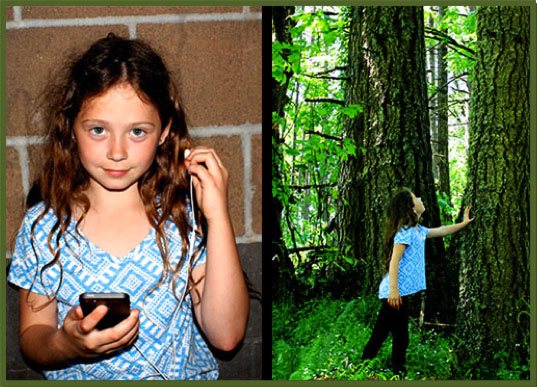
 hildren and young adults are often more tuned into the screens in front of them than the landscape surrounding them; when asked which direction is north their inclination is to check their smartphones. In response, the Environmental Leadership Program at the University of Oregon is developing environmental education projects seeking to reconnect children to nature.
The Environmental Leadership Program (ELP) is an interdisciplinary service-learning program housed in the University of Oregon’s Environmental Studies Program. Our mission is to provide undergraduates with an integrative capstone experience, our graduate students with project management experience, while engaging with the community to address real needs.
Since 2001, ELP has developed and implemented 81 projects addressing a wide array of topics. Currently, our projects fall within four primary tracks: environmental education, conservation science, sustainable practices, and community engagement.
The two main goals of our environmental education teams are to: 1) provide UO students the knowledge, skills and confidence to develop and implement place-based, experiential programs; and 2) develop age-appropriate, engaging curricula for local youth, grades K-8, that promotes the stewardship of our natural world.
During winter and spring of 2015, our two environmental education teams focused on the theme of “connections.” The new Restoring Connections team worked in partnership with Mt. Pisgah Arboretum and Adams Elementary to develop and implement a place-based curriculum which included an interactive classroom lesson and a field trip to Mt. Pisgah. The team provided over 200 K-2 students an opportunity to develop a deeper understanding of where they live and the importance of conservation and stewardship. The Canopy Connections team worked in partnership with the HJA Experimental Forest and the Pacific Tree Climbing Institute to develop and facilitate an interactive pre-trip lesson and field trip for over 200 middle-schoolers. Students studied forest succession, learned how to use a compass, wrote poetry in field notebooks, and climbed 90 feet into the canopy.
To prepare for their service projects,the undergraduates first enrolled in Environmental Education in Theory & Practice. In this class, they gained a working knowledge of best practices in EE through readings, guest lectures, field trips, and most importantly, their service-learning project in which they developed educational materials for their community partners. While the specifics of the curricula were left up to the teams to determine, all teams were required to: 1) incorporate an interdisciplinary approach, 2) include multicultural perspectives, 3) use experiential, inquiry-based methods, 4) promote civic engagement, and 5) articulate assessment strategies. Their materials were pilot-tested at the end of winter term, and the teams then worked with their community partners to implement their EE programs throughout spring term. Each UO student completed approximately 120 hours of service, which entailed facilitating classroom visits, field trips, and developing supplemental educational materials (e.g. websites, presentations). What follows are descriptions of these projects, written by the team members themselves.
 Case Study 1 –
Restoring Connections: Unplugging and Reconnecting
By Ashley Adelman, Roslyn Braun, Lucas Holladay, Kiki Kruse, Kerry Sheehan, Zoie Wesenberg, and Alicia Kristen (Project Manager).
 s a group of students made their way into the Douglas-fir forest from the oak savanna, a facilitator hushed the group with a “quiet coyote” hand signal. Immediately, everyone hunkered down, peering through the brush as the group tried to get a glimpse of the discovery. A student squealed in delight. The deer was still, its gaze locked onto ours. Having taught our students about the importance of deer ears for hearing predators, they noticed how the deer kept her ears pricked forward, waiting for our next move. The group slowly moved up the hill trying to get a better view. Experiences like this have the ability to enhance the senses like no video game or television show can. Learning about environmental issues at a young age can be overwhelming, but connecting to local nature, students can become more aware of and in tune with the natural world.
In spring 2015, the Environmental Leadership Program launched the Restoring Connections project at Adams Elementary School. Our team of six undergraduates, with the guidance of our graduate project manager, was responsible for the design, creation and implementation of this environmental education curriculum, focusing on Mt. Pisgah Arboretum’s natural ecosystems.
In this pilot year, we focused on kindergarten, first-, and second-grade students. Our goal was to address what Richard Louv calls ‘nature-deficit disorder’ through the creation and implementation of a place-based and experiential educational program. According to Louv, the cultural shift in which many youth now prefer to stay inside interfacing with screens, rather than going outside to play and explore, has resulted in devastating effects on their personal well-being – physically, mentally, and emotionally – in addition to having disastrous repercussions for the environment. How we set about addressing nature-deficit disorder was informed by Howard Gardner’s theory of multiple intelligences and David Sobel’s work, which outlines a framework for age-appropriate content. Working from this theoretical foundation, we knew we wanted to allow students to explore nature first-hand to help them develop a connection to where they lived, and nurture empathy for the plants and animals that share our bioregion. In addition, the structure of our program was influenced by the Tbilisi Declaration (1977), which states that environmental education should foster awareness, provide knowledge, develop skills, and shape attitudes in students so they can effectively participate in environmental decision making and stewardship. This idea of restoring children’s connection to nature, while they participated in restoring the land, was a central idea of the program.
The structure of our Restoring Connections program consisted of a 45-minute classroom visit on Tuesday, followed by an all-day field trip on Thursday. The classroom lessons focused on introducing key concepts, preparing the children for a successful field trip, and most importantly, instilling a sense of excitement and awe for the ‘magical forest’ they would be visiting. The field trip focused on awakening their senses, building connections and empathy, and finally, on giving students an opportunity to be involved in restoration activities.
During the field trip the kinders built elf and fairy homes out of natural materials in the wildflower garden, engaged their visual senses by finding a rainbow of colors, and engaged their auditory senses by using their ‘deer ears’ as they journeyed along the riverbank.
First-grade students explored the oak savanna, discovering how pollinators and native plants interact in this habitat. Students examined an Oregon white oak up close and played games that honed their observation and plant identification skills. The restoration work focused on creating habitat for native wildflowers by pulling invasive shining geranium, and planting native plants. Through this restoration work, students learned about native and non-native species and the importance of stewardship.
Second-grade students explored the Douglas-fir forest, studying concepts of camouflage and adaptation through role play and the study of animal behavior. Their restoration work was centered around building “habitat hotels” for decomposers found in the Douglas-fir forest.
The restoration work connects classroom learning to real-life experiences. By learning the differences between native and non-native plants, our first-grade students discovered the need to care for native species in Oregon. Gaining knowledge about the role of decomposers in the Douglas-fir forest allowed the second-grade students to understand ecosystem functions. These activities provided an example of the impact that they can have on the environment.
Throughout our ten weeks of teaching, over 200 students had the opportunity to visit and explore Mt. Pisgah. As part of our professional development, we were asked to evaluate what worked and what needed to be changed after each interaction, and then make those changes for the following week. Jenny Laxton, the education program coordinator at Mt. Pisgah, provided us with invaluable feedback to help us improve our program to best serve the needs of the Arboretum and Adams students and staff.
The opportunity to complete service work allowed the elementary students and our ELP team the opportunity to take the knowledge and skills we have gained in the classroom and use them in community action. We gained problem-solving and team management skills along with greater knowledge of best practices within environmental education. We were also encouraged to engage in critical self-reflection to improve our final outcomes.
The long term vision for this project is that starting next year, the Restoring Connectionsteam will work with a single cohort of children, from kinder through fifth-grade.This cohort of children will visit Mt. Pisgah Arboretum each season (fall, winter, spring) giving them multiple opportunities to visit, connect, and participate in restoration work. Each grade level will focus on exploring a different habitat located within the Arboretum, with activities geared toward hands on learning. By giving children an opportunity to be outside, learning in nature, we hope this project will deepen their sense of appreciation for the beauty of the natural world and reach those who may not thrive in a classroom setting. By returning each year, the children will gain an understanding of local natural history that cannot be gained through a single visit alone. By involving them in restoration efforts over time, the children will be able to witness the difference their actions have made on the landscape. Overall, Restoring Connections seeks to cultivate a lasting connection to the land, one that is based on reciprocity and respect.
To learn more about our project, please visit:https://blogs.uoregon.edu/restoring
 Case Study 2 –
Canopy Connections: Nurturing Naturalists
By Samantha Bates, Laura Buckmaster, Nicole Hendrix, Forrest Hirsh, Micaela Hyams, Elie Lewis, Amelia Remington, Nick Sloss, Tim Chen (Project Manager).
 ix middle-school students sit silently on a trail in an old-growth forest: one observes a newt run over her feet; another notices how moss and lichen create miniature forests; another writes poetry about the nearby sounds of Lookout Creek. Down the trail, students identify giant Douglas-firs, noting the distinct grooved bark in contrast to the smoother bark of the equally impressive western hemlocks. Using newly-honed plant identification skills, students compare two plots to form hypotheses about what stage of ecological succession they are observing. Further along, students put their compass skills to the test, going on a compass scavenger hunt of sorts, receiving a bearing and seeing if they can find the correct specific tree off the trail. Later, they will sit in a circle surrounded by enormous Douglas-fir, ancient Pacific yew, stringy western redcedar, and drooping western hemlock and draw a map of the forest with the creek as their backdrop. Meanwhile, their friends climb 90 feet into the canopy, finding treasures few ever ascend high enough to discover: dangling Lobaria lichen clinging to branches heavy with the plentiful “roses” of small, papery hemlock cones; licorice ferns growing out of decades-old moss carpets that blanket trees that students now observe from above.
Canopy Connections is in its seventh year. This year our team of eight undergraduates (and one graduate project manager), sought to distinguish ourselves by designing our curriculum around the theme “nurturing naturalists.” Drawing from Gardner’s multiple intelligences, our curriculum caters to multiple ways of knowing and different learning styles. All of our lessons focus on building sensory awareness.
The structure of our Canopy Connections program consisted of a 45-minute classroom pre-field trip visit, followed by an all-day field trip at H.J. Andrews Experimental Forest near Blue River, Oregon. The classroom lessons focused on introducing key concepts and preparing the middle-schoolers for a successful field trip. For the all-day field trip, each class was divided into four groups and rotated through four different stations.
Station 1: Climbing to the Canopy. At this station, students ascend 90 feet into the canopy of an old-growth Douglas-fir tree. Experienced tree climbers from the Pacific Tree Climbing Institute (PTCI) facilitate this activity. Students support one another in their learning about microclimates as they are connected to the ropes one by one and make their way up. While this activity is challenging for some children, the rush of adrenaline often provides them with a hyper sensitivity to their surroundings they might not have appreciated before. Many students leave this activity with a deeper respect for the sheer magnitude and magnificence of a 400-year old Douglas-fir tree.
Station 2: Nature’s Navigators. On the ground, students learned basic map reading and compass skills. Students worked in pairs, and with the help of facilitators, embarked on a compass expedition. Using their compass and species identification cards, they were tasked with locating and identifying four species of trees found in old-growth forests. They later observed the four tree species up close and collaborated to correctly identify them. Students used their new skills and knowledge to create a map of their immediate surroundings.
Station 3: The Life and Layers. At this station, students explored forest succession and disturbance. We introduced the four characteristics of an old-growth forest using the acronym OWLS–old, woody debris, layers, and snags. They then learned to identify several species seen on the forest floor. To paint a picture of how a forest becomes old-growth, we had students read a passage from Ancient Forests of the Pacific Northwest to each other and then look for these signs as they hiked. Through descriptions of nurse logs and pathogenic fungi, they gained an appreciation for the intricate relationships of the forest and began to consider the significance of observation for scientists and writers alike.
We encouraged students to touch the plants, compare, and describe them to each other in order to create detailed records in their field notebooks. Splitting into two groups, they examined plots located in stands of different aged forests, with the goal of using their new knowledge, observation, and recording skills to determine whether they were looking at the 40-year stand or an old-growth stand.
Station 4: Stop, Sit, Scribble. At this station, students practiced their writing skills, imitating the work done by the writers of the Long Term Ecological Reflections (LTER) project, which is designed to collect stories, poems, and essays for 200 years from 2003 to 2203. After listening to The Web, a poem written at HJA by Alison Hawthorne Deming, students followed the guiding principles of the LTER project and spread out on the forest floor to begin writing a stanza for a collaborative poem. They focused on incorporating sensory observation skills and using descriptive adjectives as do the writings collected for the LTER project.
 Although concepts of creative writing and poetry are taught in the lesson, students gain much more than an appreciation for adjectives. They learn collaboration and listening skills, while simultaneously absorbing clues from the natural world: the rush of the river, the smell of coolness in the air, the hundreds of plant species surrounding them. Sensory observation and creative writing connects with the theme of “nurturing naturalists” by bridging the gap between humanities and science.
Throughout Canopy Connection’s eight-week program, over 200 hundred students from four different middle schools participated in field trips. During nine days in the field, we totaled 54 hours of teaching with an 8:1 student-teacher ratio and led nine in-class pre-trip lessons. In addition, we worked in partnership with 23 high-school students from a local AP Environmental Literature class. These students helped us in the field, and we shared insights into going to college as well as being effective environmental stewards. Our team compiled our final curriculum and a final report, and developed a website to display our project. We presented our findings at the Undergraduate Research Symposium, a SMILE workshop at HJA, and an ELP final presentation. Our ultimate mission is positive environmental change stemming from an environmentally-literate younger generation. Many teachers and students have already reached out to express how much our field trip meant to them. To learn more about our project, please visit:
http://elp2015-canopyconnections.weebly.com/
Literature Cited
Deming, Alison Hawthorne. 2007. The Web. Orion Magazine, March/April. http://www.orionmagazine.org/index.php/articles/poem/248/
Gardner, Howard. 2011. Frames of Mind: The Theory of Multiple Intelligences. New York: Basic Books.
Louv, Richard. 2006. Last Child in the Woods. Saving our Children from Nature-Deficit Disorder. NC: Algonquin Books of Chapel Hill.
Norse, Elliott A. 1990. Ancient Forests of the Pacific Northwest. The Wilderness Society. Island Press: Washington D.C.
Sobel, David. 1996. Beyond Ecophobia: Reclaiming the Heart in Nature Education. Nature Literacy Series. Great Barrington, MA: The Orion Society.
Tbilisi Declaration. 1977. Summary of goals and guiding principles. http://www.gdrc.org/uem/ee/tbilisi.html

by editor | Sep 27, 2015 | Forest Education, Outdoor education and Outdoor School
Forest Schools and the Benefits of Unstructured Outdoor Play
 By Deanna Fahey
Miami University, Oxford, Ohio
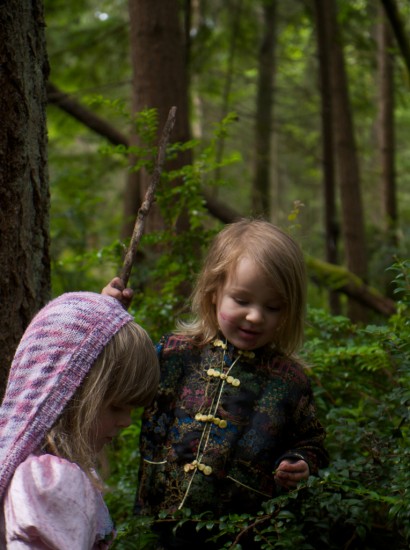
 t is snowing outside and you’re getting your child ready to go to kindergarten. While other children may be wishing for a snow day so they can play in the snow, yours is excited to go to school! Why is your child unique? Your child attends a forest school. Forest schools and nurseries are popping up around the globe and gaining momentum. Though these schools have routines that are wide ranging, they all have a common core: allowing children to experience the freedom of playing outdoors as part of their learning.
ROAD TO DISCOVERY
As a graduate student, parent and nature lover, I questioned why some adults choose to make decisions based on ecological consequences while others do not. After all, in today’s day and age, we all are aware of the consequences of our modern lives on the environment. On walks with our daughter, my husband and I spent numerous conversational hours chipping away at adult psyches trying to figure out an answer to this apparent quandary. There has to be some keystone event, I argued, in a person’s life that generates a concern for their environment as adults. During my questioning, I came across an answer. Through interviews, researchers have come to find that a direct, positive experience in nature before the age of 11 promotes a long-term connection to nature. However, given the state of today’s society, our children spend less and less time outside. What does that mean for our environmental future? It was during this time of questioning I was introduced to Erin Kenny, co-founder and lead teacher of Cedarsong Nature School. My husband had been watching Nightline when he called me in. There Kenny and parents were discussing the joys of sending their children to a forest school. I had to know more!
 FOREST SCHOOLS
Friedrich Froebel opened the first kindergarten in Germany in 1837. The core of his curriculum integrated nature and play to provide children ages three to six a place to grow. Over time Froebel’s curriculum has morphed to become more academic in character and concern for children’s growth has been replaced by concern for preparation for elementary school. However, parents around the globe are uniting and fighting to bring nature back to their children. The result of this movement by parents is the reintroduction of forest schools.
Forest schools may fluctuate in their everyday routine but the core value of spending a majority of time engrossed in outdoor play remains the same. According to the American Academy of Pediatrics (Ginsburg, 2006), play is essential to the well-being of children. The varied terrain of nature stimulates imagination, encourages creativity, and builds motor skills. Undirected play allows children to learn to share, work in groups and negotiate. Children involved in play face and conquer fears while self-esteem is boosted as obstacles are worked out and overcome. Play is so important to the overall health and well-being of children it has been recognized by the United Nations High Commission for Human Rights as a right of every child (UNICEF).
In order for children to develop a love of nature, appropriate opportunities for interaction need to be provided. Too often in today’s society children know more about exotic flora and fauna from faraway places but have no idea of the beauty that lies right outside their own door. If children grow to adulthood with no love for, or worse yet a fear of, nature how can we expect them to become environmentally empathetic adults. According to White and Stoecklin (2008) children need to experience nature on a regular basis in order to develop pro-environmental values.
 CEDARSONG NATURE SCHOOL
It was a clear morning as we drove through the forest on Vashon Island in Seattle. We were on the hunt for the elusive forest school. The sun glimmered off the dew hanging on the leaves, blinding us at times to the road ahead. Further and further we drove until at last we reached the end of the road. Where to from here though? Ah, just follow the sounds of the laughing children. We had reached Cedarsong Nature School. I was about to begin my journey into a school with no walls and where children lead the class instead of the teachers; a world virtually impossible for me to imagine but that I was eager to explore!
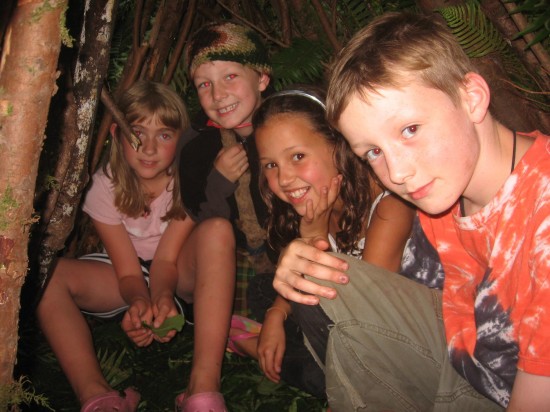
When I caught up with the children at Cedarsong, they were in the process of making some very delicious mud pies! The girls were covered head to foot in mud and they could not have been happier. They were standing in a circle chatting together over their work and discussing things only known to them. As I stood aside and watched, Erin Kenny, co-founder of Cedarsong, described to me how the children are the leaders of the day; their interests and observations dictate what will be learned. As a teacher myself, I questioned the logistics of this system. How does anything get covered when children decide what to learn? She told me how a random comment about tripping over a tree root can lead to a discussion on erosion and weather or the purpose of the roots of a tree to photosynthesis. The possibilities are endless! Changing seasons bring continual opportunities to track and record growth, and discuss hibernation and even death. New observations can lead to predictions, fallen trees and fungus can stimulate conversation on decomposition which can lead to discussions about habitats and niches. Teachers, it turns out, can just stand back and observe; it is from their observations that teacher’s take their cues of where to lead.
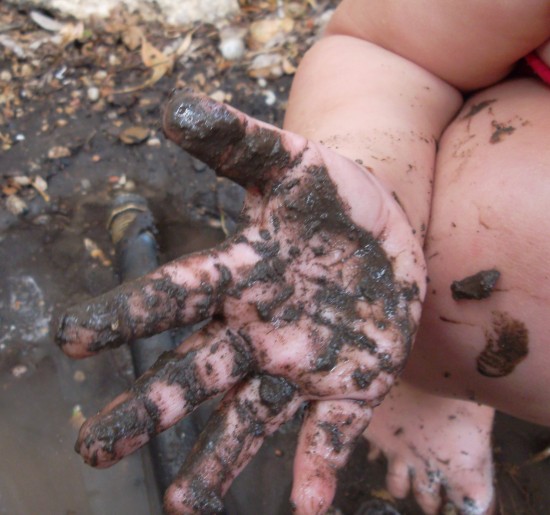 A boy had decided to explore a bit more of the area; Kenny and I followed leaving the girls in safe sight of the teachers. As we followed the child further into the forest my “inner child” was awakened and I wanted nothing more than to climb the nearest tree or jump into one of the many puddles. My senses were stimulated by the sounds of the birds and insects calling out their warnings of strangers nearby and I desperately wanted to search out the sources of those warnings calls! However, I was there to observe the children and not to indulge my own inner child so I turned my attention back to the child we were shadowing.
Further along the path the child had found a tree to climb. Though Kenny moved a bit closer, she did not flinch or move to stop the boy. I inquired about fear of accidents given the freedom the children seem to be allotted. According to Kenny not many children do get hurt— they learn and respect their own limitations. On the rare occasion one does get hurt, there are emergency protocols that all teachers are familiar with. Teachers are certified and stay current in first aid and CPR. Kenny’s experiences with accidents are similar to those from forest schools in Europe.
Marga Keller is the founder of WaKiTa, a forest daycare located in Zurich, Switzerland. Keller stated, “Experience shows that in forest institutions fewer accidents happen than in mainstream schools.” She clarifies, explaining that because the teachers consciously learn how to handle risks with the children and help them strengthen their own skills, the children can assess risk situations better. The children also do not feel the need to rebel against overly restrictive rules or prove their courage because the school actually puts this as part of the program: the teachers offer the children age-appropriate challenges.
 Back with the main group, Kenny asked if anyone would like to lead a hike to show me the rest of the forest. All the children decided to go and we set off together. As we wandered through the forest, the children impressed me with their knowledge of the local plants and fungi. I was taken to forts and shelters camouflaged in the trees, the likes of which my own children would have gone crazy for! As we strolled on, the children dispersed to different areas of the trail and Kenny and I had another opportunity to discuss the school and the children’s role. “Children challenge themselves all the time in the outdoor setting,” Kenny told me. “They display great personal pride in their achievements.”
Each day is unique and brings new sources of inquiry and excitement! Children learn to work together and cooperate through imaginative play. According to Burdette and Whitaker (2005), when children play outdoors there is more opportunity for problem solving and creative thinking. The varied terrain and multiple stimuli which nature provides deliver the perfect environment for imagination.
As my time came to an end at Cedarsong, I felt encouraged with all that I had seen. The possibilities for incorporation of nature into the American education system seemed endless and the benefits for our future generations infinite!
Bringing Back Outdoor Play
Forest schools may seem ideal for the issues I was grappling with, but not all of our schools and children have access to nature in their backyard. Urban schools are at a distinct disadvantage for this type of schooling; however, there are schools working on solutions which could be sustainable for all urban schools. For example, Muscota New School, located in New York City, utilizes Inwood Hill Park and Bear Mountain State Park, making the most of the nearby outdoor areas available to them.
According to the California Department of Education (2011), environment-based education employs natural ecosystems as a context for learning. The “environment” may be a river, a forest, a city park, or a garden carved out of an asphalt playground.
It seems any environment can be employed as an area for incorporating outdoor play, opening doors for practical outdoor play solutions.
You cannot turn on the news today without hearing about school funding issues; yet funding concerns can be overcome through partnerships, grants and community volunteer days. Taft Elementary School in Redwood City, California, partnered with Hidden Villa, a non-profit outdoor education organization to create their school garden program. CitySprouts, based in Cambridge, Massachusetts, partners with public schools to develop school gardens. Citysprouts also works to educate teachers on the integration of existing curriculum with their gardens. The Lorrie Otto Seeds for Education Grant Program provides grants for large scale projects such as the “design, establishment and maintenance of a native-plant community such as prairie, woodland, wetland, etc. in an educational setting such as an outdoor classroom.”
Modifications select schools are making to outdoor immersion are providing sustainable and worthwhile results. Our children are gaining access to the outdoors, attaching to nature and initiating positive change in their well-being.
WHERE DO WE GO FROM HERE?
Even though forest schools may not be the catch-all answer I was looking for, they can be a viable solution to our children’s lack of outdoor play and keystone moments. For those schools without a sizable amount of accessible land, compromises can be made. Vegetable gardens are being employed to reinforce geometry sills, nutrition, life science and basic math. An extension can include cultural differences in gardening techniques and vegetable preferences as well as recipes, which of course can be utilized for basic math. Trees found on school grounds can be used to teach geometry, prediction, microhabitat, and chemistry. An ecosystem extension can be incorporated by linking with international schools to compare tree data; growth rates, circumference, etc. (sites such as Jane Goodalls – http://www.rootsandshoots.org/ are perfect for this type of linking). Logs and larger branches on the ground can be used for agility, microhabitat, decomposition, nutrient recycling, chemistry, prediction and even physics. Why are branches of similar size but different trees weigh different? Water sources – even puddles after a rain – can be used for chemistry, prediction, water analysis and physics. Have you ever wondered about the force of a foot splashing in the water and the correlation to height of the splash? Cultural stories and knowledge can be shared while observing and studying local plants. I for one have always wondered about the ability of plants to break rocks as the seeds grow. Sounds like a perfect inquiry-led question for a physics class. Ant hills can be an endless source of amusement and knowledge for younger children learning about habitat. Decomposing leaves on your school grounds can become the perfect place to discuss microhabitat, nutrient recycling and niche. Of course the simplest solution would be to get rid of the cement playground and replace it with a natural playground, one complete with grass, fallen and living trees and butterfly and vegetable gardens.
In our world today adults are making choices that are counter-intuitive to what is best for our environment. Without contact with their natural world our modern children will grow up to be less inclined to save the earth than some of us seem to be today. As adults we need to come together and give our children the access to nature they deserve. With the constraints of today a feasible solution to this problem is to bring back outdoor play to our school children!
Reference:
Burdette, H. & Whitaker, R. (2005. Jan.). Resurrecting Free Play in Young Children: Looking Beyond Fitness and Fatness to Attention, Affiliation, and Affect. Arch Pediatr Adolesc Med. Vol. 159. Retrieved from www.archpediatrics.com at University of California – Berkeley
California Department of Education. (2011). School Garden Program Overview ; An overview of the school garden program including its impact on children’s health, nutrition, and academic achievement. Retrieved from http://www.cde.ca.gov/ls/nu/he/gardenoverview.asp
Citysprouts. http://www.citysprouts.org/
Ginsburg, K. (2006. May). Testimony of Kenneth Ginsburg, MS, MS Ed, FAAP on Behalf of the American Academy of Pediatricians. Natural Resources Subcommittee on National Parks, Forests and Public Lands and Subcommittee on Fisheries, Wildlife and Oceans. “No Child Left Inside: Reconnectiong Kids with the Outdoors”.
Keller, M. WaKiTa Outdoor Daycare
Kenny, E. Cedarsong Nature School
Moving Outdoors in Nature Act. Retrieved from http://www.govtrack.us/congress/billtext.xpd?bill=h111-6426
Muscota New School. http://www.muscota.org/
Rymer, B. (2009. December). Taft Elementary School’s Garden Program; A Case Study. Retrieved from http://www.redwoodcity.org/manager/initiatives/gardens/helpful/Taft%20Case%20Study%20Draft.pdf
The Lorrie Otto Seeds for Education Grant Program. http://www.for-wild.org/seedmony.html
White, R. & Stoecklin, V. (2008). Nurturing Children’s Biophilia: Developmentally Appropriate Environmental Education for Young Children. White Hutchinson Leisure & Learning Group
UNICEF. http://www.unicef.org/rightsite/files/uncrcchilldfriendlylanguage.pdf
by editor | Jun 13, 2014 | Forest Education
The LitTER Project: A field method for using litter-fall to study carbon cycling
by Lee Cain & Nick Baisley
Astoria High School Science Department
ABSTRACT
During a NASA funded Teacher-Researcher Partnership program focused on bringing Global Warming and Climate Change into the classroom, a long-term ecological study was created to get students into the field to research leaf litter fall as it relates to the carbon cycle.
Through photosynthesis, carbon in the atmosphere is converted into plant matter, which then will fall to the ground as it continues to be recycled in the carbon cycle. Our investigation is designed to answer the following question: “What is the rate at which carbon as leaf litter moves from a coniferous forest canopy to the forest floor (C-flux as Mg/ha/yr)?” A secondary question we are hoping to answer with this study is: “How does the rate of C-flux relate to coniferous age and management techniques?”
For comparison we selected one 60+ yr. old stand, a 30-50 yr. old recently thinned stand, and a young closed-canopy regenerating clearcut (15-20 yrs. old). In each stand we laid out two parallel transects, each with nine litter traps (plots) spaced 10 meters apart. Along each transect we also placed a HOBO temperature and light data logger.
We are collecting, drying, sorting, and finding the mass of leaf litter, and other sources of carbon, that have fallen into the traps. With only one fully completed set of data, we have yet to begin to answer the key questions of this study. We foresee a period of at least five years before we gather a significant data base. The purpose of this preliminary year was to choose our sites, establish transects, and work through any logistical or methodological challenges that present themselves. In the fall, students will begin taking regular field trips to the sites in order to collect and analyze the data.
 ig forests, big trees. Steep slopes, moss, and mycorrhizal strands of hyphae exposed under sliding boots. Climb up the slope, scramble down the log, lay the tape out, and spread the calipers. Then back up the slope again over the crisscrossed giant pick-up sticks to get the next measurement.
Later, taking a break for lunch, smashing microscopic biting midges against our sweaty arms, we have the chance to gaze upwards at the giant columns and wonder about what each tree has witnessed in its four or five centuries of existence. Then lunch is over, and it’s time to lay the tape out again.
This goes on day after day. Two science teachers from Astoria High School, we were in the H. J. Andrews Experimental Forest in the Cascade Mountains. This forest is part of the Long Term Ecological Research (LTER) Network, created by the National Science Foundation (NSF) in 1980 to conduct research on ecological issues that can last decades and span huge geographical areas. We were working with Dr. Mark Harmon of Oregon State University’s College of Forestry to take follow-up carbon storage measurements on forest research stands that had not been measured since the ‘70s and ‘80s.
In the following week in the computer lab, we take apart the measurements and put them back together again. On graphs, the data slowly begins to crystallize in our minds. We begin to realize that the carbon cycle is not working in the same time-frame as our short lives. It takes time for change to happen. Perhaps much more time than we have to repair the damage that we have done in a relative blink of an eye.
We now notice forests differently. We see logs in a way we did not before. Or rather, we see their absence. Replanted and managed forests appear to be empty – something is just missing. It is not just a sense of something missing – one can visibly notice the absence. No giant pick-up sticks lying crisscross on the forest floor. Such a void of stored carbon.
Back in the classroom, our challenge was to get students to see the actual carbon cycle as we have, and not just as an abstract diagram in a textbook. Then they might just be able to understand their own role in the cycle. We knew that time would be the enemy, because we never seem to have enough of it. But if we can get them to see the carbon falling, even one leaf at a time, then we will have begun the process. So we came up with the “LitTER Project,” a long-term ecological study (9th grade Integrated Science) of the movement of carbon from the forest canopy to the forest floor as falling leaves (litterfall). We realized it might take 5 years or more before we acquire any really significant database, but hoped that the process of getting kids to actually handle the litterfall would set into motion a greater awareness of the carbon cycle.
Our key investigative question was, “What is the rate at which carbon as leaf litter moves from a coniferous forest canopy to the forest floor (C-flux as Mg/ha/yr)?”
A secondary investigative question was, _“How does the rate of C-flux relate to coniferous age and management techniques?”
METHODS
Litterfall Traps — Three sites were selected within the Astoria area to give a wide range of forest ages and management approaches, yet also to be close enough to the high school to be practically accessible. For comparison we selected one 60+ yr. old stand, a 30-50 yr. old recently thinned stand, and a young closed-canopy regenerating clearcut (15-20 yrs. old).

At each site, two transects were laid out parallel, 20 m apart. All transects were set to have a 360 N orientation to be consistent in terms of solar angle of incidence. Nine litterfall traps (plots) were spaced along each transect at 10 meter plot intervals.
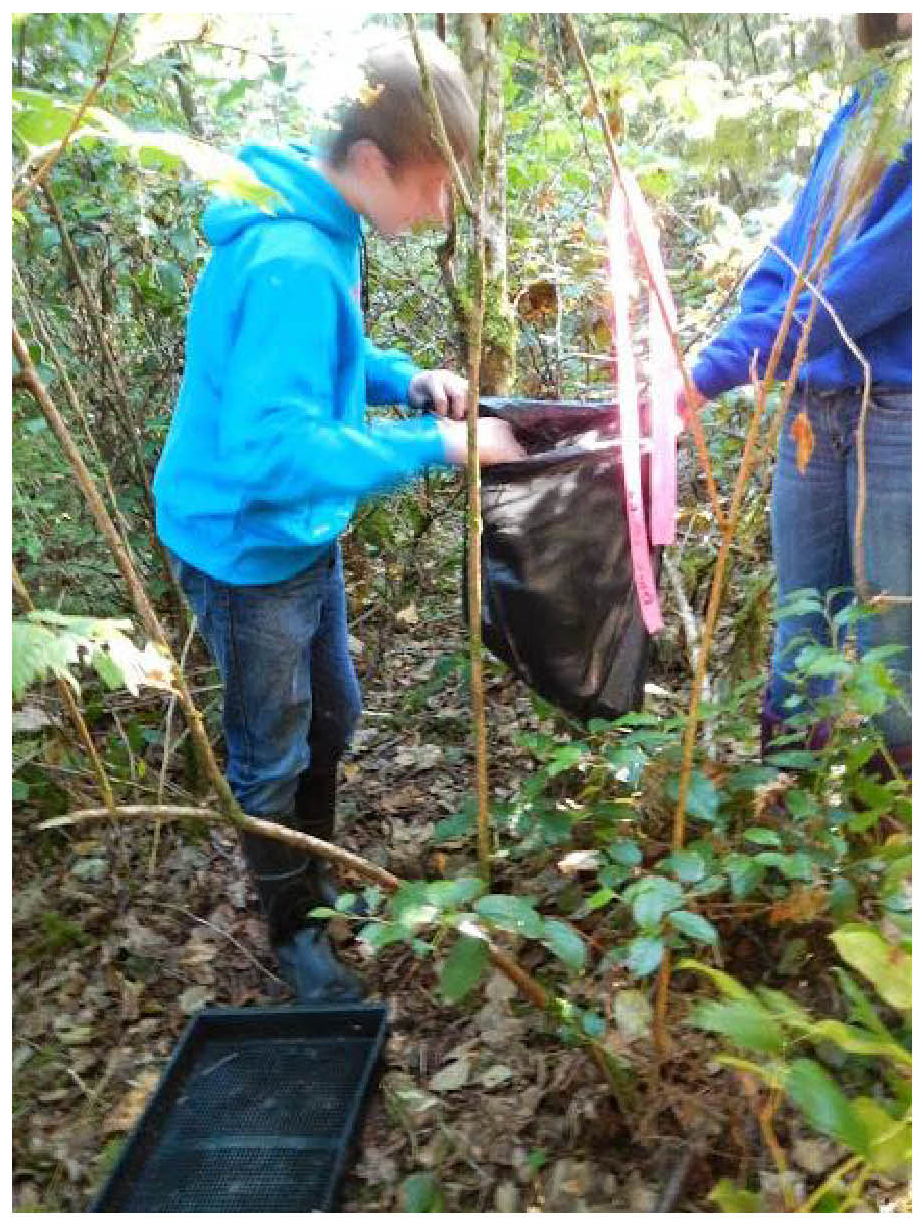
Each litterfall trap consisted of a black plastic rectangular floral tray (43 cm by 43 cm ~0.2 m2) lined with window screen to keep all litterfall from passing through the grid of the floral tray. Two wire surveyor flags were used to anchor through the trap into the forest floor and hold the mesh in place. The fluorescent flags helped to aid finding the traps on later visits. In addition, a surveyor’s ribbon with plot identification was tied to a nearby branch. Each plot was cleared of branches for 1 meter above the center of the trap.

A canopy cover photograph was taken by standing directly over the trap and shooting straight up. A HOBO temperature and light data logger was also placed next to each transect. This photograph can be digitized for percent cover using Photoshop or a similar software. Percent cover can then be used to draw relationships with carbon flux rates.
Student Visits — Students were bussed to the study sites and allowed about 1.5 hours to collect the first samples from the traps. Each team of 2-3 students was responsible for collecting the samples from one plot, and re-setting the trap to level and clearing the forest floor to level, flagging the branch above the plot and taking the canopy cover photograph.
Processing Samples — Litter from the traps was placed into black plastic bags labeled with masking tape and trap information. The empty trap was returned to exactly the same position until the next collection date. The bags were tied shut and taken back to the lab, where they were then spread out to dry for two weeks at an average temperature of 25 C. In teams, students then sorted and weighed the litter samples to the nearest 0.1 grams (Table 1) in the following categories: needles, broadleaves, total leaf, woody matter, reproductive (seeds, flowers, etc.), total plant, mineral matter, and animal (bug parts).
GRAPHS AND FIGURES
Table 1 – Teams of students were given single data tables to initially record the sorted raw weights:

Table 2 – Excel was used to summarize the raw data:

Figure 1 – Graph of summarized results of the first month of data collection:
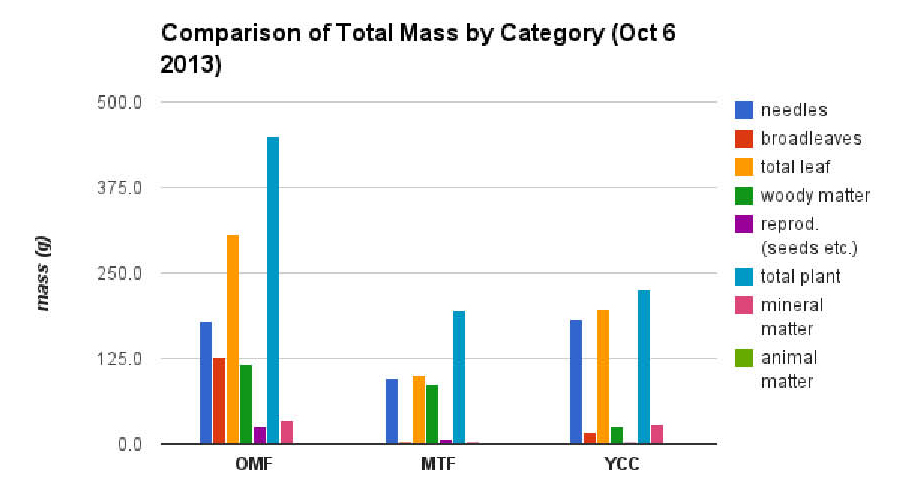
DISCUSSION
While only one data collection had been completed at the time of publishing, the tables and figures in the previous section should give an idea of how we have arranged the data.
The most obvious result in the data, though it is early yet, is that there are apparently significant differences between study sites in terms of total leaf mass compared to woody matter. Over time, these differences should develop into differences in the rate of carbon flux in the three different systems. This should not be surprising, yet is exactly these sorts of differences that students will likely not be able to see prior to participating in a LitTER project. Because there is only one sample event so far, we have not yet constructed picture of the carbon flux as litterfall over time. What is not known at this time if these differences maintain their relative distances or if it equalizes over time.
 While we are looking forward to pulling out these and other relationships from the data, we are mostly excited by the potential of this project as a tool to get students involved in science inquiry. Students become highly engaged during the data collection and processing. There are also many directions that we can go with the student learning about climate change with this project as a base.
There are still a few areas in the project protocol that we need to revise. Originally, the data collection was planned as a monthly activity that rotated between six Integrated Science classes throughout the school year. But it immediately became apparent that this didn’t work with the busy pace of school and the unforeseen effect of weather (windstorms, rain, snow days).
It is also a major organizational effort to get even one class of student scientists out to the nearest of the sites, let alone bussing six different classes to all of them. To adjust to this, we are now planning on making the data collection quarterly. Three times throughout the year, we teachers will team to collect the data (about 2 hours per site). This approach may eventually fall into the form of a senior project, to be carried out by a capable science-minded individual or group of individuals. Our 9th grade students will now experience the field data collection just once per year, on a fall day devoted to the project. While this is not as ideal as more frequent field trips, we feel that this is a balance we have to make to accommodate the public school setting of our project. At least this way the students have that field experience to help them to better relate when participating in the multiple data analysis events in the laboratory.
REFERENCES
Muller-Landau, H.C. and S.J. Wright. (2010) Litterfall Monitoring Protocol, March 2010 version.
F.S. Peterson, J. Sexton, K. Lajtha. (2013) Scaling litter fall in complex terrain: A study from the western Cascades Range, Oregon. Forest Ecology and Management 306, 118-127 Online publication date: 1-Oct-2013.
This article was submitted for ED 901 – Researcher Teacher Partnerships: Making global climate change relevant in the classroom Spring 2014 ; Oregon State University & Oregon Natural Resources Education Program (ONREP)

 This learning expedition began as all expeditions begin at Kettle Falls Elementary. The staff went through a careful study of the new Washington State standards and determined the “priority standards” at each grade level. The standards are then written as long-term learning targets. Once these standards were determined, teams researched case studies that could become the focus of the learning expeditions. The life science standards addressed focused on life cycles, animal structures and behaviors, food webs, ecosystems and human impacts as the center of the expedition.