
by editor | Sep 27, 2013 | Learning Theory
by Jim Martin
CLEARING Associate Editor
 e left the teacher we have been following as she was planning a project she and her class will do on a creek at the edge of the school property. What she is doing, as well as her plans, appear to approach what the National Board for Professional Teaching Standards proposes as five important characteristics of competent teaching. The last time we saw her, she was getting ready to plan the first steps in what could become a long-term project. (By the way, her name is Meredith.) Let’s see what the main pieces of the project are, and get some idea of how they look to her so far. The first step is to provide her students with background information which will help in the Acquisition Phase of this new learning. She plans to do it by using some standard curriculum delivered more or less as usually taught, but with students working with it in groups which may or may not become the work groups who do the particular jobs at the creek. This way, they might be more likely to transfer those learnings to the field. Topics they will study are food webs, water quality, and the riparian.
Her initial plan is to use published and on-line resources to provide background on riparian areas, then move to riparian food webs, and after that to how to measure water quality, and what the measurements mean in terms of the riparian and its food webs. Her hope is that, by learning something more dynamic than an array of facts, her students will approach the creek with more nuanced expectations than if they’d simply learned some nomenclature that applies to creeks.
Next, her student groups will visit the creek site. Her plan is to prepare work groups to assess the site to decide their stations. To this end, she supplies them with tape measures and rough sketch maps of the creek and its banks. Their job is to locate the best stations for doing their work, and measure the station’s dimensions. Then, in their work groups, they will decide how to go about making their observations. The Meredith knows that these plans will probably be modified by experience. Then, each work group will posit questions they think may help them know their part of the creek. This is most difficult for the macroinvertebrate group, because they won’t be collecting on this first trip. However, they will be asked to assess the makeup of the bottom of the creek, where the macroinvertebrates live. This completes the second part of her plan.
Designing inquiry questions takes quality time, so they will do that in the classroom. After they have posited good inquiry questions, they’ll use them to design their investigations. Meredith’s plan is to start this process while the class is making their visit to the creek site. She’ll prep this by asking them to keep track of things they notice while they’re doing their work on their particular station. As part of this prep, she suggests that they will use these things they notice to write inquiry questions to investigate. When the class returns to the classroom, they will do a quick debrief and go on to other things. (Meredith has been incubating an interesting thought that, by carrying out investigations, the class might develop a useful knowledge base about the creek and its banks. She is even contemplating using that base to drive a language arts unit and part of a math unit.)
The next class day, students will meet in their work groups to begin writing a report of their observations and decisions about locating their work stations, and a list of the questions about things they had noticed which are most interesting to them. Afterwards, each group will report its findings and questions. Then, Meredith will review the broad areas that each work group will investigate. She will ask each group to review relevant thematic information she has collected for them, and use it, along with their on-site observations, to design a plan for doing their work. As part of this work, students will be introduced to the equipment they will use, and will practice using it. After they have done this, they will meet with Meredith to review the work, receive suggestions, organize jobs within the group, and develop a fine-tuned work plan to follow when they are on the site. This is when she’ll suggest that students in each group pair up to work on their own inquiry projects. Then, she will start a discussion of inquiry questions, have students practice their own, then have students, in their pairs, write and assess an inquiry question of their own.
 This is a regular feature by CLEARING “master teacher” Jim Martin that explores how environmental educators can help classroom teachers get away from the pressure to teach to the standardized tests,and how teachers can gain the confidence to go into the world outside of their classrooms for a substantial piece of their curricula. See the other installments here, or search Categories for “Jim Martin.”

by editor | Aug 24, 2013 | K-12 Classroom Resources
by Kevin Beals & Craig Strang
 magine a residential outdoor science program where instructors—all of them—routinely combine their passion for the natural world with a deep understanding of research-based teaching approaches that are based on all we know about how people learn. BEETLES (Better Environmental Education, Teaching, Learning, Expertise & Sharing), funded by the S.D. Bechtel, Jr. Foundation, is a new project at Lawrence Hall of Science, University of California, Berkeley that designs professional development experiences for program leaders to use with their teaching staffs.
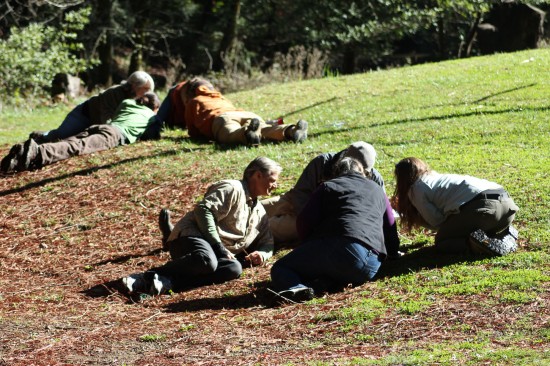
A group of 15 sixth grade students and their classroom teacher are on a hike led by a field instructor at a residential outdoor program. They come across a bracket fungus on the ground. The instructor, who has participated in BEETLES, calls out, “NSI,” a routine the students now recognize as Nature Scene Investigators. Quickly half the group kneels around the fungus in a tight circle. The other half stands in a circle around the inner circle.

(note: the discussions in this article are actual transcripts taken from trail hikes)
Instructor: OK, let’s hear some observations from the inner circle.
Student: It’s light.
Student: it looks charred.
Student: It looks like it’s broken off something.
Student: It looks like wood.
Student: It looks like it’s from a tree.
Instructor: Now let’s hear some questions from the outer circle.
Student: What does it feel like?
Instructor: OK, someone from the inner circle, can you say what it feels like?
Student: It’s rough here but smooth here.
Student: It feels smooth on the outside and rough on the inside.
Instructor: So, Kendra and Amir, would you agree that it’s smooth on the outside and rough on the inside?
They both examine it closely.
Student: Yep.
Student: I agree.
The students share more observations and questions, and continue to do so after the two circles have switched places and roles.
Instructor: OK, now I want you all to come up with explanations about it. Don’t forget to use evidence in your explanations.
Student: I think it was on a tree that got burned and it fell off and my evidence is because it’s black.
Instructor: Hey, did you all notice that Jared said, “I think…?” In science discussions, it’s good to use language of uncertainty, like “I think…” or “I wonder if…” because in science, you always need to be open-minded to other explanations and ideas if you find new evidence.
The students come up with several other explanations.
Instructor: Now does anyone have something to share about this that they’ve heard or read about somewhere else? But be sure to tell us your source of information.
Student: I think it’s a fungus, because we learned about fungi with our gardening teacher at school, and it looks like some of the fungi we studied.
Student: I’ve heard that they’re decomposers, and they turn dead things into dirt. I heard that from my teacher.
Instructor: This is a fungus. I’ve read that these are a type of fungus that grows on trees called bracket fungus or shelf fungus. I’ve also read that they are just the “fruit” of the fungus, and that most of the fungus looks like white threads and is spread out inside the wood. My source is a book written by a fungus expert. The book is called Mushrooms Demystified. We’re going to be checking out mysteries like this all day. We’ll be finding cool stuff, making observations, asking questions and trying to explain what we find.
Classroom Teacher: I just want to say, the more stuff you all pointed out the more I looked. You got me to look at it differently.
Instructor: Yeah that’s a great point and that’s one reason scientists often work in teams.
Student: Hey look, there’s one of those things on this tree.
Students excitedly swarm around a nearby tall stump with a few small bracket fungi on it.
Instructor: So what do you guys think now that you have this new evidence?
Student: It does grow on trees! It’s not burned because this tree isn’t burned and it’s still black.
Instructor: Is this tree alive or dead?
Student: Alive. No, wait. It’s just a big stump.
Instructor: As we hike, let’s keep our eyes out for more of these fungi and see what we find. Let’s see if we find any on living trees, or if they’re just on dead trees, like this one.
Classroom Teacher: (aside to instructor) I had no idea when I got on this hike it was going to be like this, because other hikes I’ve been on have been more about just delivering information. I want to learn as much from you as I can today about how I can do this with my students back at school.
What’s significant about this actual account, compared to many other outdoor science activities? Is any learning taking place? Why were so many student questions left unanswered?
We like NSI precisely because so much learning (and engagement) is going on. It sets a tone of inquiry, exploration, figuring things out and discussion of ideas. We want students’ minds to be at least as active as their feet. We want the students, not the instructor, to be making discoveries, asking questions, and trying to explain what they find. The instructor guides, but most of what happens is student-driven. This may look like the instructor isn’t doing much, but it is actually far more nuanced than blurting out three facts and a chant about bracket fungi.

Student (shown in photo): I feel like a scientist today.
Student: I know, I’ve never done this before.
Student: Yeah, I’ve been to the woods before, but not discovering and stuff like this.
Student: I didn’t even know I could do this.
Student: I’m gonna do this at the park near my house!
Activities like NSI taught by instructors who know how to look for evidence in the minds of learners as well as for evidence on the trail, engage students in the scientific practices called for in the soon to be published Next Generation Science Standards (National Research Council 2012) that are certain to be adopted by nearly every state in the US: asking questions, carrying out investigations, constructing explanations, engaging in argument from evidence, and obtaining, evaluating, and communicating information. Those are tricky things to teach in a classroom, but in a rich outdoor setting, students are surrounded by opportunities to explore and investigate with these practices. Instructors have opportunities, if they know how to take advantage of them, to help students make careful observations, work together, communicate their ideas, disagree politely, remember to base their explanations on evidence, use language of appropriate uncertainty, and cite their sources of information. These thinking skills lead directly to meaning making—a very different outcome compared to memorizing the names of trees or the three different types of decomposers. And there is an added benefit. When students are talking, instructors get to hear and understand their ideas about science topics. Effective instructors build their teaching on student’s ideas, but they can only find out what those ideas are by letting students express them!
Outdoor science schools are perfectly situated to help indoor schools by focusing their teaching on scientific practices. In a rich outdoor environment with long days, myriad inquiry opportunities and a skilled instructor, students can accomplish more in a few days than they might be able to in months in a classroom.
BEETLES is designing professional development experiences that help instructors to become expert users of approaches and tools like NSI that:
• are more student-centered, less instructor-centered.
• are less about an instructor telling students information, and more about instructors giving students chances to explore, investigate and figure things out themselves.
• are less about convincing students their instructor is ”awesome,” and more about making students feel smart and capable, moved more by what nature has revealed to them than by what their instructor has revealed to them..
• empower students with skills to use when they no longer have a field instructor leading them.
• facilitate student meaning-making.
• increase students’ wonder and curiosity about the natural world.
• are less about games or activities that can be done on a playground, and more about engaging students with investigating the natural world.
Historically, investments have not been made in the development of research-based professional development and curriculum for outdoor science programs. Unlike in K-12 schools, field instructors often rely on word-of-mouth “traditions,” and tattered copies of activity outlines passed around in bruised binders. BEETLES is designing, field testing, documenting and evaluating a series of professional development sessions, each of which presents instructors with a lens through which to view and improve outdoor science instruction.
BEETLES is also creating content sessions to help field instructors grapple with their own understanding of foundational concepts basic to many outdoor science schools: cycling of matter, flow of energy, adaptation and evolution. Finally, BEETLES is designing and collecting activities, like NSI, that reflect research-based approaches and accurate science, for use in the field with children. All these materials will be available, free, via a website.
BEETLES is hosting a 5-day California Leadership Institute during Summer 2013. Pairs of leaders will be invited from 12 different outdoor science schools throughout the state. The leaders will experience the professional development sessions, activities and hikes, share their own expertise, and plan out staff training for their own staffs. We hope to empower program leaders with new materials and perspectives, but also to benefit ourselves by capturing improvements and adaptations made by the leaders.
In 2014 & 2015, BEETLES will offer a National Leadership Institute, open to program leaders around the country. Eventually the BEETLES web site will offer supporting videos that show how the activities and professional development sessions are actually led with students and staffs.
The following is from an email sent to us by a field instructor a week after she participated in a 3-day BEETLES professional development workshop:
I wanted to relay a small snippet of some kid feedback I got this week on trail. The teachers had the kids write us all notes thanking us for their week, and it was interesting the things that popped up, besides the usual “You’re the coolest everrrrrrr” messages. One note included the following: “…We learned a lot from you, because, unlike other teachers, you go in-depth on everything we learn instead of going like ‘Here’s this’ and ‘This is that.’” I know I’ve been a “Here’s this” naturalist in the past, and throughout this week was really conscious of letting kids discover and asking them broad questions, and what a cool thing to hear back the first week testing it out! Several kids mentioned NSI in their notes, and as someone who has been a naturalist for 5+ years, it was a wonderful experience this week having a new lens to look through and launch the year with. It is wonderful to continue the learning process myself, and have new tools, and test them out, and watch some of them be wildly successful. Those kids were on the edge of their seats by the end of the week after we’d noticed, wondered, and built new frames of reference and pieced together evidence for what it reminded us of for days as to what the green lacy stuff on twigs really was. Never have I had children so excited about lichen and figuring out what it was! I just wanted to share with you, because I am excited to continue experimenting with what we learned, and pass the results on.
# # #
BEETLES invites outdoor science school instructors and leaders to participate in the development of our materials and program, and to participate in our leadership institutes. Kevin Beals (kbeals@berkeley.edu) & Craig Strang (cstrang@berkeley.edu) are the founders of BEETLES. Please visit www.lawrencehallofscience.org/beetles.
by editor | Aug 24, 2013 | Schoolyard Classroom
by Jim Martin
CLEARING Associate Editor
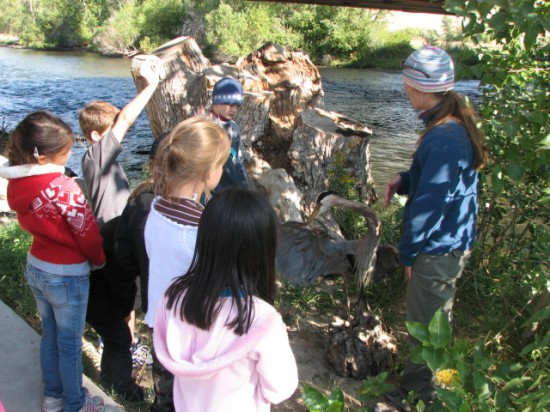
 teacher has made a commitment to design and execute a unit which explores the curriculum embedded in a small creek at the edge of her schoolyard. She didn’t just decide, then go; instead, she visited the creek, became familiar with its parts, then drew on some information she had gleaned at a teachers’ conference to construct a basic plan for how the unit would work. The plan included elements like: Place students in work groups assigned a particular task, Identify and exploit the curricula embedded in the creek and its banks, and Use group reporting to bring all of the learnings to all students in the class.
Before moving on, let’s compare what she’s done so far with what the National Board for Professional Teaching Standards teacher certification program is looking for in teachers. Their vision of effective professional teaching is based upon five propositions:
1. Teachers are committed to students and their learning;
2. Teachers know the subjects they teach and how to teach those subjects to students;
3. Teachers are responsible for managing and monitoring student learning;
4. Teachers think systematically about their practice and learn from experience; and,
5. Teachers are members of learning communities.
Let’s look at each of these propositions from the standpoint of the work of this teacher, and that of another who teaches from the book, and is committed to teaching a particular publishers’ curricula. This other teacher knows that, at the least, her students will have covered what is on the standards tests, and how well they do on that is up to them. These two teachers’ approaches to teaching are interesting to me in that they embody a dichotomy of approaches to many aspects of being human, that I, and others, identify as hierarchical:individualistic vs. egalitarian:communitarian and teachers identify as didactic vs. constructivist. This dichotomy in the way we approach life’s problems and decisions is directly related to the parts of the brain engaged. There’s a direct tie to the quality of conceptual learning in that dichotomy, both in the pedagogies employed and in the way the brain works in each case. In teaching, we’d call the two basic approaches teacher-centered and didcactic vs. student-centered and constructivist. I’ve been exploring this topic from time to time in this blog, and we’ll explore it some more.
I diverge. Back to the National Board’s Propositions. Proposition #1: Allowing groups to learn their particular part of the work, and then teach it to the rest of the class, with feedback from the teacher, tells me that she understands how students learn, how the brain learns, understands her students, and uses these understandings to develop an approach or delivery to a new set of learnings that is tailored to this class. And that she trusts that her students are ready to engage in learning. Because she intends to work with them as they negotiate and construct meaning, she knows who they are and how they learn, and has tested this enough times to have confidence in it. The other teacher presents a common base of information to her class, and helps students learn it. She uses the information in the teachers’ manual, in the prepared materials, what she has learned on her own, and would probably engage a guest speaker if she knew one. Student learnings are limited to what they read, hear, and see, and are not influenced by elements in the real world that they are learning about.
These two approaches meet the first proposition, Teachers are committed to students and their learning, to varying degrees. The first teacher is planning with what she knows about the subject, what she knows about her students, and what she believes her students can do. By moving beyond the so-called tried and true (which doesn’t actually develop into good test scores), she evidences her commitment to her students’ capacity to use their own brains to learn. The other teacher appears to be committed to the publishers’ curricula she uses, and is willing to allow an outside person to speak to the class. The fact that she conscientiously applies this curriculum indicates that she has confidence in it and is committed to her students’ learning, but places bounds on how much learning she believes they can be responsible for themselves.
Proposition #2: The teacher who uses the creek visits it to decide what to teach, and what she needs to learn. As she moves through the area, she amplifies what she knows about the subjects she uses the creek to deliver; she learns more as she teaches. Locating the curricular pieces embedded in the creek and its banks enables her to understand them better, and increases the methods she can pull off the shelf to teach them. She decides to teach more than the science of the creek, and, I assume, knows those additional subjects. I say that because she looks for them embedded in the place. (You can practice this by looking for examples of fractions and alliteration in a natural area nearby. You’ll note that you have to know the subject in order to find it.)
Here are some hurdles she must overcome in organizing and delivering her curriculum via that which is embedded in the creek and its banks: Food Webs – she has to learn about them. Mathematics – where are percents, exponents, pre-algebra, coordinates on the site. Physical Science – water quality chemistry, velocity – how to measure them in a creek rather than at a lab table. Geology – water quality and velocity = erosion, riparian geology, soils, mapping, stream morphology – how much does she know and understand about them. Social Studies – maps, vegetation communities, animal communities, transport – does the community which inhabits the creek and its banks use communities and transport systems.
The other teacher may have a background in the creek and its inhabitants, either from actual experience, or from learning about them. She may use this background to add to the curricular material the class studies. However, their learnings are mainly acquired by listening, reading, and memorizing, and not from direct personal experience. And, they are less likely to be able to teach the other groups in their class via group reporting. What is contained in the teachers’ manual and prepared materials are their main sources of insight. Both of these teachers know the subjects they teach and how to teach those subjects to students again, to varying degrees.
Proposition #3: The first teacher allows students to correct misconceptions, and amplify their learnings and thoughts, as they work and report. This teacher’s strategy of having student groups report during the project is an effective method for monitoring student learning and making mid-course adjustments. Because their teacher invests in her responsibility for managing and monitoring student learning, they are allowed to monitor and adjust their own learning activities, with the concomitant result that they also manage the flow of their work. Due to the way she delivered her curriculum, she learned more about pertinent subjects as she taught. While sharing those learnings through the activities she engaged her students in, this teacher developed methods of managing and monitoring student learning such as organizing the class into work groups, and using group reporting as learning and monitoring vehicles.
The other teacher uses standard classroom management techniques to organize her students, and publishers’ handouts to manage student learning. She knows the subject as it is expressed in the publishers’ curricula, and uses prepared handouts, assignments, quizzes, and summative tests to monitor student learning. She expands her understandings as the publishers she uses expand content particulars. She probably supplements these learnings from presentations at conferences. This is standard practice, but does not induce involvement and investment in the learning, nor does it empower her students. Again, the two teachers are responsible for managing and monitoring student learning to varying degrees.
Proposition #4: Exploring new curriculum deliveries by deciding to use the creek, visiting it, looking for embedded curricula, organizing space, and employing group reporting, compared with relying on what others have developed in curriculum deliveries, forces the first teacher to pull what she understands about teaching into working memory, and use careful critical thinking to find and engage the pedagogical components and processes that will facilitate the work. (That’s a long sentence! I’ll try to tone them down.) Locating and placing embedded curricula within its thematic place in the larger curriculum of each discipline addressed is a systematic process as is group reporting as a pedagogical strategy. Using group reporting as a teaching and assessment strategy, using what emerges from them to monitor and adjust her delivery, infers that she is considering all of the components of her curricular delivery as a system. This teacher also learns from experience and incorporates these learnings into her practice as she goes. The other teacher uses publishers’ materials conscientiously, learning the way their curricula and directions are structured, and using this structure to organize her delivery and has, at some time, learned about the effectiveness of guest speakers. As before, the two teachers think systematically about their practice and learn from experience to varying degrees.
Proposition #5: There are two learning communities associated with the first teacher. First is her classroom community, a true community of learners, The teacher allows herself to learn with her students, developing concepts together, organizing the class into work groups, and consolidating learnings via group reporting. Learning about the creek with her students generates a learning community in which all members benefit and grow. This kind of community, classroom as learning community, mirrors the dynamics of learning communities of educators in which, as proposed by the National Board for Professional Teaching Standards, “. . . teachers contribute to the effectiveness of the school by working collaboratively with other professionals on instructional policy, curriculum development and staff development.” Because the first teacher intimately involves her students in the process of learning, her class seems to be based upon the concept of a community engaged in mutual learnings; a community which shares learnings, discoveries, and methods in order to achieve a community goal.
Teachers are also members of their own professional learning communities. For this teacher, that would include the teacher who presented at the conference which started her on this journey, and the other teachers in her school. It also includes the school administration and resource personnel, and their interactions like curriculum development, staff development, and so forth. We haven’t met most of this community, so can’t say much about what they do, or assess how she works with other professionals in her school and district. Working together, this community has the potential to evaluate school progress and the allocation of school resources in light of their understanding of state and local educational objectives. The other teacher may be active in her professional learning community, but we don’t have any information with which to assess that. The two teachers developed different classroom learning communities. The first is based upon a community engaged in mutual learnings; a community which shares learnings, discoveries, and methods in order to achieve a community goal. The other community is less egalitarian, with students learning from the teacher, who is learning from the publishers and other external authorities. Most meaning in this classroom is learned, rather than being negotiated. Again, these two teachers are members of learning communities, classroom and professional, to varying degrees.
In sum, both teachers taught their students about creeks and creek communities. Only one teacher taught in a way that involved and invested her students in their work and learnings, and empowered them as persons. This was the teacher who started her students in the real world, developed incipient conceptual learnings, then used her subject knowledge and her knowledge of her students, to create an environment in which the students went to the publishers’ curricula as their efforts generated needs to know information, or to seek confirmation of what they believed they were beginning to understand. They were assuming ownership of their learning. This is what we need to teach for.
This is a regular feature by CLEARING “master teacher” Jim Martin that explores how environmental educators can help classroom teachers get away from the pressure to teach to the standardized tests,and how teachers can gain the confidence to go into the world outside of their classrooms for a substantial piece of their curricula. See the other installments here, or search Categories for “Jim Martin.”

by editor | Jun 29, 2013 | Learning Theory
Details, details, details…
The degree to which you can elaborate detail determines the level of confidence you’ll have in teaching curricula which begins in the real world
 by Jim Martin
CLEARING Associate Editor
 ust as the degree with which they elaborate the ecological details of the compost communities students study delineates the levels at which they are working, the degree to which you can elaborate detail determines the level of confidence you’ll have in teaching curricula which begins in the real world. A metaphor to illustrate this: Let’s say you live in a neighborhood like mine, in which every block has some homes with large trees in their yard or in the planting strip next to the street. A strong wind comes through and knocks a large tree limb onto a neighbor’s roof, damaging it. The neighbor immediately has the tree cut down, and every home owner in the neighborhood feels some degree of panic or anxiety about the trees near their own homes. What will they do? (more…)

by editor | Mar 29, 2013 | Environmental Literacy

- Photo credit: Sarah Sullivan, Abernethy School, Portland
by Jim Martin
Clearing Associate Editor
 he last time we met, students had planted seeds in parts of a garden plot they chose. So, where do they go now? They’ve made their decisions about where to plant each of their seeds. As the seeds sprout and grow, are there opportunities for them to engage in self-directed inquiries? Can they ask questions, like, “What would happen if ___?” followed by a perturbation they choose to introduce. Some possibilities that come to mind are things like sun flecks (the moving patches of sunlight in forested areas), watering schedules, companion plants, fertilizers and vitamins, pruning, hours of sunlight (photoperiod). What effect do these perturbations have on plants’ optimal growth? Kids have great imaginations, and I’m sure some of their perturbations would be more interesting than those I’ve mentioned. Doing this kind of work suggests that we are seriously entering the Experimental dimension of science inquiry. This is where you lose a little control over what students think and do, but not over how they go about their work. (more…)


