by editor | Jan 2, 2014 | K-12 Classroom Resources
 by Shamin Graff
Lake Katherin Nature Center & Botanic Garden
Palos Heights, IL
 he sat quietly for several moments, watching and waiting. Suddenly, a streak of yellow flew by and then another. She quickly snapped a few photos on her phone as they flew off. Excitedly, she uploaded her photographs to iNaturalist, the first goldfinches that had been added to the biodiversity project she joined. She loved to see as all the new species being added by her and other citizen scientists like herself.
Across the United States, large institutions such as the Smithsonian National Museum of Natural History and the Field Museum of Natural History have developed spaces where visitors can watch scientists in action and ask questions about the work being done (Smithsonian Institution, 2013; The Field Museum, 2008). At the North Carolina Museum of Natural Sciences, an entire wing dedicated to the pursuit of science recently opened, which includes opportunities to engage visitors in citizen science (North Carolina Museum of Natural Sciences, 2012).
If your institution is anything like mine, creating a space for science and engaging visitors in citizen science programs may seem to be a greater project than time or financial resources can support. However, the resources put into a successful program can pay dividends over time for both the institution and its visitors. Knowing this, we dedicated a small space in our nature center to science and chose existing citizen science programs that could be tailored to meet the needs of our institution. The following is the evidence-based framework we created for doing so, based on extensive research that has been done in free-choice learning environments, including nature centers and museums.
The Case for Citizen Science
Citizen science is not a new idea, as participation in citizen science programs dates back to the 1700s in Europe where amateur bird enthusiasts recorded bird sightings (Dickinson, Zuckerberg & Bonter, 2010). Utilizing the Internet, today’s citizen science programs rely on crowdsourcing, or having large groups of people who each make a contribution, to collect data or classify previously-collected data. With many people sharing the work in this way, large data sets can be compiled that otherwise would not have been possible (Dickinson et al., 2010). These large data sets can not only be used to monitor a population or phenomenon, but also serve as a starting point for new questions to be researched (Bonter & Hochachka, 2009). For example, there is a project that asks participants to help transcribe old maritime records that can then be used to study climate change (www.zooniverse.org/project/oldweather) and several that ask people to help identify animals caught on camera traps. Both tasks require enormous amounts of man-hours and would be not feasible without the help of citizen scientists.
Besides the research benefits, participating in citizen science projects also have potential to increase scientific literacy. It can be difficult to assess, but research has shown that content knowledge can be gained through participation (Brossard, Lewenstein & Bonney, 2005). When participants are specifically instructed in science inquiry and the significance of the research being done, it may be possible to affect participants’ understanding and attitudes towards science in a positive way (Trumbull, Bonney & Grudens-Schuck, 2005; Jordan, Gray, Howe, Brooks & Ehrenfeld, 2011). Though more research is needed (Jordan et al., 2011), using citizen science to engage visitors over the long-term may also be a way to increase appreciation for nature and a caring attitude toward nature and biodiversity (Brewer, 2006), something we all strive for in environmental education.
 Creating a Space for Science
Although your institution may not have a wing to dedicate to science, there may be an area that can be used to introduce visitors to science, provide reference materials and perhaps even offer scientific equipment for visitors to use. For us, we needed a space that allowed visitors to overlook not only our site, but also our planned bird feeder installation and this guided our selection. As research in free-choice learning environments has shown, the physical attributes of a learning environment can affect visitor learning in both positive and negative ways. Visitors often feel more comfortable in smaller exhibit areas (Maxwell & Evans, 2002), so do not be discouraged by limited space. Although it is tempting to create an immersive environment where visitors can feel they have been transported to someplace else, this may actually overshadow any educational messaging (Pedretti & Soren, 2006). Instead, working to minimize distractions can increase visitor attention and potentially visitor learning (Maxwell & Evans, 2002). For us, that meant separating the area from the high-traffic by the entrance and shielding noise from the adjacent area for young children. Simply rearranging and strategically placing furniture created the ideal space for us. We also included a comfortable seating area to provide visitors a place to rest and that may encourage longer stay-times.
Choosing a Citizen Science Project
Choosing the citizen science project that fits the needs of your institution is important to the future success and support of the program. We chose projects with a local focus that visitors could participate in at our site in order to fit our institution’s mission. There are a wide variety of citizen science projects to consider. SciStarter (http://www.scistarter.com) provides a searchable database of citizen science projects around the world that may assist you in finding a suitable project.
Institutional resources should be considered when choosing a project. The time investment for some projects will be greater than others. Some projects require frequent reports, sometimes even daily. Still others have fees associated with participation, require specialized training, or use equipment that must be specially purchased.
It is also crucial to consider the target audience when choosing a project. Many projects will not easily lend themselves to being used with visitors. Some data collection may be too intensive for the visitor experience while others may have strict restrictions on reporting. In these instances, you may choose to participate as an institution and then share your contributions to the project with visitors. This could be expanded by offering visitors a similar activity to participate in, as we did with Project FeederWatch, a bird monitoring program through the Cornell Lab of Ornithology. Also, some projects may have data collection periods that may not coincide with times of highest attendance. For example, Project FeederWatch only runs from mid-November through early April each year (Bonter & Hochachka, 2009), when many nature centers in northern climates have a decline in attendance.
Developing Materials
When developing site-specific materials for your chosen citizen science project, you should consider including an explanation of scientific inquiry and the role visitors are taking by participating. This may help them develop a better understanding of how science research is conducted and the importance of citizen science (Trumbull et al., 2005). Research at science museums has shown that visitors often come away with a changed view of science, but it is one that sees science as a set of facts, not a collection of knowledge that is always evolving (Rennie & Williams, 2006). We can help science literacy by showing visitors that though some scientific knowledge has been rigorously validated, there is still much that is not fully understood, even after years of study. Without addressing these misconceptions directly, we may unknowingly undermine science literacy goals.
Our institution does not have naturalists or docents who are available to facilitate the citizen science area, a major hurdle for a project like this. To support self-directed learning and participation in citizen science projects, easy-to-follow materials are recommended (Banz, 2008), such as signage, brochures and worksheets. These self-guided activities can also provide visitors with a framework designed to help them conduct their own inquiries, allowing them to see firsthand the nature of science (Allen & Gutwill, 2009). Hopefully, this will also promote repeat visits to the area and enhance learning (Banz, 2008).
Program Assessment
While developing a citizen science program, program assessment should be discussed. Simply having visitors participate was our initial goal, and multiple iterations of materials and methods are still being used to reach that goal. However, research on the impact of citizen science is limited and contributions are needed in both data and research methods (Brossard et al., 2005). If resources allow, assessment of content knowledge, scientific inquiry, impact on stewardship and changes in conservation values are highly encouraged, and are in the planning stages for our project.
The Framework in Action
At Lake Katherine Nature Center & Botanic Gardens (LKNCBG) in suburban Chicago, Illinois, the first implementation of a citizen science program following this framework is underway. With only three full-time staff members, resources are limited and minimal funds were used for the project. However, as our mission seeks to “promote environmentally sustainable choices through education, outdoor experiences and scientific research,” it has been important goal for 2013 to begin to introduce citizen science to the 26,000 visitors that come through the nature center annually (LKNCBG, 2013).
The physical space for our citizen science center was formed using a 130 ft2 area inside our nature center. The area provides a small reference library, comfortable seating and views of our bird feeders. There is literature for each citizen science project located in the citizen science center, along with worksheets and identification guides. There is also a chalkboard for visitors to record and share their data.
Three citizen science projects were selected to help us reach our goal. As an institution, we are participating in Project FeederWatch (www.birds.cornell.edu/pfw/), a program that collects bird counts at feeders. For visitors, we are offering a paper-based activity similar to the actual data collection for the project. We have also started a project online at iNaturalist (www.inaturalist.org) that allows visitors to record observations of wildlife seen at our site in order to compile a biodiversity atlas. Finally, we have joined Project Budburst (www.budburst.org) as a Botanic Gardens Partner to encourage visitors to gather data about seasonal changes in ten target plant species onsite.
These specific projects were chosen mainly to help build visitors’ ecological knowledge. Research has suggested that as cultures become more affluent, this ecological knowledge is lost (Pilgrim, Cullen, Smith & Pretty, 2008). The projects we have chosen offer an opportunity for visitors to learn about species and their roles in local ecosystems, which we hope will help address this loss of knowledge. Also by increasing ecological knowledge, visitors may become more aware of their local environment and the issues it faces (Cooper, Dickinson, Phillips & Bonney, 2007), potentially leading to greater support for restoration and preservation of natural lands, including our own site.
Although it is a modest start, and interest from visitors is just beginning, we hope that citizen science will become an integral part of the visitor experience to LKNCBG and will inspire other environmental education institutions to develop similar programs. We expect that it will take time to build a culture of science at our institution and this is just one step in that process. In the future, we plan to evaluate our program through visitor surveys to not only improve our own programs, but also to share with the environmental education community.
Taking the First Step
A citizen science center may be a great way to further your institution’s mission and goals. Using this research-based framework as a guide, it is possible to create a place to engage visitors through citizen science, even when resources are limited. Through these programs, environmental education institutions can play a key role in increasing their visitors’ science literacy and ecological knowledge. With time, visitors may start taking a more active role in stewardship and provide greater support for local environmental causes. It all starts with taking the first step.
References
Allen, S. & Gutwill, J. P. (2009). Creating a program to deepen family inquiry at interactive science exhibits. Curator, 52, 289-306. doi: 10.1111/j.2151-6952.2009.tb00352.x
Banz, R. (2008). Self-directed learning: Implications for museums. The Journal of Museum Education, 33(1), 43-54.
Bonter, D. N. & Hochachka, W. M. (2009). A citizen science approach to ornithological research: Twenty years of watching backyard birds. In T. D. Rich, C. Arizmendi, E. Demarest, & C. Thompson (Eds.), Tundra to Tropics: Connecting Birds, Habitats and People (pp. 453-458). Proceedings of the 4th International Partners in Flight Conference, McAllen TX.
Brewer, C. (2006). Translating data into meaning: Education in conservation biology. Conservation Biology, 20, 689-691. doi: 10.1111/j.1523-1739.2006.00467.x
Brossard, D., Lewenstein, B., & Bonney, R. (2005). Scientific knowledge and attitude change: The impact of a citizen science project. International Journal of Science Education, 27, 1099-1121. doi:10.1080/09500690500069483
Cooper, C. B., Dickinson, J., Phillips, T. & Bonney, R. (2007). Citizen science as a tool for conservation in residential ecosystems. Ecology and Society, 12(2), 11.
Dickinson, J. L., Zuckerberg, B., & Bonter, D. N. (2010). Citizen science as an ecological research tool: Challenges and benefits. Annual Review of Ecology, Evolution, and Systematics, 41, 149-172. doi: 10.1146/annurev-ecolsys-102209-144636
Jordan, R. C., Gray, S. A., Howe, D. V., Brooks, W. R. & Ehrenfeld, J. G. (2011). Knowledge gain and behavioral change in citizen-science programs. Conservation Biology, 25, 1148-1154. doi: 10.1111/j.1523-1739.2011.01745.x
Lake Katherine Nature Center & Botanic Gardens. (2013). 2012 Annual Report.
Maxwell, L. E. & Evans, G. W. (2002). Museums as learning settings: The importance of the physical environment. The Journal of Museum Education, 27(1), 3-7.
North Carolina Museum of Natural Sciences (2012). New wing opens with 24-hour celebration Friday, April 20. Retrieved from http://naturalsciences.org/about-us/news/new-wing-opens-24-hour-celebration-friday-april-20
Pedretti, E. & Soren, B. J. (2006). Reconnecting to the natural world through an immersive environment. Canadian Journal of Science, Mathematics and Technology Education, 6(1), 83-96. Abstract retrieved from http://www.tandfonline.com
Pilgrim, S. E., Cullen, L. C., Smith, D. J. & Pretty, J. (2008). Ecological knowledge is lost in wealthier communities and countries. Environmental Science and Technology, 42, 1004-1009. doi: 10.1021/es070837v
Rennie, L. J. & Williams, G. F. (2006). Adults’ learning about science in free-choice settings. International Journal of Science Education, 28, 871-893. doi: 10.1080/09500690500435387
Smithsonian Institution. (2013). FossiLab. Retrieved from http://paleobiology.si.edu/FossiLab/index.html
The Field Museum. (2008). DNA Discovery Center. Retrieved from http://archive.fieldmuseum.org/dna/
Trumbull, D. J., Bonney, R. & Grudens-Schuck, N. (2005). Developing materials to promote inquiry: Lessons learned. Science Education, 89, 879-900. doi: 10.1002/sce.20081
Shamim Graff is a volunteer at the Lake Katherine Nature Center & Botanic Gardens in Palos Heights, Illinois.
by editor | Jan 2, 2014 | K-12 Classroom Resources
By Jim Martin
CLEARING Associate Editor
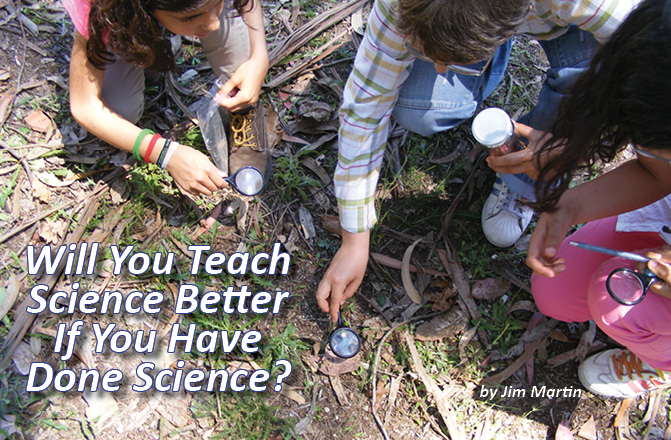
 hat if science teachers did science before they began teaching? Might a teaching model like this be possible to employ? Instructive to explore? There have been initiatives which followed up on this possibility. Their results were encouraging, but never replaced learning about science in publishers’ materials via college teacher education courses, which are simpler and less expensive to do when they are textbook-centered. The fruits of this choice have been a large fraction of K-12 graduates who haven’t achieved their potential.
What do students have to say about the way they are taught? Might some insights emerge from their comments? There is very little record of K-12 education from students’ own personal view point. Do they know whether their educations are worthwhile? A few people have looked into this, and have found that, when asked, students feel that classroom time is well spent when students treat the teacher with respect, behave the way their teachers want them to, stay busy and don’t waste time, learn a lot almost every day, and learn to correct their mistakes. Perhaps they have an intuitive understanding of an environment conducive to learning. The National Board for Professional Teaching Standards teacher certification program finds that students do well in school when their teachers are committed to them and their learning, know the subjects they teach and how to teach those subjects to students, are responsible for managing and monitoring student learning, think systematically about their practice, learn from experience, and are members of learning communities. Two complimentary views of what underlies effective education.
Taken together, these findings indicate that students know when they are taught well, and present the foundation of a clear plan for teacher pre- and in-service education. Had the K-12 graduates who didn’t achieve their potential applied questions such as stay busy and don’t waste time, learn a lot almost every day, and teachers know the subjects they teach and how to teach those subjects to students, to their teachers and curricula, and their assessments been considered in improving science teaching, might they have led to science courses which encouraged students to achieve their potential? Would they have led to pre-service science teachers actually doing science as part of their preparation for teaching science?
My experience tells me that doing science is important for science teachers. The need for science experience is a need that environmental educators have the capacity to respond to. The environments they work in abound with the kind of work pre- and in-service educators can do: mitigation, restoration, assessment, etc. They all contain the kernels of science inquiries to do. Working in collaboration with environmental educators, agency staff, and teacher education faculty and staff, pre- and in-service teachers could gain hands-on experience on the ground that they could get in no other way. My own experiences tell me that what emerges from this kind of collaborative work is science teachers involved and invested in the content that they teach, and empowered as teachers unencumbered by bureaucratic pressures outside their classroom doors; the experience necessary to change teachers’ views of science, a paradigm shift, that moves their locus of control for teaching science to within themselves, and away from the political winds that blow through schools. A key piece of the puzzle, this respite gives them a chance to develop effective science curricula.
What is it about doing science in environments outside the school that makes it so effective? I’d say that the reasons are many. An obvious one is that doing science in a familiar setting is less intimidating than doing it in a lab, which is much less familiar than, say, a quiet streambank. Another is that our brain learned to learn in the world outdoors. So learning science in a natural environment means learning in the brain’s inductive-constructivist way of learning. I’ve learned that, when teachers begin by doing science in a natural environment, they develop reasons to go into the lab, and labs become familiar places. What if we tried that? What would happen if environmental educators, agencies and organizations, and schools of education gathered together to explore the idea of a collaboration to provide pre- and in-service hands-on science education for teachers? There are all kinds of possibilities in collaborations like this.
If you’re a teacher, think back to your pre-service classes. Did you learn about a thing in class, then go out to experience it? How closely did what you experienced resemble the picture you had in your head back in the class? What if you had done the work first, then returned to the class to learn the underlying conceptual structure? Imagine a pair of pre-service teachers working together with an environmental educator, a restoration specialist from the City’s Bureau of Environmental Services, and a teacher with her students, to restore a reach of a stream flowing through a residential area near a school. Imagine further that the pre-service teachers are charged that day to identify and describe the characteristics of effective work groups. This in addition to doing the scheduled work of the morning.
The next day, back in the School of Education, all of the members of the class relate their experiences and report the characteristics of effective work groups that they had observed. Might discussion and negotiation of meaning elicit a clear concept of effective work groups, and posit connections between that and other elements of human learning? How might experiences like this influence these pre-service teachers when they do their one-year teaching internship? Would they affect the quality of their students’ educations when these interns begin full-time teaching? How would this look if a full-time teacher worked with the group from time-to-time as a mentor? If the full-time teacher would be the supervising teacher when the interns did their year in her classroom? This may never happen, but you can organize your own experiences to make this kind of experience one that you achieve yourself. All of the pieces of the puzzle are out there; they’re just not seen as elements of a functional whole. We have to learn to open our minds to recognize the relationships between what seem obviously disparate elements in a confusing world.
We’re not going to have this handed to us. But you can hand it to yourself. Find an environmental educator who is doing a restoration. Work with her. Then get your students on board. You’ll be outside your comfort zone. That’s okay. Keep your focus on what you want your students to learn, and make sure that part works. Look for workshops and institutes that provide valuable experience. In one summer institute, a teacher who had never ventured outside the classroom experienced her first encounter with the real world. By the end of the institute, she knew how to find a wetland, figure out its parameters, and design a project for her students. She had done science, and moved it into a perspective that removed its anxiety, made it eminently teachable. So she looked up an environmental educator she had met during the institute who suggested a wetland restoration project along a city-sponsored trail. The environmental educator agreed to help her plan, meet City bureau of environmental services staff, provide a training for her students, and point her toward a private granting organization which funded just this sort of project. She did the project, and continued on this path.
Let me step away from science for a moment and tell about plays my 7th graders performed when I first began teaching below college level. If I hadn’t done drama, I’d never have just hung two sheets from the ceiling light fixtures along the length of the room and said, “The side toward the windows is the audience, the side toward the blackboard is the stage. What shall we do?” My locus of control would have been too far away from me to even think of doing that. Luckily, I’d done plays for years. We picked a play, edited it, gave it. Then students, in groups, asked to write and do plays for the lower grades. And did them. I’d have been scared to death if I hadn’t acted, directed, constructed, written programs, made props, etc. I’d have simply followed a published play with directions. To the letter. And thought I was teaching drama. And I’d certainly not let them go off to the lower grades on their own. They’re seventh graders; get real.
Once you do science, it is not as intimidating as you first perceive it to be. Like me if I’d never done drama. Or, for all of us, the first time off the diving board, hitting a softball, etc. Now, you are focusing on particulars, so experience no unfocused anxieties about vague worries. We’re all good at that; once we focus on particulars, we begin to nail them down and work toward mastery. Get the start, so you know what you want to understand and do, then look around for resources like courses, workshops, knowledgeable people. Experience doing the work, then take control of your curriculum.
 This is a regular feature by CLEARING “master teacher” Jim Martin that explores how environmental educators can help classroom teachers get away from the pressure to teach to the standardized tests,and how teachers can gain the confidence to go into the world outside of their classrooms for a substantial piece of their curricula. See the other installments here, or search Categories for “Jim Martin.”

by editor | Nov 4, 2013 | K-12 Classroom Resources, Marine/Aquatic Education

1. Climate Change: Connections and Solutions
Facing the Future offers this free two-week curriculum unit for middle school and high school which encourage students to think critically about climate change and collaborate to devise solutions. Students learn about climate change within a systems framework, examining interconnections among environmental, social, and economic issues.
https://www.facingthefuture.org/Curriculum/PreviewandBuyCurriculum/tabid/550/List/1/CategoryID/16/Level/a/Default.aspx#.UmbDNBCRh8k
2. Climate Change Teacher Resources
Windows to the Universe provides interlinked learning resources that support a variety of topics, including online content for browsing or to support an introductory online course on climate change, teacher professional development resources, classroom activities, and online interactives.
http://www.windows2universe.org/teacher_resources/climate.html

3. ClimateChange LIVE! – Resources and Online Webinars
The U.S. Forest Service and partners offer this website to bring climate learning to you through a series of webcasts, webinars, and online climate education resources. The materials include climate education resources and programs gathered from 17 federal agency and NGO partners. The National Wildlife Federation is hosting a series of six webinars in connection with the ClimateChange LIVE! materials; you may register for one or more webinars at a time.
http://climatechangelive.org/

4. Teaching Climate
Teaching Climate offers a searchable database of reviewed K-12 climate education resources. The resources have been reviewed by subject experts for scientific accuracy, pedagogical soundness, and usability. Topics include Climate Systems, Measuring & Modeling Climate, Human Responses to Climate, and more.
http://www.climate.gov/teaching

5. Citizen Science: Project FeederWatch
Those interested in citizen science can join the thousands of FeederWatchers across North America who count the birds at their feeders from November through early April. All participants receive the project’s annual summary publication and the Cornell Lab’s quarterly. New project participants receive a bird-identification poster, bird-feeding information, and instructional materials.
https://store.birds.cornell.edu/Project_FeederWatch_s/42.htm

6. CMOP: Studying Coastal Margins
The Center for Coastal Margin Observation & Prediction, an NSF Science and Technology Center partnership of Oregon Health & Science University, Oregon State University, University of Washington and others, focuses on coastal margins. The website offers a collection of activities and curricula that can help you use their data resources. Check out the materials on coastal hypoxia, vertical density gradients, drifters and currents, and more. Some of the materials are available in both English and Spanish.
http://www.stccmop.org/education/k12/teacher_resources/activityarchive
7. Urban EE Resources for High School Teachers
The LEAF Anthology of Urban Environmental Education is available online. The anthology is a collection of lessons and activities designed to help high school educators infuse urban environmental themes into their curriculum. Sections include Natural Cities, Human Cities, and Evolving Cities.
http://www.nature.org/about-us/careers/leaf/resources-for-teachers/leaf-anthology-of-urban-environmental-education.xml

by editor | Sep 26, 2013 | K-12 Classroom Resources
Students at Mt. Vernon High school inspecting their school’s rooftop beehive
by Katie Boehlein
 ric Engman is a physics teacher at Mt. Vernon High School, where he has also taken on the role of “campus beekeeper.” The process of starting a school beehive began some years ago, when Eric began installing a rotational series of mostly physics-related displays in his hallway. This was a project that was first started to “inspire curiosity” for his students, and when the science department discussed adding a biology display, adding a beehive was suggested. Over the next year, Eric took the lead on getting approval for a hive from his principal, the school board, and the district (all positive responses); making the project public with parents in the community; learning about beekeeping himself through the local bee club; purchasing enough beekeeping equipment for himself and five students; and constructing a list of students interested in doing hands-on learning with bees.
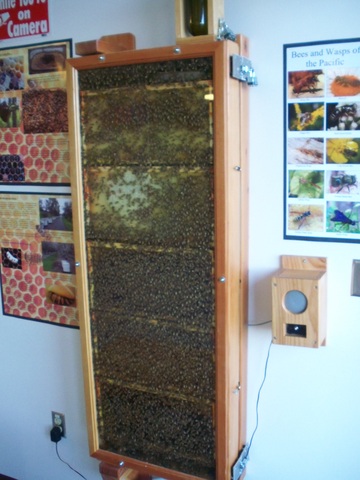
Eric Engman has installed an observational beehive in the science hallway of Mt. Vernon High School.
Today, all students at Mt. Vernon High School have the opportunity to be exposed to the natural world just by walking down their science hallway. The school’s observational beehive, which holds ten frames, is displayed vertically in the wall. Students can spend their lunch hour watching the bees’ activity from a bench near the hive, as well as listening to the colony’s buzz through a microphone installed inside the hive. Eric has also displayed seven or eight educational posters on the same wall which teach students about the biology of bees and inform them of the latest goings-on in the hive. Next to the observational hive is a wall of windows, where students and faculty can look out on the school’s second rooftop hive, located fifteen feet away. Students also have opportunities to work hands-on with the hive. Eric takes five students out to the rooftop balcony once per week, pulling from a pool of 50-60 currently interested students who have received written permission from their parents to be involved in the project. The students put on full jump suits and follow Eric out to the balcony to assist him in doing weekly hive inspections.

A set of locked doors at Mt. Vernon High School leads out from the science wing to the rooftop “MVHS Honeybee Project.”
The impact that these beehives have had on the Mt. Vernon High School community has been extremely positive. As a result of the observational hive, students have a place to convene and learn at the same time. “It’s a neat place,” Eric says. “They can see everything that’s going on without any contact with the bees at all.” Students regularly spend class breaks in front of the hive, checking in on its latest action and holding competitions on who can spot the queen first. Eric says that the beehives on their campus have inspired curiosity in all members of the school community, not just science students. Students, teachers, and parents regularly send him current articles about bees and stop him in the hallway to discuss the impacts of Colony Collapse Disorder. Not only has Eric become a practicing beekeeper, but four other staff members and one student have since taken beekeeping courses and started their own hives at home. The biggest question Eric hears on his bee-enlightened campus is, “Why are bees dying?” The concern and interest about these tiny creatures has been electric at Mt. Vernon; Eric has truly created an inspiring place of curiosity and active learning.
Katie Boehnlein is a writer/intern for CLEARING magazine and teaching assistant at Catlin Gabel School in Portland, Oregon. She enjoys writing about the endless expressions of place-based education, inspired by so many creative teachers. Katie blogs about her own ecological and urban adventures at “In the Midst,” which can be found at kboehnlein.wordpress.com.
Additional bee teaching resources:
http://www.oakland.edu/upload/docs/MiTSHAPE/Curricula/Swartz/Swartzbeeunit.pdf
http://westvistaurbanfarmschool.blogspot.com/2009/02/kids-can-keep-bees-too.html

 by Shamin Graff
 Creating a Space for Science