
by editor | Nov 20, 2014 | K-12 Classroom Resources

Reviewed by Mike Weilbacher
The Sixth Extinction: An Unnatural History
By Elizabeth Kolbert
Henry Holt. 319 pp. $28
We inhabit an extraordinary planet overflowing with an abundance of life: massive coral reefs built by billions of tiny invertebrates, rain forests teeming with uncountable plants and animals, frogs and toads singing in vernal ponds, bats flitting over summer meadows.
But we also live at an extraordinary moment when all of the creatures named above, and millions more, might disappear in our lifetime. And while climate change gets all the attention as an environmental game-changer, the loss of biological diversity, the burning of the Tree of Life, has too quietly slipped below the cultural radar screen.
Until now. Elizabeth Kolbert, staff writer for the New Yorker and author of the acclaimed Field Notes From a Catastrophe about climate change, has just published the definitive book on the biodiversity crisis. It is a must-read for every citizen of this planet.
As a science writer and reporter, Kolbert has few peers. Just as she did so effectively in Field Notes, Kolbert travels to the front lines of the issue, visiting the biodiversity hotspots you might expect, such as the Amazon rain forest and Australia’s Great Barrier Reef. But she also mixes in a ton of surprises, and much of the joy of the book is discovering where she ends up next: an Icelandic museum to visit a stuffed great auk, the last of which vanished in the 1840s, or the “Frozen Zoo,” a California lab that cryogenically stores cells from nearly a thousand species of extinct and nearly extinct species.
Kolbert begins in Panama, where she walks alongside scientists frantically searching for vanishing frogs, too quickly succumbing to a little-understood fungus. Frogs are amphibians, a group that “enjoy[s] the dubious distinction of being the world’s most endangered class of animals.” While creatures have always vanished throughout geological history, the natural extinction rate is incredibly small; amphibians, Kolbert reports, are now disappearing at a rate 45,000 times higher than normal.
The book also travels through the human understanding of extinction; these early chapters alone are worth the price of admission. She traces the history of extinction itself, the title alluding to five previous, natural, very large extinction events. The last big extinction occurred when that now-famous asteroid smashed into the Yucatan peninsula 65 million years ago, wiping out T. rex and maybe two-thirds of all life on Earth; she walks us through the science that painstakingly led to the theory, then covers the ensuing debate.
How bad is the sixth extinction? “It is estimated,” she observes, “that one-third of all reef-building corals, a third of all freshwater mollusks, a third of all sharks and rays, a quarter of all mammals, a fifth of all reptiles, and a sixth of all birds are headed toward oblivion.” That bad.
While extinction is natural, her book’s subtitle signals her impatience with anyone declaring the sixth extinction “natural.” Never before has one species so rearranged the planet, or so greatly altered the planet’s chemistry and biology, that so many creatures could die out. “This time,” one scientist says ominously, “we are the asteroid.”
The toughest part of the book is its last two chapters, where she visits not only the Frozen Zoo, but also the Neander Valley in Germany to see where fossils of our cave cousins – a separate human species that once lived alongside us – were discovered in 1856. Turns out that Homo sapiens likely killed off Neanderthals while, at the same time, intermingling with them (lots of us still carry Neanderthal genes). But “man the wise,” as our Latin name translates, seems to have been foolishly killing off life from Day 1. From Ice Age mastodons 10,000 years ago to flightless moas in New Zealand killed off in the 1400s, extinction has trailed in our wake for millennia.
We are burning tropical rain forests, poaching animals such as elephants and rhinos beyond their capacity to recover, and introducing invasive species everywhere (10,000 different species carried in ship ballast every single day worldwide). But the sixth extinction also has more subtle causes: Overheating the atmosphere with carbon dioxide changes land habitats, but also affects oceans, now acidifying from the excess carbon. Acidifying oceans are killing off coral – and possibly one-third of all ocean life as it does. The sixth extinction has multiple causes, but we are at the root of each.
Her last chapter, titled “The Thing with Feathers,” alludes to Emily Dickinson’s famous poem about hope, and she struggles to end on a hopeful note. “Though it might be nice to imagine there was once a time when man lived in harmony with nature,” she concludes “it’s not clear that he ever really did.”
Our “enduring legacy,” she ends, will be the sixth extinction.
The language of the Earth is losing nouns, names being plucked from the landscape: little brown bat, golden toad, Sumatran rhinoceros, Guam rail. While the book is not intended as a call to action, I hope its readers will rally around the burning Tree of Life, and agree that the preservation of this language is our highest calling, the necessary work of our time.
Mike Weilbacher directs the Schuylkill Center for Environmental Education in Roxborough, an island of biological diversity in Philadelphia. He can be reached at mike@schuylkillcenter.org.

by editor | Nov 20, 2014 | K-12 Classroom Resources
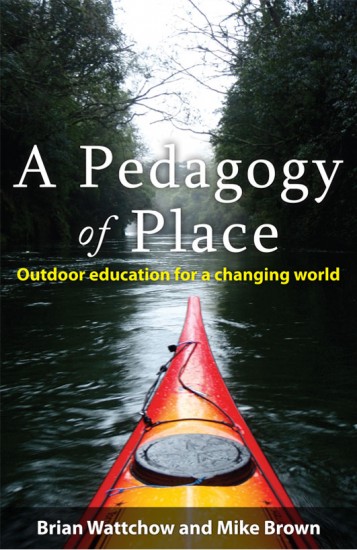
What is Outside of Outdoor Education? Becoming Responsive to Other Places
By David A. Greenwood
A review of Wattchow, B. & Brown, M.
(2011). A Pedagogy of Place: Outdoor Education for a Changing World.
Clayton, Victoria: Monash University Press.
As someone who follows the literature around place and education, and who is always curious to see how diverse educators and learners around the planet learn from diverse places, I was very interested to read Brian Wattchow (Australia) and Mike Brown’s (New Zealand) book, A Pedagogy of Place: Outdoor Education for a Changing World (2011). While it does not significantly address the local/global tensions inherent in contemporary place study (Heise, 2008; Nespor, 2008), this book represents a major contribution to the place-conscious educational literature. It is one of the first book-length inquiries in the genre that effectively blends theory and practice, cultural and ecological contexts, as well as personal and professional perspectives. Wattchow and Brown write with authority and affection about the places in Australia and New Zealand that they love and that they continue to learn from through their work as seasoned outdoor educators. Their stories of place should inspire people everywhere to pay attention to what nearby places have to teach. A Pedagogy of Place also raises significant questions about competing meanings of place, the value of adjectival educations and the complex ways in which learners might become more placeresponsive in the outdoors.
The kayak on the cover of Wattchow and Brown’s book is a good emblem for what one finds inside—an intellectual and embodied journey recounted in the voices of the two place-attached authors who have deep experience in outdoor learning. The journey begins with stories of how each author connected to outdoor places as children and adults and integrates these stories into descriptions of their experiences as outdoor educators. Next, the authors provide a convincing critique of the ironic absence of place-responsiveness in the field of outdoor education and offer a very insightful review of the meanings of place, which seem especially productive for continuing to build theory in place-responsive education. In the last part of the book, the authors narrate compelling case studies of place responsive outdoor education practice in Australia and New Zealand. The book ends with a discussion of “signposts to a place-responsive pedagogy.” These signposts provide an elegant framework for considering how educators and learners might become more responsive to the teachings of places everywhere, such as
1. being present in and with a place
2. the power of place-based stories and narratives
3. apprenticing ourselves to outdoor places
4. the representation of place experiences (p. 182)
It strikes me that any outdoor or environmental education theory or practice that fails to engage with any one of these powerful signposts is neglecting an opportunity to develop multivocal and multisensory relationships between learners and the places where they live.
The narrative writing style in A Pedagogy of Place (with the emphasis here on a pedagogy rather than the pedagogy or pedagogies) is very accessible and engaging, and the scholarship is also deep in its examination of outdoor education and its relation (or lack of relation) to the discourse of place and place-responsive learning. I find that the book would be an excellent introduction to place-responsive education for any group of educators interested in place. In its focus on getting outside for deep experiences that involve paying attention to place, the book offers an implicit critique of all indoor education, and also place-based experiences that are merely conceptual or too brief and disconnected to become storied place-responsive relationships that can only develop through a longer apprenticeship. This critique could be directed as well toward “cosmopolitan” views of learning that trade movement, speed or a “global” perspective for the presence and kinds of attention required to open to what places have to teach. In this regard, A Pedagogy of Place is a welcome reprieve from the deepening problematic trend that Aldo Leopold described over a half century ago: “[O]ur educational…system is headed away from, rather than toward, an intense consciousness of land” (Leopold, 1949/1968, p. 223).
Inside and Outside of Outdoor Education
Wattchow and Brown’s main argument in A Pedagogy of Place is that it is important to critically review key assumptions of outdoor education and reconceptualise the field through attention and responsiveness to place. As someone who does not identify chiefly as working in the field of outdoor education, it was somewhat surprising to read how this subfield of education has often neglected local cultural and ecological contexts as it has become professionalized. On the other hand, lack of attention to place seems to be part of the professionalization of all branches of education and a problem with (post)modern culture at large. As professional fields and subfields evolve, the local social and ecological contexts where people actually live their lives are almost entirely forgotten while attention is placed on the established frameworks and routines that give a particular educational approach its identity (Gruenewald, 2005). As a result, Wattchow and Brown (2011) write of outdoor education: “The geographical locations where programs run can all too easily come to be seen as clinical sites, obstacle courses, testing grounds, venues or curriculum resources.” When places become clinical sites for outdoor education, activities, regimentation, standardization and even the implementation of models such as the experiential learning cycle can dominate curricula while unwittingly de-placing or de-contextualizing experience—all typical hallmarks of colonizing educational models. When this happens, according to Payne and Wattchow (2008), it is “increasingly difficult to confidently make the claim that outdoor education is an ‘alternative’ beyond the fact that some of it occurs in the outdoors” (cited in Wattchow and Brown, 2011, p. 50).
What, then, is outdoor education and what is its relation to place and to its cousin, environmental education? While reading Wattchow and Brown’s critique of outdoor education as a field, I continually found myself puzzling over the meaning of the label “outdoor.” I wonder about the limitations of any adjectival educational subfield (outdoor, environmental, placebased,land-based, culturally-responsive, experiential, Indigenous, sustainability, etc.) in relation to the larger goal of advocating for education that is responsive to places and how they are experienced by those who inhabit them. Does the proliferation of subfields (and strands within subfields) work for or against this larger goal? Can mutual interest in place provide a meeting ground for educators with a variety of complementary commitments and forms of knowledge? Or, does professional investment in, and politicized identification with, a particular group keep us focused on defending our turf, boundaries and vocabularies while screening out possibilities for building strategic alliances? In short, can the educational subfields with interests in the outdoors, places, environments, experiences, etc., develop better political strategy in the service of people and places rather than in the service of professional subfields? If the answer is yes, what might this suggest for how we manage the labels around which our professional work currently revolves? I think it might mean that we need to consider abandoning attachment to these labels, or at least work to de-centre them, as we learn to enact what Arjen Wals (September 22, 2011, personal communication) is calling “cross-hybrid learning.”
In their focus on place as a transformative construct, Wattchow and Brown demonstrate a welcome willingness to rethink the assumptions underlying a professional field of practice—though the focus remains on outdoor education as an insular subfield. As the authors note throughout their book, place and the outdoors are not the same. In the practice of outdoor education, the outdoors can simply become another decontextualized and colonized space for scripted learning outside of buildings; a place is where meaning is made through a reciprocal relationship of coming to know. While efforts are made in A Pedagogy of Place to expand the meaning of the outdoors in outdoor education to include multiple perspectives toward place, it is somewhat ironic that the case studies provided describe a placeresponsive pedagogy mainly through the traditional practices of tripping and journeying through the “natural” environment (albeit often to nearby, “mundane” or culturally complex places).
Clearly the authors share an interest in diverse meanings of place and in the educative potential of a wide variety of place-responsive experiences. Yet, in their stories of practice, the authors sometimes risk limiting the meaning of place to the conventional outdoors (mountains, deserts and rivers) and risk limiting the context of place-practice to hiking, camping and boating. Is this inevitable or desired in outdoor education? Inviting relationship through experience with the local and regional physical geography, and the cultural stories held in place there, is a vital component of educating for place-responsiveness. But what about other “outdoor places” and built-over lands and mindscapes—such as the streets people drive and walk on every day or commoditized and damaged places like mines, highways, strip malls, power plants, factories, schools—through which hums the global engine of neoliberal economic growth and development? What about all the regulated places, public and private, whereby we are constantly told to follow the rules? KEEP OUT! NO TRESPASSING! And what of the myriad other outdoor spaces, which, depending on one’s experience, may either invite belonging or enforce exclusion? In other words, the meanings of place or the outdoors and the possibilities for placeresponsive outdoor learning extend far beyond what the authors describe in their case studies, even as their work pushes on and extends conventional meanings of outdoor education.
Through their critique of outdoor education, their attention to place theory and the development of their case studies, Wattchow and Brown certainly gesture at making connections between embodied experience in outdoor, culturally significant places and the development of critical social conscience in everyday life (see Cameron, 2008). Yet the impact of these gestures seems somehow restricted by some of the more typical contexts of outdoor education they describe (hiking, camping, boating), journeys and trips signified by the gorgeous kayak emblazoned on the cover of the book. This observation is in no way meant to critique the power of experience in the pedagogically rich places the authors lead us to. I want to be in the kayak and on the campout and learn the ecological and cultural stories there with these authors and their mentors as guides. The only way to know the power of the journey or trip is to experience it fully. No doubt many of us facing lives of increasing boredom, incarceration, shut-in, medication and screen time (Louv, 2005) would benefit from outdoor experiences that offer much less than what Wattchow and Brown provide. The point is rather to rephrase a simple question the authors themselves pose with their important book: What constitutes the outdoors in outdoor education?
In an interesting section titled “Critical Outdoor Education,” Wattchow and Brown (2011) advocate for socio-ecological or critical place-based approaches over those focused on “social justice issues (gender, sexuality, race, equality of access and so on” (pp. 86–89). They rightly argue that critical social justice perspectives are often abstracted from a larger socio-ecological framing. However, many “social justice” issues have “outdoor” characteristics that are doubtless part of a larger ecology of place. One does not have to take a very long walk in most cities, for example, to witness many varieties of power, inequality, privilege and oppression, as well as the regimes of spatial exclusion. Additionally, since the start of the resistance movement to industrial capitalism (over 150 years ago), one does not have to look far for social or ecological conditions that need to be changed, or for local people calling for it. Today, worldwide, outside in the streets , people—including homeless people who live outside—are marching for local change in global contexts, raising critical social conscience through embodied and emplaced experiences. Does observing and participating in a street protest constitute place-responsive outdoor education? What about working with people who are homeless to change the local conditions that create homelessness? Or, should the meaning of place-responsiveness in the (sub)field of outdoor education remain concerned mainly with “natural environments” removed from the everyday street life of the crowd?
In other words, this book makes me wonder with the authors: What kind of places does the field of outdoor education privilege and which do they neglect? What is the potential range of places of practice for outdoor educators? Further, what is the relationship between outdoor education, geopolitical consciousness raising, and placemaking and re-making? The Occupy movement is only one example of the intersection between the outdoors and political experience and learning. In his remarkable book Blessed Unrest , Paul Hawken (2007) reports that there may be as many as two million organizations working to create localized change in communities all around the planet. Many efforts for local change have an outdoor dimension; the same can be said of activism around climate change. Community development and revitalization, including rural, urban and regional planning, happens outside in the interface Is this mundane political process of placemaking an appropriate context of outdoor education, or does the field prefer to privilege its traditional practices of tripping and journeying for the irreplaceable experiences that these practices deliver? Is it even possible to learn what a river trip by kayak has to teach without leaving the street protest behind (and vice versa)?
Such questions probably should not be posed as either/or dichotomies. But there is certainly a tension here for me, at this juncture in the evolution of place-responsive education, between the local, regional and geo-politics of placemaking and the aesthetics of nature-based place-experience (no matter how culturally responsive), which mirrors a more general tension between politicized and depoliticized environmental education. Neither is inherently better than the other and I believe we need both, as well as a more nuanced and inquisitive stance toward the tensions between them. Reading this book kindles my desire and my too-often denied need to connect with land and water for the experiences that only land and water can provide. Borrowing from Wattchow and Brown’s (2011) framework, I want to get outside onto the land or into the seat of the kayak. I want to become present in and with a place through deep immersion. I want to leave the street and Internet protests behind as I journey into another world—perhaps the real world—where the land is alive. I want to discover and be moved by the power of place-based stories and narratives, and learn with the people who hold these stories. I want to apprentice myself with others to outdoor places. And I want also to represent and communicate my experiences with places in meaningful, creative ways. Outdoor education that is responsive to place can be as worldwide protests for social, economic and environmental justice—protests which may lack the outdoorsy appeal of a paddle or a hike, but also represent a distinctly unique aesthetic and an embodied politics unlikely to be found on a river trip. Again, these musings are not a critique of A Pedagogy of Place , but an invitation to extend the critical question that is the thesis of the book: How might a consideration of place transform outdoor education?
References
Cameron, J. (2008). Learning country: A case study of Australian place-responsive education.In D. Gruenewald & G. Smith (Eds.), Place-based education in the global age: Local diversity (pp. 283–398). New York: Routledge.
Greenwood, D. (in press). A critical theory of place-conscious education. In R. B. Stevenson, M. Brody, J. Dillon, & A. Wals (Eds.), International handbook of research on environmental education research. New York: AERA/ Routledge.

by editor | Jul 28, 2014 | K-12 Classroom Resources
Teaching Stewardship Through Native Legend

Abstract: This article provides the reader with a general background of Alaska Native education and resource conservation, focusing on southeast Alaska cultures. European contact severed these education models by creating government schools. Since then Alaska Natives have worked to balance Native culture with western education. A synopsis of several legends which speak to natural resource conservation is presented with the conservation ethic discussed. The use of these types of legends in the classroom is encouraged as a means of bringing Native values and lessons into the classroom as one means of making education relevant to Native students. The lesson from this discussion can be applied to other indigenous groups.
by Dolly Garza
To address environmental stewardship and education among Alaska Natives it is necessary to start with a brief review of Native cultures and educational systems.
Alaska Natives have lived along this northern coast for thousands of years. Groups developed cultures that revolved around local resources. The Haida, Tlingit, Tsimshian, Eyak, Supiak, Alutiiq, Yupik, Siberian Yupik, Inupiat, and the Athabascan learned how to use surrounding resources for food, clothing, shelter, transportation, regalia, and the arts.
Careful observation of animals, plants and weather over the seasons provided the knowledge base to know when to gather, or when to move. This accumulation of knowledge was necessary to the survival of the community; therefore, it was necessary to pass the knowledge from generation to generation. Knowledge was transferred through oration, observation, and action. Written instructions were generally unknown.
In southeast Alaska, among the Haida, Tlingit, and Tsimshian, children did not learn from their parents. It was generally understood that parents loved the children too much and would spoil them. It was the job of the aunties and uncles of the clan to teach the children important knowledge and skills.
Southeast Culture and Stewardship
Much of Southeast Alaska where I come from was owned or occupied by the Tlingit and Haida. Tlingit historians will tell you that many areas and the associated resources were part of a clan’s property. Their territory included permanent village sites. However a clan’s use,
territorial rights, and stewardship extended beyond these typical areas to seaweed picking areas, berry picking areas, and into the rivers and ocean with herring egg gathering sites, salmon streams, seal hunting rookeries, and halibut fishing grounds.
Anthropologist and early explorers documented many types of conservation techniques and practices. Legends such as Moldy Salmon or Herring Rock were lessons which Elders told to teach youngsters to respect and properly use salmon, herring, and other resources. Clan leaders would decide when fishing would begin and end, and determine other resource harvesting methods. Clan members understood their obligation to follow these rules and rituals. European Contact
In 1876 Alaska were purchased by the United States from Russian, an action which was protested by the Tlingit Nation in Sheetka or Sitka, Alaska. The Russian had a stronghold to very limited sites in the Sitka, Kodiak, and Aleutians areas.
The early traders brought beads, bullets, alcohol, and diseased blankets. In addition, early traders were sick from months on ships with poor water and nutrition. They passed along their sicknesses which were new, and tragic, to Native populations.
The ravages of diseases in the 1800’s have had one of the largest impacts on Alaska Native cultures. Indigenous populations were reduced to less then 1⁄2 the estimated pre-contact populations. In some areas entire villages died from small pox or influenza. Much knowledge was lost with the death of each Elder, hunter, or mother.
Gold miners, fishing companies, and pioneers followed. The military, preachers, and teachers accompanied these early arrivers. The military came to protect the white people, the Christians to convert, and the teachers to civilize the Native.
The Native peoples generally were moved from their traditional sites to designated communities where religion and education could be taught. In many areas the traditional clan structure of government was abandoned. The new education and religion systems were embraced in fear of the ravages of disease. Natives believed they would better survive under this new system, since their old plant medicines and ceremonies did not save them from new diseases.
Early Education Systems
After being taken away and educated at government schools, many Natives made it back home and were expected to live a new life. They tried to be religious and teach their children English and new cultural ways. This assimilation process was only partially successful. Many such as my grandmother Elizabeth were forced to stop speaking Haida to her children. She was devoted to her church. Her children were sent to boarding school and came home years later.
When children were sent off to school parents had no control over what they did, what they wore, what they were taught, or what they were led to believe. This generation, my mothers, came home and began their own lives. They sent their children to school and believed that this is what should be done. “Send your children to school and expect the system to do everything”. Many in my mother’s age believed they had no right to interfere with their children’s education; and for the most part this was true at the time.
Many of the “educated” from my mother’s generation came home and believed that their parents lived backward lives; or if they tried to live this new life they found their were no jobs, and no money to buy all these new commodities. Many put this education aside and went back to living the old way: hunting, fishing, putting up food, living in old ramshackle houses, some with no running water, or sewer.
Current Educational Efforts
In some senses Native people have come full circle. Part out of necessity, and a great part out of love for our culture and land, we continue to live simple lifestyles. Alaska Natives are working to balance Native culture and mainstream education.
However there is still the early education mantra that prevails among the conscious or subconscious of our Elders and thus our community: “Native people must be civilized and cleansed of their former ways”, “Western education is better”.
Today many Alaska Natives still believe that the western education is better. They see education as severed from their daily life and do not feel that they can add to this educational process. Children come to school still thinking their home life, and cultural dance or stories, are archaic and not important. This leads to poor self-esteem and often, an aversion to Native ways. It is important to help Native students understand the value of cultures.
Recent efforts such as those of the Alaska Rural Systemic Initiative, funded by the NSF, promotes incorporating Native science, knowledge, and education skills into the classroom as a means of making the science relevant to local areas and helping students understand the value of parental knowledge and their culture. One part of this broad educational effort focused on Native stories or legends that were taught to children. While these stories are entertaining their main purpose has been to teach respect.
Native Legends as Teaching Tools
As an example of ritual, in some areas salmon would be harvested only after the first salmon went upstream and were properly honored through dance and ceremony. It was told that this was done so that the spirit of the salmon would return to its brothers and sisters and report that these were good people and that the salmon should give themselves to these people.
Someone would notice the first salmon coming up stream and alert the community. Eagle down was gathered, regalia donned, and people commenced to the river. Songs were sung, and words were spoken to the salmon. Respect was shown. After this, fishing could take place at the chief’s orders. In the time it took to set up these ceremonies, hoards of salmon went up the river. Today we refer to this as escapement; the necessary brood-stock to ensure continued survival of the salmon. Without the eagle down, this is a standard fishery management practice.
In the Moldy Salmon story a young boy is taken to live with the salmon people after he disrespects salmon. Upon his return to his people he educates them on how important it is to eat all of the salmon and to respect salmon.
In the herring rock story a man is turned into a stone after he disobeys the clan leaders rule to not fish for herring after nightfall. The rest of the community understands the consequences of fishing after nightfall as they pass by this rock everyday. The rock was known to recent time in the Sitka area until it was covered during a construction project. Herring biologists know that herring school up and rise to the surface at night. During this time they are very susceptible to over harvest. A “legend” as it is now called served as a regulation.
Summary
As we teach environmental ethics to our young it is well worth using Native or other indigenous folklore to highlight traditional means of conservation. It is important to keep Native children in the folds of education and help non-Natives to understand that Natives were not savages, but lived in balance with their environment.
But as we use legends we must remember to respect tribal and clan property rights. I have not written any legend in full nor do we have permission to commercialize these legends for
profit. However the use of these legends as an educational tool is welcomed by most Elders and tribes.
Dolores “Dolly” Garza is a full-time Professor for the University of Alaska Marine Advisory Program. She has worked in Kotzebue and Sitka and now works in Ketchikan as a Marine Advisory agent, interfacing European science with Alaska’s marine resource users in the areas of subsistence management, marine mammal management and marine safety. This article reprinted from proceedings of the 2006 North American Association for Environmental Education annual conference in Anchorage, Alaska.
by editor | Feb 5, 2014 | K-12 Classroom Resources, Questioning strategies
Rivers reveal their secrets to Idaho students researching water quality through rigorous scientific inquiry
Photos and story by Suzie Boss
Squiggly blue lines cover the map of Idaho, a state with more than 2,000 lakes and hundreds of miles of rivers. From the perspective of veteran science teacher Bob Beckwith, all that water means that nearly every Idaho student has easy access to a creek, a stream, or a lake. “Probably 95 percent of the state’s population lives along a watershed,” he estimates. And where there’s water, Beckwith can promise you, there’s a science project worth pursuing.
On an early winter morning, for example, Beckwith and fellow Eagle High School biology teacher Steve DeMers loaded three classes of warmly dressed sophomores and armloads of scientific gear onto a school bus and headed off on an all-day investigation of water quality along the Boise River. By the day’s end, students had made four stops to gather data between the mouth of the river and headwaters in the mountains west of Boise. They waded midstream to collect invertebrates and dipped their hands into icy currents to test ph and oxygen levels. They checked and rechecked their measurements, keeping careful track of resulting numbers for future analysis.
Despite the frosty weather and the high spirits that come with escaping the classroom, students resisted the urge to hurl snowballs. And all day long, there was no whining. Every student participating in the trip was there by choice, doing what Beckwith calls “real science.”
Since he began teaching in 1972, Beckwith has been using projects to introduce his students to the scientific method. There’s no shortage of evidence that it’s an effective strategy. Beckwith himself is a past recipient of the Presidential Award for Excellence in teaching secondary science. Several of his students have won regional and national honors in elite science competitions, and many have gone on to launch careers in engineering, biology, medicine, and other fields that require a deep understanding of science. Even students who aren’t destined for technical careers, Beckwith points out, gain the benefit of “learning to ask a question and figure out the answer. That’s how I define science literacy.”
On the banks of the Boise River, three girls from Eagle High interrupted their fieldwork to explain the appeal of project-based learning. “We learn so much more this way compared to reading a book,” said one. “You get to experience it yourself, so you really understand what something like turbidity means,” added another. “This applies to me,” explained the third girl. “This is a river where I might want to swim or go fishing. The quality of this water matters. It’s important. And I have the tools right here to find out whether or not it’s clean,” she said, holding up a vial of river water she was evaluating for the presence of nitrates. Although she knew there would be more analysis to be done later, back in the classroom, she had already gained one insight from taking snapshots along different parts of the river: “Upstream, away from the city, the water gets cleaner.”
photo, kids gathering specimens from the river bottom
photo, examining a screen for macro invertebrates
photo, testing water quality
photo, giving the results to the teacher
During a winter day spent collecting data along the Boise River, students in hip waders used a kick screen to gather specimens from the river bottom (at top); examined the screen for macro invertebrates; tested water quality; and, finally, reported their numbers to teacher Bob Beckwith (bottom, right, with clipboard).
Sharing Skills
Through an ambitious effort he launched several years ago, Beckwith also helps other Idaho teachers acquire the skills, equipment, and confidence they need to incorporate project-based learning into their classes. Project SITE—which stands for Students Investigating Today’s Environment—engages students and teachers across the state in projects involving scientific inquiry into water quality, noxious weeds, and other real-world concerns.
Beckwith co-directs SITE with David Redfield, dean of health and science at Northwest Nazarene University in Nampa. Support for the project has come from a variety of sources, including several Idaho colleges, school-to-work partnerships, the state department of education, Idaho Rangeland Commission, and private funders such as the J.A. and Kathryn Albertson Foundation.
More than 200 teachers have gone through SITE training, which immerses them in the same kind of project-based learning they will later orchestrate with their own students. The core of training is an intensive, five-day summer workshop that reminds teachers why science is best understood through active learning. Little time is spent listening to lectures or reading texts. Instead, teachers do real fieldwork, rafting the Salmon River to collect data that relate to water quality or surveying plant life to assess the spread of noxious weeds.
“It’s not lecture/read/do a canned experiment,” Beckwith says. “We might talk for short periods about things they don’t understand very well, then provide them with an experience where they can pose questions and do research to figure out the answers. So it’s a steep learning curve. We model how science works. Science is not a textbook—that’s a history book of facts that scientists have already learned by asking questions. Those facts are an important foundation,” he acknowledges, “but real science involves going out and answering new questions.”
Between Monday and Friday of a typical training week, “teachers learn everything they need to be classroom ready,” Beckwith says. Participants also come away with armloads of gear provided by SITE. “We don’t just train them and then expect them to find a way to buy their own equipment,” he says. “We give them all the stuff they need,” he says, such as test kits, digital cameras, and a manual he wrote in accessible language to guide students through nine scientifically valid field tests designed to measure water quality.
In return, teachers agree to take their students out on data-gathering projects at least three times during the school year. They also bring SITE students together to present their projects during an annual Idaho Student Showcase Day in the spring. By fulfilling their end of the bargain, teachers can earn a stipend.
Providing teachers with such extensive support means that the SITE organizers have had to devote considerable energy to writing grants and reaching out to potential funders. The program invests about $1,500 per teacher on training and supplies, Beckwith estimates. But the investment pays off, he says, by “freeing teachers to focus on teaching.” Water quality —which integrates biology, chemistry, and physics—continues to be a prime focus of fieldwork, but funding for research on weeds has led to new SITE projects in the area of life sciences. “As long as we can collect data, work as a team, and ask questions, then it’s a valid project,” Beckwith says.
To be sure, project-based learning puts high demands on the instructor. “This takes energy,” Beckwith admits at the end of a cold day spent outdoors with a busload of teenagers. But for teachers who enjoy being learners themselves, this style of teaching “helps prevent burnout,” he adds. “It lets teachers engage in questions, too. They have to know enough to help students figure out the answers. As a teacher, you have to allow students to go places even if you don’t know the answers.”
Some teachers need a little “nurturing,” Beckwith admits, to gain the confidence to launch students on challenging projects outside the confines of the classroom. “For others, this way of learning fits so well with their teaching style—it’s natural. They pick it right up.” When Beckwith explains SITE methods to teachers who already believe in active learning, “you just have to put the idea on the table and then run to get out of their way!”
photo, girl using water quality equipment
Students use scientific equipment to measure water quality indicators— not once, but three times. Later, back in the classroom, their numbers will be added to a statewide database. Their first field lesson: accuracy counts.
Pleasant Surprises
Shannon Laughlin was in her first year of teaching middle school science when she saw a flyer about Project SITE. She signed up for two weeks of workshops last summer, including a five-day raft trip along the Salmon River.
“You work your tail off,” she recalls, laughing. “You’re on the river nine hours a day, then talk more about science at night. It’s wonderful!” Although Laughlin holds degrees in both plant science and entomology, she had never done fieldwork. “This kind of hands-on training gives you a chance to prepare,” she says, “so you’re ready when it’s time to take your kids out.”
Last fall, Laughlin began introducing her students at Marsing Middle School to project-based learning. For students and teacher alike, Project SITE has been a journey of surprises. “My kids started by asking me, ‘What are we going to find out?'” Laughlin would tell them: “I don’t know. You’re the scientists.” Project SITE is worlds removed from what Laughlin calls “canned labs, where you can guess what the results should be. What’s neat about this is, you don’t know ahead of time what you’re going to learn. I like to do things where I don’t know the answers in advance.”
Laughlin’s students have been using SITE protocols to test water quality along the Snake River, which runs right through their community and is only a five-minute bus ride from the school. “They fish in this river and swim in it. The river is a part of their life. So they have a personal stake in asking: Is it clean?” That question has led them to others, such as: What affects water quality—agriculture? pollutants? animals?
Although Laughlin says SITE has opened the door to powerful learning opportunities that build science literacy, that’s not the only benefit she’s witnessed. Using field-tested SITE methods, she asked her students to break into teams and choose their own captains. “The ones they chose as captains are not necessarily the usual leaders. But these kids blew me out of the water,” Laughlin admits. “Natural leadership does not always show up in the classroom. These kids did a great job, and it gave them a chance they might not have had otherwise to demonstrate their leadership, their competence.” She enjoyed sharing that observation with her principal, who came along on the first field trip and has become an enthusiastic supporter of the project.
Power Of Teamwork
Beckwith knows from experience that teamwork is a valuable component of SITE projects. “The tasks are such that one person can’t do it alone,” he explains. “Students have to work in teams, and team members have to depend on each other.” Back in the classroom, teams share test results as part of their quality assurance. “If the teams get similar results,” he explains, “they know they’re on target.” Because data are entered into a SITE database that students all over the state can access for research, accuracy is critical.
What’s more, the team approach to research allows all learners to contribute, no matter how diverse their skill levels or how different their learning styles. “Out in the field, they all can be active participants,” Beckwith says. “Nobody’s sitting on the bench. When they come back into the classroom, they can share their data. Every number offers some valuable information.
David Redfield, a professor of chemistry at Northwest Nazarene University in addition to being co-director of SITE, is convinced that such projects “are not just for the elite students. It’s amazing to see kids who are not particularly strong in traditional classroom settings step up and take on a leadership role on a team. They all can use their strengths.
At the university, teamwork skills are valued, Redfield notes. The depth of science literacy that SITE fosters should help prepare students for the rigor of college-level work. “By the time they reach the university, we should be seeing students who are further along as scientists,” he predicts.
SITE not only introduces students to the process of scientific inquiry, Redfield says, but also gives them enough practice in fieldwork so they can start to become confident researchers. “It’s important for them to go out at least three times during the school year to gather data,” he explains. “The first time they do the tests, it feels like a lab exercise. They’re just learning how to use the equipment, take the measurements. But by going into the real world to gather data, then returning to the classroom to analyze results, they can start to look for patterns. They ask questions to figure out why they got the results they did. It becomes a real experience—the numbers have relevance.”
As students repeat the data-gathering process, “the repetition builds their skills,” Redfield says. “If the data seem off, they can take a close look at how they’re collecting samples. That’s a problem-solving exercise right there—to figure out how to correct their methods in the field. They start to know enough to question results if the numbers seem flawed or wrong. That takes confidence.” As students repeat the cycle of posing a hypothesis, gathering data, and analyzing results, “it takes them deeper and deeper into understanding what’s happening, and why,” Redfield says. “When they’re confident about their numbers, then they can move on to ask: What are these numbers telling us? Why did the oxygen go down? What else changed? Is there a relationship, a pattern?”
Beckwith also takes a long-term view of where Project SITE might lead. “Once they learn to use this model, students should be able to apply scientific inquiry to questions of their own. There should be some students in every class who get really excited, really curious. They can take off on their own investigations,” he says.
He’s seen it happen. One of his former students became curious about Mars, and went on to design an experiment that won a national competition sponsored by NASA. Another girl had to miss some class time because her family was traveling to India. She packed along a water quality kit and tested samples of the Ganges and other rivers, which she compared to the water quality of Idaho rivers.
Recently, Beckwith received an e-mail from a student, now a junior in college, asking for a letter of reference for graduate school applications. It was in his biology class, doing Project SITE, that she did her first fieldwork and became inspired to become a scientist. Beckwith will know when project-based learning really takes off in Idaho and transforms the culture of the classroom, “because we’ll be flooded with letters like that one. It’s far better than any test score,” he says, “for measuring success.”
What’s in SITE?
Teachers currently involved in Project SITE recently came together for an all-day workshop to share information about their classroom activities. Their experiences show that project-based teaching methods can work in a variety of settings and appeal to a wide range of learners. Among the examples:
At Kuna High School, students can start participating in SITE activities as freshmen, in Ken Lewis‘s ninth-grade biology class. “We focus on ecology, and use SITE to explore biotic indicators like macro invertebrates. Working in groups, they come up with some great hypotheses,” he says. Later, when students take chemistry and physics, they use SITE inquiry methods again. “I see a bump in their understanding,” says teacher Mike Weidenfeld. “They have better techniques, deeper understanding.” In chemistry, for example, he uses SITE “as a springboard.” Collecting water samples “gets kids to ask questions like, Why is ph important?”
Roy Gasparotti teaches a yearlong projects class for seventh-graders at New Plymouth Middle School and says SITE “fits right in. Interdisciplinary projects are part of our curriculum.” He asks students to assess whether water samples “are good or bad. Then they develop PowerPoint presentations with their data. It’s more fun for kids to work with their own numbers, to graph data they have collected. It’s more meaningful to them.” Fellow teacher Craig Mefford works with the same students on writing their hypotheses and making carefully worded observations.
Will Zollman, who teaches agricultural science at Midvale Junior-Senior High, took a SITE training session on weeds last summer, along with his superintendent and a school board member. So district support for project-based learning is a given. “This has added to my teaching,” he says. “It’s made me look at weeds in a different way—how do they affect rangeland? What can we do about them?” Those are questions he hopes to have his students exploring through fieldwork this spring.
Steve DeMers, who teaches at Eagle High School, has been involved with SITE for three years. “I want to take it a step further,” he says, to get students to consider deeper questions after they have gathered data. He has students use their test results to create graphs with Excel software. “Then I ask them to look for trends. What should a graph look like? Can they explain what’s happening, and why? I’m trying to get them to recognize patterns.”
John Pedersen, a middle school teacher in Nampa, took a SITE workshop early in his teaching career and has been using project-based methods ever since. This year, students are doing water and weather studies. “One student trains the next to enter data,” he explains.
Chad Anzen at Fruitland High School is starting to see students who have had the benefit of project-based learning as early as middle school. “We have a middle school teacher who does SITE, and I’m getting those kids now in high school. They take off so much faster. They act like teachers themselves,” he says, “helping their classmates understand how to do field tests.” By the time the same students take advanced biology, he adds, “they’re ready to go to the step of analyzing. It’s exciting.”
by editor | Jan 25, 2014 | K-12 Classroom Resources
The deal was: if we saw a bald eagle on the beach the morning of the fifth annual Newport High School Senior Walk, I, the teacher, would cancel the killer vocabulary final because the appearance of a bald eagle on a publicly-owned Oregon Coast beach always instills a mighty beneficence in me and I act accordingly. Really, you should hang out with me when it happens.
This walk was my final walk at Newport High School, a tradition I inaugurated with my Honor’s Senior English students back in 2008, my first year teaching at the school. Since then, The Walk has established itself as one of the best things I’ve ever done with students. There’s never an agenda when we hit the free socialist sands at 5:30 a.m. and walk together as friends, Oregonians, and countrymen. We just walk, run, skip, strut, dart, talk, laugh, fiddle with our phones, ride piggyback, climb the North Jetty, build cairns, play, throw rocks, pose, dance, and then rally at Pig N’ Pancake where I buy breakfast for anyone who gets up at dawn to walk with their teacher a final time before the Real World beckons, commands, subsumes.
In three out of the last four years, it had rained on us, and I relished every drop. The condensation enhanced the photographs and made the drip black coffee at the restaurant all the more writerly. We are all writers on The Walk, whether any of us ever write a word about it.
As I said, this was going to be my final walk with seniors. No, I wasn’t quitting my job; it was simply time to evolve, move on, and devote my professional energy exclusively to teaching the creative arts and not a traditional English course. I’m entering the third and final phase of my career, and teaching the creative arts in an era when severe pressure exists to eliminate them from the curriculum is my only mission left as a teacher.
On May 28, I awoke at four a.m., did my usual writing, and then headed out. I arrived at the Fishermen’s Memorial in Yaquina Bay State Park 15 minutes early. Naturally it was raining. One by one the students lumbered in and we congregated near my truck, waiting for the slackers. Finally, 14 hearty teenagers and I commenced The Walk.
We cruised through the dunes quoting epic film lines from the Lord of the Rings trilogy and then emerged onto the beach, Oregon’s Great Birthright. Everything was properly gray. We inspected the remains of several driftwood forts and hunted for limpets. We discussed the fate of the earth and the death of rock. Then we just started running for no reason. If you’re teacher at any level and have never run with your students for no reason, you really have no idea what you’re missing. Running on the beach and in rain is even exponentially better. I would say it’s damn near transcendent.
At some point, we all turned and looked upward. A raptor-like bird appeared in the distance. Hark! Could it be? There were squeals of delight from the tiny tots with their wet eyes all aglow. Their prayers, conjuring, and Facebook posts had worked!
It was a hawk! I laughed at the sky. Soooooooooo sad for the seniors. The bald eagle never appeared and never would appear to forestall a vocabulary final. I had communed with him the night before and expressly asked that he stay away.
In the Pig N’ Pancake we had a banquet room all to ourselves and were happily served by the best waitress I’ve encountered in nearly two decades. The loathsome smell of crozzled bacon nearly induced vomiting in this vegetarian, but hey, I only have to endure it once a year—after The Walk.
I ate my two pancakes and marveled at Fernando, the Brazilian foreign exchange student who inhaled 20. Across the table, a plate full of congealed biscuits and gravy seemed to frighten Allie. To my left, Lily kept drinking creamer from tiny plastic cups. To my right, Cherilyn twirled a frothy blintz with a fork and did her best imitation of some celebrity or television character I’d never heard of nor would ever hear of.
It was our Last Breakfast and there would never be any betrayal. I will miss them all dearly.
As I paid the bill, the waitress said, “Have you ever been a waiter?”
It was one the oddest questions I’d ever been asked in my life.
“No, why do you ask?”
“It’s just the way you communicate and organize…it’s what good waiters and waitresses do.”
I instantly recognized a new candidate for a creative metaphor for good teaching.
She told me she was attending community college and studying communication. I had no doubt she would go far in life. She’d just handled a table of 14 hungry and texting teenagers with perfect and delightful efficiency…and took our photograph as well!
I tipped her like the eccentric-millionaire-who-teaches-for-pleasure I am, said goodbye to the crew, and walked into a floating rain, thinking harder about the “good teacher as good waiter” metaphor.
There might be something in that.
Matt Love lives in on the Oregon Coast with his husky, Sonny. He teaches at Newport High School. His latest book, Of Walking in Rain, is available at nestuccaspitpress.com and independent bookstores. He can be reached at lovematt100@yahoo.com
