
by editor | Sep 20, 2013 | K-12 Classroom Resources
by Katie Boehnlein
.
 n recent years, there has been an audible buzz, on both the community level and in the media, about the future of pollinators. In 2009, CLEARING asked you “Why Care About Pollinators?” and the issue is still hot today. The future of the honeybee is especially worrisome, due to their direct impact on America’s commercial food system (not to mention the sweet honey that they make). Over the last ten years, beekeepers across the country have been using the term “Colony Collapse Disorder” because of a noticeable decline in their healthy hives. Recent studies on pesticides in agriculture, as well as reports of significantly reduced pollinator habitat and increased pests, have left beekeepers and bee lovers alike horrified.
 The Pacific Northwest has been especially featured in these news reports, as mass bumblebee deaths in the Portland, OR suburbs of Wilsonville and Hillsboro received national exposure. Both of these instances were due to ill-timed application of pesticides to ornamental trees growing in commercial parking lots. Dewey Caron is a retired entomologist but actively keeps bees and teaches at Oregon State University’s horticultural department. In his recent Hillsboro Tribune article, “Who will speak for dead bees?”, Caron speaks about these tragic events near his home. He especially speaks to the need for citizens to “educate ourselves about pollination’s role in our lives and what consequences pesticides might play in normal functioning ecosystems.” The health of pollinators, honeybees among them, is clearly at great risk. And as Caron says, it is also clear that education must step into its role of not only enlightening our country’s decision makers and agricultural stakeholders about the necessity of pollination but our next generation as well.
 Honeybee Heroes
Luckily, educators in the Western region have rallied around issues facing pollinators. From
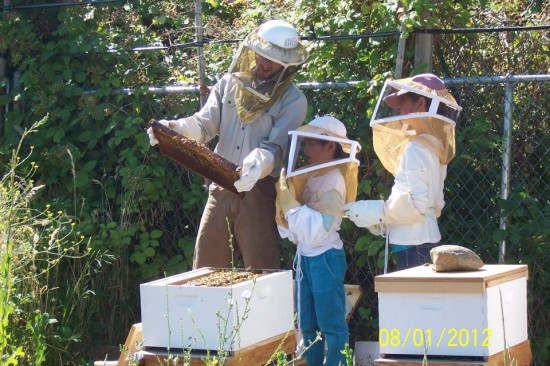
Washington to Oregon to Montana, teachers and administrators have recognized the importance of connecting their students to pollination through their studies of insects and food systems. Some have even gone a step further, installing beehives on their campuses and exposing students to an incredible ecosystem buzzing with tens of thousands of honeybees. CLEARING has sought out these “Honeybee Heroes,” educators who are exposing students of all ages to the wonders of honeybees. Stay tuned for our five-part series, where you will learn and be inspired by the stories of Eric, Ryan, Sarah, Carter, and Brian, all speaking to the impact they have seen in using beehives, or apiaries, as hands-on educational sites and their experiences in establishing successful educational models in schools.

Mt Vernon, Washington
First you will hear from Eric Engman, a high school physics teacher in Mt. Vernon, WA who has made it possible for students to really “see” the inner workings of a beehive.
.
.
.
.
.
.

Southern Oregon University
Our second installment will be about Ryan King, a recent graduate of Southern Oregon University, where he has established a successful apiary project at the university and beyond.
.
.
.
.
.
.

Ashland
Third is Sarah Red-Laird, also known as “Bee Girl,” an Ashland, OR native who has returned to her hometown to foster a “sweet” relationship between people and honeybees.
.
.
.
.
.
.

Portland
Next is Carter Latendresse, a sixth grade English teacher at Catlin Gabel School in Portland, OR who kickstarted a successful apiary project on his campus in harmony with the school’s garden and orchard. Coming October 21.
.
.
.
.
.
Finally, Brian Lacy is a beekeeper in Portland, OR and founder of LiveHoneyBees.com, an educator who has proven himself as an invaluable mentor for Portland-area beekeepers young and old. Coming October 28.
.
# # #
Katie Boehnlein is a writer/intern for CLEARING magazine. She is currently student teaching at the Catlin Gabel School in Portland, Oregon, and she writes a nature blog at http://kboehnlein.wordpress.com/.
Pollinator Education Resources
by Katie Boehnlein
Are you buzzing to get your hands on a hive tool? These resources below will get you started on connecting your students to the wonders of pollinators. If you’re looking to start a beehive on campus, start by contacting your local bee club to see when they offer beginning beekeeping classes.
Educators at a pollinator education workshop in Kalispell, MT put on by the Montana Pollinator Education Project.
Montana Pollinator Education Project (MPEP)
Visit the Montana Department of Agriculture (http://agr.mt.gov/agr/Programs/AgClassroom/LessonPlans/SchoolProjects/K-8montanapollinator/ ) website for full lesson plans, posters, seed packets, and parent outreach materials about pollinators for educators to use free of charge! For educators in Montana, the MPEP puts on workshops on how to integrate pollinator education into their existing science, language arts, and arts curriculums. The response to this project has been overwhelmingly positive, as the MPEP have been sending kits to teachers all across America; they have even had requests from overseas! All lesson plans are aligned with the Common Core standards, so teachers can easily fit the writing assignments into their existing curriculum.
USFWS Biologist Jeff Chan shows a honeycomb to students at GruB in Olympia, WA. Photo credit: Teal Waterstrat (USFWS)
U.S. Fish and Wildlife Pollinator Education Program
The U.S. Fish and Wildlife Service offers extensive educational information about pollinators on their website, from activity guides to PowerPoint presentations to a guide for creating schoolyard habitats. (http://www.fws.gov/pollinators/ ) The Fish and Wildlife Service in Washington State has also fostered a rich relationship with an alternative high school farming nonprofit called Garden Raised Urban Bounty (GRuB) in Olympia, WA. Fish and Wildlife biologist, Jeff Chan, has given classes and placed hives at their farmhouse, which has culminated in twenty of the students tending one of the hives themselves. The farm school will be integrating beekeeping into their school’s curriculum in the years ahead. Read more about this partnership on the blog for Fish and Wildlife Service members in Washington State. (http://wordfromwild.blogspot.com/2013/06/how-sweet-it-is-fws-teaches-students.html )
The Pollinator Partnership
The Pollinator Partnership is a nonprofit organization that aims at protecting the health of managed and native pollinating animals living in North America. They offer a comprehensive pollinator education program for grades 3-6 called “Nature’s Partners,” along with many other resources available for free on their website! (http://pollinator.org/beesmart_teachers.htm )
The Xerces Society
The Xerces Society is a nonprofit organization that protects wildlife through the conservation of invertebrates and their habitat. For over forty years, the Society has been at the forefront of invertebrate protection worldwide, harnessing the knowledge of scientists and the enthusiasm of citizens to implement conservation programs. They feature some great resources for educators on their website, spanning information about school gardens to native bees to pollinator identification sheets (http://www.xerces.org/educational-resources/ ). The Xerces Society also provides information on citizen monitoring, a wonderful, real-world science activity to do with students. One idea would be to follow the “Great Sunflower Project” curriculum, which involves planting sunflowers and observing pollinators that visit them. (http://www.greatsunflower.org/)
Immense Possibilities
Last year, Southern Oregon Public Television aired an inspiring 30-minute video called “Bees: nurturing the tiny connectors of sustainability,” featuring our “Honeybee Heroes” Sarah (BeeGirl) and Ryan King. (http://www.immensepossibilities.org/ipr-podcasts/bee-keeping ) “How can we help the bees survive?” they ask. It’s up to us to answer.
College Beekeeper
This website, managed by Michael Smith of Cornell University, is aimed at college students who want to start a student beekeeping program. An incredible resource with step-by-step advice, College Beekeeper could be adapted for an elementary or middle school context as well. It also calls for action: “With pollinators declining, and beekeepers aging, it’s essential to get younger people involved in beekeeping.” (https://sites.google.com/site/collegebeekeeper/)
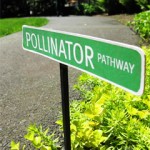
Photo credit: Studio Matthews
Seattle’s Pollinator Pathway
For Seattle-area teachers, the Pollinator Pathway project aims at creating continuous habitat where pollinators can thrive. The current pathway “draws a line of plant life” for one mile along Columbia Street in Seattle and is an inspiring artistic and scientific model for creating pollinator habitat within a city. This would be a neat idea for teachers looking to connect their pollinator education to art and mapping studies! For more information, visit the Pollinator Pathway website. (http://www.pollinatorpathway.com/ )

by editor | Aug 21, 2013 | K-12 Classroom Resources
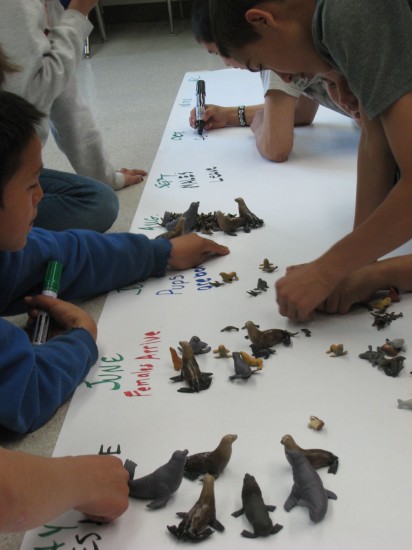
Middle school students from St. Paul School, Alaska, discuss a timeline of the northern fur seal’s annual cycle, moving plastic animals to show how the fur seal rookery structure changes over the year.
by Lisa Hiruki-Raring
AFSC Education Coordinator
Alaska Fisheries Science Center
National Marine Fisheries Service, NOAA
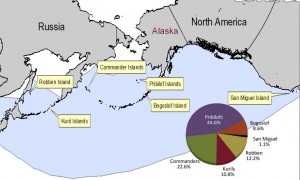
 n a small group of islands in the middle of Alaska’s Bering Sea, half of the world’s population of northern fur seals gathers each summer to breed on crowded rookeries, alive with the calls of mother fur seals, their pups, and adult males defending territories. The Pribilof Islands, legendary to the Russians of the 1700s for their wealth of seal pelts, were the central location of the commercial harvest of fur seals from the mid-1700s until 1984. The northern fur seal has always been an integral part of the history, culture and ecosystem of the Unangam (Aleut)
community in the Pribilof Islands. Although the Unangan knew of the Pribilof Islands, there were no settlements there until Russian fur hunters moved the Unangan from the Aleutian Islands to the Pribilof Islands to harvest fur seals for them in the mid-1700s.
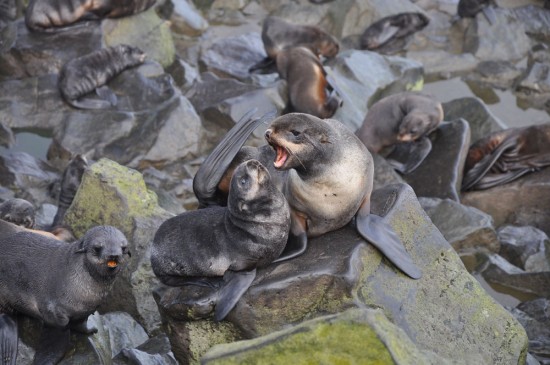
A female northern fur seal calls to her pup on the rookery.
Because of the northern fur seal’s significance to the people of the Pribilofs, the Aleut Community of St. Paul Island-Tribal Government (TGSPI) and the Pribilof School District wanted to develop a comprehensive northern fur seal curriculum to address northern fur seal natural history, the cultural importance of northern fur seals to the Unangan, the history of the fur seal commercial and subsistence harvest, and research, conservation, and sustainability of the northern fur seal population.
A Collaborative Effort
Educators from the National Oceanic and Atmospheric Administration’s Alaska Fisheries Science Center (NOAA/AFSC) in Seattle, WA worked closely with the Pribilof School District and TGSPI to develop “Laaqudax, the Northern Fur Seal,” a curriculum integrating science, math, language arts, culture, history and art into an engaging course on northern fur seals. With funding to develop the curriculum provided by NOAA and the Central Bering Sea Fishermen’s Association (CBSFA) of St. Paul Island, the curriculum was truly a community effort.
Local Relevance
AFSC educators are in a unique position to create this curriculum. Federal government scientists have been studying fur seals on St. Paul and St. George Islands in the Pribilof Islands for over 100 years, with data extending back to government counts of fur seals in the 1920s, and commercial harvest records extending back to 1867. AFSC educators worked directly with NOAA Fisheries researchers and TGSPI staff to incorporate current research and traditional ecological knowledge into the Pribilof School District science curriculum while encouraging stewardship of the natural environment.
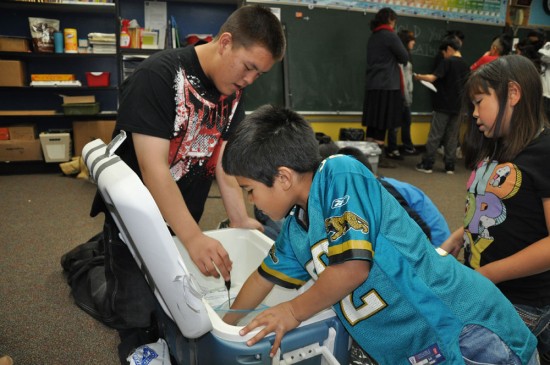
7th grade students help 4th grade students investigate adaptations to diving.
A challenge in creating the curriculum was that rural schools in Alaska often have high educator turnover, and most new teachers from outside Alaska are unfamiliar with local ecosystems and Alaska history. Additionally, even teachers who have worked in rural Alaska for many years may not have any basic knowledge about the animals closest to their schools. To address this need, the northern fur seal curriculum provides information and activities that can be taught by teachers without background knowledge of the Bering Sea ecosystem and Unangam culture. The curriculum also incorporates traditional ecological knowledge and cultural perspectives and provides activities across several subjects so that teachers can meet educational standards in a variety of areas while focusing on northern fur seals. For example, Lesson 1 (“What is a fur seal?”) includes activities on taxonomy and classification (science and math), graphing (science, math), a Venn diagram (science, math, language arts), a diagram of seals labeled in Unangan (science, culture), a writing exercise to describe a seal (science, language arts), and a physical activity about how seals and sea lions walk and swim (science, physical education).

8th grade students count seals…
A Curriculum with a Multi-grade Structure
The curriculum was developed as a spiraling curriculum, a curriculum that uses the same subject area for all grades but goes into deeper levels for older students. For example, kindergarteners learn that fur seals eat fish,
while middle schoolers use reference keys to identify fish bones from fur seal diet samples, and high schoolers analyze actual data to compare what fish are eaten at different fur seal rookeries on the Pribilof Islands. The curriculum is structured so that the first three lessons introduce students

…and a 6th grade student records observations at the rookery.
to fur seals, the Unangam people and culture, and fur seal rookeries. Subsequent lessons tackle what fur seals eat, adaptations to diving, and winter migrations. Middle and high school students have more complex and data-driven exercises, including lessons on the commercial harvest of fur seals, population management, and the Marine Mammal Protection Act. All lessons and activities have been aligned to Alaska State Educational Standards and Ocean Literacy Principles, and will be aligned to the new Common Core Standards and the upcoming 2013 Next Generation Science Standards.
Testing the Curriculum
In September of 2011 and 2012, AFSC educators worked with students and teachers from St. Paul School to test activities from the northern fur seal curriculum. Whenever possible, teachers are encouraged to collaborate and teach across subject areas, to promote interactions between students from different grades. In 2012, high school students studying Russian read Rudyard Kipling’s story “The White Seal,” talked about the origins of the names of the characters in the story, wrote the names in Cyrillic script, and discussed whether events depicted in the story were accurate or fictional. Language arts students in 10th -12th grades compared a timeline of events (1700s to the present) from a St. Paul Island community perspective to a more general historical timeline, then joined the 9th grade math class, who had graphed fur seal commercial and subsistence harvest numbers from 1860-2010. Together, the students looked at how the historical events coincided with fluctuations in commercial fur seal harvest numbers and discussed subsistence harvest from the 1980s-2010.
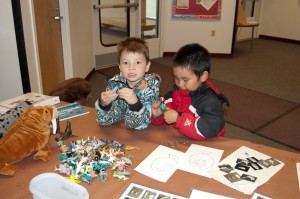
Students and parents investigated fur seal activities during the parent-teacher conference day.
Highlights of the curriculum testing included:
• middle school students helping younger students learn about adaptations of fur seals for diving
• high school students creating rubber stamps of fur seals and helping first, second and third grade students make murals of a fur seal rookery with the stamps
• field trips for seven classes (K-12) to visit the observation blind at a fur seal rookery near the school, where students observed fur seal behavior and discussed the difficulties scientists have to accurately count seals at the rookery
• community outreach during parent-teacher conference day, where fur seal activities were set up in the school lobby to engage parents
• presenting an overview of the curriculum to all teachers from St. Paul and St. George schools during a school inservice day
• teaching students from St. George School (10 students, 1st-10th grade) by videoconference
• an impromptu lesson by students on how to use an Aleut yoyo (a fur seal rib bone, twirled around the index finger)
Students and educators learned a great deal from one another: educators learned about the process for stretching and drying the fur seal throats (esophagus) to make traditional Unangam clothing, and high schoolers engaged in a spirited discussion of the subsistence harvest and the role it still plays in their lives. Through the 2 ½ years of development of this curriculum, NOAA fur seal scientists have also taken part in educational and summer camp events with the school and community on St. Paul Island, using fur seal activities for informal education. The success of this project is due to the collaboration of its partners, each of whom brought different skills and perspectives to the development of the curriculum.
Access and availability
Once the curriculum is complete, it will be available free of charge on the AFSC education website (http://www.afsc.noaa.gov/education/), in two grade bands (K-6 and 7-12). The elementary curriculum will be available in early 2013; the middle/high school curriculum’s estimated date of completion is fall 2013.
_____________________
SIDEBAR: Evaluation and Assessment
Because the curriculum is in the final stages of development, a formal evaluation and assessment framework has not been completed. Short-term evaluation of material is conducted by individual teachers (e.g., writing assignments and quizzes), and most activities have some aspect of assessment in the form of worksheets and maps. The AFSC educators have been evaluating the effectiveness of specific activities through focal group discussions with teachers and individual feedback from students and teachers. The structure of each class is unique every year in small rural schools, depending on the number of students in each grade. For example, at St. Paul School (K-12 population 88 students), the elementary classes in 2011 were K-1, 2-3-4, 5-6, while in 2012 the elementary classes were K, 1-2-3, 4-5, 6. In small schools with multi-grade classes, it is more flexible to have teachers conduct short-term evaluation of results rather than to have a program-developed assessment. AFSC educators will work closely with Pribilof School District educators to develop a long-term evaluation plan to track knowledge retention of students from one year to the next.

by editor | Jan 26, 2013 | K-12 Classroom Resources
.
 “Your class sure looked happy,” one of my colleagues remarked last week. And I agreed! They were very happy.
When the sun reappeared after a cold spell, I took my Nature Connections students outside for an activity that I was sure would be fun for them.
I’m a firm believer in fun in the learning process. And I’m not alone. Brain research has proven that students learn better when the lesson is fun and enjoyable. Not only does fun promote learning and long-term memory, it also increases dopamine and endorphins in the brain—the “feel-good” neurochemicals.
To be clear, fun doesn’t mean relaxing or goofing off. “Fun means engagement, doing and learning what has meaning and purpose, and it means challenge.” (Daniel Pink, author of Drive).
Renowned psychiatrist Dr. William Glasser states: “There are four psychological needs that we are individually driven to satisfy: the need to belong (sense of community), the need for power (control over ourselves and our environment), the need for freedom (lack of restrictions), and the need for fun (pleasure and enjoyment). These are things that we need in our lives almost as badly as food and shelter.”
As teachers, we can help satisfy these needs for our students through the way we structure our classrooms and our lessons. I focused on FUN last week. Below are some fun ideas you might like to incorporate into your classroom.
Inside: Fun and Unusual Animals
 Kids love animals, and they’re a source for so many “fun facts.” Especially when the animals themselves are really unusual. There’s Baribusa in My Bathtub: Facts and Fancy About Curious Creatures by Maxine Rose Schur is full of humorous rhymes and magical illustrations that illuminate the lives of little-known animals.
There’s a loris in your chorus? He’s quite a singer!  Care to play bingo with a dingo? Watch out, he’s a sharp one. A babirusa in your bathtub? Better leave him there – he loves water!) Witty, lively poems makes learning about these unsung animals fun—and fun to imitate by writing similar poems about well-known animals.
Outside: Creating Blobsters
 A Blobster is an imaginary creature that is made of clay and natural items. The picture shown here is a Blobster I made as a sample for my students.
Here are the steps I used in my lesson:
- Because we had been focusing on recycling in the classroom, I began this lesson discussing natural objects that can be recycled.
- I showed my sample Blobster and asked students to identify the natural objects I used to create it. We then made a list of some of the natural objects found on our playground that could be recycled to create a Blobster.
- I gave each student a small paper bag and took them outside. They had about 10 minutes to collect natural items.
The following steps may be done inside,  but my students had fun creating their Blobsters outside:
- We gathered at picnic tables on the playground, and I gave each student a “blob” of clay. (I used about 1/2 pound per student. You can use modeling clay, but I chose to use clay that would air-dry because I wanted the Blobsters to harden. It was also much less expensive than modeling clay.)
- Students had 25 minutes to create their Blobster. I reminded them to firmly push the natural items into the clay, because the clay would shrink as it dried. They discovered that some items were much more difficult to adhere to the clay than others.
- I knew some would finish in a hurry, so I had enough clay for those students to create a second Blobster—a “Blobster Buddy.”
- I had several shallow boxes on hand, and students put their Blobsters in the boxes to transport back inside.
- A few days later, when the Blobsters were completely dry, we had a Blobster Display and students admired the work of others. I ended the Blobster activity with a science/writing project about the four basic needs of all animals, which is described under More Facts and Fun with Animals.

Note: Although one side of the school still had some snow on the ground, the other side was in the sun, and kids found an abundance of dried leaves, bark, twigs, pine cones, dried seeds, and stems to use.
More Facts and Fun with Animals
All animals have four basic needs: food, water, shelter, and safety. Use the pdf Wildlife All Around Us, to introduce these needs to your students. Once they understand the terminology, have them fold a piece of white paper into 4 quadrants, labeling each quadrant with one of the basic needs. With words and/or pictures, have them show how their Blobster meets its basic needs. On the back of the paper (or on a fresh sheet), have them do the same thing for an actual animal.

Have students create a story about one of the animals found in Nature’s Patchwork Quilt: Understanding Habitats by Mary Miche. Then have them weave the four basic needs into their story in an interesting way.

David Rice, in his book Do Animals Have Feelings Too?, has collected true stories of animal behavior that is not only captivating, but also thought-provoking.
Photo sources: Dawn Publications, Carol Malnor, Brad Montgomery, Colleen Webb
by editor | Dec 5, 2010 | Place-based Education
Exploring Place-based Education Programs in the Pacific Northwest
by Becs Boyd
On 8th May I meet Ed Armstrong, grant writer for Tillamook School District, outside Tillamook High School in north-west Oregon. I’m here to find out about the amazing work Ed and others have been doing in connecting the six schools in the Tillamook School District with their community and with School Districts State-wide.
Ed’s background is as a biology teacher at Tillamook HS from 1995-2000 when the school was one of 25 national Annenburg Schools for science. He returned after a break in 2004 to become grant writer for the entire School District, and, using this wider influence and the $6m of grants he has secured, has been at the centre of a small revolution in science teaching in Tillamook which has been internationally recognised. (more…)
by editor | May 19, 2010 | Climate Change & Energy, Conservation & Sustainability, Equity and Inclusion, Gardening, Farming, Food, & Permaculture
The symbolic act of learning and living sustainability in the future should intermingle the fabric of natural systems and human made social systems
by Pramod Parajuli, Ph.D.
Doctoral Program in Sustainability Education
Prescott College
Introduction
The hundreds of thousands of initiatives of this blessed moment are not about the bread and butter, or just about the soil and water alone. Art and the things of beauty are emerging from the most ordinary—a permaculture household in El Salvador, a thread of garlic organically grown in the Chino Valley, Arizona, a solar cooker in the remote Nepalese Himalayas, a Grameen Bank in Bangladesh, a sustainable fishing regulation in British Columbia, or a bag of coffee produced under the canopy of agro-forestry in Chiapas, Mexico. One solar cooker at a time, one biogas at a time, there are millions of solutions, sprouting amidst crisis and seeming chaos. The time has come as William Blake wrote:
To see a world in the grain of sand
And a heaven in a wild flower
What might all these imply as we prepare the future generations of learners, educators and leaders? The eight transitional insights I offer below testify that the symbolic act of learning and living sustainability in the future should intermingle the fabric of natural systems and human made social systems—two most complex systems on earth. A new sustainable human trajectory will not be of humans alone shooting to Mars; it will require re-rooting ourselves with all our multiple senses, and working along with all more than human species.
You must be a CLEARING subscriber to read the rest of this article. [password]
First, there is an Inviting Context: Climate of Change amidst Climate Change
By now, almost all have accepted that the climate change is real, undeniable, and is accelerating very fast. Most among us also admit that climate change is caused largely due to the way we live our lives, the ways we extract, use and waste our resources. Many also agree that it is urgent to address it from all dimensions. Fortunately, ferocity of these very real crises are accompanied by a “climate of change.” This is the focus of my paper here, a unique opportunitythat accompanies climate change.
The “climate of change” is evident in the way hundreds of thousands of people and groups who are already involved in changing the way we have been doing things, living our lives or using our tools. In his new book, Blessed Unrest, Paul Hawken estimates that worldwide there are at least 2 million such initiatives. Maybe there are more, certainly not less.
Second, learning sustainability should help us live lives and be well in the World.
Let me offer a working definition of learning sustainability. Learning sustainability is “an art and a process that could reorient human beings to become a beneficial member of an abundant biosphere.” First, it is an art and a process. Second, the intent of this art and process is to reorient humans from one mindset/worldview to another that will then lead to new visions, dreams and designs. Third, humans can be beneficial members of the biosphere and that the human needs and that of the biosphere do not have to be in conflict but can be mutually enhancing. Fourth, the biosphere is abundant and based on that we can create foundations for an abundant and equitable human life. Fifth, that we can prepare the next generation who can be beneficial members and who can make the biosphere abundant.
As sustainability educators, at the core of our concern is nothing less than “life” itself. For me the message is loud and clear: We can be resilient and bounce back towards a sound and satisfying life systems for humans and other-than-humans. But as the author of Biomimicry, Janine Benyus, advises, we have to learn from our own evolutionary trajectory and the memory line of DNA. She reminds us to be humble of our techno-industrial accomplishments because other organisms have done everything we humans want to do without guzzling fossil fuels, polluting the planet, over harvesting water, depleting soil or mortgaging their future. For example, how do other species clean themselves and why do humans need soap, shampoo and hot water to clean? Rather than asking “What is the least toxic detergent to use?”, a more hopeful question, Janine Benyus, suggests, might be: “How does nature stay clean?” How does nature thermo-regulate? How could our ecological designs be informed by these biophilic insights?
Third, Food and Gardens could be a Gateway to Deep and Delicious Social Engagements
For the last six years, I was involved in designing and implementing the learning gardens experiment in Portland, Oregon, and now in Prescott, Arizona. We found that engaging children and youth in food and garden can offer avenues for a mode of learning that is multicultural, multisensory, interdisciplinary and intergenerational (Parajuli, 2006; Parajuli , Dardis and Hahn, 2008).
We have been a pioneer in developing curriculum for K-8 children and youth who learn at any point in the continuum between, what I call the “soil to supper, and back to Soil
(the SoSuS) loop. The SOSuS Loop not only connects children and youth with the earth, it also connected people to people, communities to communities (Parajuli, 2009). We then explore the continuum between “food to foodshed” and “water to watershed.”
Our initial conclusion is that if designed carefully and tended with heart, learning gardens may offer a series of benefits to enhance and deepen learning:
• impact a school’s physical as well as learning environments
• lead to academic enrichment and achievement for students
• enrich learning of the whole child
• cultivate and nurture motivation, resiliency and leadership among children and youth
• promote multi-sensory learning
• be applicable to grade by grade, subject by subject, and season by season instruction and learning
• use recurring themes over K-12 span of experience
• effectively link ecology, culture and learning
• enhance interdisciplinary inquiry
• address and fulfill academic benchmarks
• provide the seasonal framework for learning
• teach both time (linear and cyclical) and a sense of place
• link experience to meaning, thought to action and classroom to community
• be the best sites for inter- and intra-generational learning, and
• connect/collaborate with the larger food and garden community
Not only in the arena of nutrition and learning, our engagement in food, water and soil can take us towards a mode of social engagement that is not only “deep” but also “delicious.” Interestingly, the flavor of local, organic, and sustainable food economy is much more alive in urban centers than in rural farms and communities. Here again we are witnessing the melting of the old fences that divide the rural from urban, industry from agriculture, soil from food and people from the planet. By changing our food habits and preferences, we are witnessing a wide-ranging and a deep process of change from the very belly of the techno-industrial beast and what the food author Michael Pollan calls, the nutritional/chemical complex. Transition towards local and sustainable food could give us the most delicious inter-economic partnership, as premised in the diagram below.
Fourth, Enhance Maximum Partnerships to create a world that is not only Ecologically Sustainable, but also Socially Equitable and Bio-culturally Diverse.
For the last seven years, I have developed and used a “Partnership Model of Sustainability” as a guide to practice pedagogy for transformational leadership among the new generation of learners and leaders. This model addresses the issues of economy and ecology on the one hand and equity and bio-cultural diversity on the other.
A brief description of the four partnerships follows.
Intra and Inter-generational partnership: Explores social classes, gender, caste, race, ethnicity and other human created institutions and practices of social inequities and cleavages. Attention to intra and inter generational equity and partnership is urgent because inequality is also at the core of current ecological crisis.
Inter-species Partnership: Addresses ecological, philosophical and ethical aspects of human’s relationship with the more than human worlds. I am teaching that we humans are nature in microcosm. “We are nature in every molecule and neuron,” says Paul Hawken. “We contain clay, mineral and water; are powered by sunshine through plants; and are intricately bound to all species, from fungi to marsupials to bacteria. In our lungs are oxygen molecules breathed by every type of creature to have lived on earth along with the very hydrogen and oxygen that Jesus, Gautam Buddha and Rachel Carson breathed” (Hawken, 2007:71-72).
Inter-cultural Partnership: Examines the field of biological, cultural, and linguistic diversities and the inextricable relations between the three. It is about recognizing what I call the “ethnosphere,” the diversity of knowledge systems and diverse ways of knowing, teaching and learning.
Inter-economic Partnership: Includes mapping and reshaping of the global North and South as well as the social and economic institutions, trade, arrangements for exchanges and surplus, fair trade and free trade, rural and urban, agriculture and industry, raw and processed materials, and producers and consumers. Moreover, water, food and soil will be one of the most critical elements in the future of humanity.
Fifth, Learn and Lead for both Biospehric and Ethnospheric Health.
Through a deeper probing of the partnership model of sustainability, I have learned that no human solutions could be found by just rearranging the human world. We need to reshape our relationship with the more than human world. In the same way, ecosystems regeneration could not also be achieved by “fencing off” humans from the so called pristine natural areas but by changing how humans live their lives (Parajuli, 2004; 2001 (a and b). Thus our challenge is how to maintain the delicate balance between biospheric health and ethnospheric health.
In order to create the confluence between the three realms, the learning environment should be multisensory, multicultural and intergenerational such that it fosters interdisciplinary inquiry. Much ink has been dried writing about multicultural education, as if adequate solutions were found simply by rearranging human relations, in race, class and gender terms. While that is absolutely necessary, it is tragically inadequate. I realize that the future lies in multi-sensory pedagogy that nurtures our multi-sensory engagement in and with the earth. As eco-philosopher David Abram awakens us: “The fate of the earth depends on a return to our senses.”
Sixth, Learning should inculcate Integral Visions and Designs
The readers of this journal have worked miracles in the outward-bound and experiential education fields. But most of this genre is poised as antithetical to skills needed for what I call the “homewardbound.” On the other side, many of us have worked in creating sustainable livelihoods, through agro-ecology, permaculture, fisheries, sustainable industries and such. These homeward-bounders have hardly any time to enjoy raw nature, like the “outwardbounders” do.
There is hardly any dialogue, sharing and mutual learning between the two genres. Such isolation does not allow us to find integral visions or integrative solutions. In other words, how could we bring the David Thoreau(s) and Wendell Berry(s) in the same imagination? Vandana Shiva(s) and Jenine Benyus(s) at the same table? I urge us to develop such learning designs that connect the outward-bounders with the homeward-bounders, the wild with the domestic, nature with culture and the forest with the farm. A deeply and truly integrative vision and design is needed to heal the wounds that have been inflicted between the cities, where most of the consumption happens, and the rural where most of the production happens. The same could be accomplished between the industrial sector that eats up bunch of raw materials and agriculture where such raw materials are sustained. How could we bind the buyers and the producers by the same thread of ecological health, diversity, justice and integrity?
Seventh, let us move from Discourse to Design
My students tell me that they want to learn deep sustainability in product as well as process, in content as well as the method of inquiry. I am convinced, it is not by saturating them with discursive pessimism (even when substantiated with facts) but cultivating in them incurable optimism but which is informed by reliable dreams and viable designs. In my courses, such as Leadership for Sustainability, Sustainability Theory and Practice, Modes of Scholarly Inquiry, each student begins to articulate his/her wildest dream that they want to achieve in ten years. Then they follow a 4Ds protocol: Diagnosis, Dream, Design and Delivery. It is important that we embrace diversity of learning needs of each student and let them grow into their own space and dreams. But push them to the wildest side, we must.
Eighth, Cultivate Leadership in the open Space of Democracy
Terry Tempest Williams has articulated the notion of open space of democracy for our turbulent times. She writes: Open space of democracy is interested in circular, not linear power—power reserved not for entitled few but shared by many (Williams 2004). I also want to introduce a fairly new book by Otto Scharmer, entitled, Theory U: Leading from the future as it emerges. To begin with, Otto asks us to have open mind, open heart and open will. Only when we let go of the old habits, dreams and designs (the left line of the U), we can transition towards letting come of the new habits, designs and dreams (the right line of the U). The bottom line of the U is the incubation process between the letting go and letting come.
I urge the readers, you draw a U and practice for yourself.
Selected References
Benyus, Jenine. (2004). “Biomimicry: What would nature do here?” in Nature’s operating instructions: The true biotechnologies. Ausubel, K. and Harpignies, J.P. (eds). San Francisco: Sierra Club Books. PP 3-16.
Capra, Fritjof. (2002). Hidden Connections. Integrating the Biological, Cognitive, and Social Dimensions of Life into Science of Sustainability. New York: Doubleday.
Hawken, Paul. (2007). Blessed unrest: How the largest movement in the world aame into being and why no one saw it coming. New York: Viking (published by the Penguin Group).
Jones, Van. (2008). The green collar economy: How one solution can fix our two pressing problems. New York: Harper Collins.
Parajuli, Pramod. (2009). Greening Our Cultures: Emergent Properties of Life and Livelihoods, Learning and Leadership. Manuscript. Prescott College.
Parajuli, Pramod. (2006a). “Learning suitable to life and livability: Innovations through learning gardens” Connections 8: 1: 6-7.
Parajuli, Pramod. (2006b). ‘Coming home to the earth household: Indigenous communities and ecological citizenship in India” in J. Kunnie and N. Goduka Eds. Indigenous Peoples’ Wisdom and Power. London: Ashgate. pp. 175-193.
Parajuli, Pramod. (2004). Revisiting Gandhi and Zapata: Motion of global capital, geographies of difference and the formation of ecological ethnicities. in Mario Blaser and Harvey Feit eds, In the way of development: Indigenous Peoples, life projects and globalization. London: Zed Press. Chapter 14. pp. 235-255.
Parajuli, Pramod. (2001). How can four trees make a jungle? The world and the wild. Tucson: The University of Arizona Press. pp. 3-20.
Parajuli, Pramod, Dardis, Greg and Hahn, Tim. (2008). Curriculum Development and Teacher Preparation for the Learning Gardens. A report submitted to the Oregon Community Foundation.
Shiva, Vandana. (2006). Earth democracy. Boston: Southend Press.
Stone, Michael. K and Barlow, Zenobia. (eds.). (2005). Ecological literacy: Educating our children for a sustainable world. San Francisco: Sierra Club Books.
Williams, Terry, Tempest. (2004). The open space of democracy. Barrington, MA: Orion Society.[/password]
Pramod Parajuli is the Director of Program Development in Sustainabililty Education at Prescott College in Arizona. He has designed and developed various academic and community empowerment programs including the Learning Gardens and the Leadership in Ecology, Culture and Learning (LECL), a graduate program at Portland State University, Portland, Oregon (2002-2008). At Prescott College, he is incubating several new innovations that could build on its forty years of accomplishments and seek new heights and horizons.

 Honeybee Heroes


