by editor | Oct 23, 2014 | Language Arts
The Power of Storytelling:
Earth Tales and Activities
Show the Way for Living in Balance
by Michael J. Caduto
©2014 All Rights Reserved
From Siberia to the tip of South America, and from Africa to Polynesia, stories have grown from the very Earth upon which they were first told. Through these tales, the natural world speaks to the people who walk upon it and who use it to stay alive. But stories have wings, too, which loft them upon the winds of our imaginations.
Traditional tales contain the wisdom that countless generations have harvested by living close to the land, growing their own food and making the things they needed with their own hands. In order to live, they had to take care of the soil, the water, the plants and the animals. As the stories show, people eventually learned that the harm they caused the world around them would one day come knocking on their own door. The care they showed would be returned in kind with food, clean air and water, and materials with which to fashion tools and other necessities. In this way, stories are a kind of medicine, a way of healing the wounds of life.
In many stories it is clear that traditional cultures believe that all of nature is alive: those things that move, and those that do not. There is a breath of life in a tree, a hawk and the long wind that blows across open places and gently bends blades of grass. A spirit lives in the shadow that grows between the hills as the sun sets, in the rocks of the hills themselves, in the moon that rises into a starry sky, in the sweet smell of a flower and in the joy of a newborn fawn. Over and over in the old tales we read of the common faith in a benevolent, unseen Creator of the wonders that surround us. Like the natural world, stories are sacred and are treated with respect and reverence.
We All Have Native Roots
No matter what culture, or cultures, our ancestors come from, traditional stories can help us trace our roots back to their source. We all have ancestral ties to Native peoples who lived close to Earth. Their wisdom lies deep in our memories. One common thread that runs through the stories is the belief that we are a part of nature, and that the community of people and the natural world depends upon a mutual, respectful relationship. Although we cannot help but change our environment as we live in it and use its resources to keep us alive, we can do everything possible to have a positive impact and nurture the natural world.
Besides entertaining and helping to teach moral lessons, stories help to explain the natural world; they carry on our spiritual beliefs, our artistic traditions and the particular ways we use language. The wisdom of Earth stories is both a link to our past, and a lifeline to the beautiful, healthy Earth we want to leave as a legacy for future generations.
Earth Tales and Activities
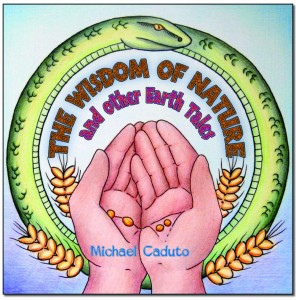
In this section I present “The Wisdom of Nature,” an original retelling of a traditional Swahili story from Kenya, Tanzania and Zanzibar in eastern Africa. The story is adapted from my book Earth Tales from Around the World and it appears on my storytelling CD, The Wisdom of Nature and Other Earth Tales. The accompanying activities are designed for children of ages 5 to 12. As with all stories in Earth Tales, the activities suggested in the back of the book can be created and adapted to suit the home environment of the intended audience. These particular activities are oriented to the plants and animals of North America and are adapted from the book Keepers of the Animals: Native American Stories and Wildlife Activities for Children.

This introduction and story, “The Wisdom of Nature,” are used with permission from Earth Tales from Around the World, ©1997 by Michael J. Caduto (Golden Colorado: Fulcrum Publishing). The story also appears with permission from the storytelling CD: The Wisdom of Nature and Other Earth Tales, ©2014 by Michael J. Caduto (Luna Blu®). The activities, ©1991 by Michael J. Caduto, are adapted with permission from Keepers of the Animals: Native American Stories and Wildlife Activities for Children, by Michael J. Caduto and Joseph Bruchac (Fulcrum Publishing). The illustration by Adelaide Murphy Tyrol is used with permission. Activities may be used only as needed for normal classroom use. Written permission is required from the author to copy this story and introduction in any form from: Michael Caduto, P.O. Box 1052, Norwich, VT 05055, USA. Phone: (802) 649-1815. Copies of these books and information on related books, music and programs can be obtained at the P.E.A.C.E.® website: www.p-e-a-c-e.net
The Wisdom of Nature
Swahili (Tanzania)
©2014 by Michael J. Caduto
All Rights Reserved
 In the thick brush at the edge of the hill country lived a magnificent snake. Its eyes blazed and the scales that covered its skin were as hard and strong as any shield. Venom flowed from its long, curved fangs. In the moment of its hunger, this huge, powerful snake devoured any wild animal it desired.
One day, the snake sat sunning itself in a small clearing. Being close to the ground, the snake sensed a roar in the distance. Its tongue picked up a strong scent. Upwind, some young hunters were burning the brush to drive the game animals into the open. Crackling flames rushed toward the snake
As it searched for refuge, the snake slithered out of the low brush and into the open along the border of a farmer’s fields.
“Please help me hide,” asked the snake. “The hunters are coming. They will kill me.”
When he saw the snake, the farmer was afraid.
“Do not fear me,” the snake called out to the farmer. “I will not harm you.”
The kindhearted farmer took pity on the snake, as he did on all animals that were in need of help.
“Quickly,” said the farmer as he opened the mouth of a large, empty grain bag, “crawl into this sack. The hunters will never think to look for you here.”
As soon as the tip of the snake’s tail disappeared into the mouth of the bag, some hunters approached. They were following the faint trail left by the snake’s belly as it slid along the ground.
“Have you seen a large snake come this way?” they asked the farmer.
“No,” he replied. “I have been working here all morning and have seen no sign of a snake. You must be reading an old trail.”
“Thank you,” said the hunters, and they walked on. When they were a safe distance away, the farmer opened the grain bag and whispered, “Come out, the danger has passed.”
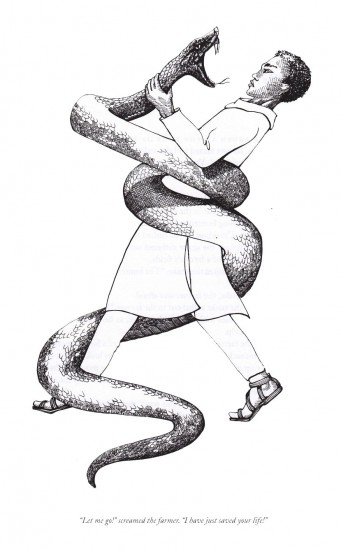
The snake crept out of the sack, threw its coils around the farmer and held him fast.
“Let me go!” screamed the farmer. “I have just saved your life!”
“That is true,” replied the snake. “But I have not eaten for many days. You will make a good meal.”
“Then you will not let me go?” asked the farmer.
“No, I am starving.”
“Before you eat me,” said the farmer, “you could at least repay me for saving your life.”
“That is only fair,” said the snake. “I agree. Now what do you desire?”
“Let us have others decide whether you should eat me.”
“If that is your wish, so be it,” agreed the snake.
The snake followed the farmer to the edge of the field where a coconut palm tree had been planted. The tree listened carefully as each of them told his side of the story.
“Well,” replied the coconut palm, “I know the nature of human beings. They eat my nuts and drink the sweet milk inside. Some even use my leaves to thatch their roofs. Why should I save a human being? I say the snake should have its meal.”
“Let us ask the bee,” said the farmer.
“As you wish,” replied the snake.
“You must be joking!” replied the bee. “Human beings smoke us out of our homes and steal our honey. They never give us thanks. I have no compassion for the farmer.”
“Perhaps the mango tree down by the road will understand my plight,” thought the farmer. “Snake, let us go ask the mango to give us its judgment.”
“Lead on,” replied the snake.
Once it had listened to their stories, the mango tree spoke. “Year after year I stand here as generations of human beings pass by. They cool themselves in the shade of my branches and eat my fruit when they are hungry. Some break off my branches for firewood or to use as the shafts of spears for hunting the wild animals. Not once has a human being thanked me. Farmer, I see no reason why the snake should not eat you.”
“How could this be?” exclaimed the farmer. “Why should my life be such a trifle in the eyes of nature?”
At that moment, the farmer spotted a gazelle grazing along the riverbank. To the gazelle the farmer now pleaded his case.
In response to his story, the gazelle told a tale of its own. “I am often the difference between life and death for the human beings. Without my meat, they would starve and perish. Because I am so generous, people take me for granted. Your life, farmer, belongs to the snake.”
A baboon was listening from where it sat on the branch of a nearby tree.
“Every creature does what it must in order to survive,” said the baboon. That is the way of nature.”
“But what of the snake?” asked the farmer.
“One cannot blame the snake for its hunger,” replied the baboon. “Like you, the snake is part of the balance that exists in the world.”
A snake is meant to eat its prey,
it catches as it can.
Its food will try to get away,
escape’s the way of man.
“What, then, do you have to say about whether or not I should eat the farmer?” asked the snake.
“First, you must show me exactly how it happened,” said the baboon. “That sack does not look big enough to hold a snake as magnificent as yourself.”
The farmer then opened the bag and the snake crawled in.
“Are you able to close bag with the snake inside?” asked the baboon.
“Yes,” replied the farmer as he drew the cord tight and tied it securely.
“Now, farmer, we will see what you have learned,” said the baboon. “Once again, the fate of the snake is in your hands. Now what are you going to do about it, hmmm?”
Activities
Prey, Tell Me
“Every creature does what it must in order to survive,” said the baboon in this story. “That is the way of nature.” Indeed, each plant and animal has specific adaptations, physical (genetic) traits and behaviors that better enable it to survive and reproduce in its particular environment. Among animals, many survival adaptations relate to eating or being eaten.
Activity: Solve some riddles that describe the survival adaptations of some prey animals by guessing the animal’s identity.
Goals: Understand what a survival adaptation is and learn some defenses of certain prey animals.
Level: Ages 5 to 12
Materials: Riddles and kids.
Procedure: Discuss the meaning of interrelationships and give examples of different kinds of animal relationships. Be sure to include examples of animals that have both positive and negative effects on each other. Ask the children to think of their own examples.
Define and discuss the concept of survival adaptation with the children. Have them call out some examples of offensive adaptation of predators and defensive adaptations of prey animals.
Now tell them they are going to hear some riddles which describe some adaptations of animals that are often hunted as prey. With older children, have them come up and take turns reading the riddles. You will need to do the reading for young children. The riddles vary from easy to challenging.
PREY, TELLME (RIDDLES)
- My home is a burrow in the ground. I only come out at night when it is cool and damp and when I am not likely to be seen. Lots of animals, especially early birds, love to eat me, but I can scoot down my burrow quickly if someone tries to grab me, and I am very sensitive to vibrations in the ground. Don’t fish around too long for the answers?
I am a (worm).
- I am a great swimmer from the minute I am born, I float almost as well as a cork. If something comes after me I use my webbed feet and tiny wings to skate quickly away over the water. The predators who spot me and try to attack from below see down when they look up. You may see me eating plants or fish.
I am a (duckling).
- My long ears, keen hearing and sensitive nose help me to detect danger from far off. I can make a fast getaway if spotted. Still, I come out from sunset to sunrise with darkness as my cover. I have a habit of twitching my nose. My tail is short and my feet are lucky.
I am a (rabbit).
- I sing my song when summertime is aging and autumn is on the way. I don’t sing with my voice though. Some people know I wing it. My long antennae help me to sense when danger is around. Still, my kind often become lunch for birds, shrews and even tiny snakes. I might live under a rock or spend my time in a clump of grass.
I am a (cricket).
- You know me well around your garden. My skin is bumpy and bad to taste. I eat ants and flies with a long, sticky tongue. When you pick me up I release the contents of my bladder to startle you into putting me down.
I am a (toad)?
- My skin of scales is a good hint. I am small and quick with a colorful tail. When a predator comes and grabs at the tip, I snap it off like the flick of a whip.
I am a (skink).
Adapt and Survive
Adapting is not simply a matter of following a pre-determined program of adaptations like a robot. Many times, like the human being in this story, the animal that survives is one that can learn from its environment and make choices based on individual situations. For animals, threats can come from both the natural world and from the actions of human beings.
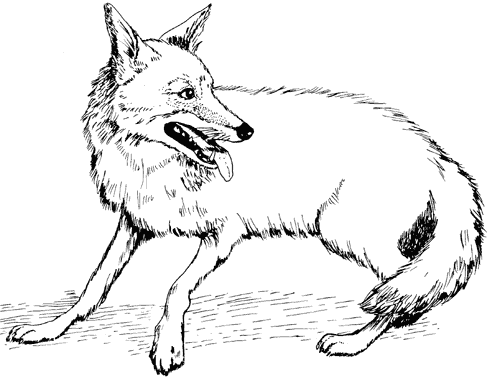
Activity: Play a game of choices to see if you are as adaptable as the coyote—to see if you can adapt to survive in a changing world.
Goals: Understand that change—both natural and human-made—is a normal part of an animal’s existence, and that adapting to change is necessary to survive.
Level: Ages 9 to 12
Materials: Copy or copies of “Coyote’s Choice: Adapt and Survive,” other materials as needed depending upon the format you use for this activity, such as a game for each child to play individually (one copy for each child), or a course that children will walk through while making the decisions (index cards, each with one of the numbered situations set up as separate stations and any props you may want to add to create a more life-like course for the children to experience).
Procedure: Discuss the adaptability of coyotes, how they have expanded their range in recent years and the many changes which are constantly occurring around them to threaten their existence. These changes can be natural, such as floods, fire created by lightning, drought or a food shortage. Change can also be caused by people, for example, clear cutting a forest, damming a river or setting out traps or poisoned bait to kill animals. Coyotes are experts at adapting to change, moving to a new habitat when they need to or sensing danger when it is near and avoiding it, even if it means turning away from food that looks suspicious when they are hungry. They do not always make the right choice, however, and cannot always adapt successfully. Sometimes they survive, sometimes they do not.
Have each child read the following story, making choices along the way as they think a coyote might make. Even if a child makes the wrong survival choice at a certain point in the story, he or she is to continue on to the next station, and so on, until reaching the end of the story. When all of the children are through, have them share their choices, adaptations and experiences. How many of them honestly made all of the right choices and were able to make the necessary changes to survive each time? Which choices made it most difficult to make the right survival decisions? Which choices were the easiest?
Note: This activity can also be set up as a fun series of stations in which the initial situation is described and illustrated and children must choose one course or another by turning over a card or lifting up a flap to reveal the consequences of their decision. Then they can move on to the next station to test their wits there.
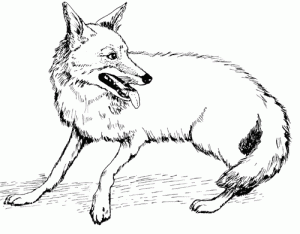 COYOTE’S CHOICE: ADAPT AND SURVIVE
- You are a tiny coyote pup and your mother has gone off to hunt for food. While you wait in the burrow a strange piece of thin wire on the end of a stick is pushed toward you from the door of your den. You see it coming and are afraid of it so you:
a. cower back against the wall of the burrow to escape.
b. attack the wire by biting it.
Answers:
• If you chose (a) you survived.
• If you chose (b) you were snared and taken away by a hunter.
- You are now old enough to do some hunting on your own. There, up ahead, you see a dead animal that looks like it is more than big enough for a whole meal. When you get closer you see some strange tracks in the soil and smell an animal you have never smelled before. You are very hungry, but afraid to go closer to the dead animal. After watching a while and looking for signs of danger you decide to:
a. eat the meat of the animal.
b. turn away and search for another meal.
Answers:
• If you chose (a) the meat was a poisoned trap set by a farmer and you are a goner.
• If you chose (b) you survived.
- It has not rained for a long time, the plants are dying and animals are becoming scarce. You are very weak, yet you feel an urge to travel to look for food. You begin to walk away from your burrow but you find it hard to walk. You decide to
a. push ahead and look for water and food elsewhere even though it means risking using up your last energy.
b. return to the burrow and wait for the rain and food to return.
Answers:
• If you chose (a) you survived.
• If you chose (b) starvation set in and you became too weak to leave your burrow. You did not survive.
- You come to a place where people are living because you know there is usually some food nearby. There is a place up ahead where the smell of food is strong, yet danger is very near and threatening. As night slowly advances with the setting sun, you decide to
a. sneak in and eat as much of the food as you can under the cover of darkness.
b. turn around and seek food elsewhere.
Answers:
• If you chose (a) you were able to eat safely while protected by the darkness. You survived.
• If you chose (b) your last strength was used when searching for food in another spot. You did not survive.
- With your strength restored you travel a short distance seeking shelter—a place to sleep and digest your meal. There is a strange burrow above ground up ahead. It is large and the morning sun shines off the strange smooth skin into your eyes. You climb up into it and try walking through the place that looks like the entrance, but you bump into something you cannot see. Finally you find an opening in the skin on the side and walk in, only to find many strange smells meet your nostrils. You sniff a few times and suddenly feel very tired. You decide to:
a. lie down and sleep here.
b. move on to look for a safer place.
Answers:
• If you chose (a) you slept in an old abandoned car and made it your temporary shelter. You survived.
• If you chose (b) you found a large hollow tree to rest in and slept safely all day. You survived.
- When you wake up the sun is setting and you are hungry again, but not starving like before. You leave your burrow and walk until you come to the edge of the woods. You see a field with some furry animals in it eating the plants, but you are not sure it is safe to enter the field or whether those animals are food or not. As you move closer you notice a freshly-killed rabbit in front of you. There are those strange tracks around it, like the ones you saw near that dead animal with the strange smell some time ago. But this meat smells good as you approach it and your hunger deepens. Then, as you move even closer, you notice something sticking out of the ground near the rabbit. It looks like it has large teeth and is made of the strange skin of that burrow with the smooth shiny skin. You look all around one more time to make sure that none of the dangerous animals who walk on two feet are around, then you
a. pounce on the rabbit.
b. run off into the underbrush, sensing danger.
Answers:
- If you chose (a) you felt a sharp, cold pain climb up your leg from one of your feet. Your foot is in a steel trap and there is no way out.
You did not survive.
- If you chose (b) you survived.
- If you have successfully survived by making all of the right choices so far, you will now raise a new coyote family. On the way back to your burrow you meet a coyote and decide to take her or him as a mate. Soon, the next generation of coyotes is born and you have pups of your own to feed.
Living In Balance: The Circle of Giving and Receiving
In “The Wisdom of Nature” the bee and the mango tree complain that the human beings take what they need but never give thanks. The gazelle says that its meat keeps the human beings alive, but that the human beings take it for granted. Many Native peoples see reciprocity—the Circle of Giving and Receiving—as essential to living in balance with nature.
Activity:(A) Make a list of all the gifts we receive from plants and animals. Practice
using only what is needed and giving thanks when receiving each of these gifts. (B) Create a special gift to return the generosity of the plants and animals.
Goals: Understand how numerous and varied are the gifts we receive from plants and animals. Realize that living in balance involves using only what is needed, not being wasteful and giving thanks to complete the circle of giving and receiving.
Level: Ages 5 to 12
Materials: (A) chalkboard and chalk or felt-tipped markers and newsprint, masking tape. (B) same materials as in (A) plus: pencils, paper, crayons, construction paper, scissors, glue, tape, very large sheet of paper such as brown postal wrapping paper, pictures or photographs of plants and animals as models for the children’s drawings, other materials as needed to complete children’s own, original projects.
Procedure A: Opening the Circle—Receiving. Use the children’s ideas and your own thoughts to make a list of the gifts we receive from plants and animals. Brainstorm a list of plants and animals that help to bring the gifts to us. Have the children go through an entire day by saying “thank you” to a plant or animal, or plants and animals in general, each time one of these gifts is used, eaten, worn, etc. An example is “Thank you honeybee” for honey and beeswax (a common ingredient in lip balm).
Encourage the children to be especially careful to use these gifts wisely—to take only what they need and not be wasteful.
Procedure B: Completing the Circle—Giving Back. Now tell the children how this story of “The Wisdom of Nature” reminds us that the plants and animals give us many wonderful gifts, and that living in balance means, in part, to return the gifts we receive by giving something of ourselves back. Ask the children to call out ways they may do this and write them down for all to see. Save them for use later.
Have each of the children write, in his or her own words, a poem or other form of saying “thank you” to the plants and animals. Children may draw a picture to depict a feeling of gratitude. Very young children may need pictures or photographs of the plants and animals to help them visualize the images for their drawings.
Create, on a large sheet of paper, an outline of a coconut palm, mango or other chosen tree, such as an apple tree. Have each child write or place her or his form of
“thank you” inside this outline. Pictures may be cut out and glued or taped on. The tree could even be entirely filled with pictures or illustrations to form a collage.
Follow through by having the children add other ways of giving thanks to the plants and animals as they think of them.
Michael J. Caduto is the creator and co-author (with Joseph Bruchac) of the best-selling Keepers of the Earth® series of books and resources. He recently released two new storytelling CD’s of stories from around the world: The Rainbow Garden—Tales of Wisdom (ages 5-10) and The Wisdom of Nature and other Earth Tales (ages 11 and up). Michael travels widely as an award-winning author, master storyteller, ecologist, educator, poet and musician. His work draws from the global well of Earth wisdom and he has worked closely with many Native peoples. His most recent books, Catch the Wind, Harness the Sun: 22 Super-Charged Science Projects for Kids and Riparia’s River received the Teacher’s Choice Award and Green Earth Honor Book Award.
by editor | Jan 2, 2014 | K-12 Classroom Resources
By Jim Martin
CLEARING Associate Editor
 hat if science teachers did science before they began teaching? Might a teaching model like this be possible to employ? Instructive to explore? There have been initiatives which followed up on this possibility. Their results were encouraging, but never replaced learning about science in publishers’ materials via college teacher education courses, which are simpler and less expensive to do when they are textbook-centered. The fruits of this choice have been a large fraction of K-12 graduates who haven’t achieved their potential.
What do students have to say about the way they are taught? Might some insights emerge from their comments? There is very little record of K-12 education from students’ own personal view point. Do they know whether their educations are worthwhile? A few people have looked into this, and have found that, when asked, students feel that classroom time is well spent when students treat the teacher with respect, behave the way their teachers want them to, stay busy and don’t waste time, learn a lot almost every day, and learn to correct their mistakes. Perhaps they have an intuitive understanding of an environment conducive to learning. The National Board for Professional Teaching Standards teacher certification program finds that students do well in school when their teachers are committed to them and their learning, know the subjects they teach and how to teach those subjects to students, are responsible for managing and monitoring student learning, think systematically about their practice, learn from experience, and are members of learning communities. Two complimentary views of what underlies effective education.
Taken together, these findings indicate that students know when they are taught well, and present the foundation of a clear plan for teacher pre- and in-service education. Had the K-12 graduates who didn’t achieve their potential applied questions such as stay busy and don’t waste time, learn a lot almost every day, and teachers know the subjects they teach and how to teach those subjects to students, to their teachers and curricula, and their assessments been considered in improving science teaching, might they have led to science courses which encouraged students to achieve their potential? Would they have led to pre-service science teachers actually doing science as part of their preparation for teaching science?
My experience tells me that doing science is important for science teachers. The need for science experience is a need that environmental educators have the capacity to respond to. The environments they work in abound with the kind of work pre- and in-service educators can do: mitigation, restoration, assessment, etc. They all contain the kernels of science inquiries to do. Working in collaboration with environmental educators, agency staff, and teacher education faculty and staff, pre- and in-service teachers could gain hands-on experience on the ground that they could get in no other way. My own experiences tell me that what emerges from this kind of collaborative work is science teachers involved and invested in the content that they teach, and empowered as teachers unencumbered by bureaucratic pressures outside their classroom doors; the experience necessary to change teachers’ views of science, a paradigm shift, that moves their locus of control for teaching science to within themselves, and away from the political winds that blow through schools. A key piece of the puzzle, this respite gives them a chance to develop effective science curricula.
What is it about doing science in environments outside the school that makes it so effective? I’d say that the reasons are many. An obvious one is that doing science in a familiar setting is less intimidating than doing it in a lab, which is much less familiar than, say, a quiet streambank. Another is that our brain learned to learn in the world outdoors. So learning science in a natural environment means learning in the brain’s inductive-constructivist way of learning. I’ve learned that, when teachers begin by doing science in a natural environment, they develop reasons to go into the lab, and labs become familiar places. What if we tried that? What would happen if environmental educators, agencies and organizations, and schools of education gathered together to explore the idea of a collaboration to provide pre- and in-service hands-on science education for teachers? There are all kinds of possibilities in collaborations like this.
If you’re a teacher, think back to your pre-service classes. Did you learn about a thing in class, then go out to experience it? How closely did what you experienced resemble the picture you had in your head back in the class? What if you had done the work first, then returned to the class to learn the underlying conceptual structure? Imagine a pair of pre-service teachers working together with an environmental educator, a restoration specialist from the City’s Bureau of Environmental Services, and a teacher with her students, to restore a reach of a stream flowing through a residential area near a school. Imagine further that the pre-service teachers are charged that day to identify and describe the characteristics of effective work groups. This in addition to doing the scheduled work of the morning.
The next day, back in the School of Education, all of the members of the class relate their experiences and report the characteristics of effective work groups that they had observed. Might discussion and negotiation of meaning elicit a clear concept of effective work groups, and posit connections between that and other elements of human learning? How might experiences like this influence these pre-service teachers when they do their one-year teaching internship? Would they affect the quality of their students’ educations when these interns begin full-time teaching? How would this look if a full-time teacher worked with the group from time-to-time as a mentor? If the full-time teacher would be the supervising teacher when the interns did their year in her classroom? This may never happen, but you can organize your own experiences to make this kind of experience one that you achieve yourself. All of the pieces of the puzzle are out there; they’re just not seen as elements of a functional whole. We have to learn to open our minds to recognize the relationships between what seem obviously disparate elements in a confusing world.
We’re not going to have this handed to us. But you can hand it to yourself. Find an environmental educator who is doing a restoration. Work with her. Then get your students on board. You’ll be outside your comfort zone. That’s okay. Keep your focus on what you want your students to learn, and make sure that part works. Look for workshops and institutes that provide valuable experience. In one summer institute, a teacher who had never ventured outside the classroom experienced her first encounter with the real world. By the end of the institute, she knew how to find a wetland, figure out its parameters, and design a project for her students. She had done science, and moved it into a perspective that removed its anxiety, made it eminently teachable. So she looked up an environmental educator she had met during the institute who suggested a wetland restoration project along a city-sponsored trail. The environmental educator agreed to help her plan, meet City bureau of environmental services staff, provide a training for her students, and point her toward a private granting organization which funded just this sort of project. She did the project, and continued on this path.
Let me step away from science for a moment and tell about plays my 7th graders performed when I first began teaching below college level. If I hadn’t done drama, I’d never have just hung two sheets from the ceiling light fixtures along the length of the room and said, “The side toward the windows is the audience, the side toward the blackboard is the stage. What shall we do?” My locus of control would have been too far away from me to even think of doing that. Luckily, I’d done plays for years. We picked a play, edited it, gave it. Then students, in groups, asked to write and do plays for the lower grades. And did them. I’d have been scared to death if I hadn’t acted, directed, constructed, written programs, made props, etc. I’d have simply followed a published play with directions. To the letter. And thought I was teaching drama. And I’d certainly not let them go off to the lower grades on their own. They’re seventh graders; get real.
Once you do science, it is not as intimidating as you first perceive it to be. Like me if I’d never done drama. Or, for all of us, the first time off the diving board, hitting a softball, etc. Now, you are focusing on particulars, so experience no unfocused anxieties about vague worries. We’re all good at that; once we focus on particulars, we begin to nail them down and work toward mastery. Get the start, so you know what you want to understand and do, then look around for resources like courses, workshops, knowledgeable people. Experience doing the work, then take control of your curriculum.
 This is a regular feature by CLEARING “master teacher” Jim Martin that explores how environmental educators can help classroom teachers get away from the pressure to teach to the standardized tests,and how teachers can gain the confidence to go into the world outside of their classrooms for a substantial piece of their curricula. See the other installments here, or search Categories for “Jim Martin.”

by editor | Nov 4, 2013 | K-12 Classroom Resources
 by Jim Martin
CLEARING Associate Editor
 mbedded curricula. The curriculum that you can find just about anywhere you go: Fractions, transportation, velocity, acceleration, centrifugal force, metaphor, alliteration, poetry, drama, communities, transportation, and on. Topics we study in school, complete with real examples. Everywhere. We need to learn how to find it in natural places, and how to help our students use it in meaningful, empowering ways. Using it means we have to pay close attention to how we teach.
The way we teach directly affects the way we learn, and what we learn. Let me illustrate two poles of learning with a real-life example, two teaching methods that affect how and what students learn. This is a true story about two field trip station leaders, one who engages a centuries-old teaching paradigm, another who engages a paradigm based on the current state of knowledge about the neuropsychology of learning. One field trip leader stands ankle-deep in a stream, and tells eight students lined up on the bank about dissolved oxygen, its importance to life in the stream, and the range of dissolved oxygen concentrations which contribute to a healthy stream habitat. Then he measures the actual dissolved oxygen level where he stands, compares its value to the range for a healthy stream, and declares this stream healthy. After that, he moves on to do the same with turbidity.
 Another leader shows her eight students how to measure dissolved oxygen, and has them do two practice trials, one in each working group of four. Then, she has them combine to do a third test on their own. The students talk about the numbers they derive, and decide to calculate their average since all three are similar. The leader congratulates them on their careful work, and sends them to reference material on the stream bank to find out what their average dissolved concentration means in terms of stream health. Students scramble, pages fly, eyes and mouths communicate, and the group returns to announce that their average dissolved oxygen concentration is healthy. They attribute that in part to the riffle just upstream, and in part to the cool temperature of the water, phenomena which they learned about while reading. Based on their readings, they think that, in addition to the oxygenation of water by riffles, the cold water holds more oxygen than warmer water. Which group learned most? Best? Will recall what they learned next Spring? Will always see riffles as oxygenators when they view them in passing? Which station would you prefer if you were learning? Why? Teaching?
Think about the last word in the previous paragraph. We won’t all respond to it in the same way. When I first began to confront the realization that how I taught affected how and what my students learned, I eventually asked, “Am I an automaton who simply clerks what I receive, telling my students what I have learned, at least the part that was in the texts I used, and asking them to tell it back to me, or am I a professional educator who can build my own effective curricula?” I began to ask myself about the excitement of science, my own personal thoughts about it. And about the topics I was teaching; some were pertinent, others rather meaningless space fillers in a section that needed more lessons to make it seem complete. Could I transmit the joy of science to my students? The natural interest in science that we’re all born with? This posed a problem for me, something I found I needed to resolve, and slowly led to better teaching and more involved and invested students. Doing this, I learned two things: I have to be the person who decides what and how I teach; and I really have to understand how brains learn.
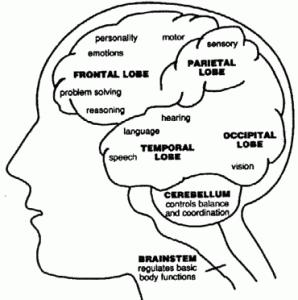 How does our brain learn? There is good evidence that we learn best when we begin new learnings by handling real objects in the real world. Do we really need to be physically involved in a learning to master it? Shouldn’t we simply be able to listen, write, and recall what is taught? Do we have to engage objects in the world to learn about them? I say that the answer to this is yes and no; there is a place for a didactic:deductive delivery, like that of the first station leader, and a place for a constructivist:inductive delivery, like that by the second leader. For instance, if the students in the first group had previously done inquiries in which they measured water quality and discussed the results of their inquiries, there would be no need to help them learn how to make the measurements, and the relationship of the station leader’s observations to a set of water quality standards would make good sense, and they could move on from there to new learnings. Once we have engaged content and concepts in the real world, we can enhance our learnings by reading, listening, and writing. And they can be extended in the real world via homework assignments that place students there. There is an appropriate time for reproducing knowledge and one for creating knowledge. Each way of teaching engages particular parts of the brain, and generates a particular kind of learning.
F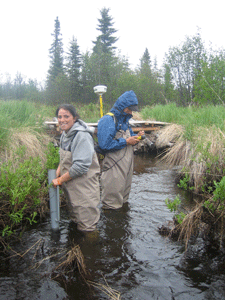 or instance, a teacher has his students identify trees along a riparian transect, and they use this information to assess that small piece of watershed. Students are shown how to start a transect at the water’s edge, and carry it, perpendicular to the stream, 100 meters up the stream bank. When they start at the water’s edge, they record this as Meter 0, and use a manual to name the trees within a 5-meter diameter and their trunk diameter and heights. Then, they move 10 meters up the transect, and record the same information within a 5-meter diameter centered on the tape measure’s 10-meter mark. They continue until they have assessed the trees in this way along the entire 100 meters, then use this information to determine the ranges of each tree species, and formulate questions based upon their distributions. When they return, they will carry out inquiries based on their questions. (They started by being told what to do, how to do it, and why. In the end, they were telling themselves what to do and how to do it because they were becoming capable of working on their own. Are they transitioning to the teaching model illustrated by the second field trip station leader?)
Back at school, they discuss their results and formulate questions they will attempt to answer the next time they are in the field. Here, they will engage the real world and try to make sense of it in terms of what they already know, and what they will find out. The next day, their teacher has them start a new unit, a street tree inventory in which they will count trees by species, height, diameter, and distance from the corner of the block they are on. So, now their transect is the block the trees are on; a transect determined by the block face and tree locations rather than 10-meter intervals on a tape measure. They’ll use this information to make inferences about CO2 absorption by leaves, but the teacher’s plan includes using the work to transition their math class into the study of ratio and proportion. He does this by establishing the protocols for measuring the distances of the trees from the corner. Students will measure their stride, then count steps as they walk from the corner to tree to tree. Before doing the work, each student carefully measures her or his stride to the nearest inch. When they make their measurements on the block, they’ll attempt to consistently walk with the same stride. They’ll use the ratio of one step to feet and inches to convert their steps walked on the block to feet and inches of its length. They make the calculation by multiplying feet and inches per step by the number of steps. In math, students will use the steps they used to convert their stride along the block to feet and inches by developing ratios and using them to make the distance calculations.
So, they start at the edge of a corner, pace to the center of the nearest tree, and record the number and fraction of a pace to get there. They continue this way to the end of the block. He’ll have them continue the work until they’re comfortable, then start the ratio and proportion unit in math. He’ll also assign them to do the same study on the block they live on, or one with trees if theirs has none. They’ll do this as a homework assignment. Now, he’s identified and used an example of embedded curricula in the real world. The curriculum is out there; we have to learn to find it.
Embedded curricula is effective curricula, probably because the student has to discover and exploit it, something our evolved brain is very good at. (I say, ‘brain,’ but I mean ‘central nervous system,’ the total set of nerve cells in the system that is coordinated by the brain.) If the brain is where we learn, then why not use it in designing the ways that we learn, both in school and on-site?
By the time the class goes out to implement the investigations engendered by their inquiry questions, they will be in charge of their learnings. The teacher has transitioned his delivery from didactic:deductive to constructivist:inductive. He started with an activity that he thought might generate students’ interest, then used that interest to engage them in self-directed learning that met his curricular objectives in science and mathematics.
Environmental educators can help teachers engage their students’ brains in effective ways. It doesn’t matter what the environmental educators offer, their sites contain embedded curricula, just waiting to be mined. They also know the classroom teachers who are serious about what they do. Put two of their heads together, and they can locate and describe curricula available on site. A team like this would be invaluable to Meredith. We have the power to bring them together, and might do that.
Here’s an anecdote to illustrate how curriculum discovered on site empowers students. Several years ago, some teachers in a middle school decided to exploit some man-made ponds and a ditched creek adjacent to the school to develop the curricula embedded there. They did this for most of the school year, then participated in the school’s Parent Science Night. That evening, the halls were filled with students who manned tables exhibiting science projects they had worked on. Parents and other adults wandered around, checking out what the students had done. The students whose projects were developed in the standard science classes used their texts and lab books to explain the experiments they were displaying. When asked a question, they inevitably read either from their books, or from notes they had written; often with a finger moving along the words. Students who worked on the ponds and creek spoke from what they knew, from what was in their heads. They answered questions, sometimes after quiet thought; always with confidence, with ownership of the learning and personal empowerment in their eyes. I’ve observed this often, but never in such fortuitous mixed company. We can learn for understanding and empowerment, but we have to do it using our brain’s evolutionary history to guide the ‘how’ of the learning.
This is a regular feature by CLEARING “master teacher” Jim Martin that explores how environmental educators can help classroom teachers get away from the pressure to teach to the standardized tests,and how teachers can gain the confidence to go into the world outside of their classrooms for a substantial piece of their curricula. See the other installments here, or search Categories for “Jim Martin.”

by editor | Oct 24, 2013 | K-12 Classroom Resources
Honeybee Heroes: Carter Latendresse at Catlin Gabel School
 by Katie Boehnlein
 arter Latendresse is the sixth grade English teacher at Catlin Gabel School in Portland, OR. In addition to his classroom courses, which focus on fostering social responsibility in his students through ancient and contemporary literature, Carter is also the Garden Coordinator at the school. The Catlin Gabel Garden Club tends 2,000 square feet of organic gardens on its 60-acre campus, a 50-tree fruit orchard, and as you have probably guessed, honeybee hives. Catlin Gabel has earned itself a reputation in the Portland Metro area as a progressive institution that encourages all of its students, aged Pre-K to 12th grade, to think deeply and learn through experience. Carter embraces this philosophy, harvesting from and working in the school’s gardens as part of his English curriculum.
 Catlin Gabel also has a history of hosting honeybee hives on its campus, as a few teachers in the 1970s kept their hives on the school’s lush grounds, but the school hasn’t had a working hive run by staff and students in quite some time. Troubled by issues such as global agribusiness, monocropping, processed food, global warming, and desertification, Carter was motivated to install a beehive in the school’s orchard, which is located on the periphery of campus, away from the normal walking paths. He hoped that by having this hive on the campus, students could learn more about local food sources, biodiversity, and organic gardening first-hand. After receiving permission from both the facilities and grounds departments, who were immediate supporters, he recruited four fellow colleagues to take a beekeeping class in Hillsboro and a few weeks later, they set up the hive.
 Since then, the beekeeping activities on campus have received a very positive reception. All four school divisions have been involved in visiting the hive, from quiet Kindergardeners to boisterous fifth graders to sixth graders learning hands-on beekeeping skills with Carter. For most of these visits, Carter has set up an observational tent with four mesh walls. This allows an entire classroom to watch the goings-on in the hive without danger of being stung. Many teachers have also been involved in tending the hive, from elementary teachers to the middle school Chinese teacher to the school-wide food services director to the head of the grounds crew to high school science teachers. Many people on campus have seen the beehive as an opportunity to learn more about a very pressing topic and involve their students directly in a solution.
 The apiary project at Catlin Gabel School is only continuing to grow, aided by little opposition to the project and a great interest from students and staff on campus. According to Carter, “Once people hear that we know who is allergic to bee stings and that we have plans, fear melts away.” He would like to increase the school’s apiary to three hives next spring, following a strategy of organic beekeeping that allows one hive to be actively producing honey, one on the rise, and allows one to dwindle. Carter has been able to tie the hive into his classroom lessons on seeds, flowers, pollination, and organic local school garden food. In conjunction with these lessons, his classes are able to go out into the observational tent as well as try out their beekeeping skills wearing a veil and gloves. Of his students, Carter says, “They love the bees—it’s both an exciting and relaxing experience, especially for those with their hands on the hive.” Twice every seven days, Carter offers a Gardening and Beekeeping activity block in the middle school, which will allow ten students to be actively involved in the gardens and with the beehive.
Carter was recently selected by the National Association of Independent Schools (NAIS) to be part of the 2013-2014 Teachers of the Future program. He is one of 25 teachers nation-wide who “inspire academic excellence in students and serve as opinion leaders among their colleagues and peers,” hallmarks of high quality education for the 21st century. As part of this honor, Carter is creating a video about the beekeeping program at Catlin Gabel School, to share beekeeping tips with colleagues nationwide who are interested in keeping bees on campus. He is being aided by Portland beekeeper Brian Lacy, another one of our Honeybee Heroes, as well as his other fellow Catlin Gabel beekeepers. He is hoping that this video will educate fellow NAIS teachers about the importance of beekeeping and empower them to start their own apiaries. The video, which you can watch here, serves to feature the interdisciplinary learning program at Catlin Gabel School as well as guide teachers through a step-by-step process of starting an apiary on their campuses. Carter is an inspiring teacher who is truly helping his students better connect with the world around them. He encourages them to find solutions to their own problems, large and small, through both studying literature and by getting their hands dirty in a garden. Speaking to the Oregonian newspaper about his role as a teacher, he says, “What can we do as teachers is impart lessons to kids that allow them to have hope but while also confronting these huge problems. For every problem, we try to present a solution and we try to allow them to do it.”
Katie Boehnlein is a writer/intern for CLEARING magazine and teaching assistant at Catlin Gabel School in Portland, Oregon. She enjoys writing about the endless expressions of place-based education, inspired by so many creative teachers. Katie blogs about her own ecological and urban adventures at “In the Midst,” which can be found at kboehnlein.wordpress.com.

by editor | Oct 15, 2013 | K-12 Classroom Resources
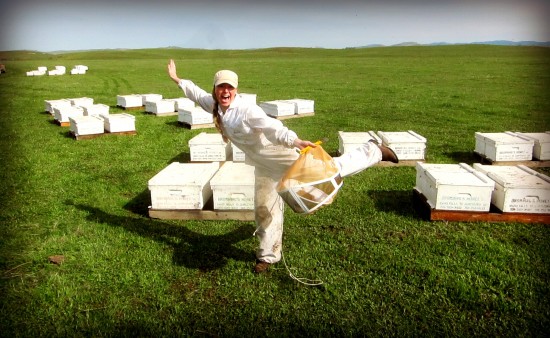
Sarah Red-Laird lives and breathes honeybees.
by Katie Boehnlein
 arah Red-Laird, or “Bee Girl” is an Ashland, OR native who says that she has been fascinated with honeybees since her early childhood. On the playground in elementary school, she would pick up bees and pet them to impress other kids. Her aunt’s partner, a beekeeper, was also a major influence on Sarah, giving her honeycomb to taste during harvest season.
“There’s nothing like eating fresh honeycomb as a toddler to sell you on bees for life!” Sarah recalls.
Many years later, the Davidson Honors Program at University of Montana gave Sarah the opportunity to fully investigate her childhood fascination. Allowed to write on any topic of her choice for her senior thesis, she chose beekeeping and Colony Collapse Disorder. Over the course of this project, she learned beekeeping skills in the field and researched in the university’s lab. She caught on quickly and after she had finished the project, she was able to present her findings at the National Conference on Undergraduate Research to a standing room only audience and was promptly offered a research position with University of Montana.

Sarah showing some of her young students a frame filled with bees. Their curiosity and wonder is evident!
When Sarah landed back in Ashland on what she thought would be a short hiatus, her skills as a beekeeper were immediately sought after. She was asked to help community members set up hives and speak in classrooms as well as to the larger community. Hence, “Bee Girl” was born. Today, Sarah’s work with apiary-based education spans not only many cities and counties in Oregon, but world-wide as well. Her nonprofit, which she also calls “Bee Girl,” (http://www.beegirl.org/) still works locally, presenting at individual classrooms and to the broader public, and she has honed an presentation engaging all five senses. She engrosses her audience in the “world of the honeybee” by bringing honey to taste, honeycomb to feel, and in the height of bee season, a live observation hive to see and hear. She also brings costumes along for kids to dress up as bees- antennae, crowns, tutus, wings, stingers, and all. Sarah has traveled to through Oregon and to the East Coast twice with her presentation, will be in Louisiana and Kentucky in 2014, and even hopes to travel to Kenya soon to speak there. Sarah’s reputation spans to far reaches, as she heads up the Kids and Bees Program for the American Beekeeping Federation (http://www.abfnet.org/displaycommon.cfm?an=1&subarticlenbr=16) and hopes to hold a position as US Ambassador for the International Bee Research Association.
Oregon is lucky to have Sarah as their local “Bee Girl” and she has proven herself as quite the mentor in Ashland. Ryan King, another one of our “Honeybee Heroes,” sought out Sarah when he began the Ashland Apiary project as part of his graduate studies. When he realized that he had a “walking beecyclopedia” in town, they began their fantastic partnership of engaging the Ashland community, especially students, in the art of beekeeping. For more information about the beginnings of the Ashland Apiary Project, you can read Ryan’s “Honeybee Heroes” profile (https://clearingmagazine.org/archives/8599). Since Ryan has recently graduated from Southern Oregon University, Sarah now acts as co-director of the SOU Beekeeping Club, “teaching students not only how to keep bees but how to become advocates for bees and sustainable farming.” She leads meetings once per week on campus and coordinates field learning and working field trips to local bee-related sites. In the future, Sarah hopes to teach beekeeping courses in the spring and fall through the SOU Sustainability Center (http://www.sou.edu/sustainable/center-for-sustainability/index.html).
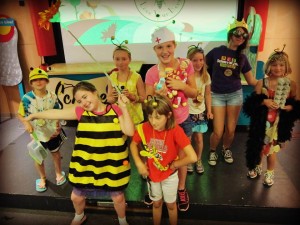
Some of Sarah’s students all dressed up and rockin out as bees as part of the Buzz About Bees summer camp at ScienceWorks Hands-On Museum in Ashland.
It is evident that Sarah Red-Laird lives and breathes the world of the honeybee. Her passion for educating students of all ages about such an inspiring species is evident and tangible. A student in one of her beekeeping classes puts it this way: “Thank you so much for leading us to care for our bees. You are a wonderful teacher, and your love for the bees shines through everything you do.” As is the case with many educators who love honeybees, one of Sarah’s main goals in her work is to dispel fear surrounding bees. She sees her youngest students as the key to reversing this social fear. “That is why I do what I do,” she says, “to inspire a sense of fascination, wonder, and love at a young age, that I hope turns to understanding or even advocacy as these kids grow into our leaders of tomorrow.” She also sees the need for our society to educate a generation of citizens that understand the complexity of our modern food system and question its flaws. When asked why pollinator education is so important, she answered, “If you can capture the heart and imagination of a child, and release the sweetness and light of the honeybee in them- they will never forget it. By saving the bee, they will save our world.” Bee-autiful. Thank you, Sarah, for being an inspiring leader in the field of pollinator education!
You can learn more about Sarah and her passion for beekeeping in this installment of “Immense Possibilities,” featuring Sarah (http://www.immensepossibilities.org/ipr-podcasts/bee-keeping/).
Katie Boehnlein is a writer/intern for CLEARING magazine and teaching assistant at Catlin Gabel School in Portland, Oregon. She enjoys writing about the endless expressions of place-based education, inspired by so many creative teachers. Katie blogs about her own ecological and urban adventures at “In the Midst,” which can be found at kboehnlein.wordpress.com.


 In the thick brush at the edge of the hill country lived a magnificent snake. Its eyes blazed and the scales that covered its skin were as hard and strong as any shield. Venom flowed from its long, curved fangs. In the moment of its hunger, this huge, powerful snake devoured any wild animal it desired.
 COYOTE’S CHOICE: ADAPT AND SURVIVE


