by editor | Oct 7, 2013 | K-12 Classroom Resources

Students at Southern Oregon University installing a beehive at their on-campus garden.
An Alternative to Traditional Education
Honeybee Heroes: Ryan King at Southern Oregon University
by Katie Boehnlein
 outhern Oregon University in Ashland, OR is a “sweet” place to be. Ryan King, a recent graduate of Southern Oregon’s Master’s of Science in Environmental Education program, has just finished his thesis on apiary-based education, or the practice of utilizing beehives in educational settings. Ryan is a pioneer in the promotion and pedagogy of this field, having been a beekeeper in various schools for the past four years after his undergraduate studies at Oberlin College.
Ryan first got “stung” while he was working at Al Kennedy Alternative High School in Cottage Grove, OR, a school that CLEARING featured in 2010 for its focus on place-based, experiential education. (https://clearingmagazine.org/archives/2368) Ryan’s principal at Kennedy asked him to spearhead a beekeeping project, since he had majored in science during his undergraduate studies and was interested in working with his students outdoors. After just a few months of working with students at the beehive, Ryan began to see the impact that the practice of beekeeping could have on a school community. He saw class attendance rates and student buy-in rise at the school, impacts that he attributed to the opportunity for at-risk students to invest time in hands-on projects. Ryan saw beekeeping as a way to connect students to the science they were learning in the classroom while at the same time giving them valuable skills they could use in the future. He sees his students as future scientists and farmers of America, and what a better way to connect students to current events than by giving them valuable skills to contribute to world problems?

Ryan King instructs young students about honeybees during a summer class for elementary-aged children at Southern Oregon University.
Consequently, Ryan focused his graduate studies on apiary-based education. Over the two years he spent in Ashland, he established a hands-on, multi-age, multi-pronged beekeeping program called the Ashland Apiary Project. In his recent article “Beekeeping as Experiential: The Ashland Apiary Project,” Ryan lays out the educational and environmental goals that emerge from apiary-based education and the outcomes that he has seen manifest from Ashland’s project specifically. (http://www.jsedimensions.org/wordpress/content/beekeeping-as-experiential-the-ashland-apiary-project_2013_05/)
The project starts with training college-aged students from Southern Oregon University, centrally located at the three-hive apiary in the school’s campus garden. These students are mentored in beekeeping skills by local beekeeper Sarah Red-Laird, who runs an educational nonprofit organization in the area called BeeGirl. (http://www.beegirl.org/) Students then take their new skills into the community, teaching high school students through the SOU Beekeeping Club and advocating for pollinator gardens and other sustainable projects at city council meetings. From there, the project reaches elementary school students through summer science camps and educational workshops. This year, Ryan sets out to establish an on-campus apiary in his new teaching position at Ruch Elementary School, a rural K-8 public school in the Applegate Valley. The apiary will serve as a satellite research site to Southern Oregon University as well as award opportunities for students to host symposia at Ruch and collaborate with local beekeepers and farmers in the community. Through these many outcomes, Ryan shows us the many benefits that can come from a school apiary project.
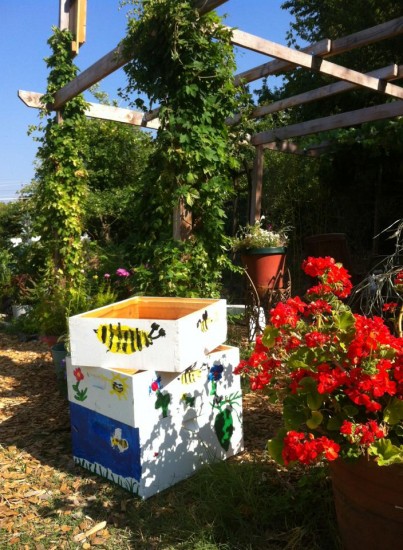
The Ashland Apiary Project thrives in Southern Oregon University’s campus garden.
Ryan sees apiary-based education as a complement to the already-existing pedagogical philosophy of place-based education. The “stuffy indoor curriculum” that he observes in schools today is not what kids need. “Kids are bored, kids are penned into curriculum, and they get spit out very unmotivated about where they’ve come from,” he says.
His solution, beekeeping, gives students a local, community perspective to their education and valuable skills for their future. Ryan reminds us that learning from bees, by nature, is localizing, as bees depend on the four miles surrounding their hive for food. Therefore, hands-on projects on campus, like a school beehive, can flatten the school’s walls while at the same time connect students to their local community. Ryan’s colleague, Sarah Red-Laird (BeeGirl) has taken on the lead responsibilities for the Ashland Apiary Project, whose future plans include an expansion to a sustainability and farm center that Southern Oregon University is developing. Here, Sarah would teach college-level classes on beekeeping and develop a full-course program at the university. Stay tuned next, as we visit with her next week!
Katie Boehnlein is a writer/intern for CLEARING magazine and teaching assistant at Catlin Gabel School in Portland, Oregon. She enjoys writing about the endless expressions of place-based education, inspired by so many creative teachers. Katie blogs about her own ecological and urban adventures at “In the Midst,” which can be found at kboehnlein.wordpress.com.


by editor | Oct 2, 2013 | Environmental Literacy, Outdoor education and Outdoor School
Fueling the Fire: North Cascade Institute’s Path for Youth

by Mollie Behn
 t is no secret that today’s youth are increasingly disconnected from nature. As a result, youth are less aware of issues and threats facing the environment and how to address them. We need to develop active and motivated citizens who are capable of implementing solutions to the challenges. These abilities derive from understanding the threats, consequences, and solutions to environmental problems, as well as feeling empowered to make necessary changes. The young people of today offer us a glimpse into a promising future, especially if we prepare them for the challenges and triumphs they will experience. Sadly, youth’s disconnect from the natural world can leave them feeling less inclined to be actively engaged citizens and stewards. North Cascades Institute is confronting this situation through the Path for Youth initiative, a suite of programs and a shared vision with public lands agencies and community partners to engage elementary to graduate level students through education, conservation and stewardship…
Read the entire story at https://clearingmagazine.org/NCIPathforYouth.pdf or at
https://clearingmagazine.org/NCI-FuelingTheFire.html (pictures have captions)

by editor | Sep 27, 2013 | Learning Theory
by Jim Martin
CLEARING Associate Editor
 e left the teacher we have been following as she was planning a project she and her class will do on a creek at the edge of the school property. What she is doing, as well as her plans, appear to approach what the National Board for Professional Teaching Standards proposes as five important characteristics of competent teaching. The last time we saw her, she was getting ready to plan the first steps in what could become a long-term project. (By the way, her name is Meredith.) Let’s see what the main pieces of the project are, and get some idea of how they look to her so far. The first step is to provide her students with background information which will help in the Acquisition Phase of this new learning. She plans to do it by using some standard curriculum delivered more or less as usually taught, but with students working with it in groups which may or may not become the work groups who do the particular jobs at the creek. This way, they might be more likely to transfer those learnings to the field. Topics they will study are food webs, water quality, and the riparian.
Her initial plan is to use published and on-line resources to provide background on riparian areas, then move to riparian food webs, and after that to how to measure water quality, and what the measurements mean in terms of the riparian and its food webs. Her hope is that, by learning something more dynamic than an array of facts, her students will approach the creek with more nuanced expectations than if they’d simply learned some nomenclature that applies to creeks.
Next, her student groups will visit the creek site. Her plan is to prepare work groups to assess the site to decide their stations. To this end, she supplies them with tape measures and rough sketch maps of the creek and its banks. Their job is to locate the best stations for doing their work, and measure the station’s dimensions. Then, in their work groups, they will decide how to go about making their observations. The Meredith knows that these plans will probably be modified by experience. Then, each work group will posit questions they think may help them know their part of the creek. This is most difficult for the macroinvertebrate group, because they won’t be collecting on this first trip. However, they will be asked to assess the makeup of the bottom of the creek, where the macroinvertebrates live. This completes the second part of her plan.
Designing inquiry questions takes quality time, so they will do that in the classroom. After they have posited good inquiry questions, they’ll use them to design their investigations. Meredith’s plan is to start this process while the class is making their visit to the creek site. She’ll prep this by asking them to keep track of things they notice while they’re doing their work on their particular station. As part of this prep, she suggests that they will use these things they notice to write inquiry questions to investigate. When the class returns to the classroom, they will do a quick debrief and go on to other things. (Meredith has been incubating an interesting thought that, by carrying out investigations, the class might develop a useful knowledge base about the creek and its banks. She is even contemplating using that base to drive a language arts unit and part of a math unit.)
The next class day, students will meet in their work groups to begin writing a report of their observations and decisions about locating their work stations, and a list of the questions about things they had noticed which are most interesting to them. Afterwards, each group will report its findings and questions. Then, Meredith will review the broad areas that each work group will investigate. She will ask each group to review relevant thematic information she has collected for them, and use it, along with their on-site observations, to design a plan for doing their work. As part of this work, students will be introduced to the equipment they will use, and will practice using it. After they have done this, they will meet with Meredith to review the work, receive suggestions, organize jobs within the group, and develop a fine-tuned work plan to follow when they are on the site. This is when she’ll suggest that students in each group pair up to work on their own inquiry projects. Then, she will start a discussion of inquiry questions, have students practice their own, then have students, in their pairs, write and assess an inquiry question of their own.
 This is a regular feature by CLEARING “master teacher” Jim Martin that explores how environmental educators can help classroom teachers get away from the pressure to teach to the standardized tests,and how teachers can gain the confidence to go into the world outside of their classrooms for a substantial piece of their curricula. See the other installments here, or search Categories for “Jim Martin.”

by editor | Aug 24, 2013 | K-12 Classroom Resources
by Kevin Beals & Craig Strang
 magine a residential outdoor science program where instructors—all of them—routinely combine their passion for the natural world with a deep understanding of research-based teaching approaches that are based on all we know about how people learn. BEETLES (Better Environmental Education, Teaching, Learning, Expertise & Sharing), funded by the S.D. Bechtel, Jr. Foundation, is a new project at Lawrence Hall of Science, University of California, Berkeley that designs professional development experiences for program leaders to use with their teaching staffs.
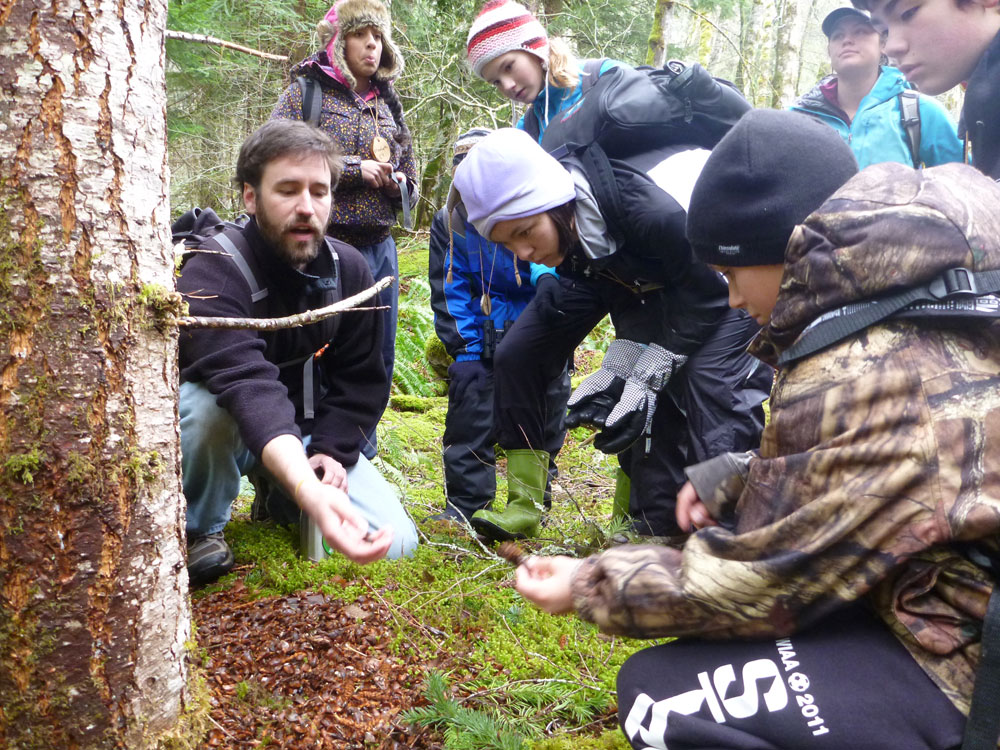
A group of 15 sixth grade students and their classroom teacher are on a hike led by a field instructor at a residential outdoor program. They come across a bracket fungus on the ground. The instructor, who has participated in BEETLES, calls out, “NSI,” a routine the students now recognize as Nature Scene Investigators. Quickly half the group kneels around the fungus in a tight circle. The other half stands in a circle around the inner circle.

(note: the discussions in this article are actual transcripts taken from trail hikes)
Instructor: OK, let’s hear some observations from the inner circle.
Student: It’s light.
Student: it looks charred.
Student: It looks like it’s broken off something.
Student: It looks like wood.
Student: It looks like it’s from a tree.
Instructor: Now let’s hear some questions from the outer circle.
Student: What does it feel like?
Instructor: OK, someone from the inner circle, can you say what it feels like?
Student: It’s rough here but smooth here.
Student: It feels smooth on the outside and rough on the inside.
Instructor: So, Kendra and Amir, would you agree that it’s smooth on the outside and rough on the inside?
They both examine it closely.
Student: Yep.
Student: I agree.
The students share more observations and questions, and continue to do so after the two circles have switched places and roles.
Instructor: OK, now I want you all to come up with explanations about it. Don’t forget to use evidence in your explanations.
Student: I think it was on a tree that got burned and it fell off and my evidence is because it’s black.
Instructor: Hey, did you all notice that Jared said, “I think…?” In science discussions, it’s good to use language of uncertainty, like “I think…” or “I wonder if…” because in science, you always need to be open-minded to other explanations and ideas if you find new evidence.
The students come up with several other explanations.
Instructor: Now does anyone have something to share about this that they’ve heard or read about somewhere else? But be sure to tell us your source of information.
Student: I think it’s a fungus, because we learned about fungi with our gardening teacher at school, and it looks like some of the fungi we studied.
Student: I’ve heard that they’re decomposers, and they turn dead things into dirt. I heard that from my teacher.
Instructor: This is a fungus. I’ve read that these are a type of fungus that grows on trees called bracket fungus or shelf fungus. I’ve also read that they are just the “fruit” of the fungus, and that most of the fungus looks like white threads and is spread out inside the wood. My source is a book written by a fungus expert. The book is called Mushrooms Demystified. We’re going to be checking out mysteries like this all day. We’ll be finding cool stuff, making observations, asking questions and trying to explain what we find.
Classroom Teacher: I just want to say, the more stuff you all pointed out the more I looked. You got me to look at it differently.
Instructor: Yeah that’s a great point and that’s one reason scientists often work in teams.
Student: Hey look, there’s one of those things on this tree.
Students excitedly swarm around a nearby tall stump with a few small bracket fungi on it.
Instructor: So what do you guys think now that you have this new evidence?
Student: It does grow on trees! It’s not burned because this tree isn’t burned and it’s still black.
Instructor: Is this tree alive or dead?
Student: Alive. No, wait. It’s just a big stump.
Instructor: As we hike, let’s keep our eyes out for more of these fungi and see what we find. Let’s see if we find any on living trees, or if they’re just on dead trees, like this one.
Classroom Teacher: (aside to instructor) I had no idea when I got on this hike it was going to be like this, because other hikes I’ve been on have been more about just delivering information. I want to learn as much from you as I can today about how I can do this with my students back at school.
What’s significant about this actual account, compared to many other outdoor science activities? Is any learning taking place? Why were so many student questions left unanswered?
We like NSI precisely because so much learning (and engagement) is going on. It sets a tone of inquiry, exploration, figuring things out and discussion of ideas. We want students’ minds to be at least as active as their feet. We want the students, not the instructor, to be making discoveries, asking questions, and trying to explain what they find. The instructor guides, but most of what happens is student-driven. This may look like the instructor isn’t doing much, but it is actually far more nuanced than blurting out three facts and a chant about bracket fungi.

Student (shown in photo): I feel like a scientist today.
Student: I know, I’ve never done this before.
Student: Yeah, I’ve been to the woods before, but not discovering and stuff like this.
Student: I didn’t even know I could do this.
Student: I’m gonna do this at the park near my house!
Activities like NSI taught by instructors who know how to look for evidence in the minds of learners as well as for evidence on the trail, engage students in the scientific practices called for in the soon to be published Next Generation Science Standards (National Research Council 2012) that are certain to be adopted by nearly every state in the US: asking questions, carrying out investigations, constructing explanations, engaging in argument from evidence, and obtaining, evaluating, and communicating information. Those are tricky things to teach in a classroom, but in a rich outdoor setting, students are surrounded by opportunities to explore and investigate with these practices. Instructors have opportunities, if they know how to take advantage of them, to help students make careful observations, work together, communicate their ideas, disagree politely, remember to base their explanations on evidence, use language of appropriate uncertainty, and cite their sources of information. These thinking skills lead directly to meaning making—a very different outcome compared to memorizing the names of trees or the three different types of decomposers. And there is an added benefit. When students are talking, instructors get to hear and understand their ideas about science topics. Effective instructors build their teaching on student’s ideas, but they can only find out what those ideas are by letting students express them!
Outdoor science schools are perfectly situated to help indoor schools by focusing their teaching on scientific practices. In a rich outdoor environment with long days, myriad inquiry opportunities and a skilled instructor, students can accomplish more in a few days than they might be able to in months in a classroom.
BEETLES is designing professional development experiences that help instructors to become expert users of approaches and tools like NSI that:
• are more student-centered, less instructor-centered.
• are less about an instructor telling students information, and more about instructors giving students chances to explore, investigate and figure things out themselves.
• are less about convincing students their instructor is ”awesome,” and more about making students feel smart and capable, moved more by what nature has revealed to them than by what their instructor has revealed to them..
• empower students with skills to use when they no longer have a field instructor leading them.
• facilitate student meaning-making.
• increase students’ wonder and curiosity about the natural world.
• are less about games or activities that can be done on a playground, and more about engaging students with investigating the natural world.
Historically, investments have not been made in the development of research-based professional development and curriculum for outdoor science programs. Unlike in K-12 schools, field instructors often rely on word-of-mouth “traditions,” and tattered copies of activity outlines passed around in bruised binders. BEETLES is designing, field testing, documenting and evaluating a series of professional development sessions, each of which presents instructors with a lens through which to view and improve outdoor science instruction.
BEETLES is also creating content sessions to help field instructors grapple with their own understanding of foundational concepts basic to many outdoor science schools: cycling of matter, flow of energy, adaptation and evolution. Finally, BEETLES is designing and collecting activities, like NSI, that reflect research-based approaches and accurate science, for use in the field with children. All these materials will be available, free, via a website.
BEETLES is hosting a 5-day California Leadership Institute during Summer 2013. Pairs of leaders will be invited from 12 different outdoor science schools throughout the state. The leaders will experience the professional development sessions, activities and hikes, share their own expertise, and plan out staff training for their own staffs. We hope to empower program leaders with new materials and perspectives, but also to benefit ourselves by capturing improvements and adaptations made by the leaders.
In 2014 & 2015, BEETLES will offer a National Leadership Institute, open to program leaders around the country. Eventually the BEETLES web site will offer supporting videos that show how the activities and professional development sessions are actually led with students and staffs.
The following is from an email sent to us by a field instructor a week after she participated in a 3-day BEETLES professional development workshop:
I wanted to relay a small snippet of some kid feedback I got this week on trail. The teachers had the kids write us all notes thanking us for their week, and it was interesting the things that popped up, besides the usual “You’re the coolest everrrrrrr” messages. One note included the following: “…We learned a lot from you, because, unlike other teachers, you go in-depth on everything we learn instead of going like ‘Here’s this’ and ‘This is that.’” I know I’ve been a “Here’s this” naturalist in the past, and throughout this week was really conscious of letting kids discover and asking them broad questions, and what a cool thing to hear back the first week testing it out! Several kids mentioned NSI in their notes, and as someone who has been a naturalist for 5+ years, it was a wonderful experience this week having a new lens to look through and launch the year with. It is wonderful to continue the learning process myself, and have new tools, and test them out, and watch some of them be wildly successful. Those kids were on the edge of their seats by the end of the week after we’d noticed, wondered, and built new frames of reference and pieced together evidence for what it reminded us of for days as to what the green lacy stuff on twigs really was. Never have I had children so excited about lichen and figuring out what it was! I just wanted to share with you, because I am excited to continue experimenting with what we learned, and pass the results on.
# # #
BEETLES invites outdoor science school instructors and leaders to participate in the development of our materials and program, and to participate in our leadership institutes. Kevin Beals (kbeals@berkeley.edu) & Craig Strang (cstrang@berkeley.edu) are the founders of BEETLES. Please visit www.lawrencehallofscience.org/beetles.
by editor | Jun 29, 2013 | Learning Theory
Details, details, details…
The degree to which you can elaborate detail determines the level of confidence you’ll have in teaching curricula which begins in the real world
 by Jim Martin
CLEARING Associate Editor
 ust as the degree with which they elaborate the ecological details of the compost communities students study delineates the levels at which they are working, the degree to which you can elaborate detail determines the level of confidence you’ll have in teaching curricula which begins in the real world. A metaphor to illustrate this: Let’s say you live in a neighborhood like mine, in which every block has some homes with large trees in their yard or in the planting strip next to the street. A strong wind comes through and knocks a large tree limb onto a neighbor’s roof, damaging it. The neighbor immediately has the tree cut down, and every home owner in the neighborhood feels some degree of panic or anxiety about the trees near their own homes. What will they do? (more…)