by editor | Aug 25, 2014 | Schoolyard Classroom
Teaching Science:
 Share Your Standards to Integrate Your Teaching
by Jim Martin
CLEARING Associate Editor
Let’s say you wish to incorporate an activity in the neighborhood of your school into a unit you are planning in science, and have been thinking about asking the math teacher if she would be interested in working with you. Then you learn from a friend that plants on the bank of a stream, when they are in leaf, pull water from the ground to use for photosynthesis. In fact, she tells you, they pull so much water up that the level of the stream drops visibly. This observable change in the height of the stream seems to you to be a door to math, writing, science, and perhaps even art. So, you begin thinking.
There is a creek which runs past the southeast corner of the school grounds, and you decide to use it as the site where your students will make their observations. You check it out, and find a spot where they can set a meter stick on a flat bottom rock to take their measurements. The creek is no more than twenty inches deep at its highest level on the bank, so you don’t have to be overly concerned about student safety while they take their measurements, and you decide to plan for doing the work.
Students will work in groups of four, which, for this class, means seven groups. If the creek traveled farther through the school grounds, you could have each group set up its own measuring site. Since that’s not the case, you decide to have the groups make quick depth measurements so that you can walk to the creek, take measurements within 15 minutes, and return to the classroom. As they wait their turn, each group estimates the percent leaf cover, based on what they think 100% leaf coverage would look like. You could have had the groups observe different aspects of the creek, but decided that would involve too much planning and confusion. This is your first effort outside the classroom, and you just don’t want to make it more complicated than it already is. A wise decision.
Now, you have to work out how the observations they will make tie to more than one curricular area. This is the tricky bit. You decide to have each group hang a data sheet on the classroom walls, depicting the data they have taken in ways they feel best illustrate their observations and interpretations. To enable them to do this, you and a math teacher help them learn to make data tables, how to organize these tables to make best sense of the data, learn to graph the data and how to make decisions about what to place on the x- and y-axes. As the work progresses, you and the math teacher have students review and assess their tabulation and graphing practices. Here’s a question for you: Are any of the above activities covered in the math standards?
As students move through this work, you coordinate with their language arts teacher to build in writing and reading activities which are tied to standards that teacher is working on. For instance, you want your students to describe what the project is about, how they are making their observations, what they think these will show them, and how this whole system works from the time rain falls from the clouds until it is either incorporated into carbohydrates, or enters the creek. How many disciplines’ standards describe this kind of work?
Thinking about this, you decide to ask their art teacher if there are ways they can use her curricula to communicate student work in this project. She replies that she’ll think about it, and may be able to work it into what they will do later in the year. Encouraged by this, and the willingness of the math and language arts teachers to work with you, you decide to start exploring standards to see how they play out in the work as you’ve visualized and planned it.
What follows are three broad phases of this project, and up to three standards each addresses in each discipline. I chose 6th grade because it is at the middle of the K-12 experience. Note that the standards named in each area were chosen from a myriad of possible standards. Some may involve more than one part of the project, but are mentioned only once. Here they are:
• Choosing the location for the project, discussion and decision to estimate leafout and measuring depth of the stream, the processes it will involve, and who will carry them out. Students perform a preliminary assessment of the site via sketches which will inform an annotated collage/painting produced in the final stages of the project. Together, they involve aspects of these standards:
Art – Make connections between visual arts and other disciplines. Create a work of art, selecting and applying artistic elements and technical skills to achieve desired effect.
Language Arts – Apply more than one strategy for generating ideas and planning writing. Generate ideas prior to organizing them and adjust prewriting strategies accordingly (e.g., brainstorm a list, select relevant ideas/details to include in piece of writing). Delegate parts of writing process to team members (e.g., during prewriting, one team member gathers Internet information while another uses the library periodicals).
Mathematics – Use variables to represent two quantities in a real-world problem that change in relationship to one another. Model with mathematics. Describe the nature of the attribute under investigation, including how it was measured and its units of measurement.
Science – Explain how the boundaries of a system can be drawn to fit the purpose of the study. Generate a question that can be answered through scientific investigation. (This may involve refining or refocusing a broad and ill-defined question.) Describe the water cycle and give local examples of where parts of the water cycle can be seen.
• Students make their observations and carry out the plan for their investigation. This involves these standards:
Art – Choose and evaluate a range of subject matter, symbols and ideas. Recognize and describe how technical, organizational and aesthetic elements contribute to the ideas, emotions and overall impact communicated by works of art. Describe how elements of art are used to create balance, unity, emphasis, illusion of space and rhythm-movement.
Language Arts – Maintain a journal or an electronic log to collect and explore ideas; record observations, dialogue, and/or description for later use as a basis for informational or literary writing. Understand and apply new vocabulary. Use multiple resources regularly to identify needed changes (e.g., writing guide, adult, peer, criteria and/or checklist, thesaurus).
Mathematics – Graph ordered pairs of rational numbers and determine the coordinates of a point in the coordinate plane. Represent a problem situation, describe the process used to solve the problem, and verify the reasonableness of the solution. Find a percent of a quantity as a rate per 100 (e.g., 30% of a quantity means 30/100 times the quantity).
Science – Plan and conduct a scientific investigation (e.g., field study, systematic observation, controlled experiment, model, or simulation) that is appropriate for the question being asked. Work collaboratively with other students to carry out the investigations. Predict what may happen to an ecosystem if nonliving factors change (e.g., the amount of light, range of temperatures, or availability of water or habitat), or if one or more populations are removed from or added to the ecosystem.
• Students are conducting the analysis and synthesis of their data, and constructing, critiquing, and presenting their reports. This work involves these standards:
Art – Respond to works of art, giving reasons for preferences.
Language Arts – Use a variety of prewriting strategies (e.g., story mapping, listing, webbing, jotting, outlining, free writing, brainstorming). Produce multiple drafts. Publish in a format that is appropriate for specific audiences and purposes.
Mathematics – Construct viable arguments and critique the reasoning of others. Analyze the relationship between the dependent and independent variables using graphs and tables. Determine whether or not a relationship is proportional and explain your reasoning.
Science –Summarize the results from a scientific investigation and use the results to respond to the question or hypothesis being tested. Organize and display relevant data, construct an evidence-based explanation of the results of an investigation and communicate the conclusions. Recognize and interpret patterns – as well as variations from previously learned or observed patterns – in data, diagrams, symbols, and words.
To me, the project, outside and inside the classroom, appears to act as a vortex, drawing several disciplines into it; integrating them in the process. The effect of this activity in the students’ brains must be related to their involvement and investment in the work, and empowerment as persons that teachers and others report when they describe student work in the world about. In most cases, this outcome is also associated with success in passing the annual tests students take to measure their accomplishment of state and national standards.
It takes courage for a teacher in today’s schools to attempt something like this. What we need are teachers and environmental educators who have done this kind of work to mentor those who haven’t, but would like to. A good place to start that would be at annual state science teacher conferences, and at state and regional environmental educator conferences. I know from my own personal experience teaching and working with teachers that a little help goes a long way. If you’re interested in the idea, leave a comment. Or, better yet, write an article and post it here. Or (where did I find this thought?) be a conference presenter.
 This is a regular feature by CLEARING “master teacher” Jim Martin that explores how environmental educators can help classroom teachers get away from the pressure to teach to the standardized tests,and how teachers can gain the confidence to go into the world outside of their classrooms for a substantial piece of their curricula. See the other installments here, or search Categories for “Jim Martin.”

by editor | Jul 21, 2014 | K-12 Classroom Resources
Climate Change Education
SWEet!: Using Cascade Snowpack to Teach Climate Change
by Padraic Quinn, Rachel Carson Environmental Middle School
Padraic_Quinn@beaverton.k12.or.us
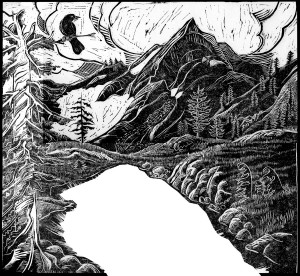
Illustration by Bill Reiswig
Three years ago I was given the opportunity to learn with the scientific leaders of climate change research as part of a teacher-research partnership through NASA, Oregon State University and the Oregon Natural Resources Education Program (ONREP). I heard scientists talk about how forests act as carbon sinks or carbon sources, how LANDSAT data are showing us changes to our landscape, how ocean currents are affecting the availability of copepods eaten by salmon, and how the growth rings in the ear bone of a fish can be studied and correlated with the growth rings of trees on the nearby coast. All of these researchers were making discoveries that played a role in our knowledge of climate change. In addition, teachers were assigned to a scientist each year to conduct research over a two-week period. This allowed both the teachers and researchers to discuss their work and determine ways that it could be transferred from climate researcher work to middle school student work. This sharing of information included access to the scientists and their work, even when I returned to my classroom.
Transferring Professional Development to the Classroom
A significant portion of my classroom science curriculum is spent on independent research projects where students work through the inquiry process to answer a question to a problem on a science topic of their choice. Prior to starting our projects this year I assessed students on their graphing and analysis skills by teaching lessons on climate change in the Northwest, primarily using the Natural Resources Conservation Service (NRCS) SNOTEL system. This automated system, under the technical guidance of the National Water and Climate Center (NWCC) provides snowpack and climate data in the Western U.S. and Alaska. SNOTEL provides real-time data that is critical for understanding future water supplies and allows my students exposure to natural resource issues that will directly affect them and their families. Based on my experiences working with snow pack research, I designed a multiday lesson on climate change that used SNOTEL data to form the basis of the students’ inquiry.
Climate Change and NW Snowpack Lessons
Day 1
Each student was asked to build a concept map for climate change showing connections among different components. Examples were given for a concept we had just finished studying (photosynthesis) so they were clear on how to see and depict interactions. The concept maps varied drastically, partially due to the fact that my classes include a mix of 6 – 8 graders but also because of the wide range of knowledge about climate change knowledge among my students. The discussion after the students completed their concept map and pretest was valuable, with many students wanting to share, ask questions and verbalize their current understanding of climate change.
Day 2
Students were excited when they sat down, and I was in the back of the room with a very loud snow-cone machine. After they got over the initial disappointment of not getting a refreshing snow-cone, each table group was asked to agree on the volume of “snow” that was in the beaker I had filled and placed on their table. Students recorded their information along with a definition of SWE or Snow Water Equivalent. Our basic definition was the amount of water in the snow. Students also made a prediction of the SWE for the “snow” that was on their table. At the end of class, after melting, students determined the percent water content in their snow.
To show a real life example on a large scale of global climate change and melting I had students watch the TED Talk, “James Balog: Time-lapse proof of extreme ice loss”. Balog shows photographs from the Extreme Ice Survey that he began in 2005 and shared in his TED Talk from 2009. Students were asked to write down new information, “WOW” information and questions they had from the talk. Connections were made since some students had been to Alaska, while others had been in the Cascades Mountains; but the majority of the students did not realize that glaciers were present in the mountains located just 65 miles from where they were sitting in Beaverton, Oregon.
Days 3 & 4
To help connect students to their surroundings I had them pick an Oregon SNOTEL site out of a hat. The sites didn’t make sense to them yet but the names are intriguing with the likes of Jump Off Joe, Blazed Alder, Bear Grass and Mud Ridge. Students went online to gather general information about their SNOTEL site such as county, latitude-longitude, and elevation. The students also collected SWE, snow depth, YTD precipitation, and Max., Min. and Average Temperature (see attached student activity sheet). To get a view of the historical context of how SWE has changed over time students collected mean SWE for March in every year that SNOTEL data have been collected. In most cases this was approximately 1978. Students found wide variations in SWE from year to year but soon were asking about specific years from other sites and realized how data were similar from site to site. Many discussions revolved around why such large fluctuations exist, trends over time, temperature’s impact on SWE and elevation impact on SWE. These discussions were difficult for even some of the more accomplished 8th graders, but interest did not diminish due to complexity. Students graphed data, wrote a short analysis and compared data with another student whose site elevation differed (+/-2000’) from their own site.
Adopt-a-SNOTEL site: Long Term Snowpack & Water Availability Activities
As a follow-up to this activity students have been monitoring their SNOTEL sites since November daily for SWE, snow depth, YTD Precipitation and Observed Temperature. (See attached student monitoring sheet.) This work has continued to keep students interested and active in local mountain snowfall and their own SNOTEL site. Each month I am asking students to conduct activities and answer questions on their SNOTEL data. This includes graphing one or more of the parameters, discussing monthly trends in the data, comparing site data with another student and finding sciences article related to snowpack, glaciers and climate change. Students will conduct this activity throughout the winter and spring months as a way to continue their learning on climate change, make a connection to their sense of place and better understand how their water supply will be affected in the short and long term.
The range of benefits to me and my students provided by the Researcher-Teacher Partnerships project have been immeasurable. I have been given open access to an elite scientific community, the collaboration among educators has been inspiring, and my current and future students will continue to learn as researchers.
References
Natural Resources Conservation Service. (2013) SNOTELand Snow Survey & Water Supply Forecasting Brochure. National Weather and Climate Center, Portland, Oregon
http://www.wcc.nrcs.usda.gov/snow/about.html
Natural Resources Conservation Service SNOTEL Data, http://www.wcc.nrcs.usda.gov/snow/
TED Conferences, LLC. (2009) James Balog: Time-lapse proof of extreme ice loss http://www.ted.com/talks/james_balog_time_lapse_proof_of_extreme_ice_loss.html
Science expertise was provided by the following Oregon State University Faculty: Dr. Anne Nolin – Professor and Travis Roth-Doctoral Student in the College of Earth, Ocean, and Atmospheric Sciences
Acknowledgements
These lessons were created using information learned in the Oregon Natural Resources Education Program’s Researcher Teacher Partnerships: Making global climate change relevant in the classroom project. This project was supported by a NASA Innovations in Climate Education award (NNXI0AT82A).
Student Activity Sheet Attached
SNOTEL Activity for Oregon.docx
SNOTEL MONITORING SHEET.docx
SNOTEL SWE for Oregon name: _______________________
SITE MONITORING
Use this to record data for your SNOTEL site for the next month. In the table below you will find the information you will need to record for your site. This should be collected at least once per week for each day that week.
1. Go to Google Search and type Oregon SNOTEL
2. Click on first site shown which will be a map of Oregon
3. Use the drop down menu Select a SNOTEL Site to find your site by name. Or if you know where your site is located you can click on the correct red dot on the map.
Site Name: ____________________________________ Site Number: ___________________________
County: _______________________________________ Elevation: _______________________________
Latitude: _____________________________________ Longitude: _______________________________
5. Click on Last 7 Days under the Daily column for Snow Water Equivalent. Record the following.
| Date |
Snow Water
Equivalent
(in) |
Snow
Depth
(in) |
Year-to-Date
Precipitation
(in) |
Observed
Temp
(degF) |

by editor | Jul 10, 2014 | Learning Theory
Are Economies the Only Things that Expand and Contract?
Do we need to inject more time for contemplation into our curricula?
by Jim Martin
CLEARING Associate Editor
Photo by Jim Martin
Concentration and contemplation. Expand and contract. Walk drive. Makes life varied, interesting, doable. In school, the intensity of work in the field or lab can make the follow-up work seem interminable. Slowing down to contemplate and write may seem, not a waste of time, but using time that needs to be spent preparing for the next test or lab or field trip. Some of us assume it can be done quickly, just make a table, graph the data in the table, and write a one-paragraph conclusion, then move on. But it’s contemplation that drives home the learnings. And makes life purposeful and meaningful. Even at the cellular level, it takes neurons time, hours to days to weeks or more, to lay down an effective memory. Even though the transmissions that set up the neuronal networks involved in that memory moved at velocities well over 100 meters per second. Contractions and expansions, working together to make the world meaningful.
Years ago, Dryas and I met a man who loved to restore old homes. Something he enjoyed working with, and which was a pleasant surprise for me, was the concept of expansion and contraction of space. For instance, two large spaces, two rooms, in our house were linked by a short, low, narrow passage. Moving from one room to another meant leaving a large space, contracting as you traversed a low, narrow space, and then expanding again into a large space. Traversing them was a small adventure. How do we recognize and use these large and small elements of our lives? Do we even allow them?
Even when life becomes unbearable – a bitter divorce, the death of one we’re close to – the emotional contraction is concentrated, intense, then opens to an expansion into a world we’re beginning to know and explore. The period before the event, if it was a life involved and invested in, was an expansion, the time we enter into understanding. It’s this concentrated period of exposing ourselves to new information, then moving to an extended period of contemplation that has the capacity to consolidate new learnings so they become elements we can easily bring to mind and to bear on new experiences. Even divorce and death.
Life today seems to emphasize contractions – tweets, texts, two people with lattes sit together talking to others on their cell phones – does it allow expansion, contemplation? As I write this, I look around my favorite coffee and crepe house and see people, many 20- and 30-somethings, talking and laughing, talking and thinking, reading; or eyes past the window, lost in thought. From time to time, a hand caresses a cell phone to life, an eye glances to see what’s there, then hand returns to thought, book, or friends. As people, we haven’t lost contemplation. Those who seem to be distracted are probably the same who have always found contemplation difficult. Of the hundred-plus people I’ve friended on Facebook, only a few send constant updates, and most of those, I know, spend quality time in contemplation.
And so it should be in school, but, paralleling school’s inability to adequately help us prepare for life in the real world, contractions tend to be the norm. Checking off standards seems to be our frenetic response to the need for doing a better job of teaching. Even though teaching less, but in more depth – expansion and contemplation – results in a better education. Test scores around the world tell us that our capacity to pass similar tests is well below that of the rest of the highly developed world. So we try to catch up by emphasizing test preparation in schools, and track our progress on tests of academic standards. We even invest heavily in preparing to take these tests. What we don’t emphasize is learning for understanding.
We don’t really understand something unless we’ve done it, thought about it, and done it again. And talked about it, and thought about it. Learning and memorizing facts in order to pass tests is effective when we are learning how to stop and go through a series of traffic lights, or to use a drill press effectively without injuring a finger. It doesn’t work as well for learning or modifying concepts for understanding. The networks of neurons for this kind of learning, learning for understanding, are much larger, and provide a broader base of information for understanding when we encounter something new. Students whose teachers engage this larger approach to teaching actually score better on standards tests than those where teachers focus significant amounts of time on preparing their students for these very tests. Let’s look at this.
Concentration and contemplation; what does this look like as an organizer for delivering curriculum? Let’s move from one large room to another via a narrow, arched passageway – contemplation, concentration, contemplation. One step further: Let’s follow the last contemplation with a sharp contraction.
Walking through the first room, observing and thinking about what’s there, we find people reading, discussing, working computers, writing. They’ve been presented with a question, “What about its local habitat influences where macroinvertebrates decide to spend their time?” The question is a short cut, devised by the students’ teacher to save time. The class has three days to develop a list of possibilities, discuss them, and find out how to observe them. They’ll do this in their work groups.
Even while they’re in this large room dedicated to contemplating the problem, some moments are busier than others, such as when they are deciding whether to add water temperature to the list, since the creek near the school has a generally predictable temperature. So, I might modify my metaphor to include large and small areas within the room; a room, nevertheless, where students know they have time to do the work.
What the teacher has done by phrasing the question in its particular way is to induce her students to employ higher level cognitive skills as a vehicle for learning. (And defining the limits of the playing field. An effectively devious method of setting boundaries.) Instead of starting by finding and memorizing facts, students begin by assessing and discriminating the macroinvertebrate habitat, which induces them to seek, acquire, and understand information, and apply what they find to answering the teacher’s prompt. This work takes time, involves research and what I call ‘negotiation of meaning’, where discourse begins to clarify meaning. While busy, students have time to think and digest information they have sought and found. Time to make sense of what they are learning. And to assure ownership of the learning.
They are starting by delineating and assessing a habitat with a mind toward developing a concept which includes macroinvertebrates and aspects of their habitat. Instead of being taught specifics about macroinvertebrates and stream habitats, then moving up the line, they start at a higher conceptual level, and the impetus for working at the lower levels comes from the students themselves by following up on the needs-to-know that emerge from their work. And they will spend their time learning the basics more effectively than if we teach to them from the front of the classroom. Not only that, but they will remember what they discover. That is what we’re after if we’re teachers.
Now, to a contraction. So they decide on temperature, water depth and velocity, characteristics of the bottom, and algae, as aspects of the local habitat which might influence where macroinvertebrates live. Now, they need intense concentration on how to observe and measure these. Then they put this into a design to answer the over-arching question, go out to the creek, and do the work. This is a straight-forward operation, much like what they usually experience in school. Except that it was derived almost entirely from their own minds. The things we’re charged with developing.
Next in the contraction is to do the work, followed by an expansion to process and interpret results. They’ll need to tabulate and analyze their results, then synthesize and interpret what emerges. After this, they will prepare to communicate their results. These processes will engage discussion and contemplation as they begin to comprehend what they have learned. By this time, they will be the owners of their learnings, and you will be tweaking things here and there to tie down the learnings which are your main curricular goals.
The final contraction? Go back to the site to follow up on questions that arose in reporting. Rarely done, but nails down the learnings. Products of their own minds.
This is a regular feature by CLEARING “master teacher” Jim Martin that explores how environmental educators can help classroom teachers get away from the pressure to teach to the standardized tests,and how teachers can gain the confidence to go into the world outside of their classrooms for a substantial piece of their curricula. See the other installments here, or search Categories for “Jim Martin.”

by editor | Mar 20, 2014 | Learning Theory
 By Jim Martin
CLEARING Associate Editor
 he young woman carefully pours hydrogen peroxide into a graduated cylinder, presses a key on a computer keyboard, then measures ten drops of liver homogenate into the cylinder. The surface of the hydrogen peroxide seems to leap at the first drop of homogenate, then the drop begins to froth and spin as it is carried deep into the cylinder, trailing a growing, spinning plume of bubbles. Each drop increases the frothing turbulence in the cylinder until it seems enveloped in a pulsing explosion of bubbles. Meanwhile, the young woman’s glance moves from a developing graph on the computer’s monitor to the activity in the cylinder and back again. Science is being done.
If we could see into her mind, what kind of thoughts must we find there? What must she have done and thought to get to where she is at this moment? How will her thoughts change when the reaction has gone to completion and she reviews the data? One thing is certain: this young woman has a history of doing process science. Another thing is certain; her work presents her with conceptual schemata which require filling out with specific facts; the work she does generates a need to know. This need can drive her into the books and the web to find out. Can we capture this kind of science in our classrooms? Can we accommodate her experiences into a model of science pedagogy?
How might this scenario play out in a stream, where the young woman is measuring water quality, collecting and identifying macroinvertebrates, and entering her data into an iPad? Is there any substantial difference in her experiences in the two environments? Certainly there are logistical differences, but I submit that these are an emergent phenomenon which arises from our traditional concept of what school is. Is school a journey of the mind, or is it a place with boundaries, where we learn to pass tests? In both places, she is engaging similar mental concepts, and procedural processes. Our bodies and brains are able to work in both environments. The significant thing is that what the mind and body are doing has to be meaningful. In the case of this young woman, what she is learning is related to what she knows of other knowledge; it is being learned within a familiar context. If she were learning for a test, she would learn the facts, but they wouldn’t necessarily be learned in order to understand. The kind of learning this young woman is engaging is active learning, in which she is constantly comparing her experiences with what she knows. Whether she is consciously aware of it, she has learned how to learn. That’s a powerful skill.
In school, we tend to move from one topic directly to another as if this is what education is about. Many of us do this in our personal world, racing through life, leafing through it as we would a magazine in the doctor’s office, never pausing to contemplate what it is, what it means. We should take the time to absorb life so we can live within it. The same goes for school. Instead of zipping on to the next topic as soon as we’ve covered the current one well enough to test on it, we should probe for students’ attainment of the concepts embedded in the topic to see if they’ve nailed them down. We ought to give students a chance to think about what they’re learning, and design a repeat investigation to nail down their understandings. We need to explore ways to transition what we have just learned to what we will be learning. Even though they can parrot words we’ve used, they may entertain misconceptions and may well not actually understand what we assume they know.
This applies also to teachers. Our pre-service preparation and most of our in-service learning was done with this industrial assembly line model, zipping us through a ritual that eventually placed us at the head of a classroom. About twenty years ago, I was doing a wetlands ecology institute for teachers, and a question came up among the staff about what to do after the teacher participants’ first afternoon in a local wetland. One opinion was, “Okay, they’ve done their first study. Let’s get them ready to go to the coast for their second study.” The other opinion was, “They’ve done what amounts to a casual observation, which might have raised some questions they could follow up with a second investigation.” Fortunately, the second opinion won the day; the participants asked questions which arose as they processed their observations, and they used these to design the following day’s study at the same wetland. Having done that inquiry, once at the coast they hit the beach running, the well-oiled machine, and they nailed down what they had been learning about wetland ecology. It took time, but it moved them further up the learning curve.
After their original casual observation, we could have left them where they were, some in the Acquisition phase, some entering Proficiency. This is what many in-service educators do. We assume the teacher will move to Mastery, but only a few have the self-confidence to do so. Instead, we leave them knowing that they could know, but not ready to take the next few steps. Dryas and I had a mutual friend, who was in late middle-age. Let’s call her Sarah. Sarah had decided to leave an emotionally abusive relationship, but had no idea what to do, nor did she have the confidence to try. A few of us located a place where she could stay, and I agreed to meet with her once a week to help her develop a business plan for using art to explore relationships as a way to earn a living. Over a period of three or four months, we’d meet once a week, and she’d bring out what she’d accomplished on the plan. Her Acquisition phase was long, about six weeks, but then she started accelerating into Proficiency. Sarah had been making collages to express her feelings then interpreting them. This is what she planned to teach others. After moving into Proficiency, each week her collages portrayed a bird, first totally enclosed in a sealed room becoming a bird looking out the window, seeing life outside the window, perched on the window sill, and finally freedom – soaring in the air toward the Sun. The slow but steady movement from locus of control far outside the body, to deep within and freedom to live her life. It takes time, but moves us up the learning curve. We need this in our emotional life, but also in our cognitive, conceptual life.
What’s the difference in insecurity about living in a relationship and insecurity about teaching in a content area? You could leave the relationship because the other isn’t likely to change. But, understanding the science means you’re in a win-win situation, and don’t have to leave, much as you would be in the relationship if the other decided to go into counseling. The young woman pouring hydrogen peroxide obviously understands what she is doing and why. She’ll continue this relationship. That’s what we want.
Are we adrift now? The point is that, like all things we do, they’re done by humans. We bring our small, effective human arsenal to bear on a large number of issues, all manageable with what a well-understood arsenal contains. In school, the secret is your confidence in your capacity to teach, just as in your personal life, the secret is your confidence in your capacity to manage a relationship. Likewise, a student’s confidence in the content and concepts determines her ownership of her learnings. We need to bring them to confidence, then we’re all ready to move to the next topic. How do we do that?
Working with Meredith, the middle-school teacher who takes her class out to the creek at the edge of the school yard, we’ve seen how she has learned to have her students repeat investigations to move along the learning curve. Like a booster rocket, they’ve got altitude and velocity; just need that extra push to get them into orbit. The first time through their work on the creek, they figured out how to do it. Setting up more than one station per group, one at a riffle, at a glide, and at a pool, would ensure students had ample opportunity to move to Mastery. At each trip to the creek, students might repeat their observations more quickly, and could move in to explore new curricula in the time saved. While moving their understanding of, say, macroinvertebrate collection, identification, and interpretation to Mastery, they could be moving their understanding of the roles of the rest of that ecosystem in generating a healthy habitat for the animals they are studying through Acquisition into at least initial Proficiency. That puts Meredith in charge of her curriculum. Which is where she should be; on the road to building competent, empowered minds.
This is a regular feature by CLEARING “master teacher” Jim Martin that explores how environmental educators can help classroom teachers get away from the pressure to teach to the standardized tests,and how teachers can gain the confidence to go into the world outside of their classrooms for a substantial piece of their curricula. See the other installments here, or search Categories for “Jim Martin.”
by editor | Jan 2, 2014 | K-12 Classroom Resources
By Jim Martin
CLEARING Associate Editor
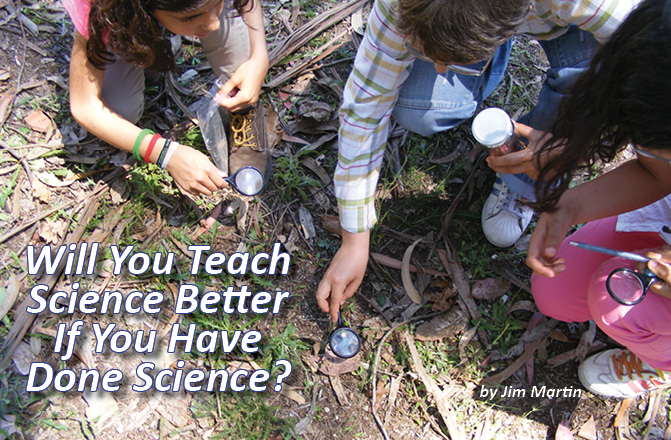
 hat if science teachers did science before they began teaching? Might a teaching model like this be possible to employ? Instructive to explore? There have been initiatives which followed up on this possibility. Their results were encouraging, but never replaced learning about science in publishers’ materials via college teacher education courses, which are simpler and less expensive to do when they are textbook-centered. The fruits of this choice have been a large fraction of K-12 graduates who haven’t achieved their potential.
What do students have to say about the way they are taught? Might some insights emerge from their comments? There is very little record of K-12 education from students’ own personal view point. Do they know whether their educations are worthwhile? A few people have looked into this, and have found that, when asked, students feel that classroom time is well spent when students treat the teacher with respect, behave the way their teachers want them to, stay busy and don’t waste time, learn a lot almost every day, and learn to correct their mistakes. Perhaps they have an intuitive understanding of an environment conducive to learning. The National Board for Professional Teaching Standards teacher certification program finds that students do well in school when their teachers are committed to them and their learning, know the subjects they teach and how to teach those subjects to students, are responsible for managing and monitoring student learning, think systematically about their practice, learn from experience, and are members of learning communities. Two complimentary views of what underlies effective education.
Taken together, these findings indicate that students know when they are taught well, and present the foundation of a clear plan for teacher pre- and in-service education. Had the K-12 graduates who didn’t achieve their potential applied questions such as stay busy and don’t waste time, learn a lot almost every day, and teachers know the subjects they teach and how to teach those subjects to students, to their teachers and curricula, and their assessments been considered in improving science teaching, might they have led to science courses which encouraged students to achieve their potential? Would they have led to pre-service science teachers actually doing science as part of their preparation for teaching science?
My experience tells me that doing science is important for science teachers. The need for science experience is a need that environmental educators have the capacity to respond to. The environments they work in abound with the kind of work pre- and in-service educators can do: mitigation, restoration, assessment, etc. They all contain the kernels of science inquiries to do. Working in collaboration with environmental educators, agency staff, and teacher education faculty and staff, pre- and in-service teachers could gain hands-on experience on the ground that they could get in no other way. My own experiences tell me that what emerges from this kind of collaborative work is science teachers involved and invested in the content that they teach, and empowered as teachers unencumbered by bureaucratic pressures outside their classroom doors; the experience necessary to change teachers’ views of science, a paradigm shift, that moves their locus of control for teaching science to within themselves, and away from the political winds that blow through schools. A key piece of the puzzle, this respite gives them a chance to develop effective science curricula.
What is it about doing science in environments outside the school that makes it so effective? I’d say that the reasons are many. An obvious one is that doing science in a familiar setting is less intimidating than doing it in a lab, which is much less familiar than, say, a quiet streambank. Another is that our brain learned to learn in the world outdoors. So learning science in a natural environment means learning in the brain’s inductive-constructivist way of learning. I’ve learned that, when teachers begin by doing science in a natural environment, they develop reasons to go into the lab, and labs become familiar places. What if we tried that? What would happen if environmental educators, agencies and organizations, and schools of education gathered together to explore the idea of a collaboration to provide pre- and in-service hands-on science education for teachers? There are all kinds of possibilities in collaborations like this.
If you’re a teacher, think back to your pre-service classes. Did you learn about a thing in class, then go out to experience it? How closely did what you experienced resemble the picture you had in your head back in the class? What if you had done the work first, then returned to the class to learn the underlying conceptual structure? Imagine a pair of pre-service teachers working together with an environmental educator, a restoration specialist from the City’s Bureau of Environmental Services, and a teacher with her students, to restore a reach of a stream flowing through a residential area near a school. Imagine further that the pre-service teachers are charged that day to identify and describe the characteristics of effective work groups. This in addition to doing the scheduled work of the morning.
The next day, back in the School of Education, all of the members of the class relate their experiences and report the characteristics of effective work groups that they had observed. Might discussion and negotiation of meaning elicit a clear concept of effective work groups, and posit connections between that and other elements of human learning? How might experiences like this influence these pre-service teachers when they do their one-year teaching internship? Would they affect the quality of their students’ educations when these interns begin full-time teaching? How would this look if a full-time teacher worked with the group from time-to-time as a mentor? If the full-time teacher would be the supervising teacher when the interns did their year in her classroom? This may never happen, but you can organize your own experiences to make this kind of experience one that you achieve yourself. All of the pieces of the puzzle are out there; they’re just not seen as elements of a functional whole. We have to learn to open our minds to recognize the relationships between what seem obviously disparate elements in a confusing world.
We’re not going to have this handed to us. But you can hand it to yourself. Find an environmental educator who is doing a restoration. Work with her. Then get your students on board. You’ll be outside your comfort zone. That’s okay. Keep your focus on what you want your students to learn, and make sure that part works. Look for workshops and institutes that provide valuable experience. In one summer institute, a teacher who had never ventured outside the classroom experienced her first encounter with the real world. By the end of the institute, she knew how to find a wetland, figure out its parameters, and design a project for her students. She had done science, and moved it into a perspective that removed its anxiety, made it eminently teachable. So she looked up an environmental educator she had met during the institute who suggested a wetland restoration project along a city-sponsored trail. The environmental educator agreed to help her plan, meet City bureau of environmental services staff, provide a training for her students, and point her toward a private granting organization which funded just this sort of project. She did the project, and continued on this path.
Let me step away from science for a moment and tell about plays my 7th graders performed when I first began teaching below college level. If I hadn’t done drama, I’d never have just hung two sheets from the ceiling light fixtures along the length of the room and said, “The side toward the windows is the audience, the side toward the blackboard is the stage. What shall we do?” My locus of control would have been too far away from me to even think of doing that. Luckily, I’d done plays for years. We picked a play, edited it, gave it. Then students, in groups, asked to write and do plays for the lower grades. And did them. I’d have been scared to death if I hadn’t acted, directed, constructed, written programs, made props, etc. I’d have simply followed a published play with directions. To the letter. And thought I was teaching drama. And I’d certainly not let them go off to the lower grades on their own. They’re seventh graders; get real.
Once you do science, it is not as intimidating as you first perceive it to be. Like me if I’d never done drama. Or, for all of us, the first time off the diving board, hitting a softball, etc. Now, you are focusing on particulars, so experience no unfocused anxieties about vague worries. We’re all good at that; once we focus on particulars, we begin to nail them down and work toward mastery. Get the start, so you know what you want to understand and do, then look around for resources like courses, workshops, knowledgeable people. Experience doing the work, then take control of your curriculum.
 This is a regular feature by CLEARING “master teacher” Jim Martin that explores how environmental educators can help classroom teachers get away from the pressure to teach to the standardized tests,and how teachers can gain the confidence to go into the world outside of their classrooms for a substantial piece of their curricula. See the other installments here, or search Categories for “Jim Martin.”

 This is a regular feature by CLEARING “master teacher” Jim Martin that explores how environmental educators can help classroom teachers get away from the pressure to teach to the standardized tests,and how teachers can gain the confidence to go into the world outside of their classrooms for a substantial piece of their curricula. See the other installments here, or search Categories for “Jim Martin.”