by editor | Jan 18, 2016 | Interviews with Educators & Leaders
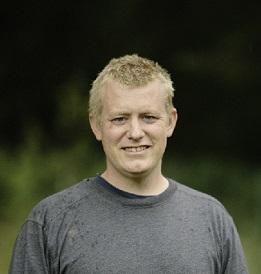
An Interview with Ryan Monger
Winner of 2015 EPA Presidential Award for Innovation in Environmental Education
Ryan Monger, Sultan High School
Sultan, Washington
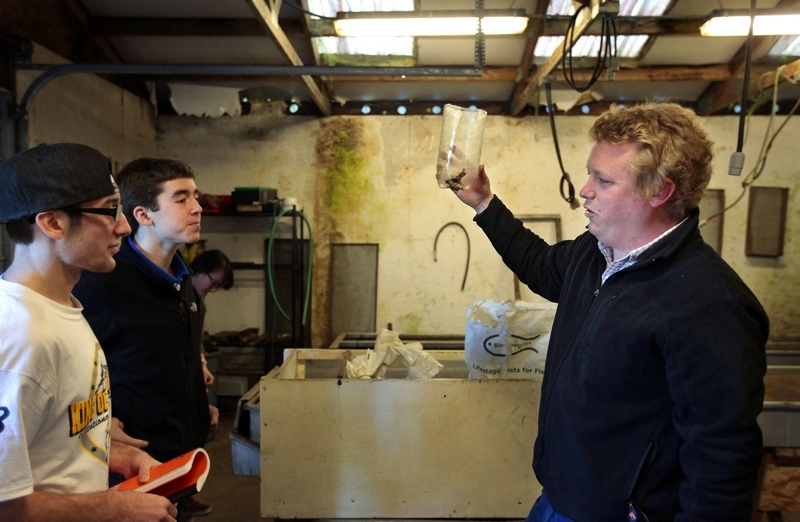
Ryan Monger, an environmental education teacher of students in grades 9 through 12 at Sultan High School in Sultan, Washington, uses this small, rural community as an outdoor classroom to encourage his students to explore science and learn about the local ecosystem. Students in Ryan’s classes participate in hands-on projects, including maintaining a salmon hatchery on the school’s grounds and releasing the fish into a local stream, surveying bacteria living on common surfaces such as those in the school’s weight room and on students’ cell phones, tapping maple trees at the school to make maple syrup, identifying trees and growing edible plants in the school greenhouse using environmentally sustainable, small-scale farming practices. Ryan’s students also participate in community-based projects, including environmental restoration projects to mitigate the impact of clear-cutting and the runoff of pollutants, and conducting an ongoing salmon study.
Ryan’s efforts to educate his students about the importance of environmental stewardship has garnered a great deal of support from the community. Local nurseries, hardware stores and seed companies donate supplies for the projects, and his students received recognition for their hard work when a local newspaper wrote a cover story on his unique curriculum. Students in his class are also working to integrate environmental education into the district’s preschool curriculum by involving preschoolers with the salmon hatchery project.
CLEARING: Tell us a little bit about yourself… how did you get started in environmental education?
Ryan Monger: I used to teach a pretty standard science curriculum, which was fun: explosions in chemistry and lasers in physics. However, when I got the job at Sultan, it was just Biology and there was not much money for fancy equipment. What we did have was a nearby river, a greenhouse, open fields, a salmon hatchery and a wonderful forest with trails behind the school. More than anything else, I was just taking advantage of the resources that I had.
CLEARING: Do you recall anything from your childhood growing up (vacations, time in the woods, etc.) that may have played a role in your becoming an environmental educator?
RM: When I was growing up I lived in the suburbs of Bellevue, but there happened to be a few acres of woods right next to our suburban home. I used to walk in those woods every day and I think they made a pretty profound impression on me. I loved catching frogs and salamanders, collecting plants, climbing trees and looking at forest flowers. Ever since, I have felt more at home and at peace in the woods than anywhere else. When I was about 10 the woods were developed into more suburban housing and I can remember feeling very angry and hopeless about this. I suppose I have wanted to do whatever I could to help the forest since that day.
CLEARING: Were you inspired or influenced by anybody in particular or anything you read or saw?
RM: I have been and always will be inspired by the natural world. I have never been into fantasy or science fiction because I always thought the real world was good enough for me.
CLEARING: How long have you been in the classroom?
RM: About nine years. I taught 4 years in England, 1.5 years on the Tulalip Indian Reservation and I have been at Sultan for almost 4 years now.
CLEARING: Talk about the inquiry and community-based projects that earned you the Presidential Award for Innovation.
RM: I think that I received the award for my work in helping to run our school’s salmon hatchery, starting gardens on school grounds, and doing habitat restoration in our forest. The hatchery could not have been successful without the help and guidance of community member Don Foltz. I have also received lots of help from Kelli Mack of Everett Steelhead and Salmon club, Trevor Jenison of the Wallace Falls State Hatchery, and our librarian Conan has helped tremendously by maintaining the trails in our forest. The district has also been helpful in their willingness to maintain the hatchery and our administration has given me the freedom to teach how I feel is right. Our students are also incredible people: helpful, humble, intelligent, and enthusiastic. I could not have done any of these projects successfully without their help.
 CLEARING: What do you find most rewarding about inquiry-based learning?
RM: I love watching students figure out problems on their own. I feel like learning to problem solve is far more important than memorizing scientific facts and vocabulary. The only way that I have ever learned in my life is by trying things for myself, so I am trying to give my students that same experience. It is both more enjoyable for me and for them when they get to explore the world around them on their own terms.
CLEARING: Are there any resources (books, curriculum, community-based) that you use that you have found particularly valuable?
RM: I have found the river and the forest to be particularly valuable. They are ever changing and are full of teaching resources. I learn more in one minute in the forest than I could over a lifetime of studying pre-prescribed curriculum. In just the last few weeks, we have seen an owl, a hawk, deer and deer tracks, nursery logs, a forest floor golden with cottonwood leaves, salmon spawning, and the most beautiful mushrooms on earth. What more could you ask for?
CLEARING: What has been the response to your program from parents and the community?
RM: Overwhelmingly positive. As far as I can tell, most (if not all) students love learning outside, even in bad weather. I have received nothing but positive comments from parents and lots of help from people in the community, particularly those listed above. My most important community asset by far has been the help of my students. They have all shown interest and I have had many helpful TA’s. Of particular help have been students who were in the running start program, but have chosen to come back and to help. Jazmen Griggs, Liam McDonell, Olivia Gasselsdorfer, Logan Berti, and Josh Morehead have a spent countless hours helping me in the classroom when they did not have to be there. I would have been lost without them.
CLEARING: Have you been able to expand your program?
RM: Yes I have. We continue to restore habitat in the woods, garden, collect mushrooms, and run the salmon hatchery. Every year, we spend more time outside. I am currently applying for grants to build an outdoor classroom and take students to visit old-growth forest.
CLEARING: Can you share a particularly memorable moment from your student projects over the past couple of years?
RM: I love walking through the forest with them. They have taught me so much about life and how to appreciate it. I love kneeling before a tree or a mushroom and admiring them together.
CLEARING: What keeps you motivated to do the work that you do?
RM: The enthusiasm of the students and the serenity of the forest.
CLEARING: Who are your environmental heroes?
RM: Salmon, cedar trees, huckleberry bushes, douglas firs, big leaf maples, black bears, bald eagles, and beavers. Anyone who has done anything to help educate about or preserve our local forests.
CLEARING: What book(s) are you currently reading?
RM: ‘Salmon’ by Peter Coates and ‘The Final Forest’ by William Dietrich.
CLEARING: Do you have any advise for young teachers just getting started?
RM: Do what you feel is right and make sure your primary feedback comes from the students and the look in their eyes. This will tell you more about your teaching successes than a whole mountain of data will. Also, treat the students with respect and they will do the same to you.
CLEARING: Any final thoughts that you’d like to share?
RM: I love teaching about the forest and the river. I hope to be able to do it until the day that I die.
CLEARING: Thank you so much for your time, and best wishes for your continued success!

by editor | Jan 17, 2016 | Arts and Humanities
Wild Words: A guide to integrating creative writing into field-based education
by Becca Deysach
“I’ve always wanted to write but never gave myself permission.”
This sentiment is the one I have heard most frequently since I began teaching creative writing several years ago. I’ve heard it from my college students, patients at a mental health clinic, and empty-nesters who are finally letting themselves do whatever the heck they want.
The more I inquire about my students’ inhibitions about writing, the more I discover that people are afraid they have nothing to say, or, worse, that they will fail terribly at saying what they want. I hear horror stories of returned papers that might as well have been dipped in red ink, and the resulting belief that they were, indeed, better off not trying.
But it’s not true: they are storytellers. We all are. Some creative impulse lives in each of us—it’s part of being human, after all—and for some, the urge to paint or dance or write becomes so great that eventually it overpowers the limitations imposed by well intentioned teachers when they were young. But then it shouldn’t get to that point.
I believe that it is the responsibility of educators to prevent our students’ alienation from their own creativity before it’s too late by nurturing their inborn sense of wonder, curiosity, and creativity, whether our discipline is wilderness leadership, stream ecology, or math.
Good teachers do this in a variety of ways, including inquiry-based learning initiatives, field studies, journaling, art projects, and more. We do these things because they are fun, and we do them because we know that experiential education leads to better learning outcomes.
 Creative writing workshops are another fabulous means by which students can engage more intimately with any topic at hand, integrate their learning, and deepen their relationship to their ecological and learning community. The only problem is, the same messages that make so many adults fearful of creative writing also prevent many educators from facilitating creative writing exercises, and students thus lose the chance to get to know forest with the sensitivity of a poet and the precision of an ecologist.
At the risk of making my job obsolete, though, I’ve got a secret for you: anybody can facilitate a writing workshop. All you need is a group of students armed with paper and writing implements, your own creative spark, and some basic facilitation tools.
The writing workshop I outline below is designed with field educators in mind, but the basic principles and format can be applied to any classroom, school yard, garden, or living room context just as easily.
But first, you must know the Rules for Freewriting:
- Write the first thoughts that comes into your head. Don’t think, just write!
- Keep your pen flowing. Don’t stop writing until the timer is up or the facilitator says, “stop”! If you get stuck, just repeat the word you’re on over and over until something else comes out.
- Don’t worry about grammar, spelling, or punctuation. You can fix that stuff later.
- Don’t try to control your writing! Let it take you where it wants to.
Ice-Breaker and Warm-Up
Writing and sharing can make us all feel vulnerable, so it’s important to begin any writing workshop by creating a safe and supportive space. If everyone is new to one another, a name game of your choice is a great place to start. If you are working with a group of students familiar to one another, begin with some variation of the following exercise, tailoring it to your group and your field of inquiry:
Read the following phrases aloud one at a time, and give everyone about thirty seconds to write their response before moving on to the next phrase. Urge your students to follow the Rules of Freewriting as they write.
- My favorite smell is…
- I wonder…
- In my free time…
- I love…
- If I could travel anywhere…
- My favorite book/plant/ecosystem/river/mountain/geologic era/invertebrate/chemical/constellation is…
- If I could travel to any point in history…
- When I grow up…
- I come from…
- I crave…
- I don’t remember…
- I remember…
- My name…
Sharing
Before any sharing takes place, let your students know that there is no right or wrong response to the prompts, and that you encourage them to share even if it feels a little scary, but that everybody has the option of passing at any point. The freedom not to share helps prevent self-censorship while writing, and that is ultimately what we’re going for.
 Go around in a circle, sharing responses to one prompt at a time. So, for example, ask everybody read aloud their response to “My favorite smell is….” before going on to “I wonder…” This creates a rhythmic group poem while exposing students to new aspects of one another. I always write and share with my students in these freewriting exercises, as it models vulnerability and helps contribute to a safe and intimate group atmosphere.
Exploration, Observation, and Writing
Once you’ve warmed your group up and they’ve begun to get comfortable with writing freely and sharing, you can move on to a longer exploration and writing exercise. Ask your students to split up and give them a couple minutes to find something in their environment that catches their eye—a rock, a plant, or a natural feature, perhaps. Depending on the type of class you are teaching, you could be specific about how they should focus their attention (“Pick a rock layer that you find intriguing”), or you could leave it open and let curiosity be their only guide.
Alternatively, you could collect some natural objects—a handful of river stones, branches covered in lichen, or decaying bark—and ask your students to each pick one. This may be a better option with younger students.
Once your students are settled in near the focus of their attention, ask them to observe it with most of their senses (taste is usually not appropriate). When 3-5 minutes have passed, ask them to begin a 5-10 minute freewrite that begins with a multi-sensory description of their focus and follows the Rules of Freewriting. Remind them to let their writing take them wherever it wants to go. You will time them.
Give your students a two-minute warning before their writing time is up, then ask them to finish up their last thoughts and rejoin the group quietly when the stopwatch strikes five (or ten).
 Sharing and Feedback
Once again, ask students to share their writing. You can also ask students to give supportive feedback to one another’s writing at this point. This encourages students to pay close attention to qualities that make good writing, builds group trust and support, and helps build writing confidence in individuals.
A few of the many things to give feedback on are:
- Images that stand out
- Interesting questions the writing raises
- Creative descriptions
- Striking language
- Any other strengths
Keep in mind that some groups are awkward about giving feedback and will need a little bit of modeling from the facilitator at first.
In addition, I ask people to refrain from giving “constructive feedback” on all off-the-cuff freewriting. It hardly seems fair to ask people to write whatever spills out and then critique it. Only once a piece has been revised is it ready for suggestions for improvement, and even then positive feedback is just as important.
Closure
It’s often most satisfying to end a writing session with a final, short piece of writing. Three-to-five minutes will do, and it’s up to you if you share for this final round. In lieu of sharing the whole piece of writing, you could ask students to share their final line.
A few suggestions for your final writing activity:
- Have students pick a favorite line from their own piece of writing and use it as the starting point for another one.
- Ask students to write down the last/first/favorite line from their previous piece of writing on a slip of paper, put the slips of paper into a small pile, and ask each student to pick a random slip to use as their first line.
- Use one of the phrases from the warm-up activity as a starting point.
- Have them close their eyes and listen, then begin by writing what they hear.
- Start with “Today I learned…..”
At the end of a workshop, I always like to thank people for their bravery and thoughtful participation. It makes everyone feel good and eager to come back for more.
Congratulations! You’ve just facilitated a successful writing workshop!
Launch Pad
Just as writing prompts are meant to be springboards for stories to emerge, the basic writing workshop model I outlined above is intended to be simply a starting point for integrating creative writing into your educational repertoire. Let your own imagination, course objectives, and field of study be your guide as you give your students permission to become the creative writers that live inside of them.
And, in the process, you might just meet the creative writer inside of you.
Becca Deysach teaches creative writing and environmental studies for Prescott College and Ibex Studios: Adventures in Creative Writing (www.ibexstudios.com). She is excited to work with teachers in all disciplines to integrate creative writing into their curricula and can be reached at becca@ibexstudios.com.
by editor | Dec 15, 2015 | Place-based Education
Engaging Students With/in Place through Community Mapping
By Susan Jagger
University of Toronto
This article was reprinted from Pathways – The Ontario Journal of Outdoor Education, Volume 26, Issue 3
 ommunity mapping brings together local people as they celebrate local geography, ecosystems, and stories of place through created representations of their communities (Lydon, 2003; Perkins, 2007). Mapmaking itself is a way of making sense of the world and of our place within it, and community mapping can help us to come to know our local environments. The process of mapmaking is key in community mapping; indeed, much of the value in community mapping is not so much in the product but rather in the collaborative sharing and discovering of place that leads to the map’s creation (Parker, 2006). I wondered about the pedagogical possibilities for community mapping in the K–12 curriculum and began a study that examined how participation in such a project could influence grade four students’ environmental knowledge, attitudes and actions (see Jagger, 2009 and Jagger, 2014 for a discussion of the research).
I worked collaboratively with Ms C.1, a grade four teacher, to plan and teach a three-month long, cross-curricular community mapping project of Sandy Beach Provincial Park. We focused on four themes in our project: local history, natural history, First Nations history, and personal connections to the park. Our mapwork drew from multiple field trips to the park, a visit to the local cemetery, and class visits from the museum manager and school First Nations liaison person. The following is an overview of some of our project’s mapping activities.
Introducing Mapmaking and Sandy Beach
We began our project with a small group brainstorming web of the question, “What can maps tell us?” To extend thinking, we shared a range of maps—from traditional topographic maps to handmade written and photographic representations of place—and asked students to then revisit their webs to make additions. The students were drawn to familiar political and road maps; some students did not identify the alternative maps as maps at all. One student, Charles, confided in me that maps were not made by people and that “you can’t make maps.”
Following this initial look at maps, we had our first visit to Sandy Beach. This visit was intended as an opportunity for students to familiarize themselves with the park and, given that it was the beginning of September, a chance for the class to build a sense of community. Students used digital cameras to take photographs and several parent volunteers accompanied us, allowing for small group, free-choice park explorations.
Back at school, students made their first maps of places very familiar to them—their bedrooms and the school playground. Bedroom maps were done by students at home and in a form of their choice. Most students created bird’s eye view maps of their rooms; some made their drawings to scale and in perspective. In small groups, students created a section map of the school playground (the playground was divided into nine sections to be mapped in a three-by-three grid; when completed the maps were put together to create a complete playground map). To guide their mapwork, students were asked to explore the sounds, textures, colours, shapes and sizes in the playground, and they spent time outside listening, touching and seeing the complexity of the playground space. The completed maps took on a variety of forms (e.g., side view, bird’s eye view) and included a range of techniques (e.g., grass pieces glued onto map, crayon rubbings to show texture).
Connecting with Local and First Nations Histories
Ms C. and I wanted to actively bring the community—its people and places—into our mapping project. To do this, we complemented our experiences at Sandy Beach with visits from both the local museum manager (Mr. B.) and the school district First Nations liaison person (Ms E.), and with a class field trip to the local cemetery.
Mr. B. arrived from the museum with (quite literally) a treasure chest full of artifacts from Sandy Beach to share with the students. Some pieces were the very tools used by the Barry family—the family who used to live and farm on the land that would become the park. The students quickly made connections between what they discovered at the park and the stories told by Mr. B. Guided by careful observations, the students made pastel sketches of chosen artefacts.
As it was important to us to recognize the traditional uses of the land in our mapping work, we invited the school district’s First Nations liaison person, Ms E., to be part of our project. Ms E. visited the class twice, and during her visits she taught the students about the traditional uses of Western Red Cedar in both practice and ceremony. In her workshops, Ms E. showed examples of woven cedar baskets and jewellery, and taught students to weave cedar mats of their own. Her underlying message to the students about cedar, and all natural elements used by First Nations people, was of respect and the importance of giving back to the land when we take from it.
The local cemetery was a short walk from the school and afforded us with a further trip back into local history. Here, the stories of the Barry family came to life as many of the family members were buried there. The students searched the cemetery for all of the members of the Barry family and used crayons and paper to make tombstone rubbings.
Exploring the Natural History of Sandy Beach
We took our second trip to the park about one month into the project. This visit was an exploration of the natural history of the park including the diversity of life and the park’s ecosystems. To guide their experiences, we asked students to keep three words in mind: unusual, interesting and change. Again, students used digital cameras to capture their explorations and parent volunteers accompanied small groups in three activities: a low tide beach walk, a scavenger hunt, and a sound and colour walk.
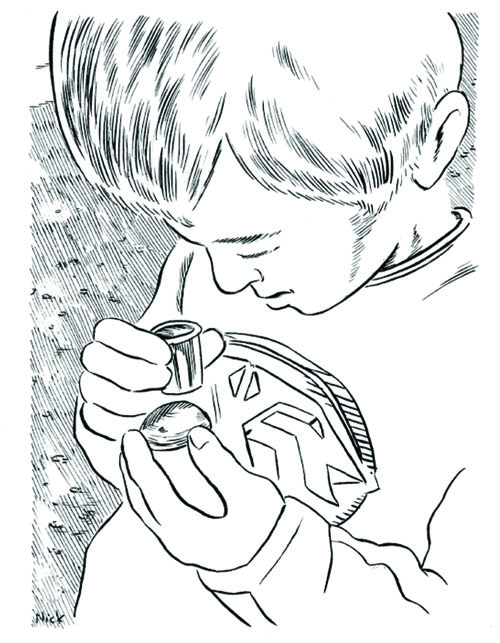
Ms C. led the students on the low tide beach walk. We planned our visit to coincide with low tide so the students could compare and contrast the high and low tidal zones and the transition between zones. Ms C.’s experience as a park naturalist at Sandy Beach guided the students’ explorations as she helped students to identify species, ecosystems and interactions. Students also used small magnifying glasses to examine details and intricacies of the features of the beach. Below, Quinn uses a magnifying glass to examine tiny molluscs attached to a rock (see Figure 1).
I created a map for a parent-led scavenger hunt that guided groups along a planned route through several different ecosystems—meadow, marsh, forest and beach. Students were asked to be mindful of their changing surroundings and reminded of the trip’s guiding words. Student observations were documented in their photographs and field notes. These photographs were put together in a class album of the visit, and back at school the groups came together again to write descriptive captions of the pictures from their walks.
To increase students’ awareness of the living things around them, I led groups on a sound and colour walk during which participants were asked to slow down and stop to listen and look. We listened quietly to the sounds surrounding us: the chirping of crickets, the laughing of ravens, the crashing of waves, the crunching of gravel. Before the start of the project, I collected paint chip cards from the local home improvement store and on our walk, we matched the cards to colours noticed along our walk. We renamed those colour samples to reflect the shades and hues of Sandy Beach (e.g., Douglas Fir Cone Brown, Rosebud Red, Arbutus Peeling Bark). The renamed paint chips were included in the class album of trips to Sandy Beach and in a mosaic frame for our emergent bulletin board map. The photographs, stories and observations from our visits to Sandy Beach were used to create an emergent bulletin board map (Sobel, 1998). I started the map with a very basic outline of the park—the shoreline, access road, parking areas and campground—and over several days, small groups of students added to the map. Some students drew in trails we walked along.
Others contributed written descriptions of features of the park they remembered. Still others added photographs that shared what we had experienced at the park. As we created the map, students looked through the album of photographs taken on our visits, shared their experiences with me, and added captions to the pictures.
Celebrating Personal Connections to Place
It was very clear to Ms C. and me that the students had developed deep personal connections to Sandy Beach. Students eagerly shared with us stories of special times at the park—recollections of weddings, first visits to the beach, earlier field trips and explorations with family and friends. It was important to us to really honour these affective understandings of place and so we focused our last visit to Sandy Beach on students’ cherished places there. As with other visits, students were in small groups, but on this visit students led the exploration of the park. The groups visited students’ cherished places and were told by the students what made that place so special to them. Many of these places were related to play—the driftwood pile that made a great fort, the tree that was like a swing, the tidal pools that were fun to explore. Students’ special places also
included spaces for quiet reflection and enjoying the beauty of the park—“the Dinosaur tree in the very quiet woods,” the beach with its beautiful shells, the amphitheatre “because I feel free there.” Students mapped their cherished places by creating clay sculptures and writing short descriptions of those places.
Mapping It All Together
Students shared their cherished places, along with their knowledge of the park’s natural, First Nations, and local histories in their If you came to Sandy Beach, I would show you… class book. We used Sheryl McFarlane’s Jessie’s Islandas a model for this mapwork, a book in which McFarlane shares the story of Jessie who writes a letter to her cousin describing all of the wonders he would see if he visited her home. With Jessie’s Islandas a guide, the students wrote letters to family members and friends who had never been to Sandy Beach. Letters included descriptions of plants, animals and ecosystems that could be seen at the park. Students recalled the stories of the Barry family’s first years on the farm and wrote about how First Nations peoples traditionally lived on the land. The letters also shared students’ own memories of cherished places and experiences at Sandy Beach. Over the course of the project, teachers and parents shared with me special memories that they had of Sandy Beach so we invited the school community to write letters as well.
Our class book beautifully brought together all of the experiences of the mapping project and allowed students (and some teachers and parents) to reflect on the experience of being and learning in place. Other books that celebrate place and could be used in mapping projects include Harrington and Stevenson’s (2005) Islands in the Salish Sea, Kronick’s (2013) How Victoria Has Changed, and Moak’s (1984) A Big City Alphabet.
Community Mapping as a Pedagogical Tool
Community mapping can be a wonderful way to infuse place-based environmental education across the curriculum. Our project was truly cross-curricular as we drew science, social studies, language arts, fine arts and citizenship together in our studies. This type of project can be easily adapted to the exploration of any local environment; the possibilities are endless. Mapping a local natural space helped the students to realize and respect the biological wealth and diversity that lived quite literally in their own backyards. Stephen Jay Gould wrote, “we cannot win this battle to save species and environments without forging an emotional bond between ourselves and nature as well—for we will not fight to save what we do not love” (as cited in Orr 2004, p. 43). Community mapping projects can help foster this critical bonding in students.
Acknowledgement
This project was partially funded by the Natural Science and Engineering Research Council, Canada’s Pacific CRYSTAL (Centres for Research into Youth, Science Teaching and Learning) for Scientific and Technological Literacy.
Notes
1 To protect the identity of participants, the names of all people and places have been changed.
References
Harrington, S., & Stevenson, J. (Eds.). (2005). Islands in the Salish sea. Surrey, BC: Touchwood Editions.
Jagger, S. (2009).The influence of participation in a community mapping project on students’ environmental worldviews. Retrieved from http://dspace.library.uvic.ca:8080/bitstream/handle/1828/2816/Final%20Final%20Draft.pdf?sequence=1
Jagger, S. (2014). “This is more like home:” Knowing nature through community mapping. Canadian Journal of Environmental Education, 18.
Kronick, I. (2013). How Victoria has changedRaleigh, NC: Lulu Publications.
Lydon, M. (2003). Community mapping: The recovery (and discovery) of our common ground. Geomatica, 57(2), 131–143.
McFarlane, S. (1992). Jessie’s island. Victoria, BC: Orca Book Publishers.
Moak, A. (1984). A big city alphabet. Toronto, ON: Tundra Books.
Orr, D. (2004). Earth in mind
(10th anniversary ed.). Washington, DC: Island Press.
Parker, B. (2006). Constructing community through maps? Power and praxis in community mapping. The Professional Geographer, 58(4), 470–484.
Perkins, C. (2007). Community mapping. The Cartographic Journal, 44(2), 127–137.
Sobel, D. (1998). Mapmaking with children: Sense of place education for the elementary years. Portsmouth, NH: Heinemann.
Correspondence concerning this article should be addressed to Susan Jagger, Department of Curriculum, Teaching, and Learning, OISE/University of Toronto; s.jagger@mail.utoronto.ca.

by editor | Dec 14, 2015 | Learning Standards, Learning Theory
Why kids need ecology now!
Teachers, as well as science majors and graduate students, need to understand the process of science. And they need to be able to argue it, discuss it, suggest novel perspectives, give and respond to criticism. Does our inservice education deliver this to us? Especially critiques of current practice? The Vision of the Framework for K-12 Science Education Vision table and, some of the descriptions of the New Generation Science Standards indicate that all science teachers will need to understand both the process of science and the process of student-centered science education.
by Jim Martin
CLEARING Magazine Associate Editor
 lobal warming; hot topic, little consensus. What if students were learning the ecology and environmental science they needed to understand the nature of global warming: its history during the tenure of life on Earth, the similarities and differences between this episode we’re experiencing now and others, the nature of food webs and their connections to the concept of species diversity, the connections between temperature and habitat? What would be the effect of this work on students? They are young citizens, and will be among the adults, as will their own children, faced with the results of our generation’s effect on global climate. How much curricular time do we devote to these topics? Are we allowed to? They’re definitely good science; but, are they currently culturally correct education?
Do these topics conform to our expectations of curricula meeting New Generation Science Standards (NGSS)? The NGSS have addressed a relatively small part of their standards to ecology. Students in schools today, and their children, need to know ecology at a level which makes it, especially at the conceptual level, clear and comprehensible; fits the understandings we need to cope successfully with the effects of global warming. They’ll be dealing directly with these effects in their lives. Will they understand and use what they know of, say, food webs and the effects of global warming? Concepts like thermal tolerance? Species replacement? The concept and applications of niche? What can we do to help? Knowledge of environments and their biota are important components of our response to global warming. We do a better job of responding to issues when we understand their pieces.
While the NGSS call for active learning in their delivery, there is no advice in the Resources Section at the NGSS web site (http://www.nextgenscience.org/resources) that assists teachers to employ active learning and learning for understanding in the classroom. They do provide brief descriptions of active learning, but provide no examples. Nor do they provide inservice instruction that will prepare teachers to engage students in active learning and acquire the requisite curricular understandings they will need to do the job well. We need to attend to this.
At the end of the NGSS Resources section[1], there is a table at the end of the NGSS Resources section which describes changes in the way science will be taught when it is aligned with the standards; how science was once taught, and how it will be taught as the NGSS is implemented. The transition moves learning from teacher-centered delivery to active, student-centered, constructivist, self-directed inquiry on the part of students, their preferred delivery modality. My experience teaching, and working with teachers, tells me that this transition is difficult, and needs time and support to do effectively. Done by confident teachers, it is always effective, involves and invests students in their learnings, and empowers them as persons. The didactic, teacher-centered modality is effective when you’re teaching how to use a dissolved oxygen probe, but for most learning, the constructivist, student-centered, active learning modality works best.
I’d like to spend some blogs describing how this transition in delivery modalities might work at the various grade levels. To facilitate this, I’d like to discuss a paradigm which is easily assimilated by humans of all ages, and which helps some of the more esoteric ecology standards make down-to-earth sense: food webs. (Note: Food Webs are also called Food Cycles. Both Food Webs and Food Cycles are composed of Food Chains, which show the chain of animals which eat a particular Producer. I favor Food Web because it infers a complex of interactions, which are the means for maintaining ecosystems.)
We’ll start with students’ (and your) own food chain. I decided to do this to illustrate the process of constructing a food web. After that, we’ll do a food web on a school ground or neighborhood for our initial food web, and amplify it as we move up the LS2 grade levels from K to 12. While we’re working, we’ll use the Vision of the Framework table to see how active learning works, and what we can do to facilitate it. I suppose that this means that there will be many blogs to follow.
Here’s how I constructed my own food chain (Since I’m the only consumer eating what I eat, a food chain will have to act as my food web!): I wrote down what I ate for each meal for a day, then looked up on all package and can labels any ingredients which were included in the prepared foods I ate. They were all derived from plants, so I placed all of the plant species’ names on the bottom row of the diagram, (Figure 1), and the things which eat them above that row. Next, I drew lines from each plant species to what eats it. (Some draw lines from the eaters to what they eat. Either type of placement does the job.) In this case, that was always me. I’ve added salmon and mackerel to my food chain, even though they don’t eat the plants I’ve listed. I did this because I eat those fish too. If I wasn’t on a vegan diet for my health, the list of one label’s ingredients would make my food chain too cumbersome to draw. As it is, the ‘web’ looks like a mess.

Figure 1. My Personal Food Chain. First Pass.
If you have started your own food web, and got this far, you might entertain the same feeling. Why do you think this, my personal food web, seems so confusing? Unnatural? Perhaps because it is. In the first place, it is a food chain, not a food web. If I were to trace each ingredient to the place where it lived, there would be very few which lived near where I do. Is this true of all organisms living in ecosystems on Earth? Do you know how to find out? Do you know enough about ecosystems to make informed opinions and decisions about our response to global warming? Should our children’s educations provide them with this capacity?
What else do I eat? Some of the food sources listed, prepared or simply harvested, contained microbes, insects, etc., either whole or in part within them. That’s just how food happens. How do I account for them? Another fact about my food chain: The mackerel and salmon I eat are part of other food webs. Do I show them? While they are consumed by me in my own food chain, I affect theirs. Migratory animals’ food webs do this as they move from one ecosystem to another, but I stay where I am. (They become transient parts of those food webs. I’m a permanent part of mine. But mackerel never swim past my house!) These questions suggest to me that my food chain needs attention. (Exploring this might present a nice activity for students of any age.) If we are to survive the effects of over-population and global warming, I think a first thing to understand is that we are members of an ecosystem, and need to be contained within it. At least, as much as is possible. Constructing a food chain is the first step in this process.
So, what will I do? I’ll cut down my producers (plants) to those which grew here. I’ll pretend all of the salmon are from here, but eliminate the mackerel. What does it look like now? (See Figure 2) You may see that this is complex. What I’ve written so far may not seem like exploring what students need to know about species diversity and the connections between temperature and habitat. I think that exploring those two topics will work best if we can envision their effects on food webs. We’ll go through this a step at a time as I do mine, and expand to a food web in a riparian area. (Is this what I will do?)

Figure 2. My Personal Food Chain. Second Pass.
I could show what Salmon eat, and that would make this a more realistic food web; more informative by placing me within an ecosystem. And I could add the herbivores who also eat the oats in my food chain. (Rest of paragraph needs work.) But, it wouldn’t be Mine! Instead, I would begin to become part of a food web based on the ecosystem I live within. Hmm . . . . Closer, perhaps, to where I should be? A further step: I can add other animals which eat the producers I do, and animals that eat them. I could even show the organisms which decompose them, and those who redistribute our parts when we die or lose them. A more realistic food web, and one which would make me a better-informed citizen when I am engaging or reading about our efforts to compensate for the effects of global warming. Just what today’s students need.
[1] (http://www.nextgenscience.org/sites/ngss/files/15-041_Achieve_ScienceChartNewVision.pdf)
 This is a regular feature by CLEARING “master teacher” Jim Martin that explores how environmental educators can help classroom teachers get away from the pressure to teach to the standardized tests, and how teachers can gain the confidence to go into the world outside of their classrooms for a substantial piece of their curricula. See the other installments here, or search Categories for “Jim Martin.”
by editor | Dec 14, 2015 | Interviews with Educators & Leaders
An Interview with Monica Nissen
2015 Environmental Educator of the Year
 The Canadian Network for Environmental Education and Communication (EECOM) has named Monica Nissen as the ‘Outstanding Environmental Education Non-profit Individual’ for 2015. In addition, the Columbia Basin Environmental Education Network (CBEEN) has given her the 2015 Environmental Education Award of Excellence. Congratulations, Monica!
A passion for the wilderness and a gift for teaching drew Monica Nissen into the field of environmental education where she has worked both inside and outside the classroom for the past 20 years. From guiding mountaineering trips to designing workshops on sustainability leadership, to describing the life cycle of the spawning salmon, Monica has spent the last two decades developing and delivering educational programs that inspire a love for nature and a stewardship ethic. In the early 90’s, Monica spent several years working as a park interpreter researching, developing, and conducting education programs for visitors to provincial, and municipal parks and conservation areas.
Since earning her teaching from UBC’s West Kootenay Teacher Education Program in 2000, Monica has taken her commitment to environmental education region-wide, supporting classroom teachers throughout the Canadian Columbia Basin with place-based education opportunities for their students..
Initially hired as an Environmental Educator by Wildsight— an organization that advocates for the protection of biodiversity and healthy human communities in Canada’s Columbia and Rocky Mountains ecoregion— Monica now assumes the role of Program Manager, running field trip and classroom -based programs including ‘Winter Wonder’, ‘Classroom with Outdoors’, ‘Beyond Recycling’, and ‘Know Your Watershed’. Monica is also a committed volunteer for the Columbia Basin Environmental Education Network, in which she is a Wild Voices for Kids Community Educator and continues to host CBEEN’s Voices for Sustainability Symposium – an annual gathering for environmental educators that she founded nearly a decade ago. She is also a tireless classroom teacher, WildBC facilitator, Know Your Watershed Educator, Kootenay Community Bat Project Educator, Stream of Dreams Educator, Adventure, Tourism, Leadership and Safety Program Leader, and a UBC-West Kootenay Teacher Education Program Instructor, among countless other roles.
Monica has also been an instrumental member on the WildBC team that responded to the Ministry of Education draft curriculum and subsequent request for their recommendations on 21st century learning competencies, science rationale and content that includes ecological literacy, systems thinking, and place-based learning concepts for K-9 Science. —from CBEEN website
 CLEARING: Congratulations on being named EECOM’s Non-formal Environmental Educator of the Year. What led you to become an environmental educator in the first place?
Monica Nissen: I remember one of my early jobs as a camp counselor at Camp Chief Hector in Alberta was very inspiring- it was an amazing camp with great out-trip programs; hiking, canoeing, and horse tripping. We also ran school programs, the classic Steve Van Matre ones like ‘Sunship Earth.’ I loved that way of teaching! I also worked at Sea to Sky Outdoor School for Sustainability Education on the Sunshine Coast. What an incredible bunch of educators. That place has always stood out for me as being on the leading edge, and for inspiring me to try and do similar things in my own area, here in the Kootenays.
CLEARING: Did you have a specific experience as a child that connected you to the natural world?
MN: I grew up near Montreal, on the north shore of the Mile-Iles River. There was a forest right out the back door. I had a tree fort and a rope swing, and we could go cross-country skiing from our house. I remember a favourite book for awhile was ‘Mudpies and Other Recipes’. My family used to go camping every summer, places like Algonquin Park and La Mauricie. One summer, we were camping in Vermont, and I remember meeting my first Park Naturalist. I remember learning about turtles and ferns…I was about 10 years old. I couldn’t believe it could be somebody’s job to be outside, learn about nature, and teach it to others. I decided then that that was what I wanted to do!
CLEARING: Do you have a favorite moment in your experience teaching environmental education?
MN: Oh, not easy to pick just one! I remember a number of years back, I was out with a class on a ‘Classroom with Outdoors’ field trip. The students were invited to do a short ‘solo’ or ‘sit spot’. Such a simple activity, to sit in the forest and just ‘be’. Silent, still, and observing. One girl came back and said that that was the most peaceful she had ever been in her life! What a gift. I think that statement really exemplified all the stuff Richard Louv was talking about, with nature-deficit disorder and over-scheduled lives that kids lead. I felt that if I could just offer the invitation to get outside a little more, and for kids to take time being mindful and peaceful in nature…then I’d be doing something worthwhile.
I have been fortunate, through the years, to see a lot of ‘ah-ha moments’ from students, and some powerful anecdotal feedback that has made me feel that I am part of something very important. It’s really as simple as (re)connecting kids to nature.
CLEARING: Have you found a favorite resource to use for teaching about the environment?
MN: Wow- there are so many!! Green Teacher magazine, online resources that are hosted by the Columbia Basin Environmental Education Network (www.cbeen.ca) a network I am very excited about!!), and I’m so pleased to discover Clearing! Some of my favourite books include classics such as Sharing Nature With Children, by Joseph Cornell, and Rediscovery, by Thom Henley. I have taken a couple of workshops and hope to make my way to the Wilderness Awareness School for some immersion in Coyote Mentorship, and appreciate very much the book, Coyote’s Guide to Connecting with Nature (by Jon Young, Ellen Haas and Evan McGown).I love Ecological Literacy- Educating Our Children for a Sustainable World (edited byt Michael K Stone and Zenia Barlow, and am so inspired by the ideas and inspiration coming out of the Center for Ecological Literacy.
I think the best ‘resource’ is place– our backyards, parks, protected areas, forests, lakes, streams, gardens, communities- the real world!!
CLEARING: So you had never heard of CLEARING Magazine before this, right?
MN: No I hadn’t, but I am so glad I have now!! It looks amazing- and like such a great way for us in our bioregion to connect!!
CLEARING: Yeah, that’s what I’ve always believed. There needs to be a strong communications tool that connects educators in this bioregion.
MN: Well, I hope this can be a great start- we have an incredible regional EE network in CBEEN, and we are really well-organized and excited to build the network
CLEARING: I’ve had some contact with CBEEN, which I agree is a one of the most energetic and well organized EE groups in the region. So how can we improve networking and communication for EE within the bioregion?
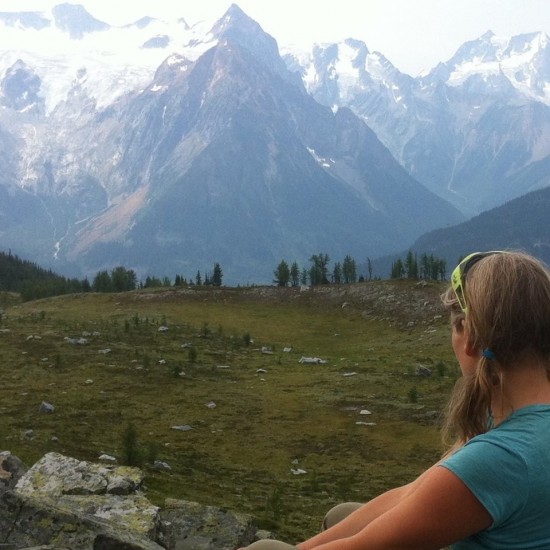
Monica Nissen in her element.
MN: I think particularly in the Columbia Basin bioregion, I would really hope that as we get closer to renewing the Columbia River Treaty, we might look at some funding for trans-boundary educational initiatives- or maybe it’s about looking at initiatives that are currently being funded and seeing if there are gaps when it comes to school and community-based education.
Political boundaries aside, there has to be a way for us to work together more. One of the program I love is the Know Your Watershed program, which is all about connecting students in our watershed. We have a great floor map that we use to show the entire Basin, and we discuss impacts and effects of water and land use on downstream users. The American part of the Basin is downstream and of course absolutely connected as well! I feel like there will be more opportunities with the renewal of the Columbia River Treaty!
I do feel very fortunate in that the programs Wildsight runs are funded in great part by the Columbia Basin Trust (cbt.org), and that we also get support from local utilities, such as FortisBc and BC Hydro. This kind of support for education programs run by non-profit organizations is so important.
CLEARING: Many funding sources still want to focus on specific issues, saying that broad-based environmental education is too long-term for their purposes. They are looking for more immediate results. What do you think about that?
MN: I really appreciate funders who ‘get it’- that long-term investment in programs that connect students to nature and build ecological literacy, even if they don’t show immediate “results”, are worthwhile. I think it’s all about shifting a worldview. That takes time.
CLEARING: Are you aware of any curriculum materials that look at the entire Columbia River basin/watershed as the context for environmental literacy?
MN: Well, the Columbia Basin Trust (CBT) website has an incredible array of resources. Great historical, cultural, ecological information. As far as a whole curriculum, the closest thing to what you are asking about that I know of is Know Your Watershed. Hmm…sounds like a trans-boundary conference on EE and specifically watershed literacy needs to happen in the Columbia basin…maybe not this year though.
CLEARING: Yeah, I’ve also been talking with David Zandvliet at Simon Fraser University. He’s coordinating a World Congress of Environmental Education in 2017. That could be a great opportunity for environmental education to make some significant gains.
MN: Oh great! He’s another mover and shaker!I know here in BC we have been going through a curriculum transformation, and the EE community has really been part of the shift, and been able to be present at the table—I think it will lead to some very exciting possibilities. As our colleagues in Alberta (Alberta Council for Environmental Education) say, “Pushing the environment from the sidelines into the mainstream.”
CLEARING: I thought I was going to ask you to be on the Clearing regional advisory board, but then I noticed the extensive list of commitments you already have in your life.
MN: Well, as I said before, I need to work on saying ‘no’ sometimes! It’s so difficult when all this amazing stuff comes up that i absolutely believe in and want to support!!
CLEARING: How do you find the time to do all that you do?
MN: Ha! Good question! Sometimes I just don’t limit myself to an 8-hour work day! This past fall I worked a lot of week-ends… seriously though, I feel that it’s important to have a good work/life balance. To walk the talk. I live where I do because of all the fantastic opportunities to explore and enjoy being outside and in the wild…
I am so pleased to be able to be mentoring and enabling educators new to the field. It is so good to know that there are many people committed to this work- maybe that makes it easier to let go and not feel like I have to do ‘it all’…
CLEARING: Is there any particular individual who has inspired you?
MN: Oh, there are so many. I have a lot of heroes, from David Suzuki, for carrying the torch for so many years despite his message falling on deaf ears, to Lee-Anne walker, a mentor of mine who began the Wildsight Education programs fifteen years ago. My parents, for getting me outside and for sharing their love for the natural world. Nancie Dohan and Daphne van Alstine, for hiring me for my first park naturalist job.
There are so many stories of inspiration and so many people working in their own ways to support a changing world view and a reconnection for kids, with the natural world…
CLEARING: What book(s) are you currently reading that relate to your work?
MN: I picked up a book by Laurie Rubin, called ‘To Look Closely- Science and Literacy in the Natural World’. It’s a really great case study of a teacher doing such a wonderful job of making the local wild places- just adjacent to the schoolyard, a focal point for a whole year of inquiry learning. I am looking forward to building my library to include some of the books she refers to and incorporates. Personally, it’s getting into ski season, so I’m reading Deep Powder –40 Years of Ecstatic Skiing, Avalanches and Earth Wisdom, by Dolores Lachapelle.
CLEARING: What does the future hold for you? What are your goals and where do you see yourself in 5 years? 10 years?
MN: Hmm…I want to keep at it, as I think there will continue to be the need, and the desire on my part to support kids in connecting to, and loving nature! I kind of dream of a future where this is all part of what is supported by and embedded in the education system, and when I don’t need to fundraise in order to make the programs happen! I am feeling relatively optimistic that this could be the case. The new curriculum in BC has a lot of exciting possibilities- if we are to teach in a way that is rooted in place-based curriculum, if we are to encourage student inquiry that is authentic and connected to the real world, then surely the kind of programs that support just that will become increasingly valued…and funded!
 CLEARING: How do you feel about the election of Justin Trudeau as Canadian PM? Any hopes that this will lead to some change in education?
MN: Oh wow- well, the change in government is really welcome- it’s like the whole country is breathing a sigh of relief. There is such a feeling of hope- we are hoping for change in so many areas.
I hope we’ll see some change in the education system as well. of course, this is more the jurisdiction of the provinces. We have been in the process of a curriculum transformation here in BC. There are some very positive things about it…
CLEARING: Already the Canadian representative at the climate change conference in Paris has said Canada is pledging to support stronger carbon standards.
MN: I know- like I said, there is so much hope. I guess if we change our whole worldview to more of a systems approach, then environment/economy/education are all part of a system, and EE isn’t a separate idea or topic but is integrated and part of all that we do…
CLEARING: One final question: What does the future of environmental education look like to you?
MN: EE is integrated in the curriculum, in a holistic way- not a separate ‘subject’ but part of all that we do with students…I think we’re getting there.
CLEARING: Well, this has been great. Thanks so much for your time.
MN: Thanks so much for your interest …I hope this has been useful. Mostly it seems like a great opportunity to look at some collaborating and increasing awareness of each other and our organizations and initiatives.


