by editor | Nov 18, 2015 | STEM
The Utility of Partnerships – Joseph Gale Elementary
Because clean water is part of daily life and it’s readily available, we often take it for granted. It’s easy to see why local utilities, wastewater included, don’t always come to mind as educational partners. In fact, many utilities are eager to partner with schools and community groups to provide relevant and valuable hands-on learning opportunities for students of all ages.
by Ely O’Connor
Clean Water Services

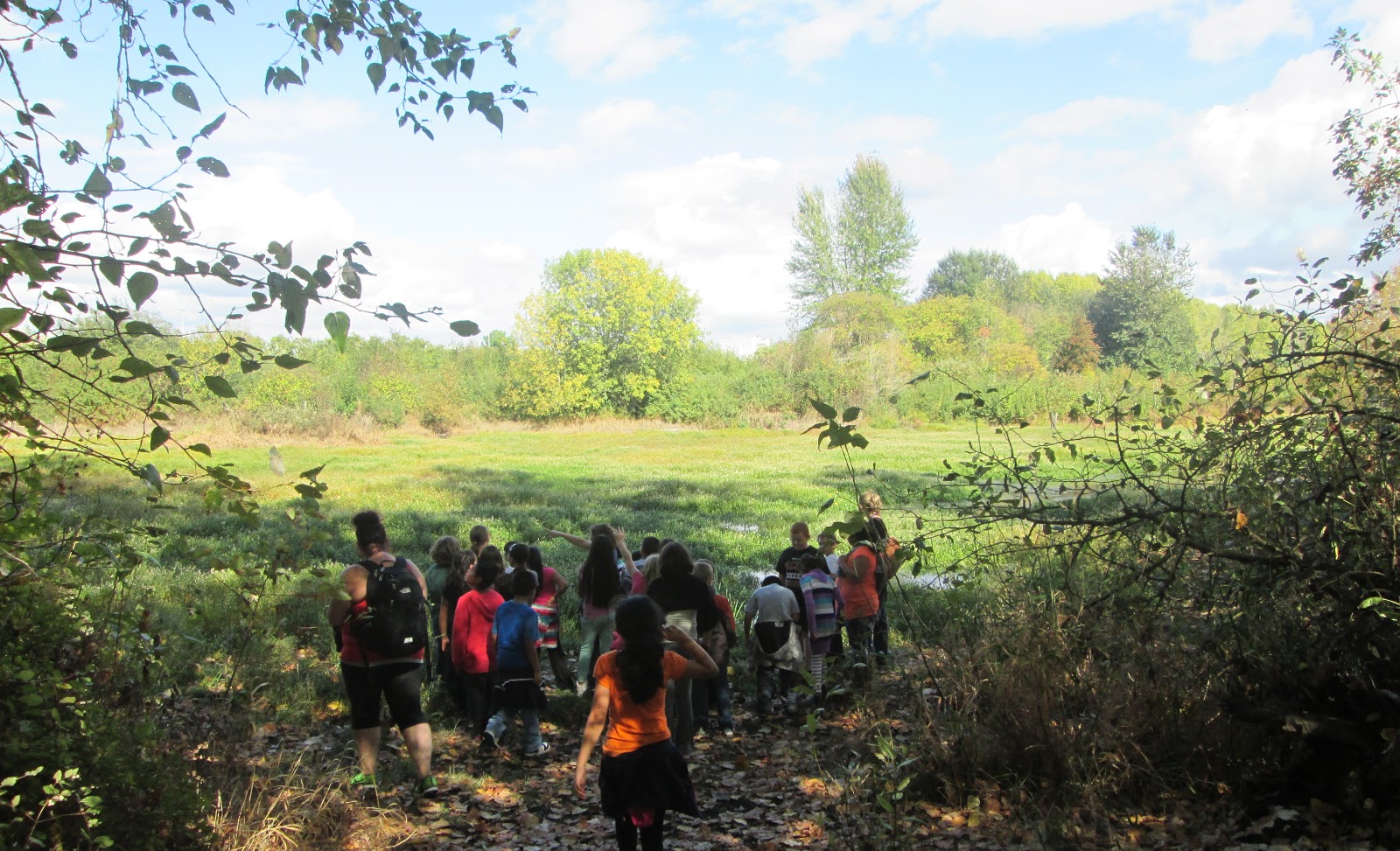
Joseph Gale students explore a marsh at Fernhill Wetlands as part of an erosion unit.
 ecause clean water is part of daily life and it’s readily available, we often take it for granted. It’s easy to see why local utilities, wastewater included, don’t always come to mind as educational partners. In fact, many utilities are eager to partner with schools and community groups to provide relevant and valuable hands-on learning opportunities for students of all ages.
Everything we do at Clean Water Services (CWS) aims to protect public health, while enhancing the natural environment Oregon’s Tualatin River Watershed. Combining science and nature, we work in partnership with others to safeguard the river’s health and vitality, ensure the economic success of our region and protect public health for more than 560,000 residents and businesses in urban Washington County.
Education is a big part of work and through participation in the Portland Metro STEM Partnership (PMSP), we’ve connected with several schools and classes that are seeking the very resources, expertise and experiences we offer. These partnerships have led to into the development of in-depth units, standards-aligned curriculum and hands-on experiences for students. Far from the one-off programming we seek to minimize.
Our partnership with the fourth grade classes at Joseph Gale Elementary in Forest Grove is one example of how non-formal educators can lend expertise and relevance to increase student understanding of complex subjects. Over the course of the 2014-15 school year, 60 fourth grade students participated in four classroom and four field experiences to investigate and understand human impacts on erosion in their watershed. To supplement teacher-led lessons, CWS staff led students on tours at Fernhill Wetlands and Forest Grove wastewater treatment facility (less than a mile from school), led field activities to measure erosion potential along a rural stream and identified and planted native species for erosion control. In class, CWS staff led lessons about the Tualatin Watershed, erosion cause and effect, explored a watershed model, and identified and planted native plant species on school grounds.

Beaverton and Forest Grove science teachers get a behind-the-scenes look at how we clean water.
CWS and Hillsboro Water staff also collaborated with the PMSP, Forest Grove and Beaverton School District science teachers to develop a water chemistry unit in 2014-15. The water professionals helped teachers work through lab logistics and protocol, with one Forest Grove teacher training in our lab with certified staff. On a professional development day ten Forest Grove and Beaverton chemistry teachers were co-trained on lab protocol and attended a specialized tour of our Rock Creek facility to learn more about the how we use chemistry (and other science disciplines) to clean water to nearly drinking water standards. In the spring nearly 400 chemistry students at Forest Grove, Aloha and Westview high schools participated in the newly developed unit. CWS staff also attended Forest Grove and Aloha science career fairs to talk about STEM and water careers.
This partnership brought capacity to our education and outreach efforts through leveraging resources. In the past, working directly with 400 students would have been a challenge.By training the teachers and assisting with curriculum development, we’ve extended our reach and supported the development of standards-based units. We love working directly with students when possible, but would definitely like to replicate the teacher training and support model.
Both of these partnerships brought the opportunity to engage hundreds of students and several teachers in our community in a way that meets our education goals and supports NGSS and STEM learning. We’ve also been able to use Clean Water Services resources and staff in a sustainable way to extend classroom learning and show real-world applications in the local community.
I would encourage looking for non-formal education partners inside your community but outside the norm. Connect with your local utilities, cities, business and non-profits to show students local examples and bring context to lessons.
To learn more about Clean Water Services’ education programs check out our Student Education Annual Report or contact Ely O’Connor.

by editor | Oct 26, 2015 | Forest Education
Seeking Environmental Maturity at Starker Forests
Helping students climb the ladder to responsible citizenship
by Richard Powell
 tarker Forests is a family-owned tree farming business of about 80,000 acres, mostly within an hour’s drive in the Coast Range west of Corvallis, OR. For many years, we’ve taken people on trips to the woods. These might be field trips for school children, university students, visiting foresters/scientists from around the world, or the general public. We’ve hosted a number of workshops for teachers.
As our society becomes increasingly urbanized, we see people becoming increasingly unaware of the origins of the things they use in their daily lives. We’ve had high schools students identify their electric hair dryers and modeling clay as not coming from natural resources. A senior remarked that he didn’t know Oregon had rock quarries (apparently the concrete floor we were standing on just magically appeared)! A group of high school students weren’t even sure what natural resources were but thought a dairy cow might be related to natural resources – although, they weren’t sure. As an example of something not related to natural resources, middle school students often point to their classroom’s television.
To become a wise user of natural resources, it is imperative that people understand where things come from. Our intent is to help them re-connect with the natural world and, more specifically, get a better understanding of the forest and the origins of all the wood products they use.
 At the same time, we find people have little sense of the history of a landscape. Students are taught the science of the environment but they do not connect that science with the landscape’s history. We want people to understand that biology and history have worked in tandem to shape what they see; the landscape is a function of both biology and history.
Of the school groups we take on field trips, most come from elementary schools; a few come from middle schools; only rarely, do they come from high school. Being so close to Oregon State University, we do get some university students and we get a lot of people from the general public. We get a number of foreign visitors – foresters, scientists, landowners, etc.
Even though we take many school classes to the woods, we get very little feedback from the teachers. [The best feedback is that most teachers come back year after year.] The absolute best feedback we get is when we see a child a year or two later. It takes very little time for us to realize we’d seen them before and that they remember quite a bit from their earlier field trip.
With adult groups, we commonly hear someone remark how a forester has to know about and care for so much more than just the trees. Sometimes, we’ll hear someone say they have to re-think what they know about forests and forestry. Now and then, they’ll remark how they still don’t like some of the things we do in forestry but they begin to understand there is a reason for what we do and it is based on science – it is not just about the money.
Though we take around 2000 people a year to the woods, we are foresters; we are not trained in pedagogy. For years, we’ve had a nagging question: is what we’re doing working? Do people “get” what we are trying to teach? Does any of this stick with them for the long term? Or, are we wasting our time and money?
This past summer, I attended the World Forestry Center’s International Educator’s Institute (IEI). As an environmental educator without any formal pedagogical or interpretive training, I found this week-long workshop enlightening and very worthwhile.
The part of IEI that I found most useful was called the “Pedagogic Steps in Environmental Maturity”. It validated what we’re doing.
 In essence, the “Steps” is a ladder and, to get to the top rung (i.e., “Environmental Maturity”), one has to climb up from the rung below. For example, it would be futile to talk to someone in Swahili if they had not first learned and become fluent in that language. Without that prior knowledge, we’d quickly see a bunch of glazed-over stares and we’d find we’re pretty much wasting everyone’s time.
Step #1 — Learn to enjoy the outdoors.
Just get people outdoors. Adults enjoy a nice drive or hike in the woods. Take the kids hiking or camping or go canoeing on the neighborhood pond or river. Let them have fun. We’ve always felt people had a good time, but, did they learn anything from their field trip and did any of that learning stay with them?
Step #2 — Experience and observe nature.
Smell the flowers, feel the sun’s warmth, or get soaked on a cold, rainy day. Explore around a beaver pond and see where the beavers had burrowed into the bank to build their dens; look for a tree’s stump or a branch the beavers had chewed. Have people simply stop, close their eyes, and listen; it is incredible what they’ll hear for the very first time. In a few minutes time, people will never become an expert at identifying a tree but we can get them to see that the leaders, buds, needles, color, feel, bark, flowers, smell, taste, pollen, etc. vary greatly between tree species (no, they do not all have pine cones nor do they all have pine needles).
Step #3 — Understand the ecological web.
Now that we have them outdoors, they are having fun, and beginning to experience and see things, they can begin to understand what they see. Pick up and look at and feel a handful of dirt. As they see and feel the litter layer, moss, worm holes, roots, bugs, fungi, moisture, texture, etc. they begin to understand it is not dirt at all – it is soil! (Dirt is what we wash off our hands before lunch; soil is the good stuff.) Likewise, they can sample the water’s pH, dissolved oxygen, and temperature and see how those might affect the macro-invertebrates in the water. They can see a tree’s cross-section and associate the narrow growth rings with a dense forest canopy or maybe see that the wider rings are due to a more open canopy.
Once they’ve seen the differing buds, leaders, bark, leaves, etc., they can begin to see how some tree species are similar while others are different. They can begin to group similar trees into a genus, name those groups and the individual species, and begin to understand a tree.
Step #4 — Understand the interplay of man and nature.
Yes, we play in nature and we like to see and experience nature. But, more than that, nature is the source of life’s very existence! Nature provides the air, nutrients, energy, and moisture required by all life forms on the planet. Take away any one of these and life ceases to exist; alter any one and life is changed. This is the food chain. Or, put another way, life is totally dependent on the extraction and use of natural resources for its very existence.
In addition to the food chain, nature is the source of everything people use. Iron, sulfur, wood, cotton, plastic, gasoline, concrete, clothing, electricity, coal, food – in some way, all of our wants and needs are extracted from the environment.
Looking back at those tree rings, maybe they can see how those narrow rings became wider. This was likely due to opening up the canopy by either a natural means (a tree died or blew over in a storm) or the forest had been thinned.
Step #5 — Make decisions on environmental issues.
This step is one we really wrestle with. We know there are a lot of controversial issues over the use of natural resources so we strive to just stick with the science and the history of the land – on these, there should be little controversy. [Unless asked, we endeavor to keep our biases or personal philosophies/opinions to ourselves.] As Project Learning Tree says, we’d rather “teach how to think, not what to think”. We’d prefer to let people take what they saw and learned and make their own decisions.
Step #6 — Be responsible for the future.
We’d hope, after going out and experiencing the woods, our visitors are better able to make more informed and better choices. With choices comes responsibility and this would be the perfect time for a community service project.
As a practical matter, we see most people for just a brief time and it is hard for us to do steps 5 and 6 with them. With students, we hope to plant some seeds that, during the course of the school year, the teacher can help germinate and grow. With that, the students may make some decisions and then take responsibility.
That said, we’ve sponsored Tree Planting Day annually for more than twenty years. We take a harvested unit, make sure it is safe, there is a reasonable traffic flow, etc. and then invite youth and their parents to come out and plant a few trees. We’ve had as many as 400 youngsters and 200 parents on a Saturday morning though 140 youngsters and 90 parents is more the norm. They have fun (step #1); we do this rain or shine and, usually, in the mud (step #2); they plant little seedlings that, hopefully, will grow into large trees (step #3); it’s on a unit that was harvested for all the products made from wood (step #4). Further, they’ve chosen to spend a Saturday morning in the cold, rain, and mud (step #5) and help ensure that that harvested unit is reforested (step #6).
 A few months ago, we took a pre-school class to the woods; these were three and four-year olds. Other than having a good time (step #1), what could these little guys possibly get from a mile-long hike in the woods; could they even get above that first step?
A few days after their field trip, I had a wonderful surprise delivered to my desk. There was a nice poster with a picture of me kneeling down and surrounded by the kids; I was showing them a stick some beavers had chewed on. Concentric, brown circles drawn around this picture gave this poster the appearance of a tree’s cross-section.
The good part was on the backside of the poster. The teachers evidently sat down with the kids to debrief and find out/reinforce what the kids had learned.
“We made duck, cougar, bear, beaver, and a raccoon print”. [Some years ago, we made some “sand boxes” across the road so kids could make animal tracks with some rubber prints.] — Step #1
“The bear foot print was the biggest; we heard birds; we learned a fir cone; we saw lots of trees”. — Step #2
“We count the rings of the tree to find out the age of the tree; trees need water; if trees don’t have water, they will not grow; trees need sun, water, air, just like us”. — Step #3
“We saw the letter ‘S’ on trees. ‘S’ trees were dead”. — [This particular plantation was on ground that had been burned around 1850 and, post-settlement, it was a pasture. We’d planted this pasture and, since it had not previously been a forest and there were no large trees, snags, downed logs, stumps, etc. for wildlife habitat, we created some snags when we thinned this forest. To help people see these snags, we’d painted an ‘S’ on several snags.] — Step #4
We were truly amazed how much these three and four-year olds took home from their mile-long hike. We were especially pleased their teachers had followed up with their students. Their comments in step #3 were especially gratifying.
About a month and a half later, a parent/teacher sent me a note. Her son was one of those pre-school students and he was still talking about this field trip!
It would have been nice if they had gotten to steps 5 and 6 but that would be quite a lot to ask of a three or four-year old.
Richard Powell is the Public Outreach Forester for Starker Forests, Inc., in Philomath, Oregon.
by editor | Oct 26, 2015 | Place-based Education
Combining the Strengths of Adventure Learning and Place-based Education
How re-conceptualizing the role of technology in place-based education enhances place responsive pedagogies through technology.
by R. Justin Hougham,
Karla C. Bradley Eitel and
Brant G. Miller
University of Idaho
Technology in Place-based Environmental Education
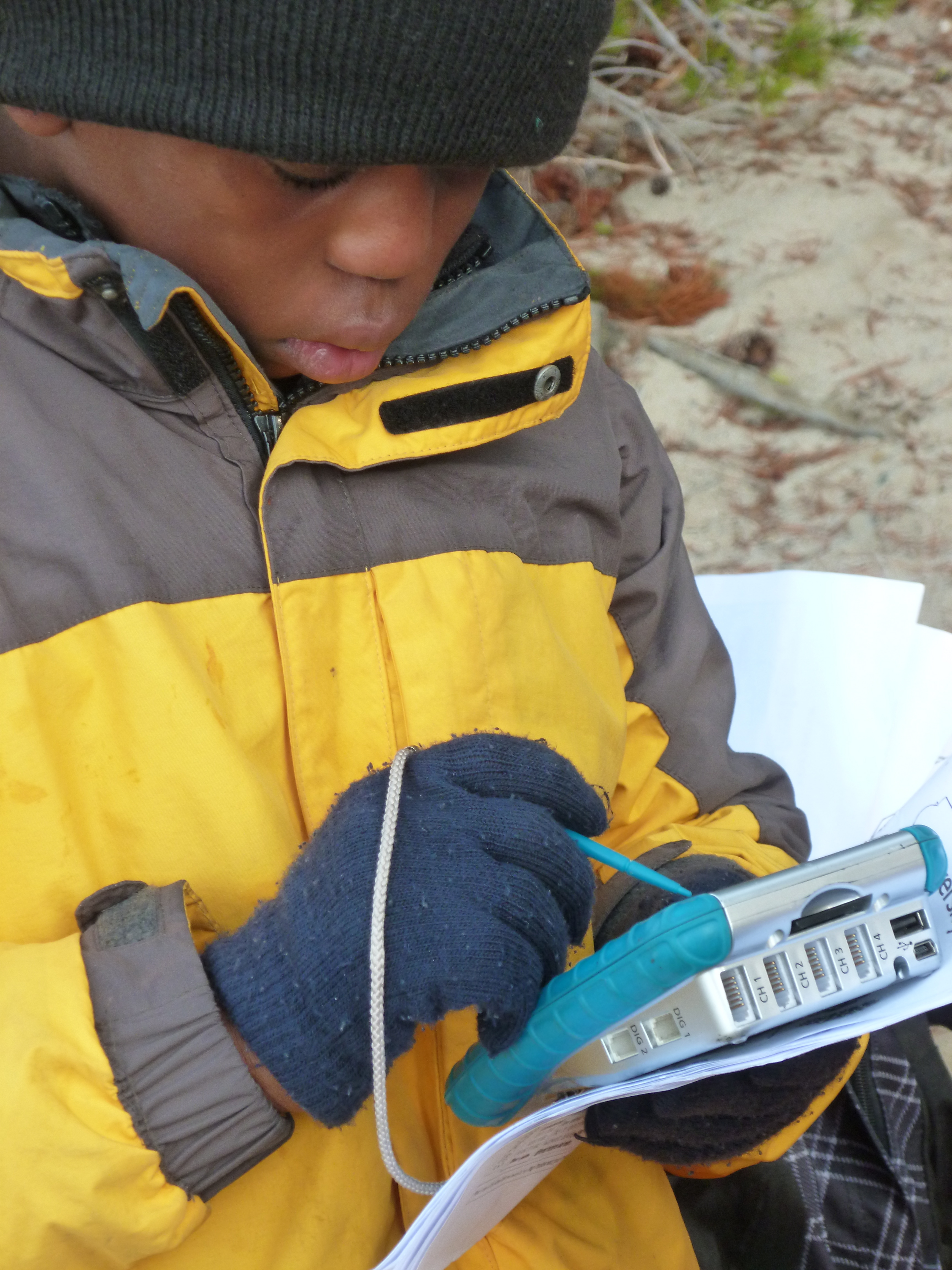
In the 21st century, students need to be able to communicate through a variety of mediums, be critical consumers of vast amounts of written and visual data, and possess skills and dispositions for addressing complex global issues with local implications, such as climate change. As practitioners of residential place-based environmental education that seeks to foster scientific literacy and connect students to place, we have traveled cautiously into the cyber-enabled landscape because of a deeply rooted feeling that technology can be a distraction to students’ deep observation in the field. That said, we are exploring the idea that technology may also provide tools that can transform our ability to connect students to place. Imagine this scenario: a field teacher uses a picture to show students a concept diagram of the water cycle; the students’ attention is on the image rather than on the place. Instead, what if cameras were used to observe water in the immediate environment, thus, cataloging water in as many phases as the students can find? Digital voice recorders could be employed to capture the haunting, ancient whale-like sounds of liquid water beneath the frozen lake; In addition, students collect and upload data about the quality or quantity of the water. This data could then be visualized within an observational database used by scientists to better understand water resources at a hyper-local scale, thereby contributing to better predictive models that inform watershed and fisheries management. In the first scenario, an age-old “technology” distracts from deep observation, but in the re-imagined scenario observation is enhanced and transformed.
It is our belief that, when used wisely, technology can enable a deeper connection to material through a multi-media approach to observing, describing places, and visualizing data collected on site. 21st century educators are increasingly being asked to integrate cyber-based tools into programs and we propose that they do so in a way that increases students’ ability to explore the socio-ecological places where they live. One way of doing this is through the AL@ approach.
 Merging Technology, Place and Change
AL@ is a re-conceptualization of the role of technology in place-based education that enhances place responsive pedagogies through technology. Adventure Learning (AL) is a hybrid online curricular approach we have explored within the context of a residential environmental education program at the McCall Outdoor Science School (MOSS). We are naming this combined theoretical frameworks of AL and PBE, Adventure Learning @ (AL@). The AL@ nomenclature is intended to express at once the online world (@) as well as the treatment offered here of AL that situates the framework in relation to the principles of PBE (as in Adventure Learning at…). Students and teachers become experts in their own experiences through studies of the places where they live, using freely available software and low cost technology. Further, we explore ways in which AL@ enhances our place-based programs by supporting connection and communication beyond the spatial and temporal boundaries of student experience. Finally, by students authoring their experience, honoring multiple world views, the hybridized approach offered through AL@ equips students and teachers to engage in experiential education that is decolonizing STEM education as well as technology in education.
Place-Based Education
Place-based education (PBE) provides an important foundation for bringing place to the forefront of student inquiries. In the book Place-Based Education, Sobel (2004) states that place-based pedagogy:
helps students develop stronger ties to the community, enhances students’ appreciation for the natural world, and creates a heightened commitment to serving as active, contributing citizens (p.7).
Sobel (2004) advocates developing curricula that are relevant, authentic and evolved from the particular context in which it is used. A central characteristic and distinguishing feature of place-based education is that it aims to break down artificial constructs and barriers like the distinction between school and community, and nature and humanity (Smith, 2002). While this pedagogy is being widely embraced, iterations of PBE lack effective strategies that connect the place experience to other venues or digitally. There is much room to explore how PBE can effectively leverage the power of experiences with the potential of technology and digital media. An enhanced AL model, found in AL@, can begin to fill this gap.
Adventure Learning @
AL is a hybrid distance education approach that provides students with opportunities to explore real-world issues through authentic adventure-based learning experiences within both face-to-face and online collaborative learning environments (Doering, 2006, 2007; Doering & Veletsianos, 2008; Veletsianos & Kleanthous, 2009). As an approach to designing learning environments, AL has been found to motivate students (Moos & Honkomp, 2011) and inspire meaningful collaborations and inquiries for students and teachers (Doering & Veletsianos, 2008; Veletsianos & Doering, 2010).
AL@ presents a powerful new approach for teaching and learning that builds upon earlier adventure learning efforts. In this reimagined model bringing to bear the intersection of PBE and AL, we envision a novel context for teaching and learning about places through technology-rich curricula. AL@ enables students to explore local places through physical experiences as well as through digital media, geospatial technologies, and online collaboration. Through the intersection of PBE and AL in AL@ we believe that each can reciprocally enhance the other. Four key distinctions in the AL@ approach include student generated knowledge, focused on local observation, smaller scale, and interconnected expeditions.
1. Students are generators and not just consumers of knowledge
The archetype model of AL positioned distant adventurers as holders and creators of knowledge. We have wondered if highlighting the experience of distant adventurers and associated content experts has undermined students’ evaluation of their own ability to generate meaningful understanding about things that matter to them. The hidden curriculum can be that students’ own experience is not as important as the experiences of scientists and adventurers that they see represented in popular media and curricular enhancements that use this “scientist /adventurer as rock star” model.
By rethinking the AL approach to position students and teachers as “experts in their own experiences,” the AL@ approach has the potential to transform the way students and teachers think of themselves with respect to being scientists, problem solvers and contributors to knowledge about their communities. The coherent narratives created around local spaces are expected to transform students’ experience of “doing science” from an abstract exercise to one in which they understand the purpose of their scientific inquiry. Thus, student inquiries are driven by their own questions and relevant to local surroundings. By defining problems of local interest, and working with experts with local knowledge who have connections to the community, students and teachers come to think of themselves as experts, scientists, and problem solvers within their own places.
2. AL@ is focused on deep observation of local places
Building reflection skills is a core tenet of PBE, and an important step in the progression towards an engaged and active citizenry. Wattchow and Brown assert (2011) that place as a conceptual frame is an important pedagogy as it “provides rich potential for outdoor educators who are already well-versed in experiential methodologies. A participant learning about the significance of a place, and how their beliefs and actions impact upon it, will be well positioned to reflect on how their community may need to adapt to the challenges ahead (p. ix).”
The richness of a grounded experience and inquiry in place lays the foundation for meaningful reflection that takes place in the digital environment. The digitized reflection is then available to a network of students locally and globally. The AL@ approach turns the narrative into a conversation rather than a story being told by someone else. By doing so, students contribute valuable perspectives to conversations about natural resources, local observations, and the nature of science.
3. Expeditions for all
Early iterations of AL have sent a team of scientists and explorers to remote places with reports back to classrooms across the world. It is our estimation that this approach is limiting. The logistical complexity and high-end equipment required can make conducting an expedition unattainable for all but the most highly resourced schools. In promoting the use of relatively inexpensive and simple to use media collection devices (e.g. digital cameras), the barriers to participation in AL@ are negligible. Considering the audience, location, and the science along the way, media products are assembled to represent each component of the system. Guidelines for teachers and students for the practical enactment of the AL@ approach includes: collecting media that can be shared easily with limited editing via the online environment, and considerations for audience, place and science.
4. Multiple interconnected expeditions are focused on thematic questions
Through a digital learning website hub, students and teachers have the opportunity to be part of a larger AL@ community. One objective of this robust media environment is to cultivate a flourishing upload and download culture between stakeholders-students, teachers, parents-and across disciplines. Archival of media products and data generated is essential, representing exciting information that will be accessible to participants for future content inquiries. Members of the education community will drive the integration of this material into the curriculum as it serves them
The combined strengths of AL and PBE create new spaces for and means of connecting to place, generating knowledge and creatively solving problems. We believe that AL@ as a pedagogy offers an approach to virtual and physical environments that can enrich local and global connections to-and between-places. Where Smith (2002) points to PBE dissolving the artificial barriers between school and community, and nature and humanity; AL@ adds the capacity to transcend the false dichotomy of global and local.
 Practical enactment of AL@MOSS
An example of applied AL@ principles is seen in the McCall Outdoor Science School (AL@MOSS). A program of the University of Idaho, the mission of the McCall Outdoor Science School (MOSS) is to facilitate place-based, collaborative science inquiry within the context of Idaho’s land, water and communities-getting people outdoors to learn about science, place and community. Located in the Payette watershed on Payette Lake in McCall, ID, the school and its partners foster scientific literacy, sense of place, active lifestyles and community skills through graduate and professional education, youth science programs, seminars, conferences, and leadership development initiatives. MOSS provides experiential learning opportunities for and among students, educators, scientists and citizens with the goal of fostering the critical thinking skills and sense of ownership necessary to address complex problems.
Students and teachers come to MOSS from across the state of Idaho for three to ten day experiences to study the natural history of the local environment, build deeper connections with their peers through team building challenges, meet scientists, participate in local service projects and engage in developing and conducting their own field-based scientific inquiries. An on-site graduate residency program engages aspiring environmental educators in coursework related to understanding the local ecological and social environment, developing leadership skills and learning about place-based pedagogies while they are serving as field instructors in residential and school-based K-12 programs. It is in this environment that the AL@ model is being explored to transform student connectivity to place and each other, no matter where they are. Numerous similar institutions exist throughout the world; this model has the potential to inform their curricula and programs as well.
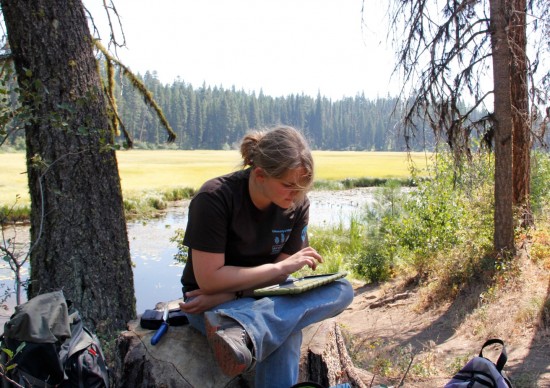
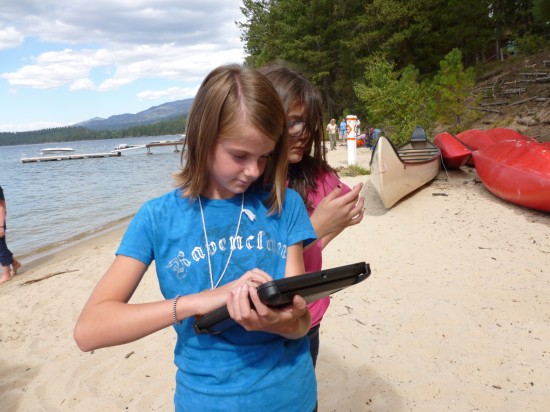
What does AL@MOSS look like? Imagine a group of middle school students studying water quality on a lake that they have known their whole lives. They start by talking about their memories of visiting this lake with their families, next they are guided to create a drawing that imagines the lake as it was 10,000 years ago, and as it will be 10,000 years in the future. They collect macro-invertebrates, measure the dissolved oxygen, pH, turbidity and nitrates. They look up at the mountains that surround the lake and envision how the snowpack becomes a reservoir from November through April, before its water begins run-off in May or June. As students conduct this place-based investigation of the watershed, they take pictures as they complete their data collection and carefully enter their data into field journals and an online database, accessed using an iPad in the field. A digital video recording captures a student’s reflections and inferences on how predicted changes in precipitation might impact the quantity of water that is available for various water users. When they return to “base camp”, these written reflections, photographs and videos are uploaded to a site where students from other communities can read and respond to their observations online. Student and teachers interested in water as a place responsive topic then have a videoconference with a local scientist who is studying changes in precipitation patterns due to climate change, a farmer who might be impacted by a change in the timing of available water, and a fisheries biologist who talks about how fish might be impacted. They finish the day by going back outside to play a game that simulates the highlights of the interconnected nature of relationships within the Earth systems.
Where will you AL@?
The promise of what AL and PBE bring to each other through AL@ is found through a democratized learning environment which becomes a digital commons. Community members, parents, learners and educators are all engaged in essential 21st century skills. By communicating digitally, participants are able to see how information of near and distant spaces is interrelated. The AL@ approach supports multiple worldviews through the invitation to engage in a process that sharpens expertise in our own experience. Equipped with AL@, educators and learners can meaningfully explore what place means through sharing their experiences. Through observation, reflection, and artifact keeping the AL@ approach supports knowledge keepers across the past, present and future narratives of places that can be connected. Highlighting relationships and breaking down spatial boundaries can serve to strengthen our understanding of the ways in which we are all connected.
Communicating Success
In the AL@MOSS approach, assessment is an important tool that we use to shape our curriculum and our delivery of programming. Content specific assessments of student learning are administered in each program session, with topics ranging from water resources and a changing climate to energy literacy and biofuels. Science identity is another research area explored in assessments in this program.
Additionally, artifacts are collected from the students experiences out in the forest, in the snow, out on the lake or on the mountain. These artifacts help us capture and communicate the success of our approach- and invite support from the network that students have in the community, including teachers, classmates, parents, and friends. These artifacts include video, pictures, and images of student work that are available in near real-time, but also archived for student portfolios that can demonstrate development in communication skills as well as progress in content areas.
R. Justin Hougham is a Post Doctoral Fellow at the University of Idaho, Department of Geography. Karla Eitel is the Director of Education at the University of Idaho McCall Outdoor Science School, College of Natural Resources. Brant G. Miller is an Assistant Professor of Science and Technology Education at the University of Idaho College of Education.
References
Doering, A. (2006). Adventure learning: Transformative hybrid online education. Distance Education, 27(2), 197-215.
Doering, A. (2007). Adventure learning: Situating learning in an authentic context. Innovate-Journal of Online Education, 3(6). Retrieved on August 30, 2008 from http://innovateonline.info/index/php?view=article&id=342.
Doering, A., & Veletsianos, G. (Fall 2008). Hybrid Online Education: Identifying Integration Models using Adventure Learning. Journal of Research on Technology in Education, 41(1), 101-119.
Hutchison, D. (1998). Growing up green: Education for ecological renewal. New York: Teachers College Press.
Orr, D. W. (2004). Earth in mind: On education, environment, and the human prospect. Washington, DC: Island Press.
Smith, G.A. (2002). Going local. Educational Leadership, 60(1), 30-33.
Smith, G. A. (2007). Place-based education: breaking through the constraining regularities of public school. Environmental Education Research, 13(2), 189-207. doi:10.1080/13504620701285180
Sobel, D. (2004). Place-based education: Connecting classrooms & communities. Great Barrington, MA: The Orion Society
The Learning Technologies Collaborative (2010). “Emerging”: A re-conceptualization of contemporary technology design and integration. In Veletsianos, G. (Ed.), Emerging Technologies in Distance Education (pp. 91-107). Edmonton, AB: Athabasca University Press.
Veetsianos, G., & Kleanthous, I. (2009). A review of adventure learning. The International Review Of Research In Open And Distance Learning, 10(6), 84-105.
Watchow and Brown (2011). A pedagogy of place: Outdoor education for a changing world (p. IX). Victoria, Australia: Monash University Publishing.
Woodhouse, J.L., and Knapp, C.E. (2000). Place-based curriculum and instruction: Outdoor and environmental education approaches. ERIC Clearinghouse on Rural Education and Small Schools.

by editor | Oct 25, 2015 | Learning Theory, STEM
schoolship.blogspot.com
Arts and Humanities in the Sciences? Is that incongruous, or what?
By Jim Martin
Have you ever ‘felt’ the weather as cloud formations began to change? I love to watch Mares’ Tails form; multiple long extensions of a cumulus cloud that race out ahead, then turn up and curl back. They signal a change in the weather; an eye-catching choreography in the sky; a dance students could perform to learn about weather. I started teaching biology to college students in 1970, and had no thoughts about using the arts and humanities in my delivery. I was open to them; my childhood and youth were infused with them. But I saw no way to employ them because it seemed to me that they were an adjunct, a vehicle I would have to tack onto an already overloaded syllabus.
Then, a few years later, concerned about the quality of my general biology (Bio 101) students’ understandings, and wondering what they were learning during their K-12 years, I accepted an opportunity to teach a 7th grade self-contained classroom. Before the first day of school, I decided not to use the school’s language arts texts and workbooks. They were utterly boring; pages to go through so you could answer a few tedious questions. So, I organized my own curriculum. In one part, the delivery vehicle was drama. We stretched sheets across the length of the classroom, and began to write and perform scripts.
I used these scripts, and their repetitious deliveries to teach topics like DNA and protein synthesis, natural selection, and more. While doing that, I discovered that certain pieces of the science were learned well with this method, so this integrated way of teaching started to become a vehicle I used to teach multi-disciplinary units in language, performance arts, and science.
This is beginning to sound ominous! Don’t despair. I did these things because I was comfortable with them. For one thing, I was teaching both language arts and science to this class. Since we were in the same classroom all day, it was an easy thing to do. I can tell you this: If you can find the courage to try to use one piece of the arts and humanities in one science activity, you might discover the strength of this method in helping students understand the concepts they are studying. And, developing critical thinking and executive functions you might not have noticed they carry with them.
Be patient. Let me finish this reminiscence, and we’ll get to the pragmatic details of how you might try one small activity; and assess it. Not long after, I found myself learning what I could of the human brain; how it learns, how it expresses these learnings. This set me on a journey I still travel. An interesting viewpoint on that journey was one where I could see the parts of the brain, and their connections (critical piece there) that were used to conceive a visualization of a piece of art, then execute its expression in the finished piece itself. Contrary to what I’d always assumed, that art and science used different parts of the brain for their work, both used nearly the same parts and their connections. No wonder my tentative attempts to teach art and science together seemed to work! While we isolate and jurisdict the disciplines, the brain does not.
It’s challenging to meet science standards and benchmarks by using the arts and humanities as vehicles for teaching to these standards. The main reason teachers who do this continue the practice is that students’ learnings stay with them. After they take the test, they don’t forget what they have learned. The Seeking System, as described by Jaak Panksepp, is a coordinated effort between the limbic system and the cortex which can lead to conceptual learnings, encourages conceptual learning by engaging learners in an active learning inquiry which builds on students’ curiosity. It’s this state of expectant curiosity which keeps students on-task, seeking an answer, finding out. Like observing paramecia flitting about among algae on a microscope slide. What are they? What are they doing? Where are they going? Curiosity a fair wind which drives their sails, students will devour the books and internet for information they seek.
While this state is initiated in the limbic, a part of the brain which does little thinking, it engages, via prompts from the limbic to the prefrontal cortex (pfc), which processes students’ thoughts, engages critical thinking, brings to working memory in the pfc other relevant information, and performs the executive functions which keep learners on task, following their plan. Learnings there then move back to the cortical regions brought on line, where they become connected; long-term memories, which can be called out via any of the neural circuits brought to the pfc to deal with this new experience.
Let’s look at an activity which incorporates the arts and humanities to drive a science unit in weather. Teachers have used dance to help their students learn the meteorological processes that cause phenomena like Mares’ Tails. You can do the observation any time in the year, then recall it when your class does meteorology. Or, start the dance when you make the observation, and finish in the appropriate unit. When students observe Mares’ Tails, then build a dance around what they have observed, they follow an interesting trail into meteorology to discover the processes involved in producing Mares’ Tails. And, even better, their connection to subsequent weather. Then, students and the teacher can use this newly learned information to better inform the choreography they are constructing.
As they observe and find out about Mares’ Tails, the fact that they are also observing for the clouds’ dynamics will engage the Seeking System in many students; the quest to find out. Engaging the idea of dance and Mares’ Tails will pique the curiosity of others. And, a very nice coincidence, both alert the prefrontal cortex and initiate the critical thinking and executive direction capacities of the brain as they build an abundance of routes to relevant memory, which your students use to move effortlessly through the landmarks delimited in Bloom’s Taxonomy.
While relatively simple, the teaching and learning in an activity like this is challenging for teachers. It is definitely not part of most of our pre-service and in-service professional educations. We all want to teach well, and to understand what and how we are teaching. If, like most Americans, the arts and humanities aren’t an integral part of our teachers’ developmental experience, incorporating them into our teaching is uncomfortable at best. In spite of this, in time, this sort of integrated teaching will have wider acceptance, but just now it seems like an adjunct to most education. I say this: The education establishment in America is woefully unfamiliar with the brain and its processes in learning, and its relationship with the rest of the body currently being described in the area of embodied cognition; the close coupling of processes in the brain and processes in the rest of the body. We need to have the courage to begin to explore this lucrative, brain-based teaching modality. The brain is the organ of learning.
By actively participating in the process of using dance to begin to learn about Mares’ Tails, both teacher and students incorporate the learning in long-term conceptual schemata they will carry with them. This is because the conceptual information they have learned is available via multiple neural pathways; much better than being accessed only by reading a question stem. Both the dance and the science inquiry follow similar trails through the brain. This is in contrast to the effect of relying on what Panksepp terms the limbic’s Fear System; the anxiety of some degree which is associated with learning science facts in order to pass a test. In this case, the information is stored by itself, un-connected to other relevant conceptual information stored elsewhere, and with no connection to the real-world memories produced during active learning. If students are to carry what they learn into their lives, they need to learn it in authentic ways. Seeking’s learnings are remembered; Fear’s are forgotten after the test. This means that the teacher has to be committed to this learning modality. And, committed to taking on only that which she is comfortable with. Should you want to try, but are unsure, you can contact a dance teacher to help, or a colleague who has taken dance. Lots of them around. You could even check a dance studio. Most people who work in the arts and humanities are open to help.
Here is a breakdown of planning steps a hypothetical teacher might take in preparing to deliver the Mares’ Tails meteorology/dance section of a unit on weather. As you read each step, ask yourself if you could do it now. You might surprise yourself.
1) Observe Mares’ Tails; either a serendipitous observation, or consult a meteorologist to find out when to expect them. Difficult until you’ve positively identified one; fun and easy after that. Students can do this as homework, or as a whole class if Mares’ Tails occur during a class. (You may have noticed that weather doesn’t program itself to coordinate with school schedules. Or their needs.)
2) During the observation, have students note any dynamics in the clouds. This is a good time to suggest the idea of clouds dancing.
3) If their interest is piqued, raise the idea of a Mares’ Tail dance; otherwise wait.
4) First approximation of the dance. Note questions which arise within groups.
5) Ask the class what more can they find out about Mares’ Tails. Give them time to find out.
6) Incorporate this information into the choreography. Name the dance’s sections from meterological learnings. (Note: I was feeling creative, in Seeking mode, by this time, and that’s when my pen wrote, “. . . (n)ame the dance’s sections from meteorological learnings.” Words and a visualization just popped up. Evidence my prefrontal cortex was coming on line. One of the things Seeking does.)
7) Perform the dance for an audience, and explain the meteorology; perhaps by dance section.
8) Two assessments or tests: Yours, based on their work; and a standard test from your publisher or the web. Compare results.
9) Assess the project: you, your students, their audience.
10) Write an article for Clearing and send it in!
 This is a regular feature by CLEARING “master teacher” Jim Martin that explores how environmental educators can help classroom teachers get away from the pressure to teach to the standardized tests, and how teachers can gain the confidence to go into the world outside of their classrooms for a substantial piece of their curricula. See the other installments here, or search Categories for “Jim Martin.”

by editor | Oct 25, 2015 | Forest Education
Environmental Leadership: Making Connections
Two service-learning programs within the Environmental Leadership Program at the University of Oregon aim to deepen students’ knowledge of their bioregion through day-long, hands-on field trips.
By Kathryn A. Lynch, Environmental Leadership Program, University of Oregon
 hildren and young adults are often more tuned into the screens in front of them than the landscape surrounding them; when asked which direction is north their inclination is to check their smartphones. In response, the Environmental Leadership Program at the University of Oregon is developing environmental education projects seeking to reconnect children to nature.
The Environmental Leadership Program (ELP) is an interdisciplinary service-learning program housed in the University of Oregon’s Environmental Studies Program. Our mission is to provide undergraduates with an integrative capstone experience, our graduate students with project management experience, while engaging with the community to address real needs.
Since 2001, ELP has developed and implemented 81 projects addressing a wide array of topics. Currently, our projects fall within four primary tracks: environmental education, conservation science, sustainable practices, and community engagement.
The two main goals of our environmental education teams are to: 1) provide UO students the knowledge, skills and confidence to develop and implement place-based, experiential programs; and 2) develop age-appropriate, engaging curricula for local youth, grades K-8, that promotes the stewardship of our natural world.
During winter and spring of 2015, our two environmental education teams focused on the theme of “connections.” The new Restoring Connections team worked in partnership with Mt. Pisgah Arboretum and Adams Elementary to develop and implement a place-based curriculum which included an interactive classroom lesson and a field trip to Mt. Pisgah. The team provided over 200 K-2 students an opportunity to develop a deeper understanding of where they live and the importance of conservation and stewardship. The Canopy Connections team worked in partnership with the HJA Experimental Forest and the Pacific Tree Climbing Institute to develop and facilitate an interactive pre-trip lesson and field trip for over 200 middle-schoolers. Students studied forest succession, learned how to use a compass, wrote poetry in field notebooks, and climbed 90 feet into the canopy.
To prepare for their service projects,the undergraduates first enrolled in Environmental Education in Theory & Practice. In this class, they gained a working knowledge of best practices in EE through readings, guest lectures, field trips, and most importantly, their service-learning project in which they developed educational materials for their community partners. While the specifics of the curricula were left up to the teams to determine, all teams were required to: 1) incorporate an interdisciplinary approach, 2) include multicultural perspectives, 3) use experiential, inquiry-based methods, 4) promote civic engagement, and 5) articulate assessment strategies. Their materials were pilot-tested at the end of winter term, and the teams then worked with their community partners to implement their EE programs throughout spring term. Each UO student completed approximately 120 hours of service, which entailed facilitating classroom visits, field trips, and developing supplemental educational materials (e.g. websites, presentations). What follows are descriptions of these projects, written by the team members themselves.
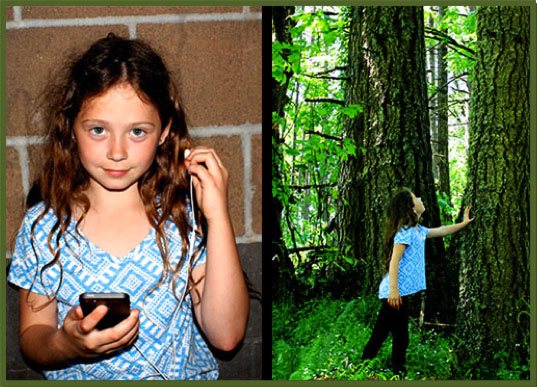 Case Study 1 –
Restoring Connections: Unplugging and Reconnecting
By Ashley Adelman, Roslyn Braun, Lucas Holladay, Kiki Kruse, Kerry Sheehan, Zoie Wesenberg, and Alicia Kristen (Project Manager).
 s a group of students made their way into the Douglas-fir forest from the oak savanna, a facilitator hushed the group with a “quiet coyote” hand signal. Immediately, everyone hunkered down, peering through the brush as the group tried to get a glimpse of the discovery. A student squealed in delight. The deer was still, its gaze locked onto ours. Having taught our students about the importance of deer ears for hearing predators, they noticed how the deer kept her ears pricked forward, waiting for our next move. The group slowly moved up the hill trying to get a better view. Experiences like this have the ability to enhance the senses like no video game or television show can. Learning about environmental issues at a young age can be overwhelming, but connecting to local nature, students can become more aware of and in tune with the natural world.
In spring 2015, the Environmental Leadership Program launched the Restoring Connections project at Adams Elementary School. Our team of six undergraduates, with the guidance of our graduate project manager, was responsible for the design, creation and implementation of this environmental education curriculum, focusing on Mt. Pisgah Arboretum’s natural ecosystems.
In this pilot year, we focused on kindergarten, first-, and second-grade students. Our goal was to address what Richard Louv calls ‘nature-deficit disorder’ through the creation and implementation of a place-based and experiential educational program. According to Louv, the cultural shift in which many youth now prefer to stay inside interfacing with screens, rather than going outside to play and explore, has resulted in devastating effects on their personal well-being – physically, mentally, and emotionally – in addition to having disastrous repercussions for the environment. How we set about addressing nature-deficit disorder was informed by Howard Gardner’s theory of multiple intelligences and David Sobel’s work, which outlines a framework for age-appropriate content. Working from this theoretical foundation, we knew we wanted to allow students to explore nature first-hand to help them develop a connection to where they lived, and nurture empathy for the plants and animals that share our bioregion. In addition, the structure of our program was influenced by the Tbilisi Declaration (1977), which states that environmental education should foster awareness, provide knowledge, develop skills, and shape attitudes in students so they can effectively participate in environmental decision making and stewardship. This idea of restoring children’s connection to nature, while they participated in restoring the land, was a central idea of the program.
The structure of our Restoring Connections program consisted of a 45-minute classroom visit on Tuesday, followed by an all-day field trip on Thursday. The classroom lessons focused on introducing key concepts, preparing the children for a successful field trip, and most importantly, instilling a sense of excitement and awe for the ‘magical forest’ they would be visiting. The field trip focused on awakening their senses, building connections and empathy, and finally, on giving students an opportunity to be involved in restoration activities.
During the field trip the kinders built elf and fairy homes out of natural materials in the wildflower garden, engaged their visual senses by finding a rainbow of colors, and engaged their auditory senses by using their ‘deer ears’ as they journeyed along the riverbank.
First-grade students explored the oak savanna, discovering how pollinators and native plants interact in this habitat. Students examined an Oregon white oak up close and played games that honed their observation and plant identification skills. The restoration work focused on creating habitat for native wildflowers by pulling invasive shining geranium, and planting native plants. Through this restoration work, students learned about native and non-native species and the importance of stewardship.
Second-grade students explored the Douglas-fir forest, studying concepts of camouflage and adaptation through role play and the study of animal behavior. Their restoration work was centered around building “habitat hotels” for decomposers found in the Douglas-fir forest.
The restoration work connects classroom learning to real-life experiences. By learning the differences between native and non-native plants, our first-grade students discovered the need to care for native species in Oregon. Gaining knowledge about the role of decomposers in the Douglas-fir forest allowed the second-grade students to understand ecosystem functions. These activities provided an example of the impact that they can have on the environment.
Throughout our ten weeks of teaching, over 200 students had the opportunity to visit and explore Mt. Pisgah. As part of our professional development, we were asked to evaluate what worked and what needed to be changed after each interaction, and then make those changes for the following week. Jenny Laxton, the education program coordinator at Mt. Pisgah, provided us with invaluable feedback to help us improve our program to best serve the needs of the Arboretum and Adams students and staff.
The opportunity to complete service work allowed the elementary students and our ELP team the opportunity to take the knowledge and skills we have gained in the classroom and use them in community action. We gained problem-solving and team management skills along with greater knowledge of best practices within environmental education. We were also encouraged to engage in critical self-reflection to improve our final outcomes.
The long term vision for this project is that starting next year, the Restoring Connectionsteam will work with a single cohort of children, from kinder through fifth-grade.This cohort of children will visit Mt. Pisgah Arboretum each season (fall, winter, spring) giving them multiple opportunities to visit, connect, and participate in restoration work. Each grade level will focus on exploring a different habitat located within the Arboretum, with activities geared toward hands on learning. By giving children an opportunity to be outside, learning in nature, we hope this project will deepen their sense of appreciation for the beauty of the natural world and reach those who may not thrive in a classroom setting. By returning each year, the children will gain an understanding of local natural history that cannot be gained through a single visit alone. By involving them in restoration efforts over time, the children will be able to witness the difference their actions have made on the landscape. Overall, Restoring Connections seeks to cultivate a lasting connection to the land, one that is based on reciprocity and respect.
To learn more about our project, please visit:https://blogs.uoregon.edu/restoring
 Case Study 2 –
Canopy Connections: Nurturing Naturalists
By Samantha Bates, Laura Buckmaster, Nicole Hendrix, Forrest Hirsh, Micaela Hyams, Elie Lewis, Amelia Remington, Nick Sloss, Tim Chen (Project Manager).
 ix middle-school students sit silently on a trail in an old-growth forest: one observes a newt run over her feet; another notices how moss and lichen create miniature forests; another writes poetry about the nearby sounds of Lookout Creek. Down the trail, students identify giant Douglas-firs, noting the distinct grooved bark in contrast to the smoother bark of the equally impressive western hemlocks. Using newly-honed plant identification skills, students compare two plots to form hypotheses about what stage of ecological succession they are observing. Further along, students put their compass skills to the test, going on a compass scavenger hunt of sorts, receiving a bearing and seeing if they can find the correct specific tree off the trail. Later, they will sit in a circle surrounded by enormous Douglas-fir, ancient Pacific yew, stringy western redcedar, and drooping western hemlock and draw a map of the forest with the creek as their backdrop. Meanwhile, their friends climb 90 feet into the canopy, finding treasures few ever ascend high enough to discover: dangling Lobaria lichen clinging to branches heavy with the plentiful “roses” of small, papery hemlock cones; licorice ferns growing out of decades-old moss carpets that blanket trees that students now observe from above.
Canopy Connections is in its seventh year. This year our team of eight undergraduates (and one graduate project manager), sought to distinguish ourselves by designing our curriculum around the theme “nurturing naturalists.” Drawing from Gardner’s multiple intelligences, our curriculum caters to multiple ways of knowing and different learning styles. All of our lessons focus on building sensory awareness.
The structure of our Canopy Connections program consisted of a 45-minute classroom pre-field trip visit, followed by an all-day field trip at H.J. Andrews Experimental Forest near Blue River, Oregon. The classroom lessons focused on introducing key concepts and preparing the middle-schoolers for a successful field trip. For the all-day field trip, each class was divided into four groups and rotated through four different stations.
Station 1: Climbing to the Canopy. At this station, students ascend 90 feet into the canopy of an old-growth Douglas-fir tree. Experienced tree climbers from the Pacific Tree Climbing Institute (PTCI) facilitate this activity. Students support one another in their learning about microclimates as they are connected to the ropes one by one and make their way up. While this activity is challenging for some children, the rush of adrenaline often provides them with a hyper sensitivity to their surroundings they might not have appreciated before. Many students leave this activity with a deeper respect for the sheer magnitude and magnificence of a 400-year old Douglas-fir tree.
Station 2: Nature’s Navigators. On the ground, students learned basic map reading and compass skills. Students worked in pairs, and with the help of facilitators, embarked on a compass expedition. Using their compass and species identification cards, they were tasked with locating and identifying four species of trees found in old-growth forests. They later observed the four tree species up close and collaborated to correctly identify them. Students used their new skills and knowledge to create a map of their immediate surroundings.
Station 3: The Life and Layers. At this station, students explored forest succession and disturbance. We introduced the four characteristics of an old-growth forest using the acronym OWLS–old, woody debris, layers, and snags. They then learned to identify several species seen on the forest floor. To paint a picture of how a forest becomes old-growth, we had students read a passage from Ancient Forests of the Pacific Northwest to each other and then look for these signs as they hiked. Through descriptions of nurse logs and pathogenic fungi, they gained an appreciation for the intricate relationships of the forest and began to consider the significance of observation for scientists and writers alike.
We encouraged students to touch the plants, compare, and describe them to each other in order to create detailed records in their field notebooks. Splitting into two groups, they examined plots located in stands of different aged forests, with the goal of using their new knowledge, observation, and recording skills to determine whether they were looking at the 40-year stand or an old-growth stand.
Station 4: Stop, Sit, Scribble. At this station, students practiced their writing skills, imitating the work done by the writers of the Long Term Ecological Reflections (LTER) project, which is designed to collect stories, poems, and essays for 200 years from 2003 to 2203. After listening to The Web, a poem written at HJA by Alison Hawthorne Deming, students followed the guiding principles of the LTER project and spread out on the forest floor to begin writing a stanza for a collaborative poem. They focused on incorporating sensory observation skills and using descriptive adjectives as do the writings collected for the LTER project.
 Although concepts of creative writing and poetry are taught in the lesson, students gain much more than an appreciation for adjectives. They learn collaboration and listening skills, while simultaneously absorbing clues from the natural world: the rush of the river, the smell of coolness in the air, the hundreds of plant species surrounding them. Sensory observation and creative writing connects with the theme of “nurturing naturalists” by bridging the gap between humanities and science.
Throughout Canopy Connection’s eight-week program, over 200 hundred students from four different middle schools participated in field trips. During nine days in the field, we totaled 54 hours of teaching with an 8:1 student-teacher ratio and led nine in-class pre-trip lessons. In addition, we worked in partnership with 23 high-school students from a local AP Environmental Literature class. These students helped us in the field, and we shared insights into going to college as well as being effective environmental stewards. Our team compiled our final curriculum and a final report, and developed a website to display our project. We presented our findings at the Undergraduate Research Symposium, a SMILE workshop at HJA, and an ELP final presentation. Our ultimate mission is positive environmental change stemming from an environmentally-literate younger generation. Many teachers and students have already reached out to express how much our field trip meant to them. To learn more about our project, please visit:
http://elp2015-canopyconnections.weebly.com/
Literature Cited
Deming, Alison Hawthorne. 2007. The Web. Orion Magazine, March/April. http://www.orionmagazine.org/index.php/articles/poem/248/
Gardner, Howard. 2011. Frames of Mind: The Theory of Multiple Intelligences. New York: Basic Books.
Louv, Richard. 2006. Last Child in the Woods. Saving our Children from Nature-Deficit Disorder. NC: Algonquin Books of Chapel Hill.
Norse, Elliott A. 1990. Ancient Forests of the Pacific Northwest. The Wilderness Society. Island Press: Washington D.C.
Sobel, David. 1996. Beyond Ecophobia: Reclaiming the Heart in Nature Education. Nature Literacy Series. Great Barrington, MA: The Orion Society.
Tbilisi Declaration. 1977. Summary of goals and guiding principles. http://www.gdrc.org/uem/ee/tbilisi.html