
by editor | Sep 27, 2015 | Forest Education, Outdoor education and Outdoor School
Forest Schools and the Benefits of Unstructured Outdoor Play
 By Deanna Fahey
Miami University, Oxford, Ohio
 t is snowing outside and you’re getting your child ready to go to kindergarten. While other children may be wishing for a snow day so they can play in the snow, yours is excited to go to school! Why is your child unique? Your child attends a forest school. Forest schools and nurseries are popping up around the globe and gaining momentum. Though these schools have routines that are wide ranging, they all have a common core: allowing children to experience the freedom of playing outdoors as part of their learning.
ROAD TO DISCOVERY
As a graduate student, parent and nature lover, I questioned why some adults choose to make decisions based on ecological consequences while others do not. After all, in today’s day and age, we all are aware of the consequences of our modern lives on the environment. On walks with our daughter, my husband and I spent numerous conversational hours chipping away at adult psyches trying to figure out an answer to this apparent quandary. There has to be some keystone event, I argued, in a person’s life that generates a concern for their environment as adults. During my questioning, I came across an answer. Through interviews, researchers have come to find that a direct, positive experience in nature before the age of 11 promotes a long-term connection to nature. However, given the state of today’s society, our children spend less and less time outside. What does that mean for our environmental future? It was during this time of questioning I was introduced to Erin Kenny, co-founder and lead teacher of Cedarsong Nature School. My husband had been watching Nightline when he called me in. There Kenny and parents were discussing the joys of sending their children to a forest school. I had to know more!
 FOREST SCHOOLS
Friedrich Froebel opened the first kindergarten in Germany in 1837. The core of his curriculum integrated nature and play to provide children ages three to six a place to grow. Over time Froebel’s curriculum has morphed to become more academic in character and concern for children’s growth has been replaced by concern for preparation for elementary school. However, parents around the globe are uniting and fighting to bring nature back to their children. The result of this movement by parents is the reintroduction of forest schools.
Forest schools may fluctuate in their everyday routine but the core value of spending a majority of time engrossed in outdoor play remains the same. According to the American Academy of Pediatrics (Ginsburg, 2006), play is essential to the well-being of children. The varied terrain of nature stimulates imagination, encourages creativity, and builds motor skills. Undirected play allows children to learn to share, work in groups and negotiate. Children involved in play face and conquer fears while self-esteem is boosted as obstacles are worked out and overcome. Play is so important to the overall health and well-being of children it has been recognized by the United Nations High Commission for Human Rights as a right of every child (UNICEF).
In order for children to develop a love of nature, appropriate opportunities for interaction need to be provided. Too often in today’s society children know more about exotic flora and fauna from faraway places but have no idea of the beauty that lies right outside their own door. If children grow to adulthood with no love for, or worse yet a fear of, nature how can we expect them to become environmentally empathetic adults. According to White and Stoecklin (2008) children need to experience nature on a regular basis in order to develop pro-environmental values.
 CEDARSONG NATURE SCHOOL
It was a clear morning as we drove through the forest on Vashon Island in Seattle. We were on the hunt for the elusive forest school. The sun glimmered off the dew hanging on the leaves, blinding us at times to the road ahead. Further and further we drove until at last we reached the end of the road. Where to from here though? Ah, just follow the sounds of the laughing children. We had reached Cedarsong Nature School. I was about to begin my journey into a school with no walls and where children lead the class instead of the teachers; a world virtually impossible for me to imagine but that I was eager to explore!
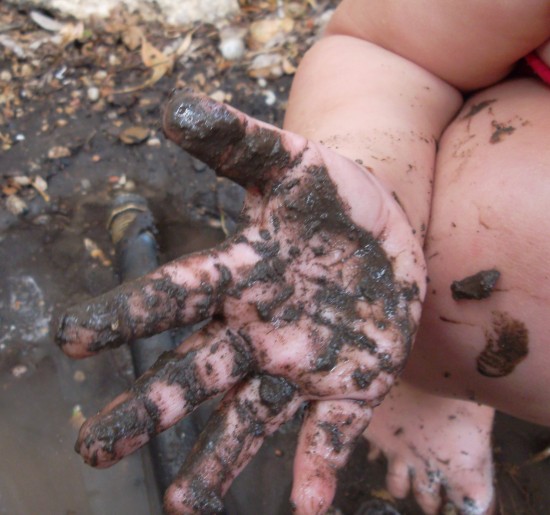
When I caught up with the children at Cedarsong, they were in the process of making some very delicious mud pies! The girls were covered head to foot in mud and they could not have been happier. They were standing in a circle chatting together over their work and discussing things only known to them. As I stood aside and watched, Erin Kenny, co-founder of Cedarsong, described to me how the children are the leaders of the day; their interests and observations dictate what will be learned. As a teacher myself, I questioned the logistics of this system. How does anything get covered when children decide what to learn? She told me how a random comment about tripping over a tree root can lead to a discussion on erosion and weather or the purpose of the roots of a tree to photosynthesis. The possibilities are endless! Changing seasons bring continual opportunities to track and record growth, and discuss hibernation and even death. New observations can lead to predictions, fallen trees and fungus can stimulate conversation on decomposition which can lead to discussions about habitats and niches. Teachers, it turns out, can just stand back and observe; it is from their observations that teacher’s take their cues of where to lead.
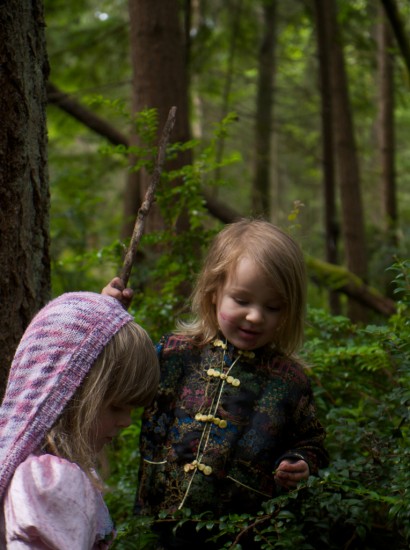
 A boy had decided to explore a bit more of the area; Kenny and I followed leaving the girls in safe sight of the teachers. As we followed the child further into the forest my “inner child” was awakened and I wanted nothing more than to climb the nearest tree or jump into one of the many puddles. My senses were stimulated by the sounds of the birds and insects calling out their warnings of strangers nearby and I desperately wanted to search out the sources of those warnings calls! However, I was there to observe the children and not to indulge my own inner child so I turned my attention back to the child we were shadowing.
Further along the path the child had found a tree to climb. Though Kenny moved a bit closer, she did not flinch or move to stop the boy. I inquired about fear of accidents given the freedom the children seem to be allotted. According to Kenny not many children do get hurt— they learn and respect their own limitations. On the rare occasion one does get hurt, there are emergency protocols that all teachers are familiar with. Teachers are certified and stay current in first aid and CPR. Kenny’s experiences with accidents are similar to those from forest schools in Europe.
Marga Keller is the founder of WaKiTa, a forest daycare located in Zurich, Switzerland. Keller stated, “Experience shows that in forest institutions fewer accidents happen than in mainstream schools.” She clarifies, explaining that because the teachers consciously learn how to handle risks with the children and help them strengthen their own skills, the children can assess risk situations better. The children also do not feel the need to rebel against overly restrictive rules or prove their courage because the school actually puts this as part of the program: the teachers offer the children age-appropriate challenges.
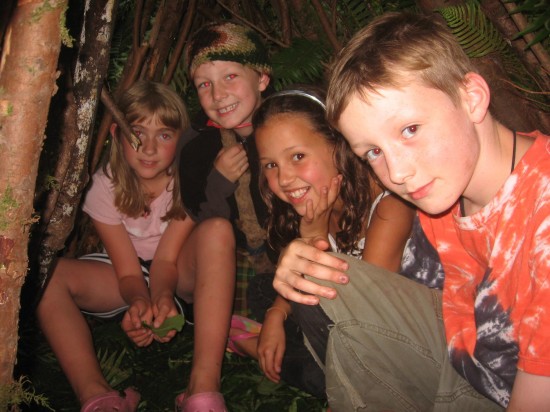
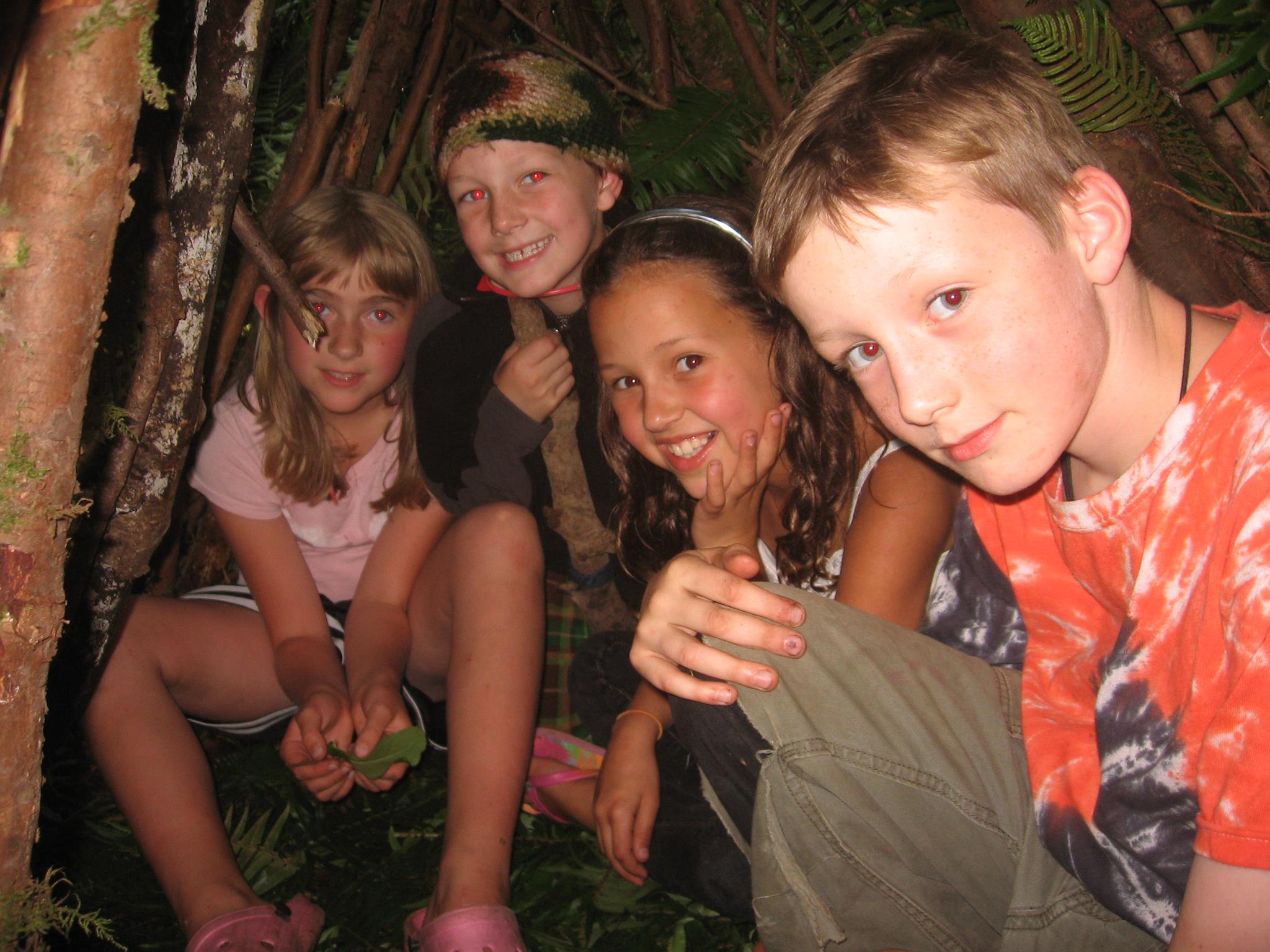
 Back with the main group, Kenny asked if anyone would like to lead a hike to show me the rest of the forest. All the children decided to go and we set off together. As we wandered through the forest, the children impressed me with their knowledge of the local plants and fungi. I was taken to forts and shelters camouflaged in the trees, the likes of which my own children would have gone crazy for! As we strolled on, the children dispersed to different areas of the trail and Kenny and I had another opportunity to discuss the school and the children’s role. “Children challenge themselves all the time in the outdoor setting,” Kenny told me. “They display great personal pride in their achievements.”
Each day is unique and brings new sources of inquiry and excitement! Children learn to work together and cooperate through imaginative play. According to Burdette and Whitaker (2005), when children play outdoors there is more opportunity for problem solving and creative thinking. The varied terrain and multiple stimuli which nature provides deliver the perfect environment for imagination.
As my time came to an end at Cedarsong, I felt encouraged with all that I had seen. The possibilities for incorporation of nature into the American education system seemed endless and the benefits for our future generations infinite!
Bringing Back Outdoor Play
Forest schools may seem ideal for the issues I was grappling with, but not all of our schools and children have access to nature in their backyard. Urban schools are at a distinct disadvantage for this type of schooling; however, there are schools working on solutions which could be sustainable for all urban schools. For example, Muscota New School, located in New York City, utilizes Inwood Hill Park and Bear Mountain State Park, making the most of the nearby outdoor areas available to them.
According to the California Department of Education (2011), environment-based education employs natural ecosystems as a context for learning. The “environment” may be a river, a forest, a city park, or a garden carved out of an asphalt playground.
It seems any environment can be employed as an area for incorporating outdoor play, opening doors for practical outdoor play solutions.
You cannot turn on the news today without hearing about school funding issues; yet funding concerns can be overcome through partnerships, grants and community volunteer days. Taft Elementary School in Redwood City, California, partnered with Hidden Villa, a non-profit outdoor education organization to create their school garden program. CitySprouts, based in Cambridge, Massachusetts, partners with public schools to develop school gardens. Citysprouts also works to educate teachers on the integration of existing curriculum with their gardens. The Lorrie Otto Seeds for Education Grant Program provides grants for large scale projects such as the “design, establishment and maintenance of a native-plant community such as prairie, woodland, wetland, etc. in an educational setting such as an outdoor classroom.”
Modifications select schools are making to outdoor immersion are providing sustainable and worthwhile results. Our children are gaining access to the outdoors, attaching to nature and initiating positive change in their well-being.
WHERE DO WE GO FROM HERE?
Even though forest schools may not be the catch-all answer I was looking for, they can be a viable solution to our children’s lack of outdoor play and keystone moments. For those schools without a sizable amount of accessible land, compromises can be made. Vegetable gardens are being employed to reinforce geometry sills, nutrition, life science and basic math. An extension can include cultural differences in gardening techniques and vegetable preferences as well as recipes, which of course can be utilized for basic math. Trees found on school grounds can be used to teach geometry, prediction, microhabitat, and chemistry. An ecosystem extension can be incorporated by linking with international schools to compare tree data; growth rates, circumference, etc. (sites such as Jane Goodalls – http://www.rootsandshoots.org/ are perfect for this type of linking). Logs and larger branches on the ground can be used for agility, microhabitat, decomposition, nutrient recycling, chemistry, prediction and even physics. Why are branches of similar size but different trees weigh different? Water sources – even puddles after a rain – can be used for chemistry, prediction, water analysis and physics. Have you ever wondered about the force of a foot splashing in the water and the correlation to height of the splash? Cultural stories and knowledge can be shared while observing and studying local plants. I for one have always wondered about the ability of plants to break rocks as the seeds grow. Sounds like a perfect inquiry-led question for a physics class. Ant hills can be an endless source of amusement and knowledge for younger children learning about habitat. Decomposing leaves on your school grounds can become the perfect place to discuss microhabitat, nutrient recycling and niche. Of course the simplest solution would be to get rid of the cement playground and replace it with a natural playground, one complete with grass, fallen and living trees and butterfly and vegetable gardens.
In our world today adults are making choices that are counter-intuitive to what is best for our environment. Without contact with their natural world our modern children will grow up to be less inclined to save the earth than some of us seem to be today. As adults we need to come together and give our children the access to nature they deserve. With the constraints of today a feasible solution to this problem is to bring back outdoor play to our school children!
Reference:
Burdette, H. & Whitaker, R. (2005. Jan.). Resurrecting Free Play in Young Children: Looking Beyond Fitness and Fatness to Attention, Affiliation, and Affect. Arch Pediatr Adolesc Med. Vol. 159. Retrieved from www.archpediatrics.com at University of California – Berkeley
California Department of Education. (2011). School Garden Program Overview ; An overview of the school garden program including its impact on children’s health, nutrition, and academic achievement. Retrieved from http://www.cde.ca.gov/ls/nu/he/gardenoverview.asp
Citysprouts. http://www.citysprouts.org/
Ginsburg, K. (2006. May). Testimony of Kenneth Ginsburg, MS, MS Ed, FAAP on Behalf of the American Academy of Pediatricians. Natural Resources Subcommittee on National Parks, Forests and Public Lands and Subcommittee on Fisheries, Wildlife and Oceans. “No Child Left Inside: Reconnectiong Kids with the Outdoors”.
Keller, M. WaKiTa Outdoor Daycare
Kenny, E. Cedarsong Nature School
Moving Outdoors in Nature Act. Retrieved from http://www.govtrack.us/congress/billtext.xpd?bill=h111-6426
Muscota New School. http://www.muscota.org/
Rymer, B. (2009. December). Taft Elementary School’s Garden Program; A Case Study. Retrieved from http://www.redwoodcity.org/manager/initiatives/gardens/helpful/Taft%20Case%20Study%20Draft.pdf
The Lorrie Otto Seeds for Education Grant Program. http://www.for-wild.org/seedmony.html
White, R. & Stoecklin, V. (2008). Nurturing Children’s Biophilia: Developmentally Appropriate Environmental Education for Young Children. White Hutchinson Leisure & Learning Group
UNICEF. http://www.unicef.org/rightsite/files/uncrcchilldfriendlylanguage.pdf
by editor | Sep 22, 2015 | Gardening, Farming, Food, & Permaculture
Teach a School to Garden…
by Brandi Mendenall
Central High School
Springfield, Missouri
 s I watched the dump truck unload what would be the first of three loads of the highest quality compost our small school club could afford, I could not help but wonder if we really understood the scale of the project we were about to launch. Three years ago, my colleague Paul and I had a common goal, to bring an educational and productive garden to our urban school community. We had both maintained small gardens at our homes, but neither had attempted anything of this magnitude. Our school environmental club was comprised of a small group of regular attendees, and we invited everyone, staff, students, and parents, to assist us with the setup of the garden. The volunteer turnout was promising and we got a great start that first day. By the time the day wrapped, the dirt was poured, scattered, and held in place by a natural stone border. I recall standing over the garden and visualizing its future, my prior reservations were quickly subsiding. We began in the fall and worked tirelessly for months planning for the upcoming spring planting season. The state of Missouri is home to countless beautiful native shrubs and flowers; keeping with the natural landscape while also harvesting produce was the ultimate goal. We were devoted to using heirloom seeds, which we were able to purchase nearby at a popular seed company, Baker Creek Heirloom Seeds. They offered us a great variety, both native and global, and were always available to answer our questions.
We utilized our small school greenhouse to get the seedlings for our new garden started. It did not take long to discover some significant issues with the greenhouse; the most substantial concern involved one of the most crucial aspects to growing plants, watering. The drain on the greenhouse floor is at a higher elevation than the rest of the floor; the watering system that many people spent hours putting together was unable to be utilized without flooding the room. In response to what we viewed as a disaster, our students created a watering schedule and took turns taking care of the seedlings while they developed and grew.
We had more success growing than we anticipated, being our first time growing this many plants, we were unsure what to expect. Our plants flourished, we had enough to fill our garden as well as make money for the club by selling the extra plants. Before the school year wrapped we were able to get the plants into the garden with the help of our many volunteers, which once again included students, staff, and parents. We found that growing and planting was a great way for our students to form relationships with their peers, and we were anxious to pursue getting more community involvement.
Our first garden was a success, so much so that we began expanding. We now have four garden spaces that we are working on developing, and have plans for more in the near future. We are starting a new club at our school this year with a sole focus on gardening and environmental sustainability education. One of our garden spaces includes six large squares embedded along a well traveled sidewalk that we assume at one time had life, when we took over they were filled with dead grass, weeds, rocks, and dirt. We asked various clubs and groups at our school to “adopt” a square and make it beautiful again. This project is still a work in progress, but all the squares have been adopted and renovations have begun. By next summer we foresee a new look to the area. We are excited to have such a variety of people helping with our gardens; our secretaries have even adopted a space.
We have had kinks along the way, finances are always an issue, but we have received generous donations of plants from a local business to help fill our gardens. Keeping the gardens watered throughout the summer when schedules are busy has been another challenge, but we have managed and this year we were able to make significant improvements to our outdoor watering system with more hoses and supplies. It has been a learning experience for everyone involved; we have many dreams and goals for our garden venture and plan to get many more people involved in the process.
“Give a man a fish, he eats for a day. Teach a man to garden and the whole neighborhood gets tomatoes, and squash, and cucumbers….”-unknown
It is our intention to eventually teach the entire neighborhood to garden, the possibilities are endless. I encourage anyone with the dream of starting a garden project in their school to get it started today; it has been an amazing addition to our school, not only for the beatification of the campus but for the social climate of the school community as well.
-Brandi Mendenall is a science teacher at Central High School in Springfield, Missouri.

by editor | Sep 17, 2015 | Conservation & Sustainability
Environmental Education: The Science of Learning and Doing
by Cecelia Bosma
Trinity Lutheran School
Litchfield, Arizona
 e live on a planet with limited resources that are often consumed without caution. Finding ways to engage students in pro-environmental behaviors that conserve these limited resources rather than take them for granted is a priority for environmental educators. The human population also needs to work on understanding the benefits and risks we take with our daily behavior. Conserving the use of paper towels at home and in public is one easy pro-environmental behavior that will have a positive impact on the environment. Paper towels do not just use up trees, they also require large amount of water for production and they end up in landfills which generates pollution as they slowly decompose. However there are numerous alternatives to using paper towels at home and at school. These alternatives are efficient effective and financially thrifty. Often times conservation practices are rejected because they are time consuming and or costly. Alternatives to paper towels are neither. The financial benefit is an incentive for people that don’t relate to the environmental impact of using paper towels.
 Last fall, I designed a project to engage my eighth grade science class in a meaningful scientific inquiry project that assisted in deepening students’ understanding of the importance of conservation action through environmental education. The project action focused on eliminating paper towels in school bathrooms. There are many environmental benefits to reducing the amount of paper towels manufactured. One benefit is the reduction of trash in landfills because generally bathroom paper towels cannot be recycled. Another benefit is the reduction of chemicals leaching back into our soil from decomposing paper towels. This in turn saves trees from being processed into paper towels. Environmental benefits are also found in the amount of water consumed in the manufacturing of paper towels, and the reduced amount of fuel burned transporting paper towels.
Getting started on an inquiry project that is focused on building environmental knowledge through conservation action on the school campus can be a challenge. I have been working middle school students on various inquiry projects to build environmental knowledge for several years. Each time I start a project I am learning right along with my students. This project was no exception. Sharing ideas about inquiry and lessons that motivate students to learn and build knowledge is how we as teachers can help each other build stronger lesson plans that benefit our students and communities.
Project Inspiration
Educating adolescents about the impact they have on their environment is necessary for nurturing lifelong environmental stewardship (Nancy & Kristi, 2006). In the last twenty years, environmental education has been gaining a stronger foothold in classrooms across America (Stevenson, Peterson, Bondell, Mertig, & Moore, 2013). The purpose of environmental education is to teach students how to make responsible decisions, using critical thinking in order to take action to maintain or improve our environment (Short, 2010). Educators should encourage even small steps toward environmental conservation, as they are building blocks to lifetime environmental conservation action (Short, 2010). Accordingly, the primary goal of environmental education is to instill knowledge that leads to pro-environmental actions and behaviors for individuals, groups and society (Heimlich, 2010). I have found that engaging the learners in hands on actionable learning has a positive effect on the outcome of environmental education.
The burgeoning population of planet Earth has brought about observable changes in the environment both in populated and unpopulated regions of the world (Short, 2010). Scientists have observed these drastic changes in the form of melting ice caps, ozone depletion, deforestation and global warming, all of which can be attributed to human actions (Tidball & Krasny, 2010). Therefore, it is society’s responsibility to take action to improve the current environmental status that threatens the very existence of humans (Stevenson et al., 2013).
Additionally, it is important to incorporate positive actions into environmental education (Tidball & Krasny, 2010). Instead of focusing on what is wrong with our environment. Students are motivated by positive changes that help our environment such as recycling. Inquiry style learning is one way to incorporate positive action. Increasing environmental knowledge is a crucial part of environmental education (Grodzińska-Jurczak, Bartosiewicz, Twardowska, & Ballantyne, 2003). This project incorporated the inquiry process into the environmental education program. The students construct their learning by observing, asking questions and problem solving (Crawford, 2000). The inquiry process is a way for students to do science like a real scientist. Educating school children about environmental concerns now will promote action in the future (Evans et al., 1996).
The Project
A class of twelve eighth grade students took part in the paper towel conservation inquiry project. The project began with students watching the video that inspired me “How to use a paper towel” (Smith, 2012). Upon completion of the video, students were asked what they thought of the video and if they thought there were other ways that we could conserve paper towels in the bathrooms on our campus. Following the video students took a trip to the boys’ and girls’ bathrooms nearest to our classroom. Science class is at the end of the day, and students observed the piles of used paper towels in the garbage and on the ground.
They were challenged to develop a plan for measuring the volume of paper towels that were used daily for a week. Students worked in pairs to identify a plan which was presented the next day in class. Students then voted on the plan they thought would work the best and took steps to put it into action. One students brought in a scale from home and others created a data sheet for recording the measurements taken daily of the weight of paper towels used in each bathroom.
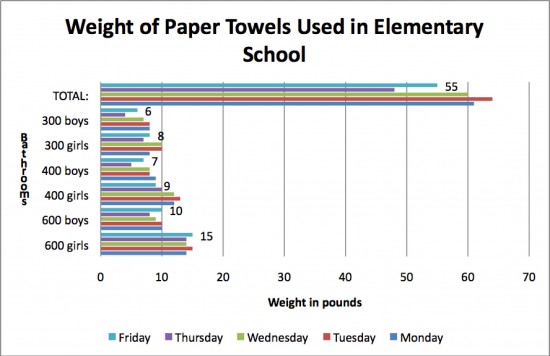
Table 1 Paper towel weight chart created by students
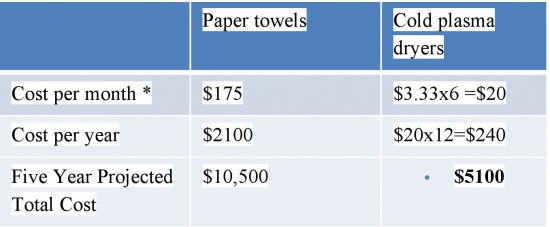
Table 2 Financial comparison of paper towels versus hand dryers created by students
The students tracked the amount, in pounds, of paper towels used in the 3 sets of boys’ and girls’ bathrooms for 5 days. This data was calculated and graphed to demonstrate the amount of paper towels that our school is disposing into the landfill each day. A total of 288 pounds of paper towels are thrown in the trash each week from the collective school bathrooms (figure 1). Students contacted the person on staff who handles the ordering of paper towels to determine that the school spends about $350.00 on paper towels each month. This information was tabulated into the final graph that compared the expense of paper towels versus the expense hand dryers (figure 2). The graph shown in figure 1 and 2 were developed by students; while it could be perfected it is meant to demonstrate the capabilities of middle school students. Upon completing the charts students noticed that the older students used considerably more paper towels than younger students did.
Students brainstormed alternative ideas to using paper towels. They researched hand dryers, cotton towel dispensers and looked at the practicality of using personal towels. After researching each option, they used the data they collected on alternatives to paper towels to create a presentation to share with fellow students, parents and the church board who has a strong influence on decision making changes. The conclusion of the study resulted in the student recommending the installation of new efficient hand dryers that dry hands in 12 seconds or less. As the students pointed out in their presentation the machines are also designed to kill germs in the air and on the skin (Gagnon, 2007).
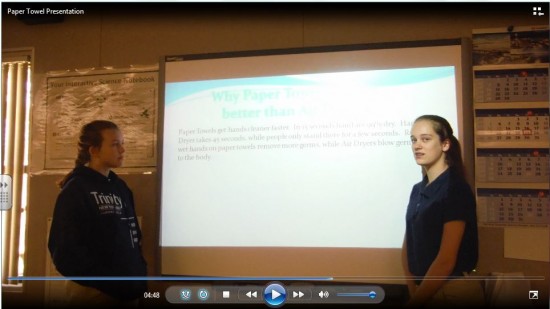 The presentation was videotaped and posted on the school website. Posting the video required getting permission from all of the parents. This was worthwhile effort because the students were then able to share what they had learned accomplished and produced with their own community of friends and neighbors. This made it possible to spread the idea of replacing paper towels with hand dryers to the larger community outside of our school.
The final piece of this project was to present a written proposal to the Board of Directors for consideration. Students were given the task and some guidelines and they had to collaborate and compromise to develop a well written proposal that included their research and data results. The objective of the assignment was to persuade the board to approve the installation of hand dryers in the bathroom. The proposal was completed and presented, and is now being considered for implementation.
Action and Reflection
The benefit of inquiry learning is that it provides a method for gaining deeper knowledge about a subject, in this case environmental education, and it also builds students skills in problem solving and analysis. This project provided students the opportunity to conduct science like a scientist. They observed and questioned. Then they looked for alternatives, conducted research, devised an action plan and carried out an investigation. The final part of the project included compiling their findings and presenting to decision makers. Encouraging and guiding students to learn about their environment and then to take action is taken to authentic level when it involves real and actionable projects. It is my hope that the board finds merit in the study and takes the necessary steps to change to electric hand dryers. This action will mitigate the burden, the use of paper towels, puts on our environment.
I know that this project was beneficial in bolstering students’ knowledge of environmental issues. Throughout the project students took ownership of each step and worked diligently to complete the work. The following are several comments from students at the end of the project.
“I liked being able to go outside for science.”
“I hope that hand dryers are installed in the bathrooms”
“I worked really hard on this project because it might be good for our school”
This paper towel action-centered conservation project works to build students conservation and knowledge that works to promote continued conservation action (Stevenson et al., 2013). Schools are looking for ways to keep the material fresh and relevant for the students incorporating inquiry science works towards that goal. We have a planet with limited resources, and an economic system that often ignores that fact. As time goes by the need for action is even more crucial for the survival of all of us. Paper towel reduction is one idea that students can be engaged in environmental education. We have to find ways for students to not only learn about importance of caring for our environment but that knowledge must lead to continued environmental action for the objective to be met.
As a teacher, focusing on improving techniques to guide inquiry learning, leads to discovering ways to make projects authentic and real. Utilizing inquiry in environmental education provides students an enriching learning environment. This is my story of a journey to use inquiry as a catalyst for environmental change. Embrace your story.
Bibliography
Crawford, B. A. (2000). Embracing the essence of inquiry: new roles for science teachers. Journal of Research in Science Teaching, 37(9), 916-937. doi: 10.1002/1098-2736(200011)37:93.0.CO;2-2
Evans, S. M., Gill, M. E., & Marchant, J. (1996). Schoolchildren as educators: The indirect influence of environmental education in schools on parents’ attitudes towards the environment. Journal of Biological Education, 30(4), 243-248. doi:10.1080/00219266.1996.9655512
Gagnon, D. (2007). Paper Trail. American School & University, 80(1), 30.
Grodzińska-Jurczak, M., Bartosiewicz, A., Twardowska, A., & Ballantyne, R. (2003). Evaluating the impact of a school waste education programme upon students’ parents’ and teachers’ environmental knowledge, attitudes and behaviour. International Research in Geographical and Environmental Education, 12(2), 106-122. doi:10.1080/10382040308667521
Heimlich, J. E. (2010). Environmental education evaluation: reinterpreting education as a strategy for meeting mission. Evaluation and Program Planning, 33, 180-185. doi: 10.1016/j.evalprogplan.2009.07.009
Short, P. C. (2010). Responsible environmental action: its role and status in environmental education and environmental quality. Journal of Environmental Education, 41(1), 7-21. doi: 10.1080/00958960903206781
Smith, J. (2012, March). How to use a paper towel. Retrieved from: https://www.ted.com/talks/joe_smith_how_to_use_a_paper_towel
Stevenson, K. T., Peterson, M. N., Bondell, H. D., Mertig, A. G., & Moore, S. E. (2013). Environmental, institutional, and demographic predictors of environmental literacy among middle school children. PLoS ONE, 8(3), 1-11. doi: 10.1371/journal.pone.0059519
Tidball, K. G., & Krasny, M. E. (2010). Urban environmental education from a social-ecological perspective: conceptual framework for civic ecology education. Cities and the Environment(1). Retrieved From: http://digitalcommons.lmu.edu/cate/vol3/iss1/11/
Wells, N. M., & Lekies, K. S. (2006). Nature and the life course: Pathways from childhood nature experiences to adult environmentalism. Children Youth and Environments, 16(1), 1-24.

by editor | Sep 17, 2015 | Questioning strategies
 What’s the Difference…
…between a single performer and an energetic band? Can students teach themselves?
by Jim Martin
CLEARING Master Teacher
 n an earlier set of blogs, we followed a middle school class whose science teacher had started them on a project to study a creek that flows at the edge of the school ground. The last time we saw them, groups were analyzing and interpreting the data and observations they collected on their first major field trip to the creek, and preparing a report to the class. The blog focused in on the group doing macros, macroinvertebrate insect larvae, worms, etc., who live on the streambed; aquatic invertebrates large enough to distinguish with the unaided (except for glasses) eye.
They eventually organized themselves into three groups, one to cover the process of collecting the macros, one to describe how they identified and counted them, and a third to find out how to use their macro findings to estimate the health of the creek. Sounds like they’re on a learning curve, moving from Acquisition to Proficiency. They would need some feedback, both from withn the group and from their teacher. She gave each group one more task, to find out what they could about effective student work groups.
The macro group prepared the presentation they would make to the class. Each of their groups prepared their part, then they gave their presentations within the group, and used this experience to tweak them into a final, effective presentation. Their presentation included the interpretation they made based on their collected data that the creek’s current health was Fair, tending toward Good.
They used the rest of their prep time to begin a search for information on effective student work groups. During their web search, they were surprised there was so little there about middle school work groups, since they are finding their work invigorating, and feel they are learning a lot. Some of the sites they visited were confusing, some targeted high schools, but most described college work groups. Among those things related to effective work groups they found and were interested in were those which described the work, maintenance, and blocking roles individuals play within work groups, and those which described how groups can make their work visible while they’re processing by using whiteboards, posters, etc. They saw how these aids would help clarify concepts as they were learning. They decided to report on these two findings, roles group members play and making the work visible so that it is easier to discuss and process.
Of the two group characteristics they decided to report on, the idea that individuals play roles in a group, and these roles affect the work of the group were the most interesting to them, and a bit of a revelation. They were especially intrigued by one of the Blocking roles, which interfere with a group’s capacity to complete its work. The one they found most interesting was the Avoidance Behaver role. Each of them had engaged this role when they were madly fighting for the D-net while first collecting macros. (By joisting to control the D-net and collecting tray, they were avoiding the work in the way in which they behaved. They had employed Avoidance Behaviors; each of them, as they joisted, was an Avoidance Behaver.) They still laughed at the fun they had been having, but also felt the odd juxtaposition of this role with the Work and Maintenance roles they also played to move the work along, clarify the processes they used and identifications they made, keeping communication lines open, and sending out consensus queries about what they thought they were finding out.
They were encouraged that most of the roles they assumed were positive ones which lead to a successful project. As they talked, they also came to consensus that this was a finding of their work as important as their findings indicating that the health of the stream was Fair, tending toward Good. A revelation for them, and would become one for their teacher.
This group has made good progress on their new learning curves, macroinvertebrates and group roles. One curve is facilitating their conceptual understanding of macros; the other curve is empowering them to understand the dynamics of an effective work group. They entered these learning curves because (1) their teacher set them up in the first place, and (2) the Acquisition phase included finding out about macros. And, perhaps inadvertently, their, and their teacher’s discovery of the importance of developing effective work groups. Because the students were first finding macros, then learning about them, they started their work seeking information and patterns which would help them know who was living on the bottom of the creek. They didn’t consciously couch their investigation in these terms, but this is what they were experiencing.
The experience of seeing if they could actually capture macros, and the fun involved in collecting and seeing them stimulated the limbic’s Seeking system in their brains, which added dopamine to the neural soup that facilitates human efforts to make work interesting. These feelings and felt interests, in turn, drove them to the books and the web to follow up on the needs to know generated by their inquiries. Under their own power. First, the excitement of learning how best to capture macros, then residual interest carried them to the manuals to begin to identify who was there. ‘Finding Out’ is a powerful student (and human) motivator, one we stamp out as students move through the grades we teach. Perhaps because many of us don’t understand the content we teach well enough to allow our students to have their own thoughts about it. (Parenthetical comment on the 50%)
We could learn to use this motivator to engage conceptual learnings in ways that involve and invest our students in their learnings, and empower them as persons. There is a big difference between memorizing for a test and trying to find out the same information. The difference between a single performer and an energetic band. One way that difference expresses itself is in our standing in global scales of learning, where we are consistently near the bottom, rarely in the upper half. Our current model of school is memorizing for tests. How well does that work? We need to rediscover this active, group-centered, collaborative way of being human, and exploit it in our classrooms and outdoor sites. Telling students what is before them doesn’t stimulate long-term conceptual memory; helping them find out does. I’d like to say, “Freeing them to find out,” but for many teachers those words, especially the first one, might be intimidating to hear.
Building effective work groups takes time and patience. Fortunately, it goes quicker if the process takes place while the groups are pursuing an inquiry. Engaging in this kind of work develops needs for just the sort of group processes which make inquiries successful. While she may not have consciously planned it, dividing the class into groups, each with its own part of the creek to study, set the stage with students who were ready to learn about effective work groups. They weren’t consciously aware that they were ready, but their needs to do the work did the job for them.
(I’m interested in Jaak Panksepp’s work at Washington State University on the brain’s limbic system’s Seeking System. It’s important to learning for understanding because this is one of the few instances in which engaging the relatively primitive Limbic System leads to effective activity in the cortex, where critical thinking happens. When educators speak of the brain and learning in the same sentence, eyes in just about any audience tend to either roll or glaze over. Even though the brain is our organ of learning, teachers and administrators tend to think of learning and publishers’ products as the only bundle that matters. No room for neuronal bundles. Connecting. In effective ways. Evolved bottom up, and may work best that way.)
First, by sending students to find out, the emotions of the Seeking system move them to the cortex and critical thinking. Then we organize the learners’ environment so the information they (their cortices) need to know is readily available. And we can watch as our students learn for understanding. My experience was this: First engage students in their inquiries, then see how much of the reading I would have assigned or lectured on that they get into on their own. My observations on learners over the years told me that any movement away from total inertia on the part of the student indicates a determined effort to learn even if it’s a small move, say 10% of the way to mastery. Perusing the research on the brain eventually clarified that particular parts of the brain, when they were working, elicited the learning behaviors I observed, and clarified students’ involvement and investment in the learning, and empowerment as persons, and prepared them to form effective work groups.
So, the teacher and her class were learning that one thing which will enhance student performance is to learn how to get group members to interact. You can facilitate this by ensuring that students’ work calls for the communication skills it takes to develop consensual decisions about complex topics. The teacher whose students we just followed did this by asking each group to research information about effective student work groups. They do the work, she gleans the information. Win-win. A further step would be deciding how to include minority opinions in final reports. Simple to do; you just announce that you allow it. In my experience, this helps students achieve ownership of their learnings. A surprise for me was that sometimes students presenting a minority report saw something other groups presented from a new perspective, that of observer, not of learner. Whether that altered their interpretation of findings wasn’t as important as the fact that they were developing the capacity to hear another view and think about it. And validate the right to hold it. And, holders of the majority opinion often did review their thoughts.
The macro group is moving through its own learning curve. Does their progress look like a learning curve? Where did they start? Where are they now? How does the learning curve differ for an individual student vs. an effective work group? I picture this difference as one between a single, good performer, and an energetic band; the interactions between group members, while they’re working, can make a routine school activity become an exciting experience, a performance to be remembered. If you’re a teacher, listen to that last word.
 This is a regular feature by CLEARING “master teacher” Jim Martin that explores how environmental educators can help classroom teachers get away from the pressure to teach to the standardized tests, and how teachers can gain the confidence to go into the world outside of their classrooms for a substantial piece of their curricula. See the other installments here, or search Categories for “Jim Martin.”
by editor | Jun 20, 2015 | Place-based Education, Service learning
 Sowing the Seeds of Place and Community-based Learning
by Becs Boyd
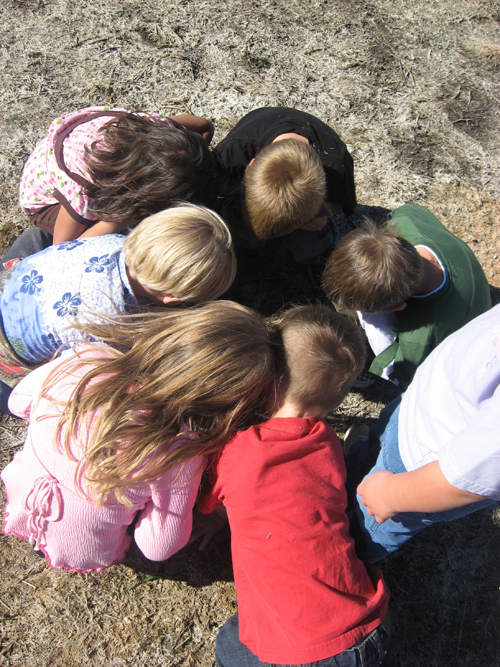
 Place and Community Based approach can be transformative for students and teachers, schools and communities. Making this approach work means taking a fresh look at the school community, the wider community and the environment, and working out how they can best support each other. Change takes time, and success, naturally, relies on a healthy physical and social learning environment, with good relationships between educators, administrators and students. Many schools will already be connecting students with their local place and helping them discover how to make their own Place in the world a positive one.
Here are some pointers drawn from the experiences of real schools, students and teachers to help plant the seeds of Place in new school communities. (more…)

 By Deanna Fahey
 FOREST SCHOOLS
 A boy had decided to explore a bit more of the area; Kenny and I followed leaving the girls in safe sight of the teachers. As we followed the child further into the forest my “inner child” was awakened and I wanted nothing more than to climb the nearest tree or jump into one of the many puddles. My senses were stimulated by the sounds of the birds and insects calling out their warnings of strangers nearby and I desperately wanted to search out the sources of those warnings calls! However, I was there to observe the children and not to indulge my own inner child so I turned my attention back to the child we were shadowing.
 Back with the main group, Kenny asked if anyone would like to lead a hike to show me the rest of the forest. All the children decided to go and we set off together. As we wandered through the forest, the children impressed me with their knowledge of the local plants and fungi. I was taken to forts and shelters camouflaged in the trees, the likes of which my own children would have gone crazy for! As we strolled on, the children dispersed to different areas of the trail and Kenny and I had another opportunity to discuss the school and the children’s role. “Children challenge themselves all the time in the outdoor setting,” Kenny told me. “They display great personal pride in their achievements.”


