by editor | Apr 21, 2015 | Equity and Inclusion
How Environmental Education Can Address Issues of Environmental Justice in Urban Settings
by Anjelique Hjarding, Alicia King and Belinda Chin
HIGHLIGHTS
• Environmental injustice occurs when the most vulnerable, poor, minority or underserved populations carry the greatest burden of environmental risk by living in “undesirable” areas.
• Environmental education can provide an opportunity to connect people to nature even in urban areas, and help empower people to mitigate environmental issues.
• Addressing the challenges of environmental justice through the support of environmental education programs can help engage people in actions to improve their environment.
• As citizens engage in environmental education and action bringing positive changes in their communities, they become more empowered to take future actions to further improve their environment.
Introduction
According to the US Environmental Protection Agency (EPA) environmental justice is defined as, “the fair treatment and meaningful involvement of all people regardless of race, color, national origin, or income with respect to the development, implementation, and enforcement of environmental laws, regulations, and policies.”Environmental injustice occurs when the most vulnerable populations carry the greatest burden of environmental risk. Environmental justice seeks to create environmental equity and address issues of environmental racism and inequalities that are the result of human settlement and industrial development. Scholars have explored the topic of environmental justice on both applied and theoretical levels. From examining the geographic distribution of toxins (Lewis & Bennett, 2013) to equitable allocation of green space (Boone et al., 2009) to the debate over how to define environmental racism, there tends to be a pattern of environmental injustice suggesting that minorities and poor people are those that live in areas considered “undesirable.”
Many of the urban communities we work with are touched daily by environmental injustices. Landfills, interstates and train lines are most often located in close proximity to low-income minority neighborhoods. These areas often have reduced access to natural amenities and green space is often distributed by socio-economic lines (Agyeman & Evans, 2003). As educators, how can we work to bring environmental justice education to the forefront?
Environmental justice issues have a history of being excluded from environmental education study (Haluza-Delay, 2012). This can occur because educators lack an understanding of environmental justice or the politics of the education system dissuades teaching on controversial topics related to race and injustice. Environmental education can provide an opportunity to connect people to nature and can help empower them to actively address environmental issues. In fact, the North American Association for Environmental Education suggests that diversity and justice should be a top priority in environmental education, and that more progress should be done in this area.
Students in the urban environment can often experience a disconnect between themselves and the natural world and may not notice their direct impacts on the environment. Lessons focused on issues such as the carbon footprint allow students to visualize their impact on the environment and will help make the issue relevant.
Seattle: Race and social justice initiative
In 2002, the City of Seattle launched its Race and Social Justice initiative, and Seattle Department of Parks and Recreation (Parks) began an Environmental Stewardship Initiative. The Race and Social Justice is Seattle’s effort to focus on the roots of problems – to change the underlying system that creates and preserves inequities – rather than attempt to treat the symptoms (Seattle, 2008). Seattle City Hall acknowledged the need to expose institutionalized racism and expunge discriminatory municipal policies, procedures and practices overall; and Parks wanted to equitably serve more people, more often in the public green spaces where people live, work and play.
In 2014, residents of a historically diverse, working class Seattle neighborhood applied for a grant from the Department of Neighborhoods to pay for an environmental assessment and design for a bike trail in a public green space imbedded within a residential area. The Parks Board of Commissioners approved the project early in the year. No one had proposed a recreational use in a public green space before. In fact, there were no policies to refer to regarding uses of public green spaces. By summer, advocates and opponents of the mountain bike trail were vying for time to speak to city council members about their points of view.
The story, as reported by the local newspaper, The Seattle Times, presented points of view that, intentionally or not, perpetuated historic social constructs (Shellenberger & Nordhaus, 2007). These included: conflicts between whites and people of color concerning uses of parklands, “people are not a part of nature,” and people of color not having access to nature unless they are working in it. Those interviewed for the article were all white residents of the area. A photograph with the story showed a white male leading a work group in the green space consisting only of youth of color (Photo 1). However, there were no direct quotes given by youth of color in the article. Imagine the empowering potential of environmental education if used in this situation as a tool to facilitate discussion for better understanding and clarity of the issues among the various stakeholders.
Both opponents and advocates of the project used environmental justice to make their arguments to City Council. Opponents claimed the mountain bike trail would “exclude all but the able-bodied,” with a neighbor quoted as saying (Seattle Times, July 28, 2014): “We’re talking about young, white male energy. This is public land. This is a social justice issue.” Advocates for the bike trail said, “…[it] would give youths who aren’t able to get out of the city an opportunity to
experience the joy of riding their bikes in the woods. And in the process… the kids
Photo 1. Volunteer work party at site of proposed bike trail.
would gain an appreciation of nature and a sense of ownership for the greenspace.”
The green space was an urban mix of invasive plant species and native flora. Neighborhood volunteers, including many youth groups, spent hours restoring the forest and installing public trails. The area attracted wildlife as well as illegal dumping, homeless encampments, and drug use. At the end, City Council voted to award the grant in favor of the bike trail, with a caveat that Parks develop policies for use of green spaces (Seattle Times, August 13, 2014).
A lot of progress has been made regarding Seattle’s institutional commitment in 2002 to expose and scrub itself of discriminatory practices, policies and procedures. That said, there is still a lot of work to be done to reach equity and social justice.
Washington,DC: Urban Bird Treaty
Urban Bird Treaty program in Washington, DC engaged with several organizations that focus on the Anacostia River. One such organization, Anacostia Watershed Society, works to engage teachers and students in public policy and advocacy actions through targeted programs.
The Anacostia has a long history as a working port and industrial river, leaving a legacy of toxic pollution that impacts the health of aquatic life and humans that fish, swim, or otherwise recreate on the river. Stormwater runoff collects trash, bacteria, and toxins, and flows into storm drains, and straight into the Anacostia River and its tributaries. With a watershed that is 70 percent developed, the Anacostia is impacted by a huge amount of impervious surface. The Anacostia River is so severely impacted by trash that in 2007 it was declared “impaired by trash” under the provisions of the Clean Water Act. Additionally, the developed areas near this river serve a primarily low-income minority population.
There are many efforts to pick up trash manually or catch it with trash traps, but ultimately trash use needs to be reduced from the source. Reducing this impact one of the biggest challenges. The Anacostia Watershed Society has several programs available for teachers and students to help engage citizens in actions that will not only teach them about the watershed environment, but also how to take actions to improve the environment and to become part of the solution.
As part of the Urban Bird Treaty program, Anacostia Watershed Society was awarded grant monies to work on several projected related to engaging diverse and minority audiences in areas that are demographically considered underserved minority neighborhoods. Sixteen teachers were mentored and equipped for the Rice Rangers program (wetland plant growing in elementary school classrooms), including 11 grow light systems set up in schools. About 300 Washington, DC students participated in a lesson on wetlands and planted native wetland seeds in classrooms, engaged in field studies on the Anacostia River by pontoon boat and participated in wetland planting events. Elementary school students grew 2200 wetland seeds in classrooms and planted the grasses in restoration plots at Kenilworth Aquatic Gardens. Kenilworth is a National Park in the inner city of Washington, DC surrounded by areas where communities are mostly underserved.
While there are not yet any statistics to show that engaging citizens in this area resulted in actions independent of the organized efforts presented to students and citizens, environmental justice actions are being shared with citizens and continued efforts are being monitored.
References
Agyeman, J., & Evans, T. (2003). Toward just sustainability in urban communities: Building equity rights with sustainable solutions. The annals of the American Academy of Political and Social Science, 590(1), 35–53.
Boone, C.G., Buckley, G.L., Grove, J.M., & Sister, C. (2009). Parks and people: An environmental justice inquiry in Baltimore, Maryland. Annals of the American Association of Geographers, 4, 767–787.
Haluza-Delay, R. (2012). Educating for environmental justice. In Wals, A.E.J., Stevenson R.B., Brody, M., & Dillon J. (Ed.), International handbook of research on environmental education (pp. 394–403). Routledge.
Lewis, T., & Bennett, S. (2013). The juxtaposition and spatial disconnect of environmental justice declarations and actual risk: A new method and its application to New York State. Applied geography, 39, 57–66.
Seattle Forestry Commission. (2014). Revised letter to Seattle Parks Commission – Mountain bike trail at Cheasty Greenspace. April 1, 2014.
Seattle Office for Civil Rights. (2008). Race and social justice initiative: Looking back, moving forward. City of Seattle.
Seattle Times. (2014). Council clears way for bike-trail work. Seattle Times, August 13.
Shellenberger, M. & Nordhaus, T. (2007). The Death of environmentalism: Global climate politics in a post-environmental world. Break through: From the death of environmentalism to the politics of possibility. New York: Houghton Mifflin Company.
Thompson, L. (2014). Residents split on parkland bike trails. Seattle Times, July 28.
Tucker, T. An Environmental justice (EJ) teaching resource: Inventory and analysis of current practices in College EJ Education. Seattle University.
Article reprinted from Urban Environmental Education, an e-book published by the North American Association for Environmental Education (NAAEE). Downloadable at http://www.naaee.net/publications.

by editor | Apr 21, 2015 | Language Arts
The Hunger Games and the Nature of Rebellion
By Natalie Gillis
In my nature explorations, I’ve always been fascinated not just with identifying the species I encounter, but with digging deeper and learning their backstories. There are many stories behind the plants and animals that fill our landscapes. Sometimes they’re hidden in history, myths and cultural narratives. Sometimes they’re hidden in our very words.
 ith Catching Fire, the second film installment of The Hunger Games trilogy, fans of Suzanne Collins’ post-apocalyptic dystopian world will be celebrating. Many educators will too, since the film’s release will revive the series for students, and thus its relevance in language arts programming.
From a literary perspective, The Hunger Games is an action-packed hero’s quest told through the eyes of a strong-but-flawed heroine fighting to survive in a dystopian future. It’s a great entry point into explorations of the monomyth, and it can be easily compared to other classic quests like The Hobbit, Harry Potter, Star Wars, The Lion King and many comic-book superheroes.
But The Hunger Games is also about a society that is completely broken—as unhealthy as societies can get. Even though it only glosses over most of the issues it touches on, it is a great springboard to deeper examination of all sorts of environmental and social justice problems. Panem is post-climate change North America. There are parallels with the Occupy movement (Panem’s 99% live with ongoing environmental strife, food insecurity and resource depletion while the remaining 1% live in the Capitol, where the nation’s wealth and power are concentrated). And just why is Panem still coal-powered, anyway? Enter conversations about technological innovation and sustainability.
The Dystopian Nature Disconnect
The Hunger Games can do more than just raise sexy contemporary issues, though. The symbolic role of nature in the story is a portal to a deeper examination of the characterization of nature across the genre. After reading The Hunger Games and thinking more broadly about dystopian fiction, I concluded that many, if not most, fictional dystopias are set in highly urban environments or ravaged wastelands. Even those that are set in relatively healthy landscapes isolate their characters from contact with the natural world, as in Ray Bradbury’s Fahrenheit 451, where the countryside is the domain of the exiles. The Hunger Games is no different: the land has been wasted, resources have been depleted, citizens are prohibited from wandering freely in the forest and gates surround the districts to separate humans from their natural environment. Wild landscapes and the animals that inhabit them are perceived as dangerous—a continuation of the civilization versus wilderness binary that is a fundamental aspect of colonial and postcolonial culture.
The Nature of Rebellion
Why is this such a common element in dystopian fiction? I think it’s because the primal connection humans have with the land is fundamentally incompatible with dystopian power structures. Beyond providing sustenance, nature has a healing and revitalizing power and is intrinsically linked to human freedom and happiness (Children & Nature Network and IUCN Commission on Education and Communication, 2012). Seen through the lens of the dualistic nature/culture paradigm, a dystopian superpower cannot effectively control its subjects if the people have healthy relationships with the land, which is by definition wild and uncontrollable. Excluding nature’s light and beauty excludes hope, which enables control. Separating people from the place in which they live is necessary in dystopian worlds, because a return to nature would lead to rebellion and independence. Seen in this light, the staging of the final battle in Star Wars: Return of the Jedi (in which the Rebel Alliance finally succeeds in overthrowing the Galactic Empire) on the lush forest moon of Endor was highly symbolic. In The Hunger Games, the return to nature and freedom is played out through the heroine, Katniss Everdeen.
Katniss’ deep connection to the land is fundamental to her survival throughout her life. As a young girl, the sight of a single dandelion inspired her to hunt and forage to keep her family from starving and to provide healing medicines. Because these acts are illegal in Panem—all resources belong to the state, and wandering in the woods is forbidden—Katniss’ relationship with the land defines her as a rebel before the story even begins. Aside from the resources the woods provide, Katniss also finds existential freedom and relief there. This bond with the natural world and the vitality it gives her is in stark contrast to the dreary hopelessness of the other residents of her community, who remain caged within the district fences, and to the shallow, overconsumptive urbanity of the Capitol residents, who do not realize they are imprisoned by their luxury.
Once she enters the Hunger Games arena, it is Katniss’ skill as a forager, hunter and herbalist that keep her alive. She knows how to read the land as efficiently as readers of books can decode symbols on a page. But beyond these skills, I think it’s Katniss’ lifelong immersion in nature that gives her the self-assurance and freedom of mind needed to defy the Capitol and ultimately spark a rebellion against its repressive regime.
Dystopias: Utopias for Educators
Katniss’ ecological literacy gives educators an opportunity to forge curricular connections with environmental stewardship and traditional ways of knowing. Questions on the links between nature, rebellion and freedom in the dystopian genre could lead to a comparative study of other dystopian novels. And it’s easy to draw parallels between the expulsion of nature in dystopian societies and our own society’s impoverished nature experiences. What is the existential and symbolic importance of natural spaces to healthy societies? With so many students already in love with The Hunger Games series, the release of the second film offers a cornucopia of discussion topics on nature and society.
Reference
Children & Nature Network and IUCN Commission on Education and Communication (2012). Children & nature worldwide: An exploration of children’s experiences of the outdoors and nature with associated risks and benefits.
Natalie Gillis is a Grade 6–7 French Immersion teacher in Peterborough, Ontario, Canada. She likes books and backpacking, and thinks more people should ride bikes.
by editor | Apr 21, 2015 | Outstanding Programs in EE
Brightwater: An Opportunity for Connection
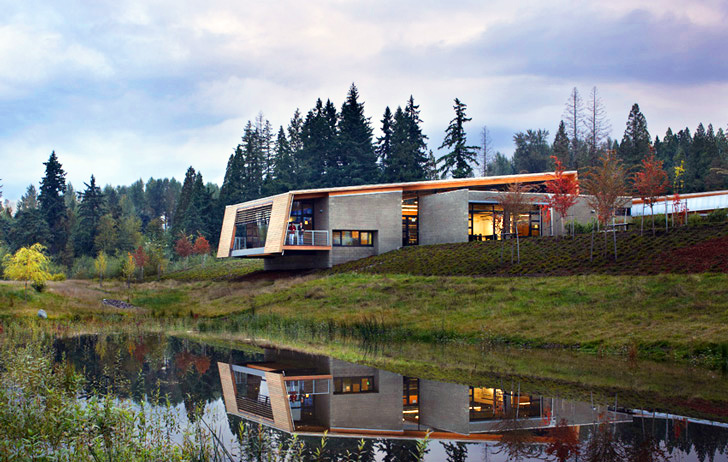
The treatment facility employs state-of-the-art technology for a cleaner effluent and odorless operation.
by Cynthia Thomashow
 he Metro bus opens its doors, releasing 40 fourth-graders who have ridden an hour from South Seattle to the Brightwater Water Treatment Center in Woodinville, Washington. “We’re in the wilderness!” squeals one of the young boys. To his credit, the landscape is very different from his urban schoolyard. But, just 20 years ago Brightwater was an industrial site, housing an old soup factory and a scrap-metal heap. Now it is home to a state-of- the-art water treatment center, flourishing wetlands, a LEED Platinum environmental education center, and 40+ acres of woods and fields crisscrossed by trails and abundant wildlife.
In 2011, IslandWood, an environmental education center on Bainbridge Island, Washington, won the contract to provide educational programming at Brightwater in partnership with Seattle Public Utilities to a mostly urban population. The Center is a laboratory and gathering place filled with interpretive displays that creatively connect water quality, engineered waste treatment processes, and the health of the Puget Sound to everyday life choices. IslandWood educators use this site to deliver field-study approaches that enhance science curriculum in the King County schools. Woven into every lesson is relevance of the field-based learning to the home environment of the urban students.
 Over 4,000 students come through the doors of Brightwater each year to study Freshwater Ecosystems, Land Forms and Humans in the Water Cycle with IslandWood educators. Sparked by the question, “Which pond at Brightwater has more types of water bugs, Storm Pond (an untreated storm water runoff catchment) or Otter Pond (a pond fed by a stream originating in the watershed above the treatment plant)?” Students may spend half the day mucking through wetlands, climbing hilly fields, and dipping their nets into containment ponds to collect macro-invertebrates. Student make observations and predictions about freshwater ecosystems in the field, collect specimens, tabulate data using microscopes in the lab and discuss their results together.
Another key question, “What happens when we ‘borrow’ water from the water cycle in our homes, schools and businesses?” begins the study of how humans participate in the water cycle every time they turn on their tap, run the dishwasher or go to the bathroom. During the Humans and the Water Cycle program, students experience the treatment process first-hand, discuss water issues in an interactive exhibit hall, and participate in a hands-on lab focusing on three different water-related STEM careers.
An ongoing professional development challenge for staff is to connect the field experiences to the actual neighborhoods where students live. The goal of IslandWood’s Brightwater Team is to ‘urbanize’ their signature field-based approach of getting kids outdoors to the urban settings where students live. Once a month, staff delve into the assumptions that define our goals around environmental education, considering equity issues, environmental justice and cultural competency as it relates to educational approaches. Every time a new group of students arrives at Brightwater, a conceptual shift moves the educators closer to relevant and meaningful engagement with the young urban leaders of tomorrow’s world.
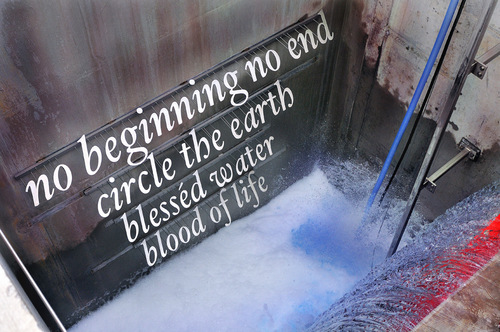
An installation by artist Jane Tsong illustrates the treatment process to visitors through poetry, and “blesses” the water before it is released.
(Photo credit: Juan Hernandez.)


 After sleeping in the tunnels with sharks and other fish swimming overhead all night, the girls recovered their light traps and investigated the success of their trap designs under the microscope. They saw many copepods, a larval fish, and several other types of plankton. Friday morning also had an opportunity for the girls to explore the HMSC visitor center and take a behind the scenes tour of the facility with female HMSC husbandry staff.