
by editor | Apr 21, 2015 | Conservation & Sustainability, Environmental Literacy, Learning Theory
Although this article was written in 1996, and contains references to events and people from that era, much of Weilbacher’s critique remains relevant today. -Ed.
 Every Day is NOT Earth Day
Reflections on the True Meaning of Earth Day
by Mike Weilbacher
 ‘ll admit it up front: I’m a sucker for Earth Day. I’m a child of the first Earth Day in 1970, for its tidal wave of publicity captivated my teenage attention and launched my career. My wife and I met planning Philadelphia’s Earth Day ’90 extravaganza – her parade met my outdoor stage, and the rest was history. Today, my workplace’s largest education program has become Philly’s longest running Earth Day event.
So few things annoy me more than the standard environmental knee-jerk position on Earth Day. You know it well, and have probably recited it like some Zen mantra: every day is Earth Day; make every day Earth Day.
As usual, we got it all wrong.
Because the environmental movement began as a countercultural phenomenon, we simply can’t stand our own successes, and continually sabotage our greatest gains. Like Earth Day.
Just think of what’s happened. Millions of kids across the planet are gearing up for some celebration of the day, perhaps a tree planting, a litter clean-up, a bad assembly featuring some whining folksinger (“Please save the rainforest, boys and girls, and when you’re done, please save every large endangered mammal”), or a recycled art contest, where eminently recyclable objects like cans and egg cartons are irrevocably glued to each other and turned into wholly non-recyclable monstrosities that are trashed after the event is over (and we’re teaching what here?).
OK, bad examples, but what it means is so startlingly simple it has flown way over our still-shaggy heads. Earth Day has arrived; it has planted a taproot in the mainstream of American pop culture, and like it or not, there it will stay, and grow, and blossom…
…Into a new intemational holiday that will one day rival Christmas in its scope. I’m dead serious. Signs of this were first revealed during the extraordinary event that was Earth Day’90. While the first Earth Day was an exclusively American college-oriented teach-in, Earth Day ’90 graduated into a global festival of more than 100 million people in more than 100 countries gathering to, in some cases, perform quite meaningful work: restore rivers, save species, reclaim battered landscapes. Earth Day ’90 was, barring world wars or Michael Jackson concerts, the largest mass event in world history.
Today, the sound of the holiday embedding itself in our cultural psyche can be heard everywhere. In schools: Earth Day has become a part of many school curricula; kids are growing up knowing that Earth Day is April 22nd, and doing something relevant on or near that day. In politics: every April 22nd, President Clinton – with Vice President Green, I mean, Gore, at his side – hosts a press conference to announce another underwhelming eco-initiative. On TV: every April, there’s a round of cheesy Earth Day specials featuring forgettable stars like Bob Saget performing amazing feats like installing toilet dams in their home bathrooms (that really happened a few years back.) On radio: Rush Limbaugh will likely repeat his tired tirade that the day reflects the true deep green plot against society, for April 22nd is also Lenin’s birthday – proof that environmentalism is a Communist plot! (Memo to Rush: April 22nd was chosen because it was the only spring Saturday Senator Gaylord Nelson had free in 1970, and no environmentalist I’ve ever met in 27 years of Earth Days ever knew when Lenin was born.
You’ll hear it in newspaper editorials and worldwide web pages; in store ads and nature center events; in zoos and museums; on T-shirts and coffee mugs.
Love it or hate it, you gotta admit it: Earth Day is here to stay.
And Earth Day will only grow in scope because environmental issues are not going to go away. Quite the contrary. With Pinatubo’s ash finally settling out, with atmospheric carbon dioxide concentrations on the rise, the global warming debate will likely warm up quite dramatically in the next few years. The biodiversity conflict is only starting to gain any intensity at all – here’s one issue guaranteed to explode as soon as a large, charismatic mammal vanishes, like the black rhino or mountain gorilla, both threatened by Africa’s political instability. And we have never properly confronted the population issue – we likely will when the next famine arrives.
On top of this, the nascent Earth Day holiday will receive a huge jolt in the year 2000. New millennium. The thirtieth anniversary. That year’s Earth Day will be a humbling event.
Sure, the “make every day Earth Day” sentiment has its place. Mostly, it serves as a reminder that the values and ethics we hold important must be cultivated daily if they will thrive. And it should remind schools of the danger of pigeonholing the ecology unit into a one-day or one-week project. Certainly, state educational mandates for ecological/environmental understandings must never be met from a one-day event, and too many schools rely on this one day to complete its environmental education requirements.
Speaking of schools, Earth Day brings out the worst in too many teacher, and too many outside educational agencies, from corporations to utilities to non-profit. There are too many lame Earth Day poster contests, where kids are asked to draw a colorful poster with an Earth Day theme. So it’s education as fascist slogan: “Don’t Pollute!” “Love the Earth!” “Reduce! Reuse! Recycle!” Relax already. We still labor under the horribly misguided notion that if we command kids’ knees to jerk in the proper direction, their heads will follow. Wrong, so wrong. Sloganeering is not educational in any sense whatsoever, teaches no information at all, and only confirms our kids’ worst fears about the state of the Earth: The Earth must be dying because the posters say so. Environmental education must be uplifting, never down- grading, and never be reduced to a bumper-sticker answer to a lapel-pin question.
Still, wading through all the flotsam and jetsam floating around Earth Day, there is a nugget of truth, a seed of change that we must hold onto tightly.
We need holidays. Better yet, we need holidays with meaning. Christmas resonates with so many people – even people who are barely Christian the rest of the year – because it speaks to a set of values we all want so desperately to believe, like the triumph of Light over Dark. The Fourth of July is centered on freedom, independence, and the meaning of America. Martin Luther King Day, I hope, will evolve to take on transcendent relevance around issues of equality, nonviolence, change and the need for multicultural connections.
Sadly, Memorial Day, Labor Day and President’s Day have lost so much of their original meaning, and exist only as three-day holidays for overworking people. Our culture may be seeking new holidays with new meanings for a new millennium, and the beauty of Earth Day is that it emerges as the only secular holiday the entire world will celebrate simultaneously. Earth Day will become just that, the “Earth’s day,” a holiday where people pause to consider what it means to be a planetary citizen, and reflect on how well we shared limited resources with so many other species.
My eldest daughter will be a graduate of the Class of 2010. I’ll wager that during her school career, she’ll have a day off from school for Earth Day. Banks will close. Governments shut down. Stores hold Earth Day sales. Greenpeace’s executive director will write an op-ed piece in the New York Times begging us to “put the ‘Earth’ back in Earth Day.”
And I’ll be on some stage somewhere hosting an Earth Day festival, living every minute of it all.
So remember: every day is NOT Earth Day. Once a year is fine. Happy Earth Day.
At the time this was written, Mike Weilbacher was executive director of the Lower Merion Conservancy, sponsor of the Children’s Earth Day Forest, an event featuring an indoor life-size recreation of a Pennsylvania forest hand-crafted by local schoolchildren.
by editor | Apr 16, 2015 | Equity and Inclusion
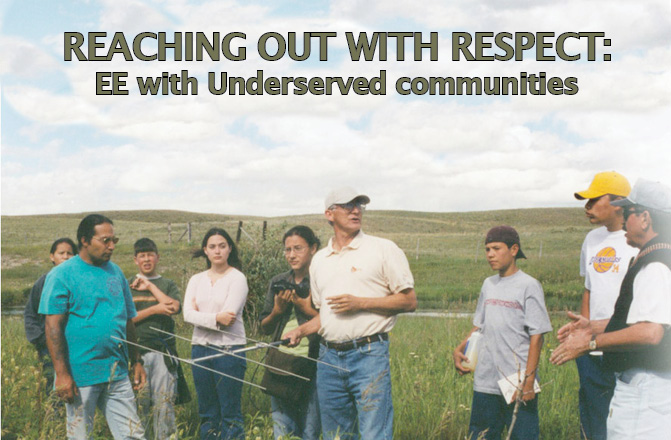
Reaching out with Respect: Environmental Education with Underserved Communities
Thinking about environmental education and underserved communities is an opportunity to challenge our assumptions about nature, culture and science, and, our assumptions about the life experiences of people of different backgrounds and cultures.
.
by Bonnie Sachetello-Sawyer and Shamu Fenyvesi
(from The Best of CLEARING)
Read article here.

by editor | Mar 26, 2015 | Questioning strategies
Is Science Communication? Can students, moving around and talking, do science?

by Jim Martin
CLEARING Associate Editor
You’re trying to answer a question. Student work groups have designed their own investigations to understand the question, develop inquiries to investigate what they have found and thought about, then present their findings to the other work groups in a symposium. There are many processes going on here. Let’s look at a few as they engage them to see what emerges in addition to discovering and testing possible answers to the original question.
Start small. In groups, you help students learn to communicate effectively. How to say, “Here’s what I think, and why;” and to listen and respond when other group members do the same. This is very basic to developing effective work groups. You have them keep notes on these conversations, and use them to elicit concepts, plan work, etc. (Basic, but essential. They need to know why they think what they do, and make what they think and why clear to others. And to learn to be advised or informed by others in their group.)
When your groups are communicating effectively, you observe for outcomes of their collaborative discussions. Do they understand their data, its patterns, its shape in graphs, etc. Are they showing signs of being able to relate data patterns to their question: Is it answered? What is the convincing evidence? What if the evidence doesn’t support their guesses about the answer to question? Or, does their question itself come into question? Are they becoming less mechanical and more purposeful in their work?
Further questions can move the groups along the learning curve by developing their critical thinking capacities: Are their interpretations of data supported by evidence? How confident are they of their data? Can they explain or justify data interpretations they have made, and their validity? What do their interpretations say about possible next steps?
You can continue to build on this conceptual foundation, each step easier because the foundation is becoming broad and more stable. You have them assess the design of their investigation and interpretations of data: How certain are they that they got the right data and used the best techniques of data acquisition? How certain are they that their data do, in fact, tell them what they need to know? Has their knowledge and expertise increased during this process? How much do they really know? Questions like these will tend to focus their thoughts on how they are learning and doing. Metacognition. Students who know how to learn know how to learn. Communication within effective work groups helps generate this capacity.
When they are ready, you have the groups report in a symposium. This is where their communication skills will be called upon to build conceptual understandings. How familiar are they with their evidence and its interpretation? How well do they comprehend other groups’ data and interpretations? How well do they generalize what they’ve learned and developed about collaborative communication within their work groups? Do they move it outward to carry on effective discussion with all of the work groups in the class? When an entire class develops the capacity to engage in substantive conversation about what they are learning, they’ll learn and nail down more than you could ever teach them using the publishers’ prepared materials and recommendations in the Teachers’ Editions.
Learning about science, but not doing science, does not develop the capacities described here. By only collecting and reporting data, students don’t engage the critical thinking capacities of their brain. I’ve observed science classes in which students looked up the boiling point of a liquid, say water, boiled the liquid and noted that it did boil at that temperature. What do they communicate amongst themselves? Is communication actually involved here? Or, are they simply engaging a perfunctory ritual? Might they have learned more if they had heated 3 or 4 liquids, noted their boiling points (or figured out how they’d know the boiling points, then test that), then looked up boiling points and made a guess about what their liquids were?)
Nor do they develop their capacity for conceptual learning when they simply learn about science, and commit science facts to memory. When students do engage in self-directed inquiries, examine the relevance of their collected data, critique it and the process of collecting it, and formulate interpretations they agree upon, they become involved and invested in the work, and empowered as persons. Engaging life. Engaged students are learning students. What our schools need today.
There’s not a lot of information out there on how to engage this part of teaching. There should be. This kind of work supports critical thinking, so it is of value. Critical thinking uses a part of the cortex that is especially well-organized for conceptual learning. That’s the prefrontal cortex, where relevant information from associative memories throughout the brain are brought together in working memory to nail down this new learning, then send it back out to associative memory; not as a fact to memorize for a test then forget, but as something more akin to common sense – something integrated into associative memory that you ‘just know.’
This critical thinking system turns on when you ask a question that is meaningful to you, and seek an answer to it. Science inquiry is a perfect complement and extension of this cortical learning system. In contrast, learning simply to prepare for a test won’t, of itself, entrain critical thinking. Instead, because of its aversive nature, learning content in order to answer test questions is accompanied by some level of anxiety, and entrains the limbic system, which isn’t good at engaging critical thinking. At least in this context, learning facilitated by anxiety about passing a test.
As the Common Core State Standards (CCSS) and Next Generation Science Standards (NGSS) continue to influence teachers’ and students’ experience in school, they present some level of anxiety to many, whether from an unfamiliar expectation for performance, change from structured, curriculum-directed teaching and learning to a more open-ended, active learning model, or from increased paperwork and accounting with no accommodating increase in free time for such work. Anxiety is processed through the limbic system, which impacts how the brain learns; which of its resources are freed for the task. As student and teacher stress levels increase, it becomes increasingly difficult to engage critical thinking. Instead, the limbic system, busy processing anxiety, increasingly limits communication with the prefrontal cortex, where critical thinking does its work. Instead, learning is limited to simple thoughts, which remain connected solely to the need to pass questions on a test, with little or no integration into associative memory, as occurs in critical thinking.
On the other hand, when students and teachers are free to explore new learnings (which the CCSS and NGSS seem to be interested in), to ask questions and seek answers to them, the limbic system supports this work with a heightened sense of pleasure and excitement, and feelings of well-being and inquisitiveness. And by assuring the doors to the prefrontal cortex are open.The different limbic involvements in learning are entrained by the properties of the learning environment. As they were when our brain evolved in the savannah during the Pleistocene. Might we use that history to revisit how we teach? How we organize student-student interactions while they learn? In the classroom and on-site in the natural world? In these cases, the limbic supports the work of the cortex, especially the prefrontal cortex, where working memory resides, and the brain’s conscious executive functions do their work. Work in which goals direct effort, reasoning and abstract thought are supported, and critical thinking takes place. Where we actively construct knowledge and commit it to long-term associative memory; ask questions, design investigations, develop needs-to-know which drive us into the information we seek, desire to complete and communicate our work.
When we are driven only by anxiety about not being able to answer questions on tests, this wonderful part of our brain is lost to us. The limbic system limits its use, and we simply memorize disconnected bits of information long enough to use them on a test, then forget. Are we teaching for fight or flight, or for higher-order critical thinking?
Used knowledgably, communication as practiced in doing science has the capacity to produce a foundation for critical thinking. By the information it generates, the testing of the information, and its processing and communication, it involves and invests students in critical thinking; in using their prefrontal cortex, its executive and working memory functions. The key feature is that the students, not the teacher, are involved in constructing knowledge. The teacher, while responsible for producing an environment where a constructivist approach to learning will probably happen, becomes a facilitator of their work. A difficult transition for many of us to make. I went into it willingly, but once committed, sorely missed lecturing and wowing students with the wondrous things I could show them in the lab. In spite of this, when I would pull out my old lesson plans, it would be immediately clear to me that this constructivist model was much, much more effective and empowering. And I eventually discovered this was because it used those sites and connections in the brain which were organized to engage conceptual learning. Something my pre-service and graduate education in teaching never addressed. It should have. Had it, and we learned as our brain is organized to learn, we just might have learned well.
Communication, when it is substantive, has the capacity to facilitate critical thinking. It does this by requiring us to consider what we are saying and doing, which is a readily useable road to the prefrontal cortex and working memory. Sort of like working in a shared workspace, a place with all the resources and facilities you need to focus on what you are learning, and the executive capacity to follow up on what you have learned.
 This is a regular feature by CLEARING “master teacher” Jim Martin that explores how environmental educators can help classroom teachers get away from the pressure to teach to the standardized tests,and how teachers can gain the confidence to go into the world outside of their classrooms for a substantial piece of their curricula. See the other installments here, or search Categories for “Jim Martin.”

by editor | Mar 25, 2015 | Conservation & Sustainability, Environmental Literacy
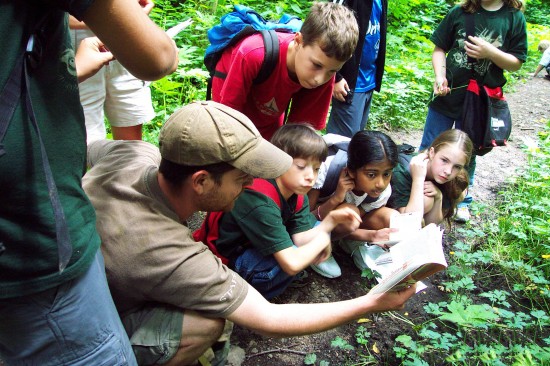
Creating the Need to Pay Attention
Field trips and adventures in the woods are tremendously important experiences for children, especially those students that don’t often get to spend time in a natural setting. Some of the most important, lasting results of good Environmental Education are the heartfelt connections that young people make with nature. They value the natural world because they have experienced first hand the beauty and magic of living ecological systems. To really feel this in a personal way, the kids have to go outside and experience it.
by Chris Laliberte
 he excitement of exploring outside with friends and classmates can turn a well behaved class into a pretty raucous crowd, and in all the commotion, it’s very easy for students to pay more attention to each other than to the woods around them. And while they might huddle up at each interpretive spot for a brief lesson or activity, what teacher or educator could possibly be there with each student for the whole walk, helping them learn from each moment as they explore the landscape with all their senses? The trick to making the entire outing an intense learning experience is to find ways to ensure that the students are invested in paying close attention the whole time.
“Tree Tag” is the classic example of creating a need to pay attention. Kids love to play tag, and they NEED a base, some place to avoid the tagger. So when base is whatever kind of tree the teacher calls out, the kids suddenly have a very real need to be able to identify trees correctly, so they can get to base. I love to watch what happens when kids disagree about correctly identifying trees, and they have to prove to each other what kind of tree it is. Tree Tag, however, illustrates a deeper point around creating need. A game of tag is a boisterous, wild, hectic thing. But remarkably, within this game is a fantastic heightening of awareness. The danger, the risk of being tagged, or the need to tag someone, is visceral. It creates physical and chemical responses in the body that affect awareness and the learning process. Adrenalated states provide a powerful opportunity for learning. Notice that this suggests an interesting point: in Tree Tag, the key dynamic for learning is the creation of a certain amount of anxiety, or a state of discomfort. This creates a very strong need to pay attention, and then the game focuses the heightened awareness onto something very detailed and specific — in this case, the differences in bark, leaf, branching pattern and color of different trees. By paying careful attention, the student can resolve the anxiety and get to someplace “safe.”
 It’s a testament to the power of the adrenalated state that, more often than not, kids will leave base and venture back out into the fray on their own for another dose. Of course, some students will be reluctant to leave base, so the teacher can keep the game active by announcing that base is now a different kind of tree, and it starts again: more adrenaline, more awareness, more attention to details of different kinds of trees, more good learning about nature.
So how can this dynamic be harnessed so that it is present throughout the whole field trip? Here’s one method that has proved enormously powerful at Wilderness Awareness School. It’s called “Bird Language.”
The basic principle behind Bird Language is that birds love to gossip. They are constantly announcing to each other and the world around them just how they are feeling about their lives at that moment. It’s almost like a town crier who likes the job so much that s/he uses any excuse to make another public announcement. “The forest is calm and happy!” “The forest is still calm and happy!” But what birds love to talk about most of all is danger and peril. Anything that might possibly be a threat is immediately announced and pointed out. Jim Corbett, a famous tracker from India, once mentioned how puzzled he was that anyone could ever get eaten by a tiger. The birds and monkeys are so loud and aggressive in announcing the presence of any tiger, and even following along above it in the treetops, screaming out their warnings, that it seemed inconceivable to him that anyone could be taken unaware by a tiger in the jungle. By coming to understand Bird Language, students can learn to recognize all the movement and activity going on in the forest around them. They’ll know when raptors or other predators are moving through, or when animals like deer or raccoons are sneaking away.
Using Bird Language with your students starts with creating the need to pay attention to what the birds are saying. For some younger students, the possibility of seeing fairies or unicorns works wonders at getting them to listen for the announcements of the birds. This is especially good if students are already uncomfortable with being outside in the woods and need a little assurance. Our favorite strategy at Wilderness Awareness School is to set up the day so that students are hiking or exploring in small groups, and might at any time be ambushed by another group sneaking up on them. If you don’t have the ability to set up the ambush dynamic, or if the group is older and more callous to the woods, the classic anxiety here in the Pacific Northwest is the threat of the cougar. Wilderness Awareness School is very careful in using this particular set-up for bird language. We let students know that cougars are sneaky but cowardly hunters, who like to attack unseen and avoid a fight or struggle. To really help students feel the anxiety in a visceral way (like the threat of being tagged), you can describe the nerve endings in the canine teeth of the cougar that help it to feel just where to bite on your neck to cleanly sever the spinal column like scissors through a banana . Now, we are careful to point out that cougars don’t normally attack people. But they sometimes can’t help themselves when a really loud, obviously unaware, small, tasty looking person hurries by without paying any attention to the woods at all. But if you notice a cougar, and make yourself look tough, maybe yell at it, then the cougar won’t bother you. They’re really pretty timid once they’ve been found out.
Regardless of what strategy you use to create a need to pay attention, listening to Bird Language can provide the focus for your students’ heightened awareness, and will allow them to resolve their tension and anxiety appropriately. For if they are listening carefully to Bird Language, no cougar or group of kids will be able to sneak up on them without alarming the birds and giving itself away. Really accurate interpretation is a fine art, and requires a lot of practice sitting outside and investigating bird alarms, but mastery is not required for Bird Language to be a remarkably effective learning tool. Here are the basic details your students will need to know to be able to get started successfully:
 Bird Language: A Quick Summary
Pay closest attention to the small ground-feeding birds: Robins, Sparrows, Juncos, Wrens, Towhees, etc. They are the best sentries.
Learn to distinguish the Five Voices of the Birds. The first four Baseline Voices indicate that the forest is relatively comfortable, and therefore “in baseline.” The last voice, the alarm, indicates a threat, usually a predator, often a human.
1. The Song: Birds singing their characteristic celebration, they are often loud but the feeling is very comfortable.
2. Companion Calling: Birds in pairs or groups call back and forth to each other regularly, either with their voice or with body movements, just to let each other know that they are alright. Usually this is soft, quiet language. It can occasionally sound scolding if one bird gets out of sight from another and fails to respond quickly enough.
3. Juvenile Begging: Young hatchlings can make quite a racket demanding to be fed. This repetitive whining may sound obnoxious, but don’t mistake it for distress.
4. Territorial Aggression: Generally made by males, this is loud, aggressive language that can sound like alarms, but you’ll notice that it doesn’t bother other birds (females, or birds of other species).
5. The Alarm is dramatically different from the four baseline voices. While the baseline voices sound like someone happily whistling, the alarm sounds like someone yelling for help. Different species sound different, but they all sound terribly upset, worried and nervous, and you’ll find yourself feeling that way too, when you open yourself up to really listening receptively to birds.
Watch the body language of alarming birds:
1. Where does it go when it alarms?
Does it fly up higher into the branches, or down low to the ground? Ground-feeding birds are typically brown, so they like to be down low where they are camouflaged and hidden. The only reason they fly UP is if there’s a threat on the ground. They will fly just high enough to avoid the danger, so how high up they fly is a good indicator of how high the danger can reach. If they go down, it’s because they’ll be safer down low in the thick brush, so it’s either a raptor or a threat that can’t get into the bushes (like a human).
2. Does the bird fly up and then look back to where it came from as it alarms?
If so, it was scared out of its place by something close by on the ground. Does it fly up and look forward, or out and around? If so, it was probably startled by a sound or another bird’s alarm and it is looking for the danger. It usually looks towards the source of the alarm (remember, these birds often look sideways).
3. Does it just fly madly away alarming as it goes? If so, it has been “plowed” out of the area, quite likely by a human.
Those are the very basics of Bird Language; however, the most important aspect of all is the “Secret Lesson” that you don’t even talk about. By attending to bird alarms, students soon realize that they themselves are disturbing the “baseline” of the forest. One of the old sayings from Kenya that young kids heard constantly was “Never disturb a singing bird.” Once they notice that they are scaring all the birds away, they begin to work at not alarming birds, and the transformation that this causes is remarkable. Once oblivious, boisterous and unconnected kids turn into quiet, observant, and respectful participants in the ecological community. Listening to birds now becomes a fabulous tool to encourage heightened awareness and a phenomenal source for amazing close encounters with animals that they want to see, like elk, deer, foxes, and raccoons, because now the birds aren’t warning these animals of the approaching students five minutes before they arrive.
In Wilderness Awareness School’s experience, Bird Language works best initially as the focal point for new students who have been “set up” to pay attention by the cultivation of a state of discomfort, and quite literally gives students the awareness they need to be safe, aware and feel comfortable in the woods. Remember, it will take some time to establish this as a routine for your students. They’ll need plenty of reminders early on. The most effective one is simply “Ssshhh! What was that? Did you hear that alarm?” Above all, have fun with it! You’ll be amazed at the transformation Bird Language can work in your students if you just stick with it.
Chris Laliberte is the Program Director for Wilderness Awareness School, a national not-for-profit environmental education organization based in Duvall, WA which is “dedicated to caring for the earth and our children by fostering appreciation and understanding of nature, community and self,” on the web at http://www.WildernessAwareness.org
Resources for Bird Language Study
Audio:
The Language of the Birds and Advanced Bird Language: Reading the Concentric Rings of Nature, beginning and advanced audio series by Jon Young. Available at http://www.WildernessAwareness.org
Backyard Bird Walk and Marshland Bird Walk, and other recordings by Lang Elliott. Available at http://www.naturesound.com
Books:
Kamana One: Exploring Natural Mysteries, by Jon Young, part one of Wilderness Awareness School’s four-level independent study Kamana Naturalist Training Program. Includes bird language, tracking, wilderness living skills, traditional herbalism, and naturalist mentoring. Available at http://www.WildernessAwareness.org
Jungle Lore, by Jim Corbett. A powerful narrative from the Indian jungle which includes Bird Language lore.
Bird Tracks and Sign: A Guide to North American Species, a unique new resource for studying birds by Mark Elbroch , Eleanor Marks, and Diane C. Boreto.
A Guide to Bird Behavior, Vols. I,II, and III, by Donald and Lillian Stokes.
Peterson Field Guides: Western Birds, by Roger Tory Peterson.
Other:
A Birds World, permanent exhibit on Bird Language at the Boston Museum of Science. http://www.mos.org
by editor | Mar 25, 2015 | Indigenous Peoples & Traditional Ecological Knowledge, Marine/Aquatic Education, STEM
CMOP: The Best Environmental Education Program You’ve (Probably) Never Heard About
 .
.
.
Coastal Margin Science and Education in the Era of Collaboratories
by Vanessa L. Green, Nievita Bueno Watts, Karen Wegner, Michael Thompson, Amy F. Johnson, Tawnya D. Peterson and António M. Baptista

.
nterdisciplinary science is needed to make big decisions when it comes to complex and fragile ecological environments such as the Columbia River estuary. Effective communication of that science is necessary to engage students and to work across scientists, educators. policy-makers and the general community. For these reasons, the Center for Coastal Margin Observation and Prediction (CMOP) has developed a “coastal margin collaboratory,” which brings together sensor networks, computer models, cyber-infrastructure, people and institutions to better understand the Columbia River coastal margin ecosystem as a whole (Baptista et al. 2008).
CMOP scientists study the Columbia River and transform the openly shared data and tools into a better understanding of current conditions and into the anticipation of future trends from increasing climate and anthropogenic pressures. Many types of users access CMOP data for their own needs and/or collaborate with CMOP on joint scientific and educational efforts. Through the collaboratory, CMOP enables a common understanding among interested groups such as natural resource managers for local, state, federal and tribal agencies, enabling effective discussions and long-range planning.
WHAT ARE COASTAL MARGINS?
 Coastal margins, broadly defined as the interface between land and ocean, contain important and highly productive ecosystems. They often mitigate the negative impacts of human activities from local to global scales, for example ‘filtering out’ excess nutrients that enter watersheds from fertilizer applications. Coastal margin environments are naturally variable because of tides, seasons and year-to- year differences in the forcing from rivers, oceans, and the atmosphere. Ecosystems adapt to that natural variability, but are often less well equipped to adjust to major shifts caused by population growth, economic development and global climate change. CMOP seeks to understand how biological and chemical components of the Columbia River interface with and are affected by physical processes, with the ultimate goal of predicting how they might respond to climate change and increased regional development.
A recent study (Frontier Economics Limited 2012) estimates that the world’s ten most populated river basins account today for l0% of the global gross domestic product, and that by 2050 that share will grow Io 25%, which will be more than the combined gross domestic product of the United States, Germany and Japan. This type of growth could be ecologically devastating, locally and globally, should it not be managed in a perspective of long-term sustainability and with the support of sound science. The datasets and predictions provided by the CMOP collaboratory can serve as useful examples that can be “exported” to other similar river and estuary systems worldwide.
THE COLUMBIA RIVER-TO-OCEAN ECOSYSTEM
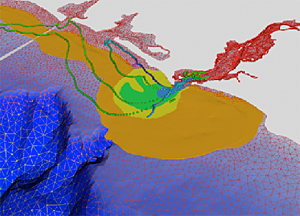 The Columbia River watershed extends across seven states in the United States and two provinces in Canada, and contributes about 70% of the freshwater input to the Pacific Ocean between San Francisco and Juan de Fuca (Barnes et al. 1972). Big decisions are needed to determine policy about the hydroelectric dams, protection and regulation of the migratory salmon, and changes in water quality such as ocean-driven estuarine hypoxia and acidification. All of this is set in the context of continued population growth, economic development and climatic change-and amidst a complex regulatory environment that includes the Endangered Species Act, a federal treaty between the U.S government and Native American tribes, and a soon-to-be renegotiated treaty between the U.S. and Canada.
CMOP science has already led to the identification of previously unrecognized environmental issues, from a benign but ecologically relevant seasonal red water bloom in the Columbia River estuary (Hertfort et aI. 2012) to the development of seasonal and severe ocean-driven estuarine hypoxia (Roegner et al. 2011) and potential acidification- and is showing how those apparently distinct processes are tied together. CMOP science is also contributing to an understanding of anthropogenic and climatic changes to estuarine and ocean processes, which affect salmon habitat and life cycle.
THE CMOP EDUCATIONAL PATHWAY
Progress towards our scientific goals has opened exciting opportunities to entrain a new and diverse workforce in coastal margin science. CMOP offers an educational pathway that includes a broad range of age-appropriate activities for students and teachers. Our pathway includes short courses; camps; sustained professional development programs for teachers; curricula for high school classes; individualized research experiences through high school, undergraduate and teacher internships; interdisciplinary graduate curricula through Oregon Health & Science University (OHSU) and affiliated degree programs at partner universities; and lifelong opportunities for scientists and natural resources professionals to incorporate outcomes of CMOP science in their activities and decision-making processes (Figure 2).
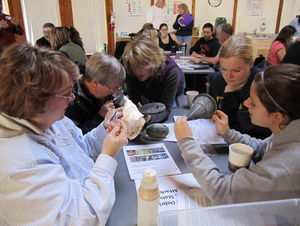
From left, Sam Case third-grade teacher Fanny Drews, Newport Intermediate fifth-grade teacher Christie Walker, Taft Elementary fifth-grade teacher Valerie Baker and sixth-grade teachers Beth Parsons and Kara Allen identify microbes that live on marine debris. Photo courtesy of NewsGuard of Lincoln County, Oregon.
Teachers and informal educators engage with CMOP in a variety of ways. Teachers access data through user-friendly modules that can be used to plot time series and explore correlations between estuary variables. As an example, teachers could design an experiment that demonstrates how red water blooms influence dissolved oxygen levels, using CMOP’s models to explore various scenarios. CMOP offers a regularly updated activity archive on the CMOP website (Science Activities and Curriculum URL). Lessons are designed for adaptability between age groups and data are appropriate for math, science, and social science classrooms. These lesson plans align with the essential principles of Ocean Literacy and the Next Generation Science Standards (Ocean Literacy Guide URL) and were generated through an interactive teacher professional development workshop. Teachers can engage in individualized internships of their own, conducting original research within CMOP teams and incorporating their experiences into their classroom curricula.
A three-year collaboration of the Oregon Coast Aquatic and Marine Partnership (OCAMP) consisting of CMOP, the Lincoln County School District, Hatfield Marine Science Center, Oregon Sea Grant, Oregon Department of Fish and Wildlife/Oregon Hatchery Research Center, the Oregon Coast Aquarium, and the Bureau of Land Management’s Yaquina Head Outstanding Natural Area aimed to provide teachers with the tools needed to carry out meaningful field experiences and inquiry driven learning while improving ocean literacy during sustained, year-round professional development colloquia as well as summer workshops. A follow-up program, entitled the Oregon Coast Regional STEM Center, extended OCAMP’s partnership to include Tillamook School District, Western Oregon University, and a variety of local businesses and agencies, and seeks to support teachers in their use of problem-based learning to improve student outcomes in STEM disciplines through engagement and the incorporation of 2lst century skills. The latter program is being carried out in a blended model of professional development, with in-person and web-based activities. CMOP can also engage with an entire school community through the CMOP- School Collaboratories (CSC) program. Cohorts of teachers from CSC partner schools can engage with CMOP to develop an integrated curriculum that emphasizes an inter-connected environment (Hugo et al. 2013).
THE VALUE OF A SCIENCE AND TECHNOLOGY CENTER
 The structure of the National Science Foundation Science and Technology Center program (NSF STC) has greatly enabled the development of this educational pathway through the decade-long investment in exploratory yet rigorous, potentially transformative science. lt is this structure that allows CMOP to expose students to a multi-disciplinary approach, engaging scientists from a broad range of relevant fields and from several collaborating universities, as well as practitioners from many state, federal and tribal agencies and from industry. The longevity of the STC investment has also contributed to our ability to effectively engage in sustained efforts to broaden participation among Native American, Alaska Native (Bueno Watts and Smythe 2015) and other groups underrepresented in Science, Technology, Engineering and Math (STEM) disciplines.
The synergy among anchoring academic partners (OHSU, Oregon State University and University of Washington, in the case of CMOP) is critically important to the success of a STC. Also critical is the engagement of regional stakeholders, which offer a natural, realistic, enriching and often pressing context for our science and education programs. For instance, Native American tribes of the Columbia River have historically been active and effective stewards of the land, water and natural resources in the basin. The Columbia River lnter-Tribal Fish Commission (CRITFC) has partnered with CMOP to identify potential threats to salmon and lamprey through investigation of factors that influence habitat quality. This collaboration has effectively engaged several Native American students in the CMOP education pathway and has also educated non-Native students on tribal cultures and natural resource management strategies.
DEVELOPING THE COASTAL MARGIN WORKFORCE
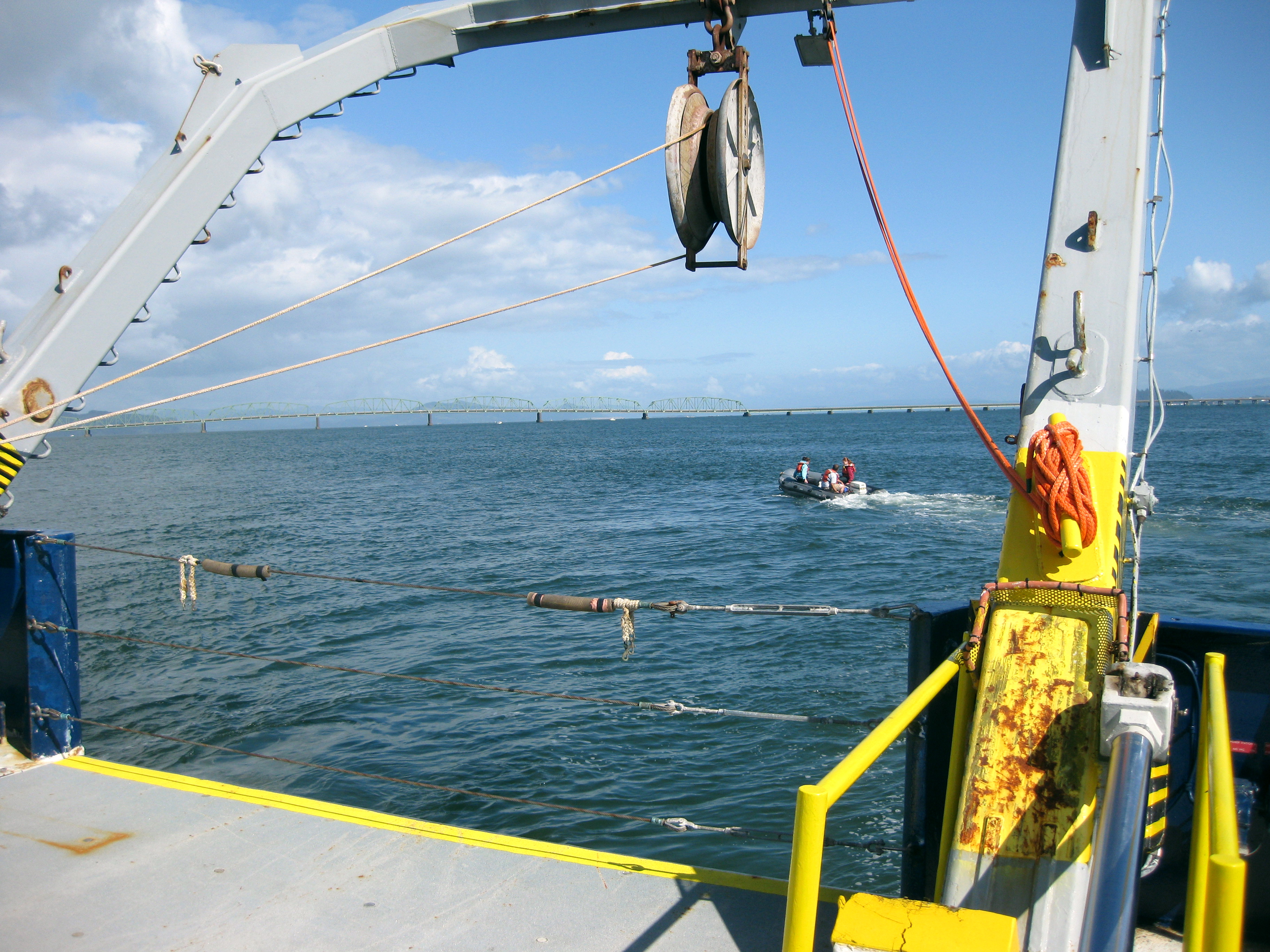
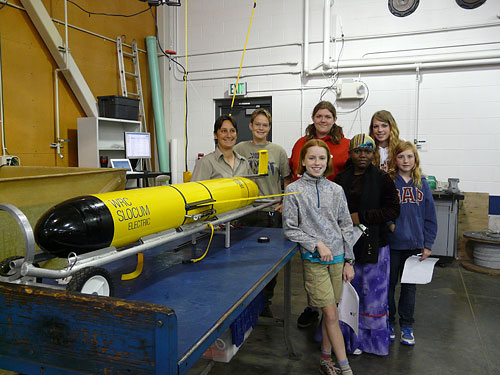
 CMOP students are engaged at all levels of the collaboratory. They participate in the development of sensors and models, and take active part in oceanographic cruises that might range from research to mariner-training vessels, autonomous underwater vehicles (Figure 3) and even kayaks (Rathmell et al. 2013). CMOP students, from high school to graduate, conduct research projects that relate to important biological hotspots, attempting holistic descriptions of their underlying physics and biogeochemistry that cover gene-to-climate scales. Students learn, shoulder-to-shoulder with researchers and practitioners, how to characterize, predict and inter-relate processes driving estuarine hypoxia and acidification. plankton blooms, and the biogeochemistry of lateral bays and of estuarine turbidity maxima (ETM)-turbid water regions located at the heads of coastal plain estuaries near the freshwater/saltwater interface. CMOP students also gain an understanding of broad topics that provide context to CMOP research science initiatives, such as global nutrient cycles, climate change, managing natural resources, mitigating natural hazards, and protecting fragile ecosystems.
Within the curriculum or with their mentor teams, students conduct fieldwork in the Columbia River estuary and in the coastal waters of Oregon and Washington using a variety of approaches, ranging from simple  river-front water sampling from a dock to participation in major research campaigns aboard University-National Oceanographic Laboratory System (UNOLS) vessels. Students gain hands-on experience within laboratories, using state-of-the-art equipment such as imaging flow cytometers (FlowCAM), an Environmental Sample Processor (ESP), a Conductivity, Temperature, and Depth Sensor (CTD), or a Scanning Electron Microscope. Students also gain exposure to the “Virtual Columbia River,” a data-rich simulation environment that offers multiple representations of circulation and ecological processes, including their variability and change across river-to-shelf scales (Virtual Columbia River URL). The models that form the Virtual Columbia River simulate estuarine conditions, enabling predictions of changing physical properties (tides, currents, salinity and temperature) and biogeochemical cycles (e.g., nitrogen and carbon) important to ecosystem management. Comparisons between field observations and model simulations allow for continued learning and refinement of the process.
INCORPORATING CMOP SCIENCE INTO THE CLASSROOM
Curricula available on the CMOP website combine elements of coastal oceanography, environmental microbiology, biogeochemistry, computational sciences, and information technology. Student participants in K-12 activities have continued working with CMOP, ‘graduating” to more sophisticated, longer-term participation as undergraduate interns. Likewise, undergraduate interns have continued their research by matriculating into the CMOP-affiliated M.S./Ph.D. Environmental Science and Engineering degree program offered through the lnstitute of Environmental Health (IEH) at OHSU. IEH graduates have gone on to related careers in academia, private research, and with related federal and state agencies. To date, CMOP has served over 800 K-l2 students, over 70 teachers, over 100 undergraduate students, and has graduated 28 M.S. and Ph.D. students. CMOP students have graduated from the Environmental Science and Engineering Program at Oregon Health & Science University; the Ocean, Earth and Atmospheric Sciences Program at Oregon State University; the Computer Science program at Portland State University; the Marine Estuarine Environmental Sciences program at the University of Maryland; the Computer Science program at the University of Utah; the Physical Oceanography Program and the Biological Oceanography Program at the University of Washington. Students who have engaged in the CMOP Education “pathway” have become citizen scientists with a nuanced knowledge of coastal-margin science issues, and many have gained expertise and skills that have enabled them to contribute to a growing professional workforce in coastal margin science.
For middle- and high-school students, CMOP offers classes. day-camps and high-school internships in partnership with Saturday Academy, a non-profit organization dedicated to providing hands-on, in-depth learning and problem-solving activities. Past topics have included microbiology, marine biology, oceanography, and ocean technology. The curriculum is designed to enable students to easily identify the importance of coastal-margin related issues to their own academic interests and personal lives.
Undergraduate interns join CMOP mentor teams, which include a “Frontline Mentor” and a “senior Scientist.” The Frontline Mentor-typically a graduate student, staff member or post-doctoral fellow-establishes a project relevant to one or more CMOP research initiative. The Senior Scientist mentor provides guidance and ensures academic caliber. Over the course of the ten-week program, interns gain autonomy within their mentor teams as they gain contextual knowledge and skills. lnterns regularly interact with each other and with other CMOP participants through professional development seminars encompassing scientific themes, career opportunities and scientific ethics. lnterns visit sites along the river from Bonneville Dam to downtown Portland and to the mouth of the Columbia River estuary, to gain a first-hand understanding and appreciation of the complex interactions of biological, chemical, and physical processes. lnterns document their work through a daily lab notebook, a weekly blog (Undergraduate lnternships URL), a final presentation and a synthesizing paper. lntern research projects have been thoroughly incorporated into CMOP research; interns have co-authored CMOP publications in peer-reviewed journals (Publications URL) and have presented at national and international conferences (Presentations URL).
ASSESSING IMPACT
The CMOP Education program seeks to make full use of the resources available to this NSF STC to enable a wide range of teachers, students, and other users to learn more about and contribute to place-based knowledge of coastal margins. The University of Washington’s Office of Educational Assessment regularly evaluates the effectiveness of our program. Evaluations include surveys and focus groups with each participant cohort as well as follow-up surveys for longitudinal data. Data analyses demonstrate that high school and undergraduate participants in CMOP programs have increased interest in STEM education; increased confidence in their ability to engage in STEM research; enhanced relevant technical and professional skills, and, for undergraduate students, clarified research foci both within their degree programs and related to their decision of graduate programs. Eighty-seven percent of undergraduate survey respondents who obtained bachelor degrees went on to matriculate into STEM graduate programs, 4O% in fields related to their internships. All of these graduates agreed or strongly agreed that “Being part of the [CMOP] summer internship strengthened my application to this graduate degree program.”
ACKNOWLEDGEMENTS
CMOP is primarily supported by the National Science Foundation, through cooperative agreement OCE-O4246O2. Crant CEO-I034611 extended our CSC program to Native Alaskans.
REFERENCES
Baptista, A., Howe, B., Freire, J., Maier, D., & Silva, C. T. (2008).
Scientific exploration in the era of ocean observatories. Computing in Science & Engineering, l0 (3),53-58.
Barnes, C. A., Duxbury, A. C., and Morse, B. (1972). Circulation and selected properties of the Columbia River effluent at sea. ln: The Columbio River Estuory and Adjocent Oceon Woters: Bioenvironmental Studies, edited by A.T. Pruter and D.L. Alverson. Seattle: University of Washington Press, pp. 71-80.
Bueno Watts, N. & Smythe, W F. (2013). It takes a community to raise a scientist:A case for community-inspired research and science education in an Alaska Native community. Current: The Journal of Morine Educotion 2B(3).
Frontier Economics Limited. (2012). Exploring the links between woter ond economic growth: A report prepared for HSBC. London, England: Frontier Economics Limited.
Herfort, 1., Peterson, T. D., Prahl, F. C., McCue, L. A., Needoba, J. A., Crump, B. C., Roegner, C. C., Campbell, V., & Zuber, P. QO12). Red waters of Myrionecto rubrq are biogeochemical hotspots for the Columbia River estuary with impacts on primary/secondary productions and nutrient cycles. Estuories ond Coqsts,35 (3), B7B-891.
Hugo, R., Smythe, W., McAllister, S., Young, B., Maring, B. & Baptista, A. (2013). Lessons learned from a K-’12 geoscience education program in an Alaska Native community. Journal of Sustainability Education,5 (SSN 2-51:7452).
Ocean Literacy Cuide URL http:,/www.coexploration.orgl ocean literacy/documents/Ocea n LitC u ide_LettersizeV2.pdf
Presentations URL http://www.stccmop.orglknowledge_transfer/presentations
Publications URL http://www.stccmop.orglpublications
Rathmell, K., Wilkin, M., Welle, P., Mattson, T., & Baptista, A. (2015). A very smart kayak. Current: The Journal of Marine Education QB)3.
Roegner, C. C., Needoba, J. A., & Baptista, A. (20I). Coastal upwelling supplies oxygen-depleted water to the Columbia River estuary. PLoS ONE, 6 @), e18672.
doi:1O.137 1 /journal.pone.00l 8672
Science Activities and Curriculum URL http://www.stccmop.org/education/teacher/activityarchive
Undergraduate lnternships URL http://www.stccmop.org/education/undergraduate
Virtual Columbia River URL http://www.stccmop.org/datamart/virtualcolumbiariver
AUTHORS
Vanessa L. Green M.S. serves as Director of Student Development and Diversity at the NSF Science and Technology Center for Coastal Margin Observation and Prediction. Having earned a M.S. in Higher Education Administration she has focused her career on broadening participation and increasing engagement, persistence and retention among first-generation and underrepresented students in high school, undergraduate and graduate programs. She served as a founding faculty member and Dean of Students at the King George School in Vermont and served as a member of the Board of Trustees at Marlboro College. She currently serves on the Education and Outreach Steering Committee for the Center for Dark Energy Biosphere lnvestigations (C-DEBI).
Nievita Bueno Watts Ph.D. is a geotogist, science educator and Director of Academic Programs at the NSF Science and Technology Center for Coastal Margin Observation & Prediction. She conducts research on broadening the participation of underrepresented minorities in the sciences and serves on the Board of Directors of the Geoscience Alliance, a national organization dedicated to building pathways for Native American participation in the geosciences.
Karen Wegner MSW was rhe first Director for K-12 Education for the NSF Science and Technology Center for Coastal Margin Observation & Prediction. She brought years of experience as a wildlife biologist and environmental educator to CMOP. Along with education partners Saturday Academy and the SMILE Program she developed K-12 programs initially offered at CMOP. She credits the success of the K-12 program to the fantastic support offered by CMOP researches and students. Karen is now a Palliative Care Social Worker and Program Manager in Montana.
Michael Thompson Ph.D. is the Education and Outreach Coordinator at the NSF Science ahd Technology Center for Coastal Margin and Observation. He has an M.S. in Biochemistry and a PhD in Chemical Education with a focus in Engineering Education. He has been instrumental in the establishment of the EPICS High-school program, development and implementation of teacher training workshops, STEM learning communities for undergraduates, and service-learning experiences for high-school and undergraduate students.
Amy F. Johnson M.S, serves as the Managing Director for the NSF Science and Technology Center for Coastal Margin Observation and Prediction. Having earned an M.S. in Management in Science and Technology, she has years of experience managing in science and technology companies and education institutions. Prior to joining CMOP she was the Assistant Dean for Craduate Education at the OCI School of Science & Engineering at the Oregon Health & Science University.
Tawnya D. Peterson Ph.D. is an Assistant Professor in the Institute of Environmental Health at Oregon Health & Science University. She holds a Ph.D. in Biological Oceanography and carries out research that seeks to identify the factors that shape planktonic community diversity and function in aquatic systems. ln addition to scientific research, she is interested in the development and implementation of professional development programs for K-l2 teachers.
Antonio M. Baptista Ph.D. is a professor and director of the lnstitute of Environmental Health, Oregon Health & Science University and the director of the NSF Science and Technology Center for Coastal Margin Observation & Prediction. He has 25 years of experience in team science and graduate-level teaching, and uses leading edge coastal-margin science and technology as a catalyst for informed management decisions, workforce development and broadening participation.
PHOTO CREDITS
All Photos: Courtesy of CMOP staff member Jeff Schilling
Reprinted from Current, the Journal of the National Marine Education Association


