
by editor | May 27, 2015 | Critical Thinking, Learning Theory, Place-based Education, Questioning strategies
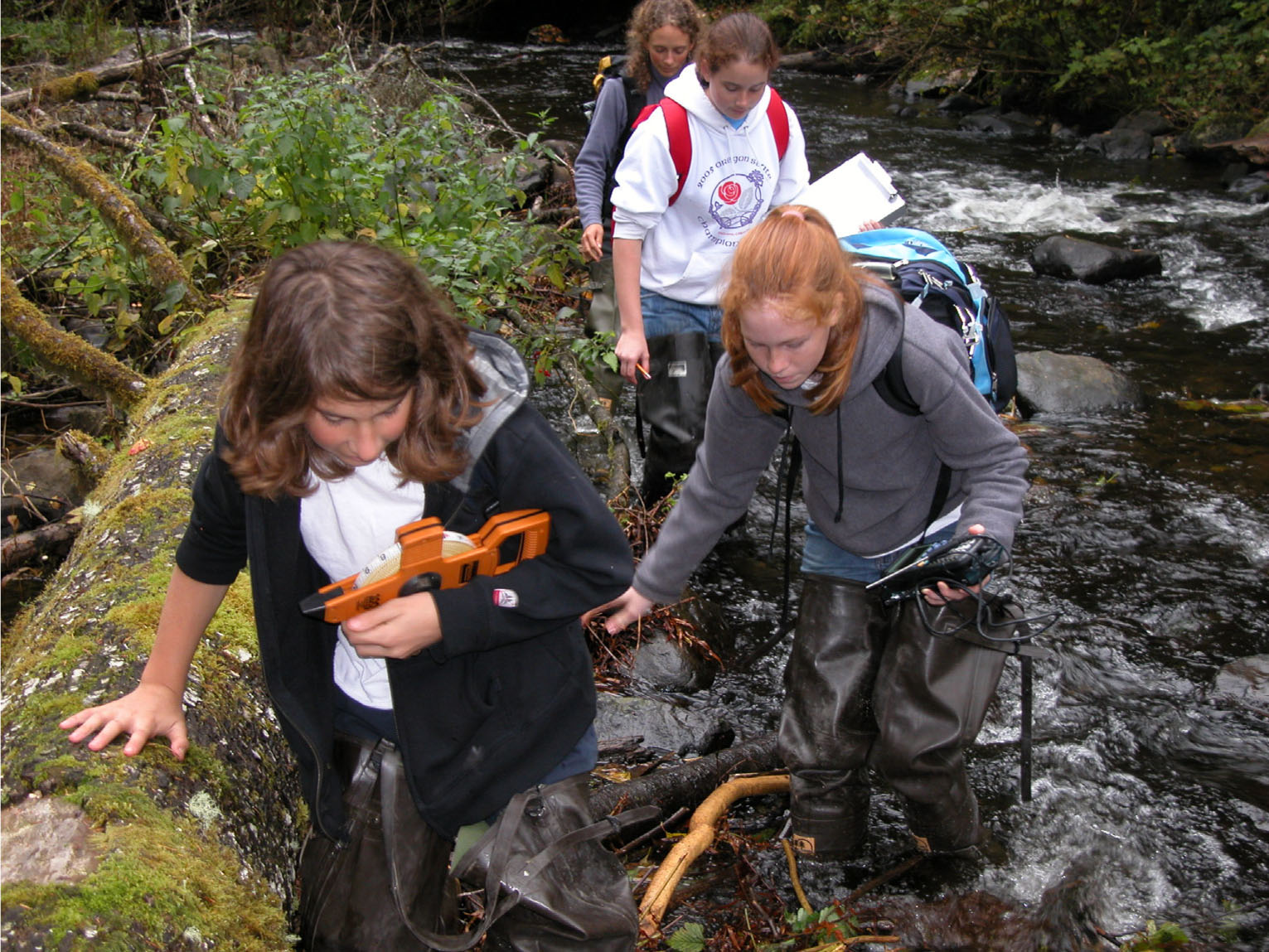
Photo by Jim Martin
“Lessons for Teaching in the Environment and Community” is a regular series that explores how teachers can gain the confidence to go into the world outside of their classrooms for a substantial piece of their curricula.
Part 3: Emergent phenomena
by Jim Martin, CLEARING guest writer
If you go to a place in the world outside your classroom – your school yard, a trail nearby, a stream bank – and think about it, you’ll find it is a prism which, oriented effectively, holds the power to involve and invest your students in their educations, and empower them as persons. Simple miracle; takes work to discover.
You’ve found a place for your project, large or small, and thought of a partner or partners. Quite possibly, you might have noticed a piece of embedded curriculum. And maybe even thought of what students would do. These are the sort of things that emerge from the places in the real world when you go to them with your teacherly knowledge, skills, and understandings. The part of you that is Teacher is the prism from which the potential that resides in your community and environment emerge in observable form, paint their elements, disclose the human mind.
We named two projects last week. Let’s take a closer look at them and see what emerges.
A Small Project
Your class visits a nursing home every spring, and your students would like to grow flowering plants, pot them, and take them when they make their visit. You discuss this, and decide to plant seeds in the soil just under your classroom’s windows. When they’re growing well, students will transplant them to pots, which you have in your room.
What are the partnerships that will help you do this work? To do the project, you must get students out of the room and back, procure seeds and tools, touch bases with the custodian and principal, do the potting and manage kids on station. Plus, you have to deliver the fractions and biology lessons that you discovered in the schoolyard near your window. You have some resources, like the manager of a small local pharmacy, who has a limited budget for public services expenditures. Also, the nursing home and the school, which has gardening tools.
You need seeds, so ask the manager of the pharmacy outlet for a donation of one packet each of eight kinds of annual flowers. She agrees, and you get your seeds. So, children plant, seeds grow, students pot and then take their flowers to the nursing home. During the work, they learned about fractions and studied a biology unit on seeds. A resource you used is doing fractions and studying biology on site, so that you don’t do the project in addition to your already heavy teaching load.
Let’s call the people, institutions and organizations you worked with your “Partners,” and think of the project as one done with partnerships. Your Partnerships assist you with the logistical load involved in doing projects.
So, one tool you use is Partnerships, however small, to share the load. Sharing the load is an important part of doing projects. We live in communities, and ought to use them. It’s important to understand partnerships. Even though your partners are sponsoring part of the project, you are doing something for them and they are doing something for you. That’s why people engage in partnerships, because all parties bring something useful to the table.
A Larger Project
This project is a streambank restoration sponsored by a regional bird sanctuary and the local Friends of Trees organization. They provide tools, supplies, plants, and training for you and your students,. They also schedule three Americorps Volunteers for field trips and one classroom visit. You provide workers (your students), student-made site maps, site habitat assessments, and a summative Power Pointtm presentation.
The project entails a site visit to orient yourselves and begin site mapping, one to clear vegetation and continue mapping, another to survey, one to plant, and another to monitor the planting. In this sort of project, your partnerships are crucial to beginning and finishing the project. The bird sanctuary has some equipment and materials available to you for making the observations you’ll need to make the site map, and guidelines for performing the habitat assessments. They also have a person who will mentor you as you go through the stages of a streambank restoration project. This will give you the large picture within which your students’ work will fit. It also has, embedded within it, lots of useable curricula. Friends of Trees will help to plan and do vegetation clearing and using GIS techniques to map plants your students will put into the ground.
This means that you now must manage transportation, substitutes, and curriculum on your own. These present their own learning curves. The prism which organizes this confusing chatter of pieces, parts, jobs, and so forth, into recognizable and useful bands, bands which clarify community and environment based education into an inspiring and inviting rainbow is your capacity for doing self-directed science inquiry. In my experience, that seems to be the key empowering piece of the education puzzle. Most of us have never done a science inquiry from noticing something interesting, to asking a clear question about it, designing an investigation, collecting data, analyzing and interpreting it, communicating our findings, and identifying interesting follow-up questions. Somehow, engaging this from start to finish leaves teachers with a fresh perspective on what they are teaching, and how. And empowers them to thoroughly involve and invest their students in their educations and their lives. If you’ve ever seen the face and eyes of an empowered child, you’ll know what I mean.
Part of this change in perspective comes from releasing yourself from dependence upon directions in the publishers’ materials and teachers’ editions, and discovering that your students will find better, more effective ways to use them. Especially those in your bottom 25th percentile. (You can get an idea of what this might look like by going to Mike Weddle’s article here. He gives the most complete picture of what community and environment based education looks like that I’ve read. Written from the pen of a teacher. Jude Curtain, also on the website here, gives the best one-page description of science inquiry that I’ve read. They both know, and clearly express student-directed science inquiry.)
So, let’s walk through an inquiry, one blog at a time. The site can be your school, a natural area, a parking lot. They all work. Here’s what to do. If you can, spend some time in a place you’d like to do an inquiry. It doesn’t have to be one you’d take your students to. Browse around; find things that either interest you or raise questions in your mind. Just immerse yourself in the place. Here’s how one started for Dryas, my wife, and Carol Lindsay, our African Drum teacher, on a summer afternoon several years ago. We were by a side channel of a local stream, and they saw what they thought was a dragonfly with eight wings. They wondered what it really was, and set out to find out. This happens when you let something catch your eye. Go out this week and let it.
 This is the third installment of “Teaching in the Environment,” a new, regular feature by CLEARING “master teacher” Jim Martin that will explore how environmental educators can help classroom teachers get away from the pressure to teach to the standardized tests, and how teachers can gain the confidence to go into the world outside of their classrooms for a substantial piece of their curricula. See the other installments here.
by editor | May 27, 2015 | Critical Thinking, Place-based Education, Questioning strategies, Schoolyard Classroom
Photo courtesy of Jane Goodall Environmental Middle School
“Lessons for Teaching in the Environment and Community” is a regular series that explores how teachers can gain the confidence to go into the world outside of their classrooms for a substantial piece of their curricula.
Part 2: Developing Capacity
by Jim Martin, CLEARING guest writer
“And then the whining schoolboy, with his satchel,
And shining morning face, creeping like a snail
Unwillingly to school.”
– William Shakespeare
Why creep, unwilling, to school? Could it be that school is, itself, unwilling? Unwilling to allow its students’ brains, wonderfully autonomous learning machines, the freedom to learn, to engage their world and discover its nature, become empowered within it?
We evolved to survive in wild environments by learning them. Our brain did this learning by finding and exploiting patterns in the world it encountered. In the end, our brain has developed into an autonomous learning machine. Students have demonstrated in many schools that engaging in inquiries in the places where we evolved causes them to become involved and invested in their educations, and empowered as persons. While significantly improving their scores on the current barometer, standards exams. Use this innate capacity we humans are born with to touch, think, learn, assimilate, to structure your curricula. Those who have are successful.
Here’s one I personally know: The faculty of the Jane Goodall Environmental Middle School (JGEMS) in Salem, OR, decided to build their curricula around experiences in the world outside the classroom. Each student’s journey is developmental, culminating in groups doing self-directed inquiry in various places: a farm in the country, a coastal estuary, the Oregon Zoo, a forest in the Coast Range. The school’s focus is not on preparing students for the state standards tests. Instead, they give their students a solid and empowering education. The last time I visited JGEMS, their students racked up an impressive record: 100% passed the science standards, and the reading and math standards in the high and middle 90s. (Check their school out yourself at www.jgems.net.) Students who begin their learnings in the world in which they will live out their lives become involved and invested in their educations. The education establishment doesn’t recognize this accomplishment of classroom and environmental educators, but it is real. And doable.
There are many places you can start the journey toward effective, empowering education. One is with what I call Developing Capacity. When you have the capacity to teach science as it should be taught, you can start a science unit with words like these where you describe a spider’s web, against the morning sun, with dew glistening on its surface;
This is what life is like: The cells which make living things are composed of molecules which have been selected and put into place by little pieces of sunlight. Together, when these cells are organized into the organisms in foodwebs, they sparkle, and receive more little pieces of sunlight. As long as the sun shines, its light will add sparkle to life, and, intoxicated, life will gather more sunlight. Once entrained, this is a self-perpetuating process. Let’s study it as such an enchanting, self-directing phenomenon.
Note the difference in opening a unit on plant and animal cell physiology this way vs. saying that, in this unit, we are going to learn about the processes of photosynthesis and respiration, and the structure and functions of enzymes in cellular processes. The difference between comprehending the content you teach and knowing you can adapt your teaching to foreseeable contingencies, vs. relying on the words and suggestions in the teacher’s edition for your understanding of the content and its delivery. Altogether too many science teachers in this nation rely on publishers’ materials to prepare them to teach their curricula. This is unacceptable, and we need to do something about it now.
What follows may make you feel a little uncomfortable, like being out on a limb, sawing on the tree side. If it does, and you continue anyway, you’ll make it. In spite of the fact that you’ll never quite lose that feeling of being out there with the scratching sound of the saw in your ear. By then you’ll know there is nothing to fear, and will be on your way to taking charge of your curriculum.
Pick a project. Make it simple, but at your instructional level. Here are two to give you an example of what I mean. The first is a small flower bed your students will put into place on the school grounds. The second is planting and restoration work along a local trail. Somewhere in the continuum between these two projects, you should find something that fits your instructional level. (You don’t necessarily have to do these, but you must walk and think through the steps of the project you envision. Generating part of your curriculum in the real world wasn’t covered in most of our teacher education courses. It’s a very learnable process, you simply need to experience it and reflect on it.)
My goal here is teachers who are empowered with the capacity to build partnerships to facilitate their real world curricula. If you’ve never done a project, then you’re in the Acquisition phase of this learning curve, and simply hooking up with a local planting project done by someone else is a good place to start. Keep in mind that, while your students are there to plant, you’re there to see how the project works, who’s a good person to keep in touch with, materials you’ll need to acquire, etc. In short – develop your teacherly antennae. They’re very helpful things to have.
The first step is to check out the place where you’ll actually do the work. Look at the actual site, find where you’d have students work, envision what they would discover. Think of one piece of the curriculum you will soon teach and find it there. Get to know the place as part of your classroom.
The second, after you see a clear picture of the project, is to begin to develop helpful partnerships. These you’ll need, especially if you’ve never done a project outside your school building. For the school planting, the principal, custodian, and another teacher make great partners. For the second, you can call the parks and recreation department, a local agency, or an environmental group. You can have your students help develop a list of people to contact. This can be empowering work for them.
This is your self-directed inquiry. So, decide on a project at your instructional level, check out the place where students will work, and identify at least one or two potential partners. Next week, the blog will pick up with these examples and use them to discuss the myriad things it takes to effectively use the real world to generate curricula.
I’ll leave you with one final charge: find a teacher who already uses the environment to build curricula. If you don’t know one, your school district probably knows of at least one. Tell the teacher your thoughts and keep in touch. It’s an easy way to reduce the isolation of the classroom.
Remember; this is all doable. You just have to start.
This is the second installment of “Teaching in the Environment,” a new, regular feature by CLEARING “master teacher” Jim Martin that will explore how environmental educators can help classroom teachers get away from the pressure to teach to the standardized tests, and how teachers can gain the confidence to go into the world outside of their classrooms for a substantial piece of their curricula.

by editor | May 26, 2015 | Outdoor education and Outdoor School
 Tips for bringing students into the field: Strategies for success
By Joshua Klaus
Director of Academic Programs, Ecology Project International (EPI)
 aking students into the field can provide an endless array of occasions to learn new skills, see theoretical concepts enacted, make connections, and learn about the world around us. Given the endless places that offer valuable learning opportunities, it must just be a matter of heading out the door for students to have impactful educational experience, right?
Though it would be nice if it were that easy, there are a few key strategies that will allow any educator (novice or veteran) to make the most of their time – before, during, and after their field experience.
Educators will have a higher likelihood of success if they keep the following things in mind:
• Go outside! The natural world offers limitless educational opportunities. Given the amount of time students spend in front of computers, screens, and isolated from weather, plants, and animals, exposure to the natural world is a fantastic way to engage students’ bodies and minds.
• Real-world projects: Involving students in applied research, service-learning, and conservation or community-related projects will give them a sense of connection to something larger than themselves.
• Find good partners: Working with established land managers, non-profit organizations, or government agencies can help provide additional resources, information, expertise, and motivation.
• Incentivize good work: Offer students school credit, lab hours, or community service credits if they meet or exceed your expectations while in the field.
• Have fun! Focusing on specific learning outcomes is a good idea, but balancing learning with fun, exploration, and freedom will increase the likelihood that students will have a positive, meaningful experience.
Preparation:
As the old adage instructs, failing to adequately plan and prepare often means planning for failure. Preparing students for a field experience is of paramount importance and should include setting clear expectations about goals and behavior, in addition to providing students with the tools, background, vocabulary, and knowledge necessary for success and high-quality outcomes. Advance preparation might include proper gear and equipment, safety protocols, practicing field methodology in advance, and providing a theme or integrating context for learning. At the very least, prior to heading into the field students should be given a structured opportunity to determine what they already know about a particular place or activity in addition to the chance to articulate what questions they have and what they’d like to learn. This could be as simple as asking students to draw a picture, make a list, or tell a partner what they know about a concept. Additionally, individuals could make a K-W-L chart, and the entire group could share the information in the ‘W’ column.
Adequate advanced preparation will help students stay comfortable, safe, and well-fed! By engaging students in managing risks they might encounter in the field – whether hiking on a trail or crossing a busy street – they’ll have a better understanding of the potential dangers they’ll encounter as well as the rationale for making appropriate decisions that will help keep them safe. When students understand why they should do something (instead of just being told they should) they’ll cultivate a deeper sense of ownership and personal responsibility.
Collaboration/ maximizing resources
Many organizations, government agencies, and companies are more than willing to host a group of visiting students. Call the local fisherman to take a tour of his boat, approach the university about a tour of the wet lab, or ask a conservation group to give an on-site presentation to your class about their restoration projects. Experts often love to talk about what they do and are happy to share their knowledge with students. When teaching in Oakland, CA one teacher took his physics class to a boat yard a couple blocks away and a crusty sailor taught them about mechanical advantage and pulley systems used for dry docking and offloading cargo. When the Pixar Studio in nearby Emeryville was under construction, his students crawled around the open foundation with a bunch of engineers who were delighted to tell them all about how they designed the building to withstand a 9.0 earthquake. Think creatively about what you consider a ‘field’ experience, and likely you’ll discover a long list of wonderful opportunities right within your community.
The wheel already exists
Talk to your local conservation group, nature center, government agency, or tourist outfitter about what you would like to do and ask if they can help. Many of these groups have some kind of educational mandate associated with their work, and if you can help them achieve their goals by involving your students in their work, they will likely be accommodating.
Go for it!
For beginning teachers, it’s a great idea to keep things simple until you establish a track record of success with your students and within your community. Start with small, accessible field experiences before making too large a commitment. That being said, despite the importance of preparation (as described above), don’t over-think your first field experiences. Once you’ve covered your bases and the basics, it really can be as simple as heading out the door. The world awaits, so don’t worry – once you get there, your students will thank you.

by editor | May 26, 2015 | Recycling
Schools Gone Green
Get inspired by these four Portland-area schools that are doing more than their part to save the planet.
“What makes me most excited about Oregon Green Schools is hearing from the students about their progress. I appreciate that we are preparing kids for the rest of their lives. Resource conservation is not just a choice. It’s something our kids are going to have to do.”
– Laurel Bates, board chair of the Oregon Green Schools Association.

Taking stock of light usage at Trillium Creek Primary School.
Most Oregonians can rattle off the three R’s: reduce, reuse, recycle.
But can you name the three W’s?
It’s waste, watts and water, and reducing all three is the goal of the Oregon Green Schools Association, a nonprofit that has been working for almost 20 years to help schools across the state reduce their environmental footprint. From its roots with just a handful of Portland-area schools, it’s grown to about 250 schools around Oregon. Want to get your school on board? It helps to have student, staff and parent volunteers who aren’t afraid to get their hands dirty.

A cozy nest for reading, at Trillium Creek Primary School in West Linn.
“Every single program is different and adapted to the needs of the school,” says Laurel Bates, board chair of the OGSA. There’s no cost for schools to participate, and Bates says schools often end up saving money while building a stronger, more united community.
Start by conducting a waste audit. Yes, that’s what you think it is: Digging through the garbage and taking inventory of what’s thrown away. Picture half-eaten sandwiches, stinky milk cartons, broken pencils, glue sticks and lots of plastic food packaging. It’s good, messy fun for kids, while volunteer parents and teachers learn a lot. Everyone can set shared goals around waste reduction, recycling and composting once they’ve gotten up close and personal with the trash.
“When I help with waste audits I encourage kids to look at their own home,” explains Bates, who adds that a secondary goal of the program is getting students to bring the green zeal home.
From compost to chickens

Working on “the bird garden” at Sunnyside K-8.
Schlepping compost isn’t usually anyone’s first choice for chores. But at West Hills Montessori, an Oregon Green School, you’ll find even the youngest students happily lugging around large compost buckets.
Sometimes the school’s food waste goes home with one of the teachers, to feed her chickens. They call it “West Hills treats.”
West Hills Montessori embarked on its OGS Green Level certification just last school year. The private school, with three campuses, focused its green efforts at the Vermont Hills site, where students range from 3 to 9 years old.
Driven by the efforts of Victoria Poth, a primary teaching assistant, West Hills hit the ground running, in hopes that students would learn “how to be ambassadors of our environment.”

Students at Southridge High School are proud of their water bottle refilling station.
“Children are fascinated by water,” said Poth, so they’ve emphasized the importance of saving enough clean water for plants and animals.
They launched a “water savers” campaign, posted signs and taught students how to wash their hands without wasting water. They installed low-cost faucet aerators, reducing their average water usage by 500 gallons a month.
The school also developed a “how to pack a waste-free lunch” flier, which was shared with parents. In addition, the school hosted a fundraiser for durable lunch containers. The results? A 60 percent reduction in lunch waste.
“The children were going home and telling their parents,” Poth said. “They were seeing how much was going to waste.”
School Director Anne Blickenstaff agreed: “the enthusiasm from the children has just been wonderful.”
A job for every grade
If you asked the folks at Disney to build a green school, it might look like Trillium Creek Primary School.

Working on a waste audit at West Hills Montessori School.
Trillium sits on a 15-acre site with big trees and paths for students to run on. It harvests rainwater that is filtered and used for toilet flushing. It’s got a wind turbine, solar power and rooftop gardens. The library is lit with natural light. Branchlike wooden pillars form a tree house that supports a cozy, pillow-filled nest for quiet reading, while an adjacent slide offers an express route down to the first floor. Nearby LED light poles provide real-time data on the school’s natural-resource usage.
Opened in the 2012-2013 year, Trillium is a neighborhood school in the West Linn-Wilsonville School District with 550 K-5 students. It’s won numerous awards for architectural design and sustainability. According to principal Charlotte Morris, being an Oregon Green School draws families to the neighborhood. Trillium became Green Level the first year, and is now working toward Merit.
At Trillium, each grade does its own waste sorting in grade-level “neighborhoods,” while kids on the leadership team perform skits at assemblies to show the rest of the school what they’ve been up to.Fourth graders are responsible for composting. They take the job seriously, weighing the amount of compost collected daily, preventing food waste andensuring the compost isn’t contaminated. Fifth graders are in charge of recycling, making sure the many recyclables collected are put in the right bins.
“We really try to build a culture to help the kids know where things go,” explains Dina Soriano, counselor and sustainability coordinator.
“One of the biggest things is to help kids to be thoughtful about this for life,” adds Morris, who credits the district for its support of sustainability efforts, and parent volunteers for keeping it all working.
“Recycling is great, but reducing your carbon footprint is (also) important.” says Soriano. “My challenge is student ownership of that.”
The ripple effects of going green
From a green perspective, Sunnyside Environmental School seems to have it all: solar panels, rainwater harvesting, worm bins, vast onsite gardens, and even an “Iron Chef” inspired cooking competition where students prepare meals from quirky combinations of food they’ve grown. And it wouldn’t be Portland without a few chickens: The coop is right by the school’s front door.
Except, they also have a really old school, built in 1926, that’s not exactly energy efficient. So the focus-option, neighborhood K-8 school focuses instead on green practices, which its principal credits with drawing more families to the surrounding neighborhood.

Chickens live in stately splendor at Sunnyside Environmental School in Portland.
“Service learning is a huge part of our curriculum,” says principal Amy Kleiner. Each grade has its own garden plot. Fifth graders study colonial history, so their garden is edged with a white picket fence, and they grow medicinal herbs, such as wormwood and echinacea.
Sunnyside’s PTA funds part-time sustainability coordinators, who, Kleiner adds, help take the load off the school’s teachers.
Its sustainability efforts don’t go unnoticed. In 2012, Sunnyside was recognized as a Green Ribbon School by the U.S. Department of Education. In 2014, singer Jason Mraz helped create a bird-friendly habitat and garden while touring Portland.
And now that Sunnyside has thoroughly integrated sustainability into its school culture, its principal is thinking beyond her school’s hallways. “What I would like is more environmental-education access for all kids,” Kleiner says.
Turning out the lights
Southridge High School makes it look easy to be green.
Its campus is an energy-efficient dream, built in 1999 and bustling with 1,700 students. It was the first school in the Beaverton School District to achieve Oregon Green School: Premier Level certification.

A gentle reminder to turn down the lights, at Southridge High School.
At Southridge, student government keeps it green with the support of Erik Reinholt, activities director and leadership teacher.
“We are very focused on being a green school,” says senior Nicholas Piwonka. “It’s definitely part of the culture now. It’s ingrained in what we do here. It’s on all levels. Everyone is working together to try and stay a green school.”
Meleah McGlinchy, also a senior and student government president, agrees: “If you throw a piece of paper in the garbage, people cringe!”
Students have decreased electricity usage by hosting weekly “Dim Days,” where teachers and students are asked to keep the lights low. These days, they usually find that lights are already half off. So the student government is brainstorming creative ways to revamp and increase the Dim Day challenge.
Got water? “There is always a kid with a water bottle filling up,” says Reinholt, who explains that the leadership team sold durable water bottles as a fundraiser several years ago, which funded the purchase of a water bottle filling station.
The student leaders also find a way to leverage the ubiquitous phones and embrace online culture for environmental good, and have pretty much become paperless as a result.
“We can take advantage of technology better, like taking a picture,” explains McGlinchy. “Paper isn’t the only choice.”

Oregon Green Schools application here.
Renee Limon is a freelance writer, best known locally for the locally grown blogs EnviroMom.com and ReadySetMom.com. She lives in Southwest Portland with her husband, two tweenage daughters and two rats.

by editor | May 26, 2015 | Questioning strategies, Teaching Science
Can I become a science inquiry facilitator? . . . If I’ve never been one?
by Jim Martin
What do I need to be competent in, comfortable with, being a facilitator instead of a top-down teacher? I think a first thing is the recognition that people can learn on their own; that they don’t need to hear me say every single thing that I want them to know. To be free to allow that, facilitators have to be comfortable with their understandings of the content they are delivering. And, they need to be comfortable developing effective work groups. Actually, I can think of a bazillion things, but these three are, so I currently believe, essential to making the transition.
If the Common Core State Standards (CCSS) and New Generation Science Standards (NGSS) are going to become more than simply another swing of the pendulum that arcs through the schools with predictive regularity, then teachers need to rally to support and develop those pieces of these initiatives which are directly targeted at the deficiencies in our teaching. Deficiencies which have landed us in a mediocre position in the educational statistics describing achievement on the globe. We’re the only ones who can do it.
Both the CCSS and NGSS initiatives profess to be based on a constructivist, active learning model of teaching and learning. This, to me, is wonderful news. Our brain is admirably organized to learn by actively constructing conceptual schemata, conceptual learnings. It does this best by asking questions of the real world. This means that teachers aren’t , of necessity, people who put learning into other people’s brains; rather, they are people who can organize their teaching environments to draw out the learning potential which resides in their students’ brains. They facilitate those brains to enter a conceptual space, engage and discuss what is there, and find out as much as they can about it. Like the little robotic vacuum cleaners, when, once their switch is turned on, clean up all the dust and litter in the room. All by themselves, with no one directing them. Once you turn on a brain, it doesn’t turn off. Unless it loses its freedom to work.
I’ve observed this dichotomy of teaching practices as long as I have taught, and been a student. Didactic, teacher-centered practices, and constructivist, student-centered practices: Is it a matter of personality, or of comfort with the content and methods being used to teach it? That makes a teacher prefer one or another? I’ve had (and observed) teachers who told me what to learn and how to learn it, then tested me on the results. Twice, in high school, I had teachers who threw out an idea, then sat back as I tried to find out more about it. I remember what I learned by finding out 60 years later. And the excitement of the learning. I carry no specific memories of learnings from the rest, except for things which personally interested me, like diagramming sentences. Which, odd it may seem, I loved to do.
The didactic teacher I had from fifth through eighth grades was the kind who told me what to learn and how to learn it all the way to the last days of eighth grade. Then, she started us on the way to pre-algebra by saying, “You don’t have to learn this. Just see if you can follow the argument.” Then, she wrote on the board the first algebraic expression I’d ever seen, a + 2 = 6. I looked at that for awhile and thought, “Wow! You can use letters to stand for anything! You could learn about anything with that!” A mind, at last free to explore.
For that brief moment, my stern, demanding teacher had become a facilitator. All by herself. That was 1952. Had her stern and demanding exterior reflected a lack of comfort with the content she was teaching and the methods used to deliver it; or, was her exterior reflecting the personality within? I can’t answer that question, but the obvious interest and enthusiasm she brought to the introduction to equations suggest she may not have actually been a stern and demanding person. It seems almost, from hindsight, relief to be free to teach as she thought she ought that I observed those very few days at the end of eighth grade. Today, more teachers have experienced being facilitators, but many have not. What would you need to become one? How can you find out?
At this point, I should leave you to find out; but, I’ll barge ahead with my own ideas, just as any didactic teacher would. Hoping all along that you’ll adopt a constructivist approach to the subject. That said, let’s start with my offering of three things a person who is a facilitator must have encountered and successfully engaged.
The first is probably the most difficult for a teacher to entertain – recognizing that people can learn on their own. When I first experienced this, I was in my first year teaching below college, in a 7th grade self-contained classroom. I didn’t know it at the time, but I had begun employing a constructivist teaching paradigm. It was hard, exciting work, yet I always felt the anxiety-producing peer pressure from colleagues whose view of school was students sitting in rows doing quiet seat work. Luckily, I had a very supportive principal, who encouraged what I was doing. And I applied what I had so far learned from raising my own children, that they do best when they are following up on choices they have made, which I had offered them, and which were within the limits I knew were workable.
So, what did I learn about using constructivist vehicles for delivering 7th grade curricula? About whether and how students can learn on their own? One, that this worked. At least, for me. They had two and a half hours each morning for language arts. During that tiem, they scheduled and worked on open-ended (but contained) writing and reading assignments. We also used speech and drama to engage active learning. (I didn’t know that’s what it is called; I simply knew it worked.) For instance, while working in groups to write and deliver one-act plays to elementary classes, they also learned the current language arts curriculum I had to deliver. Students became involved and invested in their work, and I noticed they also seemed empowered as persons. These were outcomes of the work; I wanted to know how this involvement and investment in their educations came to be. And that started my lengthy, often-interrupted journey into the human brain. A long stretch for me, with my background in intertidal marine invertebrate communities!
How would a constructivist science-inquiry delivery look in an actual classroom in two very different activities? The first is a microscope activity, where students observe for the stages of mitosis in plant cells. The second is a field activity, where students observe the effects of streamside vegetation on the temperature and dissolved oxygen content of the water adjacent to it.
When you employ a constructivist paradigm to organize the delivery of your curriculum, the students’ job is to construct the concepts you hope they’ll acquire by examining the pieces of the concept they are acquiring. Instead of you telling them the concept, they learn its essential parts by engaging them, and then use these parts to tell themselves the concept. A different way to teach; but effective. The first few attempts call for courage and confidence on the part of the teacher. And, in time, the patience to take the time to allow the learning to happen.
How does this play out? In the mitosis activity, you might start by projecting a slide of plant tissue containing cells whose chromosomes have been stained; the usual root cells most of us have observed. You have students pair up to do two things: Locate as many chromosomal configurations as they can and draw them. Or, if you know your students well, ask them to find out if there is any underlying order in the mish-mash of chromosomal configurations they see. This done, they are to organize their drawings in the order they think they occur during the progress of cell division. If you’re truly brave, you might ask them to find and draw other cellular evidence to support your placements. That done, they can present their findings, then go to the books and internet to find what other scientists have found about cell division. They will learn as much, or more, than you would have taught them. And moved further on the road to becoming life-long learners; explorers of the world they live in.
In the streamside activity, you ask each group to take a reach along the stream, then find out the effect of the vegetation on temperature and dissolved oxygen in the water along that reach. Nearly all students can do this. You can provide gentle hints about overhanging vegetation if necessary. The hard part of this work for you is locating a stream which has enough overhanging vegetation for the number of groups in your class. When they’ve collected the data, they find out what they can about temperature and dissolved oxygen, and relate that to what they observed. Next, they prepare presentations about their work, what their data tell them, and what next steps would be if they have discussed them in their groups. (Note that these are things the students and teacher do. To know what they think, we need to go into the brain.)
Eventually, with a constructivist approach to conceptual learnings, coupled with a didactic approach to things like safely lighting a bunsen burner or using a dissolved oxygen probe, I became convinced that this consistently led to solid learning. So, I slowly began to learn about the brain we carry with us, and the ways that it learns. What I found reinforced what I observed; validated it as a teaching paradigm based on real evidence. I had observed evidence over the years that students seeking answers to their own questions involved and invested them in their work; but that was just me, making observations and inferences. As I learned more about how the brain processes input from the world outside the body, I discovered that what I observed was real. Students get better and better at this. Probably quicker than you do. This relates to students as autonomous learners. Autonomous because they are pointing their needs to know, and following up on them.
The other two things a facilitator must engage, comfort with understandings of content, and comfort with developing effective work groups, are our responsibilities. Here is how I approached them. First, I recognized that they are, indeed, our responsibilities. Just as it was my responsibility to take college and graduate courses to fill the gaps in my understandings when I taught in college. Goes with the job. We’re teaching professionals, and that places the onus on us to do what is necessary to become comfortable with the content we teach. The only way to do that is to learn the content. We can take courses in it, work out an internship with someone who does the work, or teach ourselves. It’s an unfortunate fact of American education that we’ll be asked more than once in our careers to teach content we’re either marginally prepared to teach, or know next to nothing about. It will take all of us, working together, to resolve that.
When I finally decided to teach in K-12 schools, I knew nothing about teaching reading. I’d taken literature courses in college, but could only recall that we read, then discussed, then wrote papers. Not much help. I’d noticed in the few teacher education courses I’d taken that the most informative were the special education courses, so I enrolled in a course in corrective reading. It was taught by Colin Dunkeld, and delivered within a constructivist paradigm. (This was in the early 1970s!) I became comfortable enough to make my own decisions about teaching language arts. The corrective reading course was very hard and time-consuming work, but had a great payoff – confidence in content and comfort in delivery. That, and my life-long love of words helped me build a useful / effective / profitable / worthwhile7th grade language arts curriculum.
When you decided to do the mitosis and streamside vegetation activities, you marshallled together your understandings about those topics. You’d observed slides of dividing onion root-tip cells in a genetics course you took in college, and felt familiar enough with the process and observations that you would probably only have to review and practice to come up to speed in the mitosis activity. You’d also taken two botany courses because you’ve always loved plants, so felt you could understand the vegetation part of the overhanging vegetation activity. Temperature and dissolved oxygen in streams is new to you, so you decide to ask around about finding help. You contact the school district science specialist who recommends a field trip program which focuses on the riparian (streams and their banks) which includes water temperature and dissolved oxygen in its offerings. As a real bonus, the program includes measuring the effect of streamside vegetation on temperature and dissolved oxygen near the stream bank, and a field trip for you and your students. Offerings like the one described are fairly common! You do have to ask.
If your circumstances are different for your preparation to teach these two activities, how would you approach them? Leave your thoughts as a comment for others who will, you can be sure, be interested. Or, leave a question for me to answer!
Aside from knowing and teaching the learner inside each student who enters your door, your becoming comfortable with content and its delivery is something you cannot bypass. Its effect on your students is profound. Think of yourself as being assigned to perform as a heart surgeon, even though you’d never done it. Would you be satisfied knowing that, while you did have experience in knee surgery, you had none in heart surgery? Like surgeons, we directly affect the quality of our students’ lives, and must be certain we are delivering the best education possible. We can’t do that if we’re uncertain about our content understandings and delivery methodologies. Knowing is our responsibility.
If you know the learner who lives within your students, and are comfortable with the content you teach, then you’re ready to become comfortable developing and using what I call Effective Work Groups. These are small groups of students who know how to work together to accomplish tasks, and who can coalesce into larger groups to carry out projects. Humans are social beings, and can learn to work together effectively. Let’s look at the two examples of constructivist approaches to learning as they would appear from within an effective work group, or team. First, make the groups, then have each group discuss the work and decide how to organize it. After each session, they will discuss how it went, decide on any modifications, and then continue. When the work is completed, and it’s time to move on to more curriculum, they in their groups, then as a class, nail down what they know about effective work groups. (Be sure to call them that, and that they know this is a goal. Toward the end of the year, have them develop a description of effective work groups.)
Now, here is what one group has decided to do. Mitosis: Identify chromosomes; find different examples of chromosomes; each person will use a microscope because they all need to develop this skill; sort chromosomes out; declare the steps in mitosis; research what other scientists have found out about chromosomes; develop and critique their report; report to the class; assess their work. Communication is important here; one of the keys to becoming effective. You have them assess the role of communication in the effectiveness of their work after they have found and identified chromosomes, sorted them into a process, and have prepared their report to the class. They decide they’ll each observe their own slide, and will show others what they find and what they think it means. They assign tasks when they present. Streamside vegetation: They divide into temperature and dissolved oxygen teams; each team learns how to do the observation, then teaches the other group; then they divide the reach. After they arrive on site, they decide to assign a group of Mappers to map the vegetation. The group works on communication when they discuss data’s meaning, and divide jobs when they look up other scientists’ work on web and in books. You ask them to assess their roles in their group, and the outcome of their working together.
Active learning within a constructivist paradigm is effective, even at the college level. Many teachers engage it, but far from enough. It takes confidence in your students’ capacity for autonomous learning, and confidence in your capacity to do and facilitate this kind of work. And patience; lots of it. If you don’t believe students of almost any age can engage this paradigm, find a class of young students which uses it and observe them at work. When they are born, children possess wonderful potential. The environments they develop in determine, to a large extent, whether they will generate the capacity to achieve their potential. If their environment believes they cannot, more than likely they won’t. If their environment recognizes the learner within, they more than likely will. And feel this is normal.
 This is a regular feature by CLEARING “master teacher” Jim Martin that explores how environmental educators can help classroom teachers get away from the pressure to teach to the standardized tests,and how teachers can gain the confidence to go into the world outside of their classrooms for a substantial piece of their curricula. See the other installments here, or search Categories for “Jim Martin.”


