
by editor | Mar 31, 2021 | Climate Change & Energy, Conservation & Sustainability, Environmental Literacy
PEI Offers Food Waste and Climate Change Storyline Workshop for Teachers
Despite being one of the wealthiest countries in the world, the United States is also one of the most wasteful. America holds the dubious distinction of throwing away more food than every other nation except Australia, an average of a pound per person each day. In total, 150,000 tons of food gets dumped daily in the U.S., the equivalent of a third of the calories we consume.</p style>
 What many may not realize is how those actions contribute to the climate crisis. Now, thanks to an innovative workshop through the Pacific Education Institute (PEI), that may change. In December, 5th-grade teachers and high school teachers from Clark County and surrounding areas explored PEI’s food waste and climate change lesson plans and storyline through a free two-day professional development workshop. PEI is an award-winning statewide organization that helps teachers, schools and districts integrate place-based STEM education into their curriculum.
Funding for the workshop was provided through the Office of the Superintendent of Public Instruction’s (OSPI) ClimeTime initiative.
The training offered teachers an opportunity to explore the science using data, hands-on activities, and Traditional Ecological Knowledge (TEK), according to PEI’s Lower Columbia Regional Coordinator Chad Mullen. “We spend a good part of the time building teacher capacity,” he explains. “We don’t assume that teachers will arrive having background knowledge of why food waste is worth focusing on or the science behind decomposition and we don’t assume that they’ll come with a diverse background of cultural values around food and waste.”
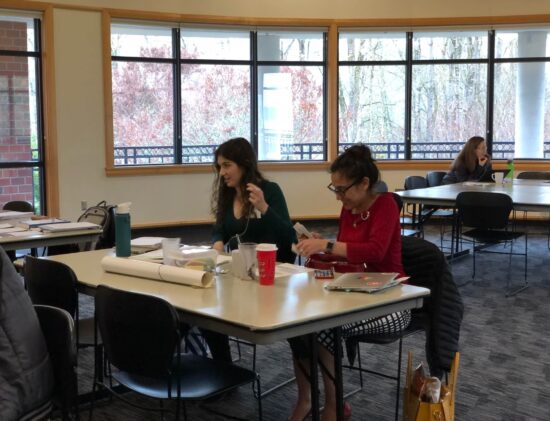
At the workshop, teachers gained tools to help students understand the issue by applying math and science. For example, in one activity they measured how much energy, water and land goes into one pound of milk in a school lunch and how much atmospheric CO2 will be produced if it’s thrown out. “We help teachers understand the tools we’ve gathered for them to use with their students,” says Mullen.
Participants learned about the tremendous resources that go into food production through seeds, water, energy and land and how to calculate the greenhouse emissions from the food that is thrown away. “Wasted food is a big part of the climactic impact,” says Mullen. “We are providing students an opportunity to understand how individuals, classrooms, and schools can be part of the climate solution.”
Food waste ends up in one of two places: the compost bin or the landfill, both of which are problematic. “If it goes into the compost, the carbon that plant pulled out of the air to make food is all going to decompose and turn back into atmospheric carbon or carbon that’s being held in the soil,” says Mullen. The decomposition process releases CO2, a recognized greenhouse gas.
But that’s not nearly as bad as what happens when food goes into a landfill. In the absence of oxygen, as it breaks down it gets converted into methane, which in the atmosphere is 104 times more destructive than CO2 over a twenty-year time span.
At the workshop, teachers gained tools to help students understand the issue by applying math and science. For example, in one activity they measured how much energy, water and land goes into one pound of milk in a school lunch and how much atmospheric CO2 will be produced if it’s thrown out. “We help teachers understand the tools we’ve gathered for them to use with their students,” says Mullen.

Cinnamon Bear, PEI’s tribal liaison for western Puget Sound region.
Another central aspect of the workshop is incorporating indigenous perspectives about food and waste. Cinnamon Bear served as PEI’s Tribal Liaison for the western Puget Sound region during the first year they offered the training. “Food waste is a prime example of how we have disconnected from our local environments and the ecosystems that provide the gifts of food and medicines that sustain us,” she says. “It’s something we can all have a very real and important impact on.”
This is the fifth food waste workshop PEI has offered and whenever possible, they include a local tribal elder or leader who can speak to the issue. When that’s not an option, participants view TEDtalks from indigenous leaders and teachers who share their perspectives. Bear says that expanding teachers’ ideas of what constitutes science has been an important first step.
“Giving hands-on, specific experiences is the method I’ve found most successful,” she says. “Having teachers make cordage from nettle, enjoy a traditional meal so they can experience how indigenous communities view food as a gift, or make a salve from cedar during a TEK lesson, all of that makes this knowledge personally relevant and motivating to the teachers who have such important work to do with our youth.”
The workshop also included collaborations with several community partners. Staff from the Clark County Green School shared their work in diverting food out of the waste stream and participants toured the Clark County Food Bank to learn about their strategies to redirect food waste toward those who need it most. Finally, they heard from Josh Hechtman, a 17-year-old high school senior who started Reproduce 81, a club at Lewis and Clark High School in Spokane to send food that would normally be wasted at school home with students who would otherwise go hungry.

Teachers in the workshop heard from Josh Hechtman, a 17-year-old high school senior who started Reproduce 81, a club at Lewis and Clark High School in Spokane to send food that would normally be wasted at school home with students who would otherwise go hungry.
The collaborative approach is typical of PEI’s educational model, which brings together schools and districts with conservation groups, resource management companies, and other community leaders to deliver real-world, outdoor-based STEM education rooted in local ecosystems and the industries that have grown around them. Previous workshops have yielded extraordinary results; in Chewelah, after fifth-grade students saw all the food waste they were producing, they produced a breakdown of how much it was costing the district per person – roughly the salary of one full-time teacher.
The class ended up meeting with representatives from the Spokane Tribe and managers from their local Safeway before presenting their findings to Governor Inslee. They also shared their discoveries with an international audience at the annual North American Association for Environmental Education conference.
Mullen and Bear anticipate inspiring results once Clark County teachers begin implementing what they learn in December. “I hope to see teachers and their students come out of this experience with a better understanding of some cultural values that might be different from theirs,” says Mullen, “and for our students from indigenous backgrounds to see themselves represented in the curriculum.”
Bear sees strong potential for young people to take the lead. “I want them to know they were born for this time and have a direct impact in the world we are creating and leaving for our future descendants,” she says. “I hope they realize their power and engage with the world around them with respect and reciprocity.”
 To learn more, visit PEI’s website, the ClimeTime website or call 360.705.9294.
by editor | Jan 10, 2021 | Environmental Literacy
Integration Can Help You Teach
More Science and Environmental Education
by Jim McDonald
Central Michigan University
The demands on classroom teachers to address a variety of different subjects during the day means that some things just get left out of the curriculum. Many schools have adopted an instructional approach with supports for students that teach reading and math, with the addition of interventions to teach literacy and numeracy skills which take up more time in the instructional schedule. In some of the schools that I work with there is an additional 30 minutes a day for reading intervention plus 30 more minutes for math intervention. So, we are left with the question, how do I fit time for science or environmental education into my busy teaching schedule?
_________________________________________________________________________________________________________________________
In a recent STEM Teaching tools brief on integration of science at the elementary level, it was put this way:
We do not live in disciplinary silos so why do we ask children to learn in that manner? All science learning is a cultural accomplishment and can provide the relevance or phenomena that connects to student interests and identities. This often intersects with multiple content areas. Young children are naturally curious and come to school ready to learn science. Leading with science leverages students’ natural curiosity and builds strong knowledge-bases in other content areas. Science has taken a backseat to ELA and mathematics for more than twenty years. Integration among the content areas assures that science is given priority in the elementary educational experience (STEM Teaching Tool No. 62).
Why does this matter? Educators at all levels should be aware of educational standards across subjects and be able to make meaningful connections across the content disciplines in their teaching. Building administrators look for elementary teachers to address content standards in math, science, social studies, literacy/English Language arts at a minimum plus possibly physical education, art, and music. What follows are some things that elementary teachers should consider when attempting integration of science and environmental education with other subjects.
Things to Consider for Integration
The integration of science and environmental education concepts with other subjects must be meaningful to students and connect in obvious ways to other content areas. The world is interdisciplinary while the experience for students and teachers is often disciplinary. Learning takes place both inside and outside of school. Investigations that take place outside of school are driven by people’s curiosity and play and often cut across disciplinary subjects. However, learning in school is often fragmented into different subject matter silos.
Math and reading instruction dominate the daily teaching schedule for a teacher because that is what is evaluated on standardized tests. However, subjects other than ELA and math should be kept in mind when considering integration. Social studies and the arts provide some excellent opportunities for the integration of science with other content areas. In the NGSS, the use of crosscutting concepts support students in making sense of phenomena across science disciplines and can be used to prompt student thinking. They can serve as a vehicle for teachers to see connections to the rest of their curriculum, particularly English/Language Arts and math. Crosscutting concepts are essential tools for teaching and learning science because students can understand the natural world by using crosscutting concepts to make sense of phenomena across the science disciplines. As students move from one core idea to another core idea within a class or across grade-levels, they can continually utilize the crosscutting concepts as consistent cognitive constructs for engaging in sense-making when presented with novel, natural phenomena. Natural phenomena are observable events that occur in the universe and we can use our science knowledge to explain or predict phenomena (i.e., water condensing on a glass, strong winds preceding a rainstorm, a copper penny turning green, snakes shedding their skin) (Achieve, 2016).
Reading
Generally, when I hear about science and literacy, it involves helping students comprehend their science textbook or other science reading. It is a series of strategies from the field of literacy that educators can apply in a science context. For example, teachers could ask students to do a “close reading” of a text, pulling out specific vocabulary, key ideas, and answers to text-based questions. Or, a teacher might pre-teach vocabulary, and have students write the words in sentences and draw pictures illustrating those words. Perhaps students provide one another feedback on the effectiveness of a presentation. Did you speak clearly and emphasize a few main points? Did you have good eye contact? Generally, these strategies are useful, but they’re not science specific. They could be applied to any disciplinary context. These types of strategies are often mislabeled as “disciplinary literacy.” I would advocate they are not. Disciplinary literacy is not just a new name for reading in a content area.
Scientists have a unique way of working with text and communicating ideas. They read an article or watch a video with a particular lens and a particular way of thinking about the material. Engaging with disciplinary literacy in science means approaching or creating a text with that lens. Notably, the text is not just a book. The Wisconsin DPI defines text as any communication, spoken, written, or visual, involving language. Reading like a scientist is different from having strategies to comprehend a complex text, and the texts involved have unique characteristics. Further, if students themselves are writing like scientists, their own texts can become the scientific texts that they collaboratively interact with and revise over time. In sum, disciplinary literacy in science is the confluence of science content knowledge, experience, and skills, merged with the ability to read, write, listen, and speak, in order to effectively communicate about scientific phenomena.
As a disciplinary literacy task in a classroom, students might be asked to write an effective lab report or decipher the appropriateness of a methodology explained in a scientific article. They might listen to audio clips, describing with evidence how one bird’s “song” differs throughout a day. Or, they could present a brief description of an investigation they are conducting in order to receive feedback from peers.
Social Studies
You can find time to teach science and environmental education and integrate it with social studies by following a few key ideas. You can teach science and social studies instead of doing writer’s workshop, choose science and social studies books for guided reading groups, and make science and social studies texts available in your classroom library.
Teach Science/Social Studies in Lieu of Writer’s Workshop: You will only need to do this one, maybe two days each week. Like most teachers, I experienced the problem of not having time to “do it all” during my first year in the classroom. My literacy coach at the time said that writer’s workshop only needs to be done three times each week, and you can conduct science or social studies lessons during that block one or two times a week. This was eye-opening, and I have followed this guidance ever since. My current principal also encouraged teachers to do science and social studies “labs” once a week during writing time! Being able to teach science or social studies during writing essentially opens up one or two additional hours each week to teach content! It is also a perfect time to do those activities that definitely take longer than 30 minutes: science experiments, research, engagement in group projects, and so forth. Although it is not the “official” writers workshop writing process, there is still significant writing involved. Science writing includes recording observations and data, writing steps to a procedure/experiment, and writing conclusions and any new information learned. “Social studies writing” includes taking research notes, writing reports, or writing new information learned in a social studies notebook. Students will absolutely still be writing every day.
Choose Science and Social Studies Texts for Guided Reading Groups: This suggestion is a great opportunity to creatively incorporate science and social studies in your weekly schedule. When planning and implementing guided reading groups, strategically pick science and social studies texts that align to your current unit of study throughout the school year. During this time, students in your guided reading groups can have yet another opportunity to absorb content while practicing reading strategies.
Make Science and Social Studies Texts Available and Accessible in Your Classroom Library: During each unit, select texts and have “thematic unit” book bins accessible to your students in a way that is best suited for your classroom setup. Display them in a special place your students know to visit when looking for books to read. When kids “book-shop” and choose their just-right books for independent reading, encourage them to pick one or two books from the “thematic unit” bin. They can read these books during independent reading time and be exposed to science and social studies content.
Elementary Integration Ideas
Kindergarten: In a kindergarten classroom, a teacher puts a stuffed animal on a rolling chair in front of the room. The teacher asks, “How could we make ‘Stuffy’ move? Share an idea with a partner”. She then circulates to hear student talk. She randomly asks a few students to describe and demonstrate their method. As students share their method, she will be pointing out terms they use, particularly highlighting or prompting the terms “push” and “pull”. Next, she has students write in their science notebooks, “A force is a push or a pull”. This writing may be scaffolded by having some students just trace these words on a worksheet glued into the notebook. Above that writing, she asks students to draw a picture of their idea, or another pair’s idea, for how to move the animal. Some student pairs that have not shared yet are then given the opportunity to share and explain their drawing. Students are specifically asked to explain, “What is causing the force in your picture?”.
For homework, students are asked to somehow show their parents a push and a pull and tell them that a push or a pull is a force. For accountability, parents could help students write or draw about what they did, or students would just know they would have to share the next day.
In class the next day, the teacher asks students to share some of the pushes and pulls they showed their parents, asking them to use the word force. She then asks students to talk with their partner about, “Why did the animal in the chair sometimes move far and sometimes not move as far when we added a force?”. She then asks some students to demonstrate and describe an idea for making the animal/chair farther or less far; ideally, students will push or pull with varying degrees of force. Students are then asked to write in their notebooks, “A big force makes it move more!” With a teacher example, as needed, they also draw an image of what this might look like.
As a possible extension: how would a scientist decide for sure which went further? How would she measure it? The class could discuss and perform different means for measurement, standard and nonstandard.
Fourth Grade Unit on Natural Resources: This was a unit completed by one group of preservice teachers for one of my classes. The four future elementary teachers worked closely in their interdisciplinary courses to design an integrated unit for a fourth-grade classroom of students. The teachers were given one social studies and one science standard to build the unit around. The team of teachers then collaborated and designed four lessons that would eventually be taught in a series of four sessions with the students. This unit worked to seamlessly integrate social studies, English language arts, math, and science standards for a fourth-grade classroom. Each future teacher took one lesson and chose a foundation subject to build their lesson upon. The first lesson was heavily based on social studies and set the stage for the future lessons as it covered the key vocabulary words and content such as nonrenewable and renewable resources. Following that, students were taught a lesson largely based on mathematics to better understand what the human carbon footprint is. The third lesson took the form of an interactive science experiment so students could see the impact of pollution on a lake, while the fourth lesson concluded with an emphasis on language arts to engage students in the creation of inventions to prevent pollution in the future and conserve the earth’s resources. Contrary to the future educators’ initial thoughts, integrating the various subject areas into one lesson came much more easily than expected! Overall, they felt that their lessons were more engaging than a single subject lesson and observed their students making connections on their own from previously taught lessons and different content areas.
References
Achieve. (2016). Using phenomena in NGSS-designed lessons and units. Retrieved from https://www.nextgenscience.org/sites/default/files/Using%20Phenomena%20in%20NGSS.pdf
Hill, L., Baker, A., Schrauben, M. & Petersen, A. (October 2019). What does subject matter integration look like in instruction? Including science is key! Institute for Science + Math Education. Seattle, WA: University of Washington Retrieved from: http://stemteachingtools.org/brief/62
Wisconsin Department of Public Instruction. (n.d.) Clarifying literacy in science. Retrieved from: https://dpi.wi.gov/science/disciplinary-literacy/types-of-literacy
Jim McDonald is a Professor of Science Education at Central Michigan University in Mt. Pleasant, Michigan. He teaches both preservice teachers and graduate students at CMU. He is a certified facilitator for Project WILD, Project WET, and Project Learning Tree. He is the Past President of the Council for Elementary Science International, the elementary affiliate of the National Science Teaching Association.

by editor | Sep 17, 2019 | Environmental Literacy
An Educator’s Guide to Stewardship
by Breanna Caruso
Click on the title to view PDF version of article.

by editor | Jun 17, 2019 | Environmental Literacy
Photo by Jim Martin
Why Environmental Educators Shouldn’t
Give Up Hope
by Jacob Rodenburg
I’m trying hard not to get discouraged. Being an environmental educator in today’s world feels like you are asked to stop a rushing river armed only with a teaspoon.
There are so many issues to be worried about—from climate change to habitat destruction, from oceans of plastic to endangered species, from the loss of biodiversity to melting glaciers. And the list goes on. The field itself has become ever more siloed and compartmentalized over time, leaving schools, parents, and outdoor programs with little unified guidance. How do we teach kids—in a hopeful and empowering way—about today’s formidable challenges? And how do we translate this increase in knowledge about environmental issues into action?
Today’s Challenge
Children today are given few opportunities to be outside. In a school system rife with worry about liability, it is simply easier to stay indoors. Insurance rates are cheaper if kids are contained, accounted for, and “safe” inside.
Yet the safety argument needs to be turned on its head: It is unsafe NOT to take children outside, not to provide them with rich immersion time in the living world. Leaving kids indoors cuts them off from the knowledge and understanding of what it means to be a living being that shares a world with other living beings. Children have a right to experience the joy of discovering the richness, complexity, and diversity of life.
Children’s disconnect from their surroundings and their environment does not stem from a lack of desire. As an outdoor educator, I have spent many happy hours with school children tramping through wetlands, lifting up rotten logs, and canoeing through still waters hearing comments like “Wow! This is cool!” To fulfill children’s need to connect, the field must develop a coordinated and developmentally appropriate approach—one that is rooted in what kids are ready to learn at each age.
Building Age-appropriate Environmental Education
Children learn about the natural world in vastly different ways as they grow up. Environmentalists are keen to teach children about global warming, pollution, species depletion, and a whole range of admittedly important issues, but they forget that younger children aren’t cognitively, perhaps even psychically, ready for this.
Young children are, however, always ready to love the natural world. Connecting with nature is about establishing a relationship and building intimacy. What is the story of the land near where a child lives? How did that oak get that large hole in it? Who lives under this decomposing log? If we think about tending to and nurturing relationships, then we’ll remember to take kids to the same places over and over again. We’ll help them find their magic places, their stories of that place and, more importantly, their place within that place. We will teach them the power and possibility of restoring nature in their school yards, their backyards, and in nearby parks.
Kids connect best to places through stories and faces. A teacher once shared a story with me about a mystery bird that had built a nest in a parking lot. After doing a bit of research, the children found out that this bird was called a killdeer. They watched the bird as she did her broken wing trick (to lead predators away from the nest). Over the days, they watched her scoop out her nest and sit upon it. They cordoned off an area with yellow emergency tape to protect her from cars. They watched her raise her young. This was their killdeer, and they would have done anything to protect her. The students became involved in her unfolding story, and the killdeer suddenly had a face. In a way, she revealed herself to them.
Another teaching tip: young children love micro environments. A friend of mine told me about a time when he took his children, 4 and 5 years old, up to an incredible view of a valley. He asked, “Isn’t this beautiful?” and watched in amazement as his kids hunkered down and stared at the ants scurrying at their feet instead.
Finally, young children adore discovery. It is the art of an educator to know what to say and what to refrain from saying. If I had a job description, it would be simply this: to help reveal wonder and cultivate awe. I take my students to a place called Salamander Alley and say, “I wonder what’s under that log?” If they find a salamander, there is a palpable feeling of joy in the discovery. Had I said, “Let’s go find some salamanders. They’re probably under this log,” the effect would have been completely different. When a child finds something, I let them own that discovery. I honor and celebrate it. The power of this kind of learning can never be undervalued.
Neil Everenden writes that we do not end at our finger tips. Instead, we radiate out into the landscape. We are inextricably bound up in the processes of life. With every breath in and out we are part of the natural systems that surround us. Our role today is to guide our children, in ways that resonate with their interests and development, to realize this connection.
Where to Go From Here
We can create nature-rich communities where kids feel a deep and abiding love for the living systems that we all are immersed in. Eventually, children will learn even to go beyond sustaining and to engage in acts of regeneration. That is where true hope resides.
Here’s hoping we can all coordinate our efforts throughout every age and stage of a child’s development. We need to work collaboratively with schools, parents, community groups, faith groups, governments, and non-governmental agencies to help future generations love, learn about, care for, protect, and enhance the environment. Indeed the future of the planet depends upon it.
Jacob Rodenburg is Executive Director of Camp Kawartha and The Camp Kawartha Outdoor Education Centre, located in Ontario, Canada. He is a contributing author in the Worldwatch Institute’s EarthEd: Rethinking Education on a Changing Planet.
by editor | Oct 19, 2016 | Environmental Literacy
Critical Questions
1. What kinds of support are available in your school, district and community for supporting environmental educational activities?
2. In what ways can environmental education activities enhance learning?
3. What are the most effective strategies for integrating environmental education across all content areas?
4. In what ways do students, teachers and communities benefit from classrooms engaged in environmental educational projects?
5. What are compelling environmental issues that can be explored through environmental educational projects?
Possible Actions
1. Become well informed about the characteristics of environmental education, effective models and strategies for integrating across subject areas taught in school.
2. Share this information with your colleagues, friends, and others interested in integrating environmental education into their classrooms or conducting environmental action projects in their communities.
3. Know your national, state, and local school standards. You will find them on the Internet. Consider ways in which environmental education activities can achieve many of the standards across various content areas.
4. Learn effective strategies for guiding students in conducting comprehensive and sophisticated research about environmental issues, solving specific local environmental problems, and acting on their solutions.
5. Encouraged by recent brain research, many educators recognize the value of hands-on, project- and problem-based learning methods, and integrated-interdisciplinary approaches. Use the natural environment and local community as the framework, and integrate environmental education into your everyday teaching.
-from New Horizons for Learning

by editor | Feb 17, 2016 | Environmental Literacy, Place-based Education
Human/Natural Systems Interactions:
A Framework
A critical thinking tool for developing ecological literacy throughout the curriculum compares cultures and their relationship to the natural world.
by Barbara Jackson
 n this era of relentless consumption of non-renewable resources, there is a tremendous need for the teaching of ecological concepts, in as many ways and places as possible. Society is at risk from these future consumers and decision makers who have little direct experience with the natural world and who often lack opportunities to make direct connections between their studies and their impact on ecosystems. Without creating accurate yet gloomy scenarios on the state of planetary health that often engender a feeling of hopelessness and powerlessness in the individual, it is possible to provide information that helps fill in the missing pieces. Hopefully, those little pieces can help build a larger picture that looks at the interrelationships between man and planetary systems.
 In formal educational settings, ecology and ecological literacy, if taught at all, are generally the domain of the science teacher. In such places, there is a need to provide more opportunities for kids to be exposed to what was once common knowledge of the living world. Infusion of small pieces is a valuable approach when one considers that the process of becoming ecologically literate is much more than a unit in science class. Ecological literacy is a way of seeing the world and the interactions between people and the living systems as interconnected. It comes from developing a body of basic knowledge from first hand experience and from reflection upon useful information gained through exposure to varied media.
There is the risk of offering small, disconnected pieces, yet in fact such an approach provides the opportunity to scatter many small seeds of connectedness into the still open mind of the adolescent. By planting seeds, the kids are being given information that hopefully they will find useful in the future as they look deeper at the world around them.
The Human/Natural Systems Interactions matrix below was most recently used as a wrap-up exercise after reading two books in class, The Giver, a tale of a future time in a society devoid of memory by Lois Lowry and Two Old Women by Velma Wallis, which is a tale of survival of two elderly Aleut women, abandoned by their band in a time of starvation during a hard winter. For the student, the focus of the exercise is to make a comparison between the future society as found in The Giver , the indigenous culture in Two Old Women and the life they live as typical North Americans. The matrix also lends itself to a comparison between a historic time period, the present and the future time and also can be used to compare what is known about different cultures and their world views.
The matrix exercise evolved from two complementary musings. In The Co-Evolution Quarterly in a 1981-82 article on bio-regionalism and watersheds, the editors asked:
1. What soil series are you standing on?
2. When was the last time a fire burned your area?
3. Name five native edible plants in your region and their seasons of availability.
4. From what direction do winter storms generally come in your region?
5. Where does your garbage go?
6. How long is the growing season where you live?
7. Name five grasses in your area. Are any of them native?
8. Name five resident and five migratory birds in your area.
9. What species have become extinct in your area?
10. What are the major plant associations in your region?
When first exposed to those questions, I was intrigued, But, after answering the questions to my own satisfaction, I forgot about them until I saw them again in the David Orr’s book Ecological Literacy.
At the time I was reading Ecological Literacy, my daughter’s 7th grade social studies teacher used “Cultural Universals” for the class study of ancient civilizations. Cultural Universals is an outline format to help students look at the commonalities underlying cultures, in the areas such as art, religion, trade, and government. The Cultural Universals outline helps students recognize that while we may look different and speak different languages and call our gods different names, there are common activities to all cultures. With this frame of reference, attempts at understanding humanity throughout the ages can become more than a recitation of facts.
Furthermore, outlining cultural universals is a great way to practice going from the general to the specific as the skills of outlining are developed.

The Human-Natural Systems Interaction matrix evolved as an extension of the Co-Evolution questions and the Cultural Universals outline. As a matrix it can be used to look at how human nature has both changed and stayed the same for many generations.
The matrix is a critical thinking tool to help students develop a frame of reference for making comparisons between cultures. It also helps students delve deeper into the author’s message, rather than simply asking them to prepare a rehash of the storyline and a list the characters. The matrix provides the opportunity to reflect upon what we know of the natural world and our relationship to that world.
References
Co-Evolution Quarterly, 32 (Winter 1981-2).
Lipetzky, Jerry, Dig 2, Interaction Publishers, Lakeside, CA, 1982.
Orr, David W. Ecological Literacy, State University of New York Press, Albany, 1992.
When this article was published, Barbara Jackson was an 8th grade teacher at Anacortes Middle School in Anacortes, Washington.

