by editor | Nov 20, 2014 | K-12 Classroom Resources, Outdoor education and Outdoor School

Early literacy skills can be developed and enhanced through journaling and data collection. Even the youngest learners can feel successful.
Effective Education: Turning the Classroom Inside Out
By Indira Dutt
 s a child at school I remember sitting in a stuffy portable looking out the window to the field and houses beyond. I felt constrained: my seat was attached to the desk, the classroom was just barely big enough to fit all of us, the windows were small, and the air was stale. I also remember the playground outside. I played hide and seek in the small stand of trees beside the field; I helped friends pile up the leaves in the fall and we all jumped in; I imagined an extraordinary museum of found objects–we made displays of the natural oddities that intrigued us and told stories about each treasure.
The two sides of the portable wall felt inexorably different and though I did well in school I was often wrangy in the classroom, wanting a little more of the freedom I felt when I was outside. Funny then that I should chose a career that keeps bringing me back into classrooms.
As a teacher I notice that, when the outside and inside feel completely separate, there is a problem. My teaching needs to be both connected and applicable to the everyday lives of my students and they need to feel free enough to be creative and capacious in their thinking so they can meaningfully participate in their education.
The literal and metaphorical notions of the outdoors are vital for me and so I work to soften the edge between inside and out.
One way I can do this is by creating and embellishing meaningful indoor–outdoor relationships. Connections between indoor spaces and outdoor areas are important “so that the outdoors becomes a natural extension of indoor learning” (Nair, Fielding & Lackney, 2009, p.111). This area of school design is sometimes overlooked or minimized by architects and educators, and this negatively influences students’ relationships to the natural world (Taylor, Aldrich & Vlastos, 1988).
Indoor–outdoor interfaces facilitate indoor–outdoor relationships. These interfaces are points, areas or surfaces that serve as a juncture between the inside and outside of a building. They include features that provide connection to the outdoors such as windows, skylights, natural building materials, aquariums, plants, interior living walls and porches. Even multimedia devices connected to the outside world via the Internet can bridge the gap between interior and exterior.
In 2009 I conducted a qualitative study that explored how intermediate students’ experience of the natural world was mediated by the design of their school building. My study site was the Bowen Island Community School (BICS) located on Bowen Island, a 20-minute commute by ferry from West Vancouver. The school was built on public land, parceled out of west coast rainforest. There are numerous large cedars and Douglas firs surrounding the property. I worked with grade six and seven students at BICS and collected data from two focus groups, semi-structured interviews, photographs and field notes.
One of the major findings of this study was that a school occupant’s experience of being inside their school building extends beyond the physical boundaries of the structure. When I asked students about their experience inside the school, they repeatedly spoke about the school grounds.
From a child’s perspective the whole school site as well as the school’s immediate A school occupant’s experience ofbeing inside their school building extends beyond the physical boundaries of the structure surroundings is a substantive part of their school experience. As well as being drawn to the outside, students expressed the significance of their sense of freedom, joy and beauty. Despite a focus on the fixed structure of the school building and school grounds, the student interviews were saturated with instances in which students reflected that indoor–outdoor connections deepened their freedom of movement, solitude, expression and imagination as well as the freedom to take mini-breaks from work. At BICS these instances of freedom were always associated with their connection to the exterior of the building. Students also recounted joy and places of beauty as critical in their learning.
I believe that my experience as a child varies little from students today. It is no surprise to any of us who have spent time in the classroom with children (of any age) that students’ attention is often drawn away from the topic or task at hand. I think that as teachers we get caught up in expending energy on refocusing, directingand corralling our students into the confines of the classroom, when instead we could find ways to capitalize on students’ desire to move outside. At times this movement is literal, but students’ imaginations can and do take them out in a figurative sense as well.
At BICS, teachers work with the imaginative drive and thirst for freedom that children have. The teachers at BICS incorporate the indoor–outdoor interfaces into the teaching process; they use the view from their classroom windows to highlight relevant elements of curriculum and they bring the children out into the hallway to stand or sit under the skylight and talk about the clouds outside. There is an active engagement with the outdoors from within the structure of the school.
While BICS is situated in what some might consider an idyllic teaching environment, certain aspects of the BICS students’ experience can be generalized to any location, rural or urban. If we can acknowledge the importance of freedom in the life of our students we can start to embrace and incorporate the interfaces to which we have access instead of thinking of classroom windows as distractions and covering them up using blinds or construction paper.
 As a part of my research, I asked 55 grade six and seven students to draw an ideal school building, one that they thought would foster their connection with the natural world. I asked them to label important features they included. The most dominant features of these drawings were plants and animals. During my study I found that students expressed great joy witnessing the complete life cycle of plants. At BICS students could see the garden from their large classroom window. One student exclaimed, “It’s fun to watch everything [in the garden] because you go in the beginning of the year and there are little sprouts and then you go later and there are big shoots and stuff.” At a more urban school in Toronto each class grows a different kind of seed (grade one grows peppers while grade two grows tomatoes) and later in the spring they transplant their seedlings into the garden. In both these examples students develop relationships with food they eat in addition to having an indoor–outdoor connection.
When resources permit, adding indoor–outdoor interfaces by creating a “living things zone” (Nair, Fielding & Lackney, 2009) can delight students and inspire observation and investigation. I noticed students would consistently gather around a seaquarium in the foyer at BICS and watch the sea creatures inside. One student exclaimed with joy, “You don’t see a seaquarium everyday. It’s my favourite. Sea cucumbers, yeah, they spit out their guts for protection.” Students used their excitement about sea creatures and ability to watch them for long periods of time to write daily observations and creative stories in their journals.
Living things zones can include elements such as plants, sprouts, a window farm, living walls, an aquarium and small animals. In some Waldorf classes, one daily routine (first and last thing of day) consists of each child retrieving their potted plant from a table top, bringing it to their desk for the day and then putting their plant back on the tabletop at the end of the day, watering it when need be. Each child sees their plant change over time, while having something small for which they are responsible, and they always have a living thing close at hand. Even this very small and relatively easy version of a living thing zone has a profound effect on students.
If we take a broader view of nature, and humans’ place within it, we might even conceive that the very busy urban street below a school window has natural lessons waiting to be learned. Rich conversations result when we explore what is happening beyond the walls of the classroom regardless of where our school is situated.
With our students’ best interests in mind we can utilize existing indoor–outdoor interfaces to enhance curriculum. While I feel a particular affinity for green spaces and places where dirt and water and clean air are easily accessed, in reality many schools occupy sites with precious little green or naturalized space. We can find ways to incorporate the nature outside, be it the trees or the bustle of humanity on city streets, in our classrooms to create an expanded sense of freedom and joy in our students.
References
Nair, P., Fielding, R. & Lackney, J. (2009). The language of school design: Design patterns for 21st century schools. Rev. ed. Minneapolis, MI: DesignShare.
Taylor, A., Aldrich, R.A. & Vlastos, G. (1988). Architecture can teach … and the lessons are rather fundamental. In Context, 18(Winter), 31–38.
Wilson, E.O. (1993). Biophilia and the conservation ethic. In S.R. Kellert and E.O. Wilson (Eds.), The biophilia hypothesis (31–41). Washington, DC: Island Press.
Indira Dutt is a graduate of the Center for Cross-Faculty (Architecture and Education) Inquiry in Education at University of British Columbia. She is currently participating in a Participatory Design Process at Cassandra Public School and working at Outward Bound, Evergreen Brickworks. This article was originally published in Pathways: The Ontario Journal of Outdoor Education 2010 23(2).

by editor | Jan 26, 2014 | Outdoor education and Outdoor School
Race, Class, Climate Change and Outdoor Education
By Jay Roberts
A recent post on climate change and race (http://tinyurl.com/b6fzp7) brings up an issue that really needs to be on the forefront of outdoor and environmental education moving forward. It is becoming increasingly clear that climate change will become the defining issue of our times. Just as with civil rights in the 1960’s, this will require sustained and imaginative work on the part of our education system (both formal and informal).
Recent surveys show that the percentage of citizens claiming that the “science is mixed” on human caused climate change is on the rise. Worse, even among those who believe it to be a human-caused problem, there is a high percentage who don’t feel that it is an immediate threat (http://tinyurl.com/cc6uuo). Clearly, we have not just technological and scientific work to do, we have educational work to do. I call this the importance of both “outer” work (the work of technical problem solving that comes from policy changes, technological advances, scientific research, and economic modeling for example) and “inner work” (the work of education, of faith-based institutions, community organizing, etc.). (more…)

by editor | Oct 2, 2013 | Environmental Literacy, Outdoor education and Outdoor School
Fueling the Fire: North Cascade Institute’s Path for Youth

by Mollie Behn
 t is no secret that today’s youth are increasingly disconnected from nature. As a result, youth are less aware of issues and threats facing the environment and how to address them. We need to develop active and motivated citizens who are capable of implementing solutions to the challenges. These abilities derive from understanding the threats, consequences, and solutions to environmental problems, as well as feeling empowered to make necessary changes. The young people of today offer us a glimpse into a promising future, especially if we prepare them for the challenges and triumphs they will experience. Sadly, youth’s disconnect from the natural world can leave them feeling less inclined to be actively engaged citizens and stewards. North Cascades Institute is confronting this situation through the Path for Youth initiative, a suite of programs and a shared vision with public lands agencies and community partners to engage elementary to graduate level students through education, conservation and stewardship…
Read the entire story at https://clearingmagazine.org/NCIPathforYouth.pdf or at
https://clearingmagazine.org/NCI-FuelingTheFire.html (pictures have captions)
by editor | Apr 11, 2013 | Environmental Literacy, Forest Education, Learning Theory, Outdoor education and Outdoor School

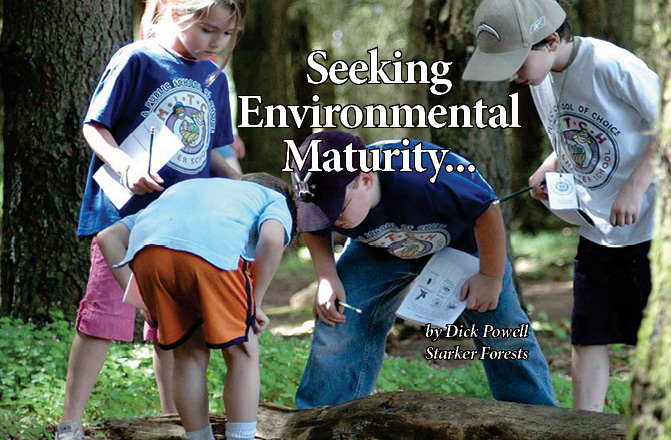
…at Starker Forests
Helping students climb the ladder to responsible citizenship
by Dick Powell
This past summer I attended the World Forestry Center’s International Educator’s Institute (IEI). As an environmental educator without any formal pedagogical or interpretive training, I found this week-long workshop enlightening and very worthwhile.
The part of IEI that I found most useful was called the “Pedagogic Steps in Environmental Maturity.” It validated what we’ve been doing.
Read the article here. (From the 2012 CLEARING Compendium).
by editor | Nov 2, 2012 | Outdoor education and Outdoor School
Salmon Watch is back by popular demand and coming soon to a stream near you!
.
by Lizanne Saunders
.
 his Fall ten classes of middle and high school students in the Portland metropolitan area are participating in a revitalized Salmon Watch program sponsored this pilot year by the World Salmon Council, Bureau of Land Management, U.S. Forest Service, Trout Unlimited Clackamas Chapter, and U.S. Fish & Wildlife Service. Participating schools this year include Grant High School, Madison High School, Portland Waldorf School, Winterhaven School, Reynolds Middle School, and daVinci Arts Middle School.
Founded by Oregon Trout (later called the Freshwater Trust), the Salmon Watch environmental education program educated some 60,000 students across much of Oregon from 1993 to 2010. Much to the dismay of Salmon Watch devotees across the state, the program was discontinued by The Freshwater Trust in late 2010 due to a shift in organizational mission. (more…)

by editor | May 15, 2012 | Outdoor education and Outdoor School, Schoolyard Classroom
“Lessons for Teaching in the Environment and Community” is a regular series that explores how teachers can gain the confidence to go into the world outside of their classrooms for a substantial piece of their curricula.
Part 20: Beginning at the Beginning
.
 by Jim Martin, CLEARING guest writer
 n the last blog, we looked at planning an inquiry unit from the perspective of a student display, isolating the parts of the display and tracing them backwards. Now, let’s start at the beginning, and look at the inquiry unit as a scope and sequence. Until you’re comfortable taking your students out into the real world, it’s easy to forget some of the details in this kind of work until you’re on site, or waiting by the school for a bus you haven’t ordered. It happens!
It’s difficult, in the blog’s format, to construct a scope and sequence using a long timeline, so we’ll do it as a narrative. You might practice laying the parts out on a timeline, at least mentally, as the visual feedback often suggests things to do that you won’t notice as you read a narrative.
Our reed distribution inquiry began with the Casual Observation. At least, as written. However, just getting to the site means you’ve ordered a bus and substitute, have talked with your students about safety, given specific directions about clothing and lunches, sent permission slips home for parents to sign and return, looked for equipment students might need, prepared student logs so they can record their experiences, done a preliminary site visit yourself, and prepared the substitute’s lessons.
On a time line, these would line up on the left under a heading, “Casual Observation.” They would be on the left side of this column. On the right of that column, you would list the things students will do. For instance, they will need to know something about the site they will visit, and, in general, what they will be doing there. You’ll need to organize reference materials the class will need when they return, and decide which references you will carry to the site. All before you board the bus. So your timeline would begin at least a month before you’re on that bus, headed toward your site.
The actual observation won’t take up much space on the timeline. You ought to give your students a tour of the site. Then have them follow prompts you give them, or just follow their own noses. At first, this will depend on your comfort level. Eventually, it will depend on your recognition of the potential embedded in a student’s ownership of the work and learnings.
Where we go from here depends upon your schedule. If you’re here for the day, then your students can move through all the pieces of the unit. If you are planning for two briefer field trips, then the timeline will look different, but most of the components should be the same. Because this is a linear unit, with each piece completed before moving to the next, the parts of the scope and sequence will be similar, but the days won’t.
When students have completed their casual observation, you might have them share what they noticed. As students work, some may go to the references for information, others may not have thought of this, or are waiting. As you move around the site, some may ask for advice. Be careful not to tell them what they can find out themselves. A sentence that almost always works for me is, “Good question; how can you find out?” The number and kinds of questions students raise are mostly a function of their locus of control. Okay, let’s move to the Develop an Inquiry Question phase.
Before starting this phase, you should have samples of good and not so good inquiry questions for students to critique. Do you have them do this before, or after they have written two or three tentative questions? Again, this depends on your comfort level and teaching style. Because Assimilation is one of the main conceptual structures that underlie the organization and delivery of my curriculum, I like to have students write first, so they have concrete referents to use when we discuss the characteristics of good inquiry questions.
The process is simple, but takes time. Basically, students write and critique inquiry questions using the examples you provide until they have one or two they are comfortable with. Then, they assess these questions and develop a final inquiry question. You might introduce the concept of operational definitions if appropriate, and naming protocols, which are sort of operational definitions. (Use naming protocols for plants or animals whose names they are unsure of. Mine was, “Give it a name and use it until you have good reason to change it.” This seemed to work; relieves anxiety and reduces confusion.)
If you’re doing two field trips, you’ll want to check permission slips, equipment, bus, and sub. So, under Develop an Inquiry Question, you would just have something like Develop an Inquiry Question on the right, and Prepare Sample Questions and Assessment Criteria on the left, and if you’re doing two trips, check permission slips, etc., on the left. (You might have noticed that all of the items we’ve been adding fall into two groups, logistics and pedagogy. This could be a way to further clarify your scope and sequence.)
After students have developed their inquiry question, they need to Design an Investigation. This is always pretty straightforward; their question tells them what to do to answer it. The other items in this column might be safety reminders, prep the analytical math they’ll need to process their collected data, practice using tables to organize observations, and practice on any equipment they plan to take into the field. They are important, not so much to the design of their investigation as to the next item, Collect Data. However, this is the time, before they leave the school, to do this. Of course, you can move it to Collect Data. I like the idea of prepping these things as students are designing their investigations because they have an opportunity to integrate these concepts into their planning at a time when it makes sense to them.
The Collect Data column is short, unless you include the logistical pieces in it, like take the bus, arrive at site, go to stations, collect data, pull the work together, return to bus. Students ought to iterate safety rules before you release them into the site. After that, students do the work and return to school. By this time, they ought to be the well-oiled machine.
Back at school, they Analyze and Interpret their data. Now that they have concrete referents about data, this is a good time to review what they learned about tables and analytical math. Since student groups will move through this phase at different paces, show them what you want to include (but not be limited to) in their reports and displays, if they are making them. As questions arise, this is where you do targeted mini-lectures. Most classes will welcome a demonstration of the analysis of a hypothetical set of data, both the mathematical and graphical analyses and interpretations. If you’re weak in this area, and lots of us are, this can be a good learning experience for you.
After students have analyzed and interpreted their data, they prepare to Communicate it, the last heading in the scope and sequence. They should at least make a presentation to the class, complete with a poster. You’ve already briefed them on what to include in their display, and this is a good time to reiterate it. After all reporting is done, you ought to consider having the class summarize the meaning of all of the findings. You’ll find, over the years, that you’ll learn as much about teaching as they learn about environments.
This description of attempting to use a scope and sequence has generated a great deal of detail. More detail than you’d want on a simple timeline. You can take lumps of these details, give each lump a name that makes sense to you, and just name the lump. It will help build a better scope and sequence. Somewhere below these briefer descriptors you can jot down the details. (I’ve used spreadsheets to do this, since you can go as far to the right, and down, as you want.)
It may be time, while we’re engaging underlying structures, to examine their significance. Next time, we’ll do this, and discuss some of the reasons structure is significant.
 This is the twentieth installment of “Teaching in the Environment,” a new, regular feature by CLEARING “master teacher” Jim Martin that explores how environmental educators can help classroom teachers get away from the pressure to teach to the standardized tests, and how teachers can gain the confidence to go into the world outside of their classrooms for a substantial piece of their curricula. See the other installments here, or search Categories for “Jim Martin.”

 As a part of my research, I asked 55 grade six and seven students to draw an ideal school building, one that they thought would foster their connection with the natural world. I asked them to label important features they included. The most dominant features of these drawings were plants and animals. During my study I found that students expressed great joy witnessing the complete life cycle of plants. At BICS students could see the garden from their large classroom window. One student exclaimed, “It’s fun to watch everything [in the garden] because you go in the beginning of the year and there are little sprouts and then you go later and there are big shoots and stuff.” At a more urban school in Toronto each class grows a different kind of seed (grade one grows peppers while grade two grows tomatoes) and later in the spring they transplant their seedlings into the garden. In both these examples students develop relationships with food they eat in addition to having an indoor–outdoor connection.